SUBSCRIBE TO OUR FREE NEWSLETTER
Daily news & progressive opinion—funded by the people, not the corporations—delivered straight to your inbox.
5
#000000
#FFFFFF
To donate by check, phone, or other method, see our More Ways to Give page.
Daily news & progressive opinion—funded by the people, not the corporations—delivered straight to your inbox.
"Given the sheer frequency of Elon Musk's posting of disinformation and partisan rhetoric, it is almost inevitable that he will be one of the top spreaders of election-related disinformation in this cycle," one expert said.
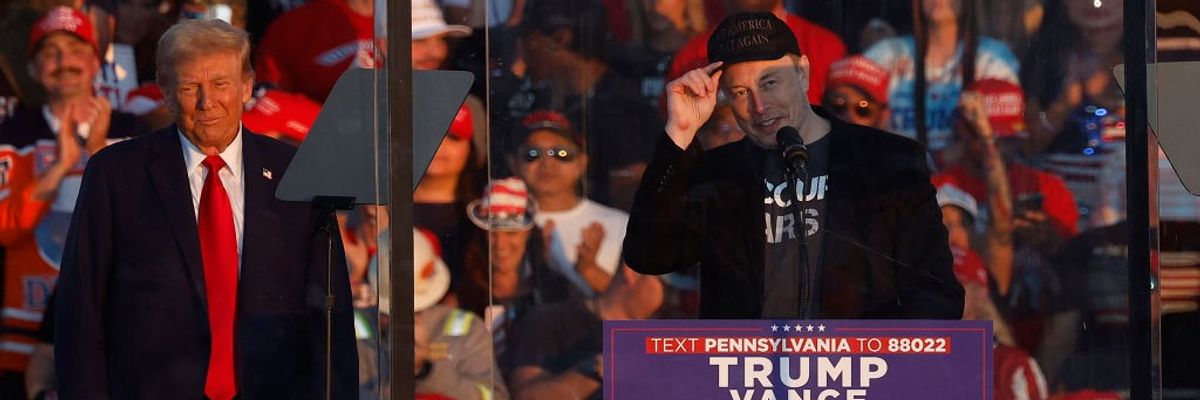
Since richest-man-alive and X-owner Elon Musk endorsed former Donald Trump for president in July, he has emerged as the No. 1. financial backer of Republican candidate's campaign. But his support hasn't only come in outright donations. His tweets in support of the former president, according to a new analysis, are worth a total of $24 million.
In a report published Monday, the Center for Countering Digital Hate (CCDH) found that Musk's political posts between July 13 and October 25 received over twice as many views as U.S. "political campaigning ads" run on X during that time. If any of those advertisers had wanted to reach the same number of people as Musk, they would have had to pay $24 million.
"X has long dropped its pretense to be anything but a loudspeaker for its owner's opinions, personal vendettas, and conspiracies," CCDH wrote on the platform as it shared the report.
Since he endorsed Trump, Musk made a total of 746 posts that mentioned key terms such as "Donald Trump," "Kamala Harris," "voting," or "ballots." These posts were viewed a total of 17.1 billion times compared with 7.7 billion times for all paid political ads.
What's more, at least 87 of Musk's election-themed posts between January 1 and October 23 contained "false or misleading about the presidential election."
These were seen 2 billion times, and none of them was appended by a "community note," a mechanism by which X users can fact-check or provide context to inaccurate posts.
CCDH pointed to two main genres of misleading tweet shared by Musk: those claiming that the Democratic Party was importing immigrant voters and those claiming that U.S. voting systems are not reliable.
For example, on September 18, Musk wrote: "The Dem administrative state is flying millions of future voters directly into swing states. They are being sent to cities and towns throughout Ohio, Pennsylvania, Wisconsin, and Arizona. Given that this is a sure path to permanent one-party rule, it is a very smart strategy."
Musk made more than 66 posts along these lines that were seen nearly 1.3 billion times.
Fact-checkers say these claims are false because it takes years for an immigrant to become a U.S. citizen and to be able to vote, and there would be no guarantee that such a person would vote for the Democrats. Existing laws already penalize noncitizens who vote with either deportation or incarceration.
In an example of the second category of lie, Musk wrote on September 4 that "not requiring ID, combined with mail in voting, makes it completely impossible to prove fraud (obviously)."
Musk has made 19 of these types of posts targeting either mail-in or electronic voting, which were viewed almost 532 million times. However, research has shown that voter fraud related to either mail-in voting or drop boxes is exceedingly rare. A full 36 states mandate that voters show an ID before voting, while 14 others have other ways of confirming identity, such as checking a signature against one on file. In all states, voter fraud is against the law.
"Given the sheer frequency of Elon Musk's posting of disinformation and partisan rhetoric, it is almost inevitable that he will be one of the top spreaders of election-related disinformation in this cycle," CCDH founder Imran Ahmed told CNN.
"He is using the platform to persuade people that elections are rigged," Ahmed continued, adding "it is such a tragic waste of a phenomenally powerful tool."
Dear Common Dreams reader, It’s been nearly 30 years since I co-founded Common Dreams with my late wife, Lina Newhouser. We had the radical notion that journalism should serve the public good, not corporate profits. It was clear to us from the outset what it would take to build such a project. No paid advertisements. No corporate sponsors. No millionaire publisher telling us what to think or do. Many people said we wouldn't last a year, but we proved those doubters wrong. Together with a tremendous team of journalists and dedicated staff, we built an independent media outlet free from the constraints of profits and corporate control. Our mission has always been simple: To inform. To inspire. To ignite change for the common good. Building Common Dreams was not easy. Our survival was never guaranteed. When you take on the most powerful forces—Wall Street greed, fossil fuel industry destruction, Big Tech lobbyists, and uber-rich oligarchs who have spent billions upon billions rigging the economy and democracy in their favor—the only bulwark you have is supporters who believe in your work. But here’s the urgent message from me today. It's never been this bad out there. And it's never been this hard to keep us going. At the very moment Common Dreams is most needed, the threats we face are intensifying. We need your support now more than ever. We don't accept corporate advertising and never will. We don't have a paywall because we don't think people should be blocked from critical news based on their ability to pay. Everything we do is funded by the donations of readers like you. When everyone does the little they can afford, we are strong. But if that support retreats or dries up, so do we. Will you donate now to make sure Common Dreams not only survives but thrives? —Craig Brown, Co-founder |
Since richest-man-alive and X-owner Elon Musk endorsed former Donald Trump for president in July, he has emerged as the No. 1. financial backer of Republican candidate's campaign. But his support hasn't only come in outright donations. His tweets in support of the former president, according to a new analysis, are worth a total of $24 million.
In a report published Monday, the Center for Countering Digital Hate (CCDH) found that Musk's political posts between July 13 and October 25 received over twice as many views as U.S. "political campaigning ads" run on X during that time. If any of those advertisers had wanted to reach the same number of people as Musk, they would have had to pay $24 million.
"X has long dropped its pretense to be anything but a loudspeaker for its owner's opinions, personal vendettas, and conspiracies," CCDH wrote on the platform as it shared the report.
Since he endorsed Trump, Musk made a total of 746 posts that mentioned key terms such as "Donald Trump," "Kamala Harris," "voting," or "ballots." These posts were viewed a total of 17.1 billion times compared with 7.7 billion times for all paid political ads.
What's more, at least 87 of Musk's election-themed posts between January 1 and October 23 contained "false or misleading about the presidential election."
These were seen 2 billion times, and none of them was appended by a "community note," a mechanism by which X users can fact-check or provide context to inaccurate posts.
CCDH pointed to two main genres of misleading tweet shared by Musk: those claiming that the Democratic Party was importing immigrant voters and those claiming that U.S. voting systems are not reliable.
For example, on September 18, Musk wrote: "The Dem administrative state is flying millions of future voters directly into swing states. They are being sent to cities and towns throughout Ohio, Pennsylvania, Wisconsin, and Arizona. Given that this is a sure path to permanent one-party rule, it is a very smart strategy."
Musk made more than 66 posts along these lines that were seen nearly 1.3 billion times.
Fact-checkers say these claims are false because it takes years for an immigrant to become a U.S. citizen and to be able to vote, and there would be no guarantee that such a person would vote for the Democrats. Existing laws already penalize noncitizens who vote with either deportation or incarceration.
In an example of the second category of lie, Musk wrote on September 4 that "not requiring ID, combined with mail in voting, makes it completely impossible to prove fraud (obviously)."
Musk has made 19 of these types of posts targeting either mail-in or electronic voting, which were viewed almost 532 million times. However, research has shown that voter fraud related to either mail-in voting or drop boxes is exceedingly rare. A full 36 states mandate that voters show an ID before voting, while 14 others have other ways of confirming identity, such as checking a signature against one on file. In all states, voter fraud is against the law.
"Given the sheer frequency of Elon Musk's posting of disinformation and partisan rhetoric, it is almost inevitable that he will be one of the top spreaders of election-related disinformation in this cycle," CCDH founder Imran Ahmed told CNN.
"He is using the platform to persuade people that elections are rigged," Ahmed continued, adding "it is such a tragic waste of a phenomenally powerful tool."
Since richest-man-alive and X-owner Elon Musk endorsed former Donald Trump for president in July, he has emerged as the No. 1. financial backer of Republican candidate's campaign. But his support hasn't only come in outright donations. His tweets in support of the former president, according to a new analysis, are worth a total of $24 million.
In a report published Monday, the Center for Countering Digital Hate (CCDH) found that Musk's political posts between July 13 and October 25 received over twice as many views as U.S. "political campaigning ads" run on X during that time. If any of those advertisers had wanted to reach the same number of people as Musk, they would have had to pay $24 million.
"X has long dropped its pretense to be anything but a loudspeaker for its owner's opinions, personal vendettas, and conspiracies," CCDH wrote on the platform as it shared the report.
Since he endorsed Trump, Musk made a total of 746 posts that mentioned key terms such as "Donald Trump," "Kamala Harris," "voting," or "ballots." These posts were viewed a total of 17.1 billion times compared with 7.7 billion times for all paid political ads.
What's more, at least 87 of Musk's election-themed posts between January 1 and October 23 contained "false or misleading about the presidential election."
These were seen 2 billion times, and none of them was appended by a "community note," a mechanism by which X users can fact-check or provide context to inaccurate posts.
CCDH pointed to two main genres of misleading tweet shared by Musk: those claiming that the Democratic Party was importing immigrant voters and those claiming that U.S. voting systems are not reliable.
For example, on September 18, Musk wrote: "The Dem administrative state is flying millions of future voters directly into swing states. They are being sent to cities and towns throughout Ohio, Pennsylvania, Wisconsin, and Arizona. Given that this is a sure path to permanent one-party rule, it is a very smart strategy."
Musk made more than 66 posts along these lines that were seen nearly 1.3 billion times.
Fact-checkers say these claims are false because it takes years for an immigrant to become a U.S. citizen and to be able to vote, and there would be no guarantee that such a person would vote for the Democrats. Existing laws already penalize noncitizens who vote with either deportation or incarceration.
In an example of the second category of lie, Musk wrote on September 4 that "not requiring ID, combined with mail in voting, makes it completely impossible to prove fraud (obviously)."
Musk has made 19 of these types of posts targeting either mail-in or electronic voting, which were viewed almost 532 million times. However, research has shown that voter fraud related to either mail-in voting or drop boxes is exceedingly rare. A full 36 states mandate that voters show an ID before voting, while 14 others have other ways of confirming identity, such as checking a signature against one on file. In all states, voter fraud is against the law.
"Given the sheer frequency of Elon Musk's posting of disinformation and partisan rhetoric, it is almost inevitable that he will be one of the top spreaders of election-related disinformation in this cycle," CCDH founder Imran Ahmed told CNN.
"He is using the platform to persuade people that elections are rigged," Ahmed continued, adding "it is such a tragic waste of a phenomenally powerful tool."