SUBSCRIBE TO OUR FREE NEWSLETTER
Daily news & progressive opinion—funded by the people, not the corporations—delivered straight to your inbox.
5
#000000
#FFFFFF
To donate by check, phone, or other method, see our More Ways to Give page.
Daily news & progressive opinion—funded by the people, not the corporations—delivered straight to your inbox.
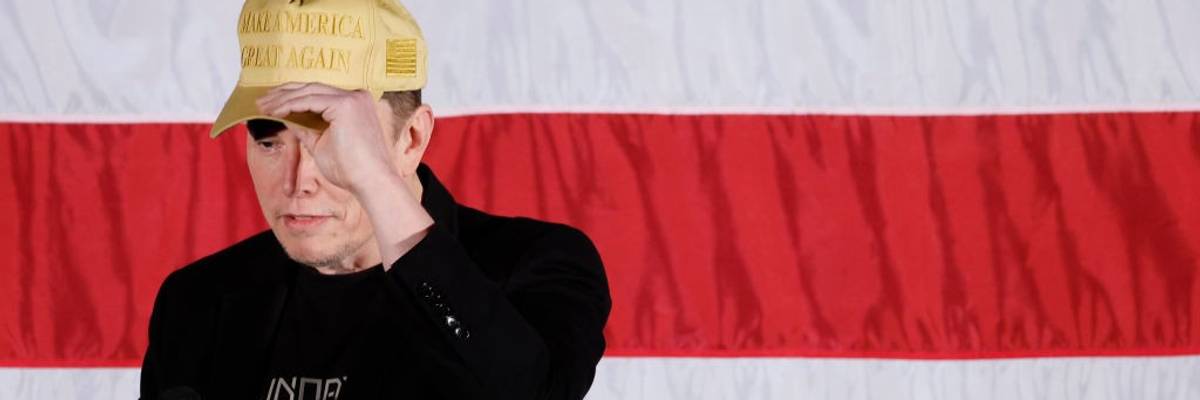
Billionaire Elon Musk encourages early and absentee voting in a town hall meeting on October 17, 2024 in Folsom, Pennsylvania.
The world's richest person has stepped up his contributions to a pro-Trump super PAC as he pushes a deregulatory agenda.
Billionaire Elon Musk gave $43.6 million to the America PAC in early October, raising his total contributions to the group to at least $118.6 million since July, according to federal filings released Thursday night.
America PAC is a super political action committee that supports Republican presidential nominee Donald Trump in battleground states such as Pennsylvania. Musk formed the super PAC in May and has contributed nearly all of its money. The additional $43.6 million moved him into second among Trump's backers, behind only Timothy Mellon, a banking heir who's given $150 million.
Musk, the wealthiest person in the world, also gave $10 million to the Senate Leadership Fund, a super PAC dedicated to electing Republicans in the upper chamber of the U.S. Congress, according to the new filings, which cover the first 16 days of October.
The world’s richest man has given at least $118 million to America PAC, a pro-Trump effort, since July. Thursday’s campaign finance filings are the last full accounting expected before Election Day. https://t.co/rDhbBF2jWm
— The Washington Post (@washingtonpost) October 25, 2024
Vice President Kamala Harris, the Democratic presidential nominee, maintained a sizable fundraising lead over Trump, both in official campaign cash and money for allied groups such as super PACs, the filings show. However, the money doesn't guarantee electoral success: Former Secretary of State Hillary Clinton, the Democrats' 2016 nominee, lost to Trump despite a roughly 2-to-1 cash advantage.
More billionaires reportedly favor Harris over Trump, but the conflicts of interest posed by Musk's political engagement—he has campaigned fervently in person in recent weeks—have drawn particular scrutiny from watchdog groups and journalists.
Musk's sprawling business empire includes SpaceX, Tesla, and X, formerly known as Twitter. His companies benefit from a wide array of government contracts and are also subject to regulations put in place by the executive branch, as well as scrutiny from the justice system; they face at least 11 criminal and civil investigations for alleged fraud or other misconduct.
Public Citizen, a watchdog group, on Tuesday released a report arguing that Musk was pushing for a Trump victory as a way to avoid corporate accountability.
Musk has openly acknowledged that he seeks large-scale deregulation.
"If Trump wins, we do have an opportunity to do kind of a once in a lifetime deregulation and reduction in the size of the government," he said at a conference last month.
Trump has said that he will appoint Musk to lead a new federal "efficiency commission" if elected—an idea Musk floated during an interview with the former president on X in August. Observers have questioned the legality of such an arrangement.
"That would essentially give the world's richest man and a major government contractor the power to regulate the regulators who hold sway over his companies, amounting to a potentially enormous conflict of interest," according to an investigation published Sunday in The New York Times.
Musk drew regulatory attention this week not for his business dealings but for his campaign tactics. The U.S. Department of Justice sent a letter to America PAC warning that it might be in violation of federal laws for paying voters, the Times reported.
The DOJ warning, which came alongside an outcry from Public Citizen and other watchdog groups, was issued because the super PAC established a lottery system that randomly awards $1 million each day to a registered voter in a swing state who signs a petition involving the right to bear arms. The giveaways appear to have continued on Thursday despite the DOJ warning, after an apparent pause on Wednesday, New York magazine reported.
The filings released Thursday night show that America PAC in early October received its first contributions from people other than Musk, including $2 million from former U.S. Secretary of Education Betsy DeVos and her family members.
Musk's $43.6 million in contributions to America PAC came in four parts: $11 million on Oct. 4, $10 million on Oct. 9, $7.9 million on Oct. 11, and $14.7 million on Oct. 15. The Thursday filing is expected to be the last of its kind that will be made public before polling closes on November 5.
Dear Common Dreams reader, It’s been nearly 30 years since I co-founded Common Dreams with my late wife, Lina Newhouser. We had the radical notion that journalism should serve the public good, not corporate profits. It was clear to us from the outset what it would take to build such a project. No paid advertisements. No corporate sponsors. No millionaire publisher telling us what to think or do. Many people said we wouldn't last a year, but we proved those doubters wrong. Together with a tremendous team of journalists and dedicated staff, we built an independent media outlet free from the constraints of profits and corporate control. Our mission has always been simple: To inform. To inspire. To ignite change for the common good. Building Common Dreams was not easy. Our survival was never guaranteed. When you take on the most powerful forces—Wall Street greed, fossil fuel industry destruction, Big Tech lobbyists, and uber-rich oligarchs who have spent billions upon billions rigging the economy and democracy in their favor—the only bulwark you have is supporters who believe in your work. But here’s the urgent message from me today. It's never been this bad out there. And it's never been this hard to keep us going. At the very moment Common Dreams is most needed, the threats we face are intensifying. We need your support now more than ever. We don't accept corporate advertising and never will. We don't have a paywall because we don't think people should be blocked from critical news based on their ability to pay. Everything we do is funded by the donations of readers like you. When everyone does the little they can afford, we are strong. But if that support retreats or dries up, so do we. Will you donate now to make sure Common Dreams not only survives but thrives? —Craig Brown, Co-founder |
Billionaire Elon Musk gave $43.6 million to the America PAC in early October, raising his total contributions to the group to at least $118.6 million since July, according to federal filings released Thursday night.
America PAC is a super political action committee that supports Republican presidential nominee Donald Trump in battleground states such as Pennsylvania. Musk formed the super PAC in May and has contributed nearly all of its money. The additional $43.6 million moved him into second among Trump's backers, behind only Timothy Mellon, a banking heir who's given $150 million.
Musk, the wealthiest person in the world, also gave $10 million to the Senate Leadership Fund, a super PAC dedicated to electing Republicans in the upper chamber of the U.S. Congress, according to the new filings, which cover the first 16 days of October.
The world’s richest man has given at least $118 million to America PAC, a pro-Trump effort, since July. Thursday’s campaign finance filings are the last full accounting expected before Election Day. https://t.co/rDhbBF2jWm
— The Washington Post (@washingtonpost) October 25, 2024
Vice President Kamala Harris, the Democratic presidential nominee, maintained a sizable fundraising lead over Trump, both in official campaign cash and money for allied groups such as super PACs, the filings show. However, the money doesn't guarantee electoral success: Former Secretary of State Hillary Clinton, the Democrats' 2016 nominee, lost to Trump despite a roughly 2-to-1 cash advantage.
More billionaires reportedly favor Harris over Trump, but the conflicts of interest posed by Musk's political engagement—he has campaigned fervently in person in recent weeks—have drawn particular scrutiny from watchdog groups and journalists.
Musk's sprawling business empire includes SpaceX, Tesla, and X, formerly known as Twitter. His companies benefit from a wide array of government contracts and are also subject to regulations put in place by the executive branch, as well as scrutiny from the justice system; they face at least 11 criminal and civil investigations for alleged fraud or other misconduct.
Public Citizen, a watchdog group, on Tuesday released a report arguing that Musk was pushing for a Trump victory as a way to avoid corporate accountability.
Musk has openly acknowledged that he seeks large-scale deregulation.
"If Trump wins, we do have an opportunity to do kind of a once in a lifetime deregulation and reduction in the size of the government," he said at a conference last month.
Trump has said that he will appoint Musk to lead a new federal "efficiency commission" if elected—an idea Musk floated during an interview with the former president on X in August. Observers have questioned the legality of such an arrangement.
"That would essentially give the world's richest man and a major government contractor the power to regulate the regulators who hold sway over his companies, amounting to a potentially enormous conflict of interest," according to an investigation published Sunday in The New York Times.
Musk drew regulatory attention this week not for his business dealings but for his campaign tactics. The U.S. Department of Justice sent a letter to America PAC warning that it might be in violation of federal laws for paying voters, the Times reported.
The DOJ warning, which came alongside an outcry from Public Citizen and other watchdog groups, was issued because the super PAC established a lottery system that randomly awards $1 million each day to a registered voter in a swing state who signs a petition involving the right to bear arms. The giveaways appear to have continued on Thursday despite the DOJ warning, after an apparent pause on Wednesday, New York magazine reported.
The filings released Thursday night show that America PAC in early October received its first contributions from people other than Musk, including $2 million from former U.S. Secretary of Education Betsy DeVos and her family members.
Musk's $43.6 million in contributions to America PAC came in four parts: $11 million on Oct. 4, $10 million on Oct. 9, $7.9 million on Oct. 11, and $14.7 million on Oct. 15. The Thursday filing is expected to be the last of its kind that will be made public before polling closes on November 5.
Billionaire Elon Musk gave $43.6 million to the America PAC in early October, raising his total contributions to the group to at least $118.6 million since July, according to federal filings released Thursday night.
America PAC is a super political action committee that supports Republican presidential nominee Donald Trump in battleground states such as Pennsylvania. Musk formed the super PAC in May and has contributed nearly all of its money. The additional $43.6 million moved him into second among Trump's backers, behind only Timothy Mellon, a banking heir who's given $150 million.
Musk, the wealthiest person in the world, also gave $10 million to the Senate Leadership Fund, a super PAC dedicated to electing Republicans in the upper chamber of the U.S. Congress, according to the new filings, which cover the first 16 days of October.
The world’s richest man has given at least $118 million to America PAC, a pro-Trump effort, since July. Thursday’s campaign finance filings are the last full accounting expected before Election Day. https://t.co/rDhbBF2jWm
— The Washington Post (@washingtonpost) October 25, 2024
Vice President Kamala Harris, the Democratic presidential nominee, maintained a sizable fundraising lead over Trump, both in official campaign cash and money for allied groups such as super PACs, the filings show. However, the money doesn't guarantee electoral success: Former Secretary of State Hillary Clinton, the Democrats' 2016 nominee, lost to Trump despite a roughly 2-to-1 cash advantage.
More billionaires reportedly favor Harris over Trump, but the conflicts of interest posed by Musk's political engagement—he has campaigned fervently in person in recent weeks—have drawn particular scrutiny from watchdog groups and journalists.
Musk's sprawling business empire includes SpaceX, Tesla, and X, formerly known as Twitter. His companies benefit from a wide array of government contracts and are also subject to regulations put in place by the executive branch, as well as scrutiny from the justice system; they face at least 11 criminal and civil investigations for alleged fraud or other misconduct.
Public Citizen, a watchdog group, on Tuesday released a report arguing that Musk was pushing for a Trump victory as a way to avoid corporate accountability.
Musk has openly acknowledged that he seeks large-scale deregulation.
"If Trump wins, we do have an opportunity to do kind of a once in a lifetime deregulation and reduction in the size of the government," he said at a conference last month.
Trump has said that he will appoint Musk to lead a new federal "efficiency commission" if elected—an idea Musk floated during an interview with the former president on X in August. Observers have questioned the legality of such an arrangement.
"That would essentially give the world's richest man and a major government contractor the power to regulate the regulators who hold sway over his companies, amounting to a potentially enormous conflict of interest," according to an investigation published Sunday in The New York Times.
Musk drew regulatory attention this week not for his business dealings but for his campaign tactics. The U.S. Department of Justice sent a letter to America PAC warning that it might be in violation of federal laws for paying voters, the Times reported.
The DOJ warning, which came alongside an outcry from Public Citizen and other watchdog groups, was issued because the super PAC established a lottery system that randomly awards $1 million each day to a registered voter in a swing state who signs a petition involving the right to bear arms. The giveaways appear to have continued on Thursday despite the DOJ warning, after an apparent pause on Wednesday, New York magazine reported.
The filings released Thursday night show that America PAC in early October received its first contributions from people other than Musk, including $2 million from former U.S. Secretary of Education Betsy DeVos and her family members.
Musk's $43.6 million in contributions to America PAC came in four parts: $11 million on Oct. 4, $10 million on Oct. 9, $7.9 million on Oct. 11, and $14.7 million on Oct. 15. The Thursday filing is expected to be the last of its kind that will be made public before polling closes on November 5.