SUBSCRIBE TO OUR FREE NEWSLETTER
Daily news & progressive opinion—funded by the people, not the corporations—delivered straight to your inbox.
5
#000000
#FFFFFF
To donate by check, phone, or other method, see our More Ways to Give page.

Daily news & progressive opinion—funded by the people, not the corporations—delivered straight to your inbox.
"Hiring was ice cold in February," said one economist.
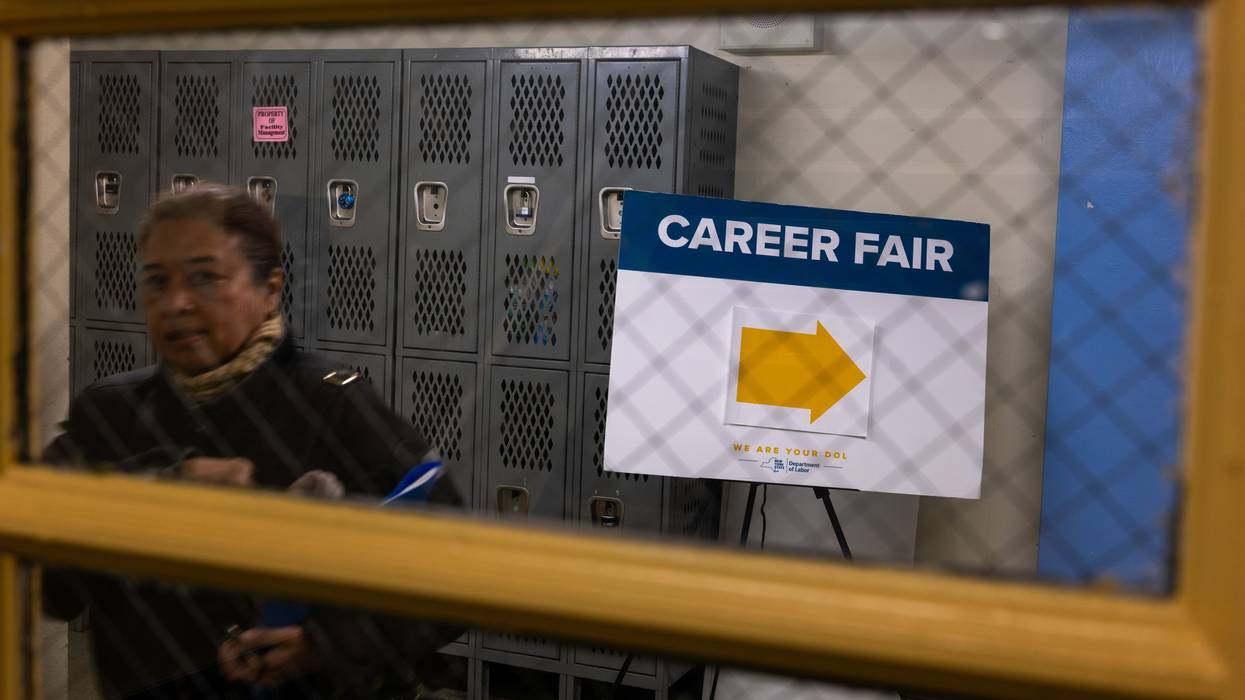
New data from the US Bureau of Labor Statistics released on Tuesday continued to show weakness in the American jobs market.
The latest Job Openings and Labor Turnover Survey (JOLTS) shows that the number of new hires in February decreased to 4.8 million, which was roughly 400,000 fewer hires than were recorded in February 2025.
The report also shows that the US hiring rate in February fell to just 3.1%, which is the lowest rate since April 2020, when the economy was shut down due to the global Covid-19 pandemic.
The good news in the report is that the number of quits and layoffs remained relatively steady, meaning that people who already have jobs are retaining them at a healthy clip.
But Heather Long, chief economist at Navy Federal Credit Union, noted that these bad hiring numbers came before President Donald Trump launched an illegal war with Iran, which has since destabilized global energy markets and raised prices for oil, gasoline, and diesel fuel.
"This is a hiring recession," Long wrote in a social media post. "And Americans are feeling it. There were notable hiring pullbacks in February in hospitality and construction. Bottom line: The job market was already frozen before the war in Iran began. It's worrying that a 'no hire, no fire' situation could turn into a 'no hire, start to fire' job market quickly if there isn't a resolution soon."
Long's analysis was echoed by Laura Ullrich, director of economic research at hiring site Indeed, who wrote in a research note flagged by Axios that hiring in the US "was stuck in neutral going into this [Iran] conflict," and "getting it into gear just got harder" thanks to the war.
Guy Berger, director of economic research at the Burning Glass Institute, noted that hiring rates in the US hit 3.1% or lower the last two times the country was in a severe recession.
"3.1% is not only comparable to the Covid low point—it's also comparable to late 2009 and early 2010, when the unemployment rate was around 10%," Berger explained. "Hiring was ice cold in February."
Scott Lincicome, a senior fellow at the libertarian Cato Institute who has been a harsh critic of Trump's tariffs, found that the February JOLTS report wiped out an unexpected January increase in manufacturing job openings that the president's allies attributed to his trade policies.
"Alas, the perils of cherry-picking," Lincicome commented.
The new data on hiring in the US job market comes weeks after a BLS report estimated that the economy lost 92,000 jobs in February. On the whole, the American economy has posted a net loss of jobs since Trump announced his “liberation day” global tariffs in April 2025.
An immigration researcher at the Cato Institute found that the Trump administration is "raking in billions of dollars in immigration fees and not providing the adjudications that applicants are entitled to."
The US State Department under President Donald Trump has been accused of stealing more than a billion dollars from immigrants and sponsors in what experts are calling “the largest fraud in the history of the US immigration system.”
A report published last week by the Cato Institute, written by director of immigration studies David J. Bier, found that the State Department and Department of Homeland Security were receiving millions of applications from immigrants whom Trump has made ineligible for legal status and pocketing the fees without ever processing the requests.
"The US government collected over $1 billion in immigration fees then refused to process the applications," said Austin Kocher, a fellow at Immigration Lab and a professor at Newhouse and Syracuse University in a social media post breaking down the report on Monday. "No denials. No refunds. Just silence."
The report zeroes in on a series of policies signed by Trump and enacted by Secretary of State Marco Rubio and US Citizenship and Immigration Services (USCIS) head Joseph Edlow, which have collectively barred nationals from 92 countries from immigrating to the US.
One proclamation signed by Trump in December bans legal entry and most visas for the nationals of 40 nations—including Cuba, Venezuela, Nigeria, Iran, and Haiti—based on nationality. A memo sent by Edlow extended the freeze to many USCIS immigration-benefit applications for people from targeted countries already living in the US, including work authorization and permanent residency filings
Another State Department policy bans visa applications from immigrants in 75 countries from being processed indefinitely, purportedly based on data showing that residents of those countries use welfare at disproportionately high rates.
These policies block more than 320,000 people abroad from entering the US and potentially as many as 561,000 potential permanent residents when those already living in the US are considered.
Although people from these countries are categorically denied immigrant visas and most other visa types under a series of travel bans signed by Trump, the government is still collecting fees for visas, work permits, and green cards.
The report cited evidence that the department has directed consular officers that they "should not counsel applicants or advise them" that they are subject to the bans when they come in for their interviews, because it "could be seen as pre-adjudication."
Upon revealing this directive last month, immigration attorney Curtis Morrison described it as a way that "embassies scam visa applicants subject to the travel ban out of fees."
As Bier explained:
To immigrate to the United States or to obtain authorization to work or travel internationally, noncitizens must usually pay a fee to have their applications processed. USCIS’s immigration fee revenues were nearly $7 billion, and the Consular Affairs budget was about $6 billion.
The fees stack up. For instance, to sponsor a spouse, a US citizen must pay a $675 fee to USCIS to petition for their spouse to obtain lawful permanent residence. Then, the immigrant must pay $1,440 to adjust status from temporary to permanent residence. That application takes so long that people usually pay $560 for the spouse to receive an employment authorization document, so the total fees can add up to $2,675.
Bier estimated that more than 2 million applications were affected by the bans, with fees coming primarily from work permit filings and permanent residency or immigrant visa applications.
He explained that these fees are difficult to track precisely because the government does not publish detailed statistics on them. He was also forced to rely on out-of-date fee statistics from 2023-24 because the Trump administration "has simply stopped publishing most statistics."
That said, Bier noted that the numbers are most likely to “understate reality” because they include only those who likely had their requests processed in the past year, not those whose processing was delayed by backlogs.
Of the more than $1 billion in fees the Trump administration would have collected for services it never rendered, data from previous years suggested that about $543 million came from Cuban immigrants, who filed about 935,000 applications during the period under review.
The next highest were Venezuelans, who paid an estimated $138 million in fees. Iranians, Haitians, and Afghans were also among the nationalities with the highest numbers of unprocessed applications.
The Trump administration has used high-profile instances of fraud committed by members of immigrant groups, such as Somalis in Minneapolis, to cast aspersions upon entire nationalities and target them for immigration bans and attacks by federal law enforcement.
However, as Bier explained before the Senate Judiciary Committee last month, based on the findings of a Cato report, "immigrants aren't to blame" for most welfare fraud, accounting for just 5% of it, 31% less per capita than native-born US citizens.
He argued that the Department of Homeland Security "isn't anti-fraud" but instead "openly carrying out the largest fraud in the history of the US immigration system... raking in billions of dollars in immigration fees and not providing the adjudications that applicants are entitled to."
"DHS and State can deny anyone who fails to make their case. Instead, this administration is pocketing thousands of dollars from hardworking Americans and their relatives, including spouses and minor children of US citizens, and then not even looking at their applications," he said. "This is a scam. This is fraud."
Republican Sen. John Kennedy scoffed as David J. Bier of the Cato Institute outlined how the Trump administration has openly demanded "ethnic cleansing" through the deportation of 100 million people.
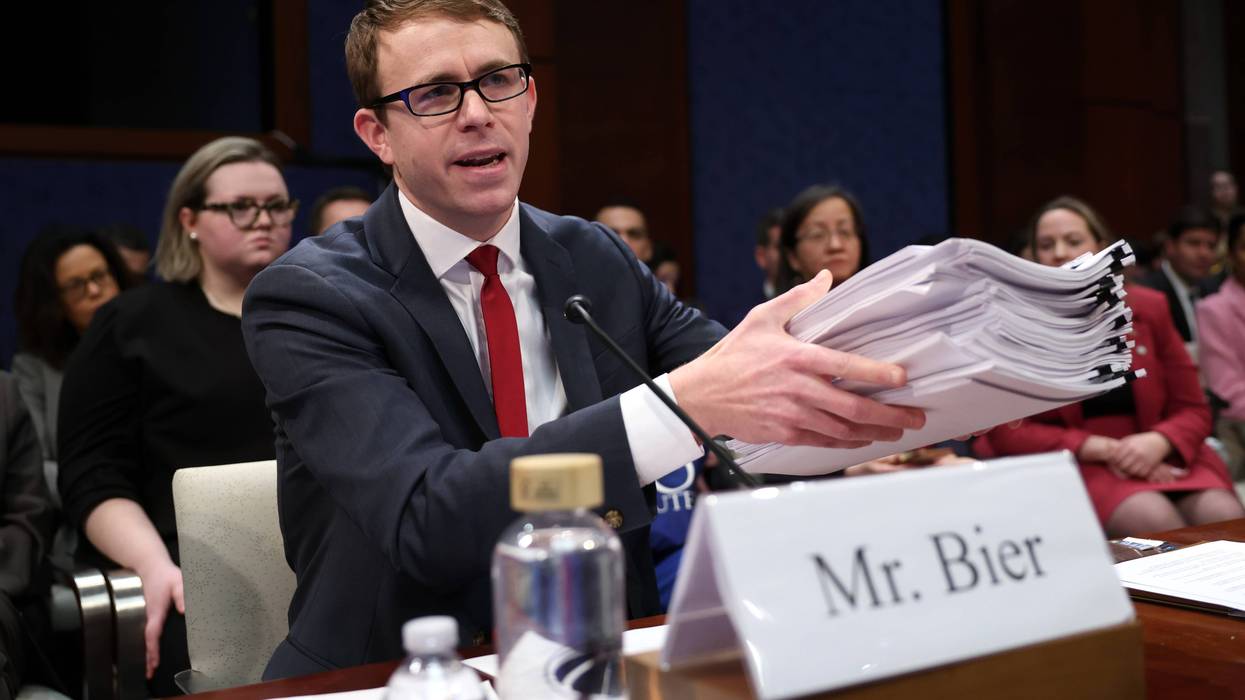
A Republican senator on Tuesday accused an immigration policy expert of "hyperbole" in his condemnation of President Donald Trump's anti-immigration agenda during a hearing—but the witness, David J. Bier of the libertarian Cato Institute, emphasized that the administration's own words and policies have clearly pointed to a goal of expelling millions of citizens from the United States.
At a hearing on sanctuary cities held by the Senate Budget Committee, Sen. John Kennedy (R-La.) read a post Bier wrote on social media in December 2025 in which he said Trump administration officials "think they can troll their way into us accepting ethnic cleansing," suggesting it was one of many "hyperbolic statements" that discredit Bier.
Bier, the director of immigration studies for the Cato Institute, has spent the past year tracking the Trump administration's mass deportation agenda, in which a majority of people who have been detained have had no criminal convictions, despite the White House's persistent claims it is targeting "the worst of the worst" violent criminals.
He was unfazed by Kennedy's questioning, quickly replying that his comment was in response to a social media post by the Department of Homeland Security's official account in which the agency shared an image of a Cadillac on a beach, featuring the message, "America after 100 million deportations."
"That was in regard to a Department of Homeland Security post about advocating 100 million deportations," said Bier as the senator attempted to talk over him. "One hundred million deportations would be ethnic cleansing. You would be removing one-third of country."
This exchange between David Bier and Sen Foghorn Leghorn (R-LA) is something else. Kennedy thinks he has him in three separate gotcha moments, but not so fast Bier had his number. The clip is a bit long but it’s 3 minutes of Kennedy getting owned. Watch👇pic.twitter.com/HPHicyUcl1
— Brian Cardone 🏴☠️🇺🇦 (@cardon_brian) March 10, 2026
Kennedy didn't respond, instead reading a post Bier wrote on March 2 which said: "If you rule against Trump's population purge agenda... the nativists will name you, threaten you, and come after you. These judges are much braver than the [Immigration and Customs Enforcement] agents who hide behind masks while violating the Constitution."
Bier stood by his defense of judges; his post had been in reference to a "60 Minutes" interview given by US District Judge John Coughenour, who described a hoax in which law enforcement showed up at his house after getting a report that he had murdered his wife. He also received a bomb threat, with both incidents taking place after he ruled against Trump's executive order aimed at ending the 14th Amendment's guarantee of birthright citizenship.
The Cato expert also defended his reference to a "population purge," saying: "I'm talking about the fact that they're trying to deport US citizens, people born here. They are trying to deport them as well. So it's not a 'mass deportation agenda.' It is also an agenda intended to reduce the population of the United States."
"These are not hyperbolic statements," he said as Kennedy hurled insults at Bier, asking "what planet" he was from and telling him he triggered the senator's "gag reflex" before being cut off by Sen. Lindsey Graham (R-SC).
Kennedy also accused Bier of making a "hyperbolic statement" on February 11, when he posted on the social media platform Bluesky that in addition to advising US military officers to refuse to carry out illegal orders, Democratic members of Congress should warn them "to refuse unethical orders."
Bier readily defended his remark, asking Kennedy: "Do you disagree with it? You think people should do unethical things?" The senator didn't respond.
It was unclear whether Kennedy was unfamiliar with the president's plan to strip people of their US citizenship—one of the first efforts of his second term, with the executive order signed just after he took office—or if he was simply "looking for fundraising sound bites," as one Cato Institute staffer posited.
Bier said Wednesday that it was the second time in a month that Kennedy has appeared "shocked" to learn about the policies of the president he has supported for nearly a decade.
"Just a month earlier I had explained to him how the Trump administration has already banned HALF of all legal immigrants to the US," said Bier, pointing to his testimony from February in which he explained how the White House has suspended immigrant visas and US Citizenship and Immigration Services benefit applications.
Listen to how shocked Senator Kennedy was. I should've clarified more how it's actually three different overlapping policies (the presidential visa ban, the USCIS benefits suspension, and the State Dept immigrant visa suspension) leading to the theft from applicants. pic.twitter.com/SZh4PMzc6j
— David J. Bier (@David_J_Bier) February 11, 2026
The hearing on sanctuary cities was subtitled "The Cost of Undermining Law and Order," but Bier focused his testimony on the Cato Institute's extensive research that's found immigration has reduced government deficits by at least $14.5 trillion over the last 30 years.
"I was invited to the Budget Committee because of this comprehensive study Cato published, not to discuss random tweets," said Bier. "The Democrats all wanted to talk substance. The other side name-called. Incredible contrast."
"MAGA’s claim that immigrants are a drain on government budgets? It’s a lie."
A groundbreaking new report released Tuesday details how immigrants in the United States over the last three decades have contributed a massive surplus to the nation's economy, resulting in a total of more than $14 trillion over that period due to the fact that immigrant families generate significantly more benefits to fiscal health than they take away in the form of benefits received or downside costs.
The white paper by the libertarian free-marketeers at the Cato Institute, not a left-leaning outfit, builds on an existing model developed by the National Academies of Sciences, Engineering, and Medicine (NASEM) to create a first-of-its kind analyses to determine "how immigrants, both legal and illegal, and their children affect government budgets" in a cumulative manner.
Looking at 30 years of data, the 95-page report—titled "Immigrants' Recent Effects on Government Budgets: 1994-2023"—discovered that immigrants overall "generated a fiscal surplus of about $14.5 trillion" over those years. In part, the NASEM-Cato model shows:
The paper concludes that "the average immigrant is much less costly than the average US-born American, and that immigrants impose lower costs per person on old-age benefit, education, and public safety programs."
The findings arrive with the US embroiled in a heated debate about immigration enforcement as President Donald Trump—backed by far-right xenophobes in his inner orbit, including White House deputy chief of staff for policy Stephen Miller and Department of Homeland Security Kristi Noem—has unleashed violent federal agents into communities nationwide to sweep up undocumented workers and their family members.
In a video produced for social media, David J. Bier, director of Immigration Studies at Cato and one of the report's co-authors, said the analysis shows in detail why it's a lie to believe that immigrants are "sucking us dry," a familiar argument by anti-immigrant "nativists" like Miller.
For every year from 1994 to 2023, immigrants in the US paid more in taxes than they received in benefits from all levels of government. Check out the latest study from Cato’s @David_J_Bier. pic.twitter.com/0cigBbJwBq
— Cato Institute (@CatoInstitute) February 3, 2026
In summary, the report notes that immigrants produce a net fiscal benefit in the US economy because:
As shown in the figure below, the difference between taxes paid by immigrants and the public benefits they receive "has grown from $158 billion to $572 billion in real terms since 1994." Just to look at 2023, working immigrants that year paid $1.3 trillion in taxes yet received only $761 billion in benefits.
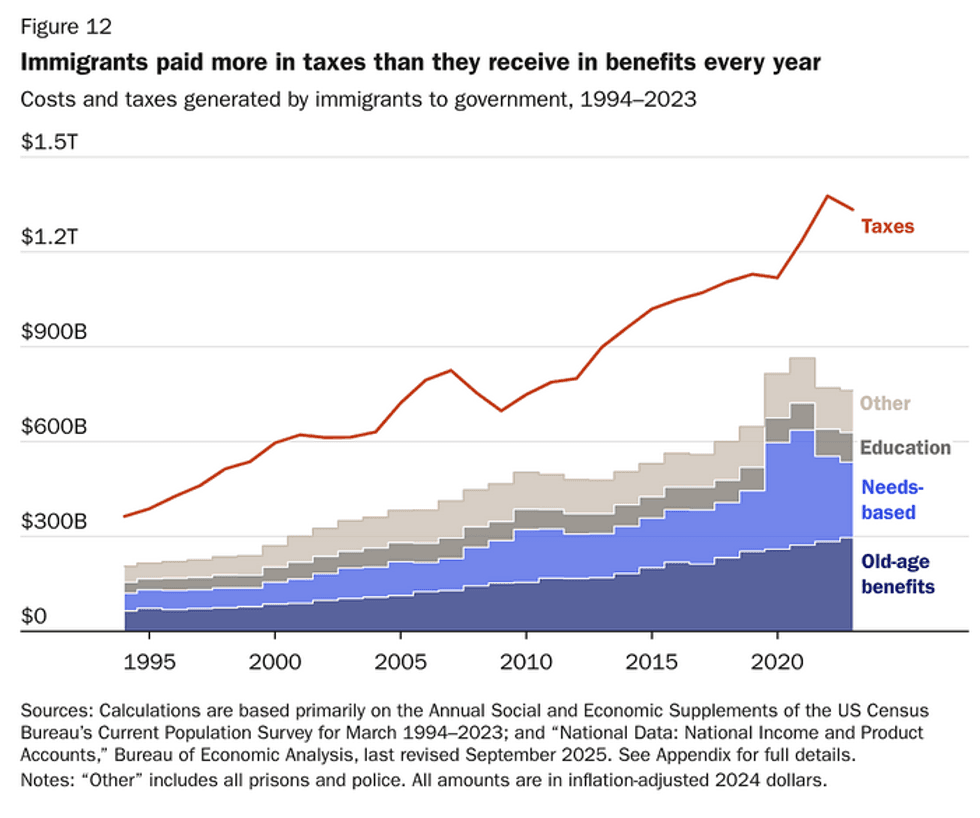
This trend, despite endless cries from far-right pundits and xenophobic lawmakers that immigrants are a drain on public coffers, has held steady for decades—with no sign of it ending in the future.
"For decades, nativists have sold America this narrative that immigrant welfare is behind our deficits and debt," said Bier. "This figure shows how absurd that is."
The report argues that "rather than treating [immigrants—both documented and undocumented] as the cause of America’s fiscal struggles, we should consider immigrants part of the solution."
Mark D. Levine, comptroller of New York City, was among the public officials pointing to the report as timely evidence that the Trump-Miller-Noem narrative about immigration is built on a foundation of falsehoods.
"MAGA’s claim that immigrants are a drain on government budgets? It’s a lie," said Levine.

"I've spoken to dozens of people held inside ICE detention centers in Arizona and this tracks," said Democratic Congresswoman Yassamin Ansari.
The libertarian Cato Institute this week further undermined the Trump administration's claims that it is targeting "the worst of the worst" with its violent immigration operations in communities across the United States by publishing data about the criminal histories—or lack thereof—of immigrants who have been arrested and booked into detention.
David J. Bier, the institute's director of immigration studies, previously reported in June that 65% of people taken by US Immigration and Customs Enforcement (ICE) had no convictions, and 93% had no violent convictions.
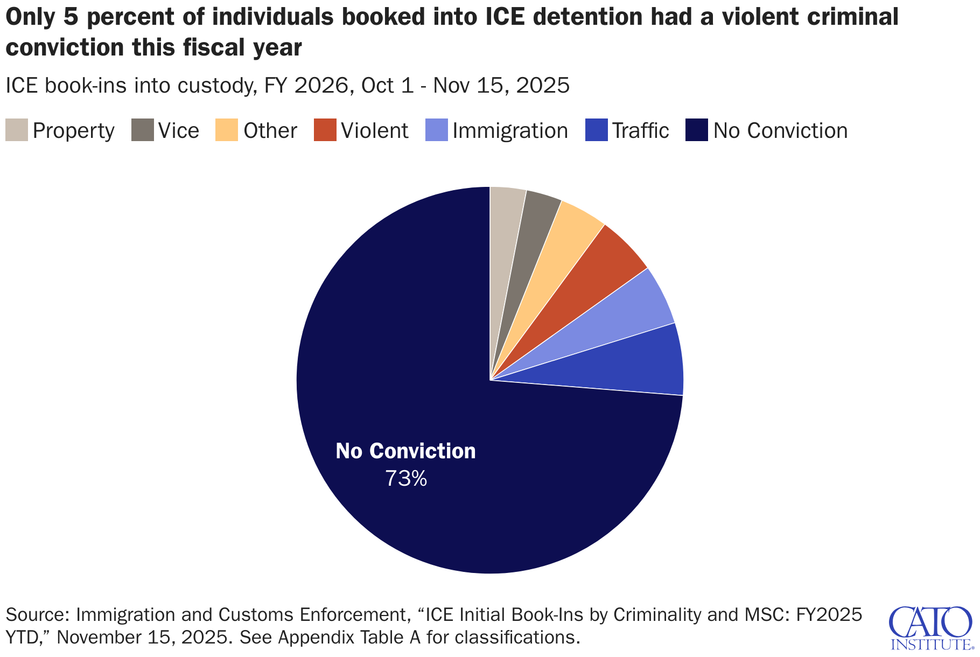
Monday evening, Bier shared a new nonpublic dataset leaked to Cato. Of the 44,882 people booked into ICE custody from when the fiscal year began on October 1 through November 15, 73% had no criminal convictions. For that share, around two-thirds also had no pending charges.
The data also show that most of those recently booked into ICE detention with criminal convictions had faced immigration, traffic, or vice charges. Just 5% had a violent conviction, and 3% had a property conviction.
"Other data sources support the conclusions from the number of ICE book-ins," Bier wrote, citing information on agency arrests from January to late July—or the first six months of President Donald Trump's second term—that the Deportation Data Project acquired via a public records request.
The data show that as of January 1, just before former President Joe Biden left office, 149 immigrants without charges or convictions were arrested by ICE. That number surged by 1,500% under Trump: It peaked at 4,072 in June and ultimately was 2,386 by the end of July—when 67% of all arrestees had no criminal convictions, and 39% had neither convictions nor charges.
Bier also pointed to publicly available data about current detainees on ICE's website, emphasizing that the number of people in detention with no convictions or pending charges “increased a staggering 2,370% since January from fewer than 1,000 to over 21,000."
In addition to publishing an article on Cato's site, Bier detailed the findings on the social media platform X, where various critics of the administration's immigration crackdown weighed in. Among them was Congresswoman Yassamin Ansari (D-Ariz.), who said: "These are the facts. I've spoken to dozens of people held inside ICE detention centers in Arizona and this tracks."
US Sen. Chris Murphy (D-Conn.) declared: "This is the scandal. Trump isn't targeting dangerous people. He's targeting peaceful immigrants. Almost exclusively."
The US Department of Homeland Security, which includes ICE, also jumped in, as did DHS spokesperson Tricia McLaughlin. Responding to Murphy, McLaughlin said in part: "This is so dumb it hurts my soul. This is a made-up pie chart with no legitimate data behind it—just propaganda to undermine the brave work of DHS law enforcement and fool Americans."
Bier and others then took aim at McLaughlin, with the Cato director offering the raw data and challenging her to "just admit you don't care whether the people you're arresting are threats to others or not."
Aaron Reichlin-Melnick, a senior fellow at the American Immigration Council, said that "DHS's spokeswoman lies AGAIN," calling out her post as "either a knowing lie or an egregious mistake."
"The data David J. Bier published was distributed to multiple congressional staffers and is just a more detailed breakdown of data, which is publicly available on ICE's own website," he stressed.
Journalist Jose Olivares noted that this is "not the first time Tricia McLaughlin has said that ICE's own data is 'propaganda.' Months ago, she slammed me and my colleague at the Guardian on PBS... even though we used ICE's own data for our reporting."
The report from investment bank Goldman Sachs comes as President Donald Trump is piling up even more tariffs on imported goods.
New research from investment bank Goldman Sachs affirms, as progressive advocates and economists warned, that US consumers are bearing the brunt of President Donald Trump's trade wars.
As reported by Bloomberg on Monday, economists at Goldman released an analysis this week estimating that US consumers are shouldering up to 55% of the costs stemming from Trump's tariffs, even though the president has repeatedly made false claims that the tariffs on imports exclusively tax foreigners.
Goldman's research also found that US businesses will pay 22% of the cost of the tariffs, while foreign exporters will pay just 18% of the cost. Additionally, Goldman economists estimate that Trump's tariffs "have raised core personal consumption expenditure prices by 0.44% so far this year, and will push up the closely watched inflation reading to 3% by December," according to Bloomberg.
Despite all evidence that US consumers are shouldering the costs of the tariffs, the Trump administration has continued to insist that they are exclusively being paid by foreign countries.
During a segment on NBC's "Meet the Press" last month, host Kristen Welker cited an earlier Goldman estimate that 86% of the president's tariffs were being paid by US businesses and consumers, and then asked US Treasury Secretary Scott Bessent if he accepted that the tariffs were taxes on Americans.
"No, I don't," Bessent replied.
“Goldman Sachs says 86% of the tariffs have been paid by American businesses & consumers. Do you acknowledge that these tariffs are a tax on Americans?” - NBC
“No I don't.” - Scott Bessent
pic.twitter.com/6wtAznhpCc
— Spencer Hakimian (@SpencerHakimian) September 7, 2025
As Common Dreams reported in August, executives such as Walmart CEO Doug McMillon have explicitly told shareholders that while they are able to absorb the cost of tariffs, Trump's policy would still "result in higher prices" for customers.
Goldman's report comes as Trump is piling up even more tariffs on imported goods that will ultimately be paid by US consumers as companies raise prices.
According to The New York Times, tariffs on a wide range of products including lumber, furniture, and kitchen cabinets went into effect on Tuesday, and the Trump administration has also "started imposing fees on Chinese-owned ships docking in American ports."
The administration has claimed that the tariffs on lumber are necessary for national security purposes, although some experts are scoffing at this rationale.
Scott Lincicome, vice president of general economics at libertarian think tank the Cato Institute, told the Times that the administration's justification for the lumber tariffs are "absurd."
"If war broke out tomorrow, there would be zero concern about American ‘dependence’ on foreign lumber or furniture, and domestic sources would be quickly and easily acquired," he said.
Even the Cato Institute found that incarceration rates for immigrants are far lower than those for the native-born.
Fear of street crime and criminals is a politically charged issue. Politicians stoke that fear to gain the consent of voters, from the anti-Black Willie Horton commercial ads of US GOP President George H. W. Bush against Democrat Michael Dukakis in the presidential campaign of 1988 to President Donald Trump’s 2016 and 2024 successful runs for the White House. After decades of economic globalization and climate disruptions, the tough-on-crime platform has evolved from anti-Blackness to migrant demonization. While the former remains central to US politics, the latter demonizes the national origin of criminals, actual and fictional, right up to the president castigating immigration as an invasion creating social ruination at the United Nations recently.
How does such rhetoric match up with data on incarceration for immigrants and the native-born in the US.? We turn to a new study from the Cato Institute, a contributor to the Department of Government Efficiency, a wrecking ball on federal programs and workforce, and Project 2025, the Trump White House’s playbook for restructuring US democracy.
Cato scholars Alex Nowrasteh and Krit Chanwong analyzed annual data from the American Community Survey and found that incarceration rates for immigrants are far lower than those for the native-born.
To this end the duo plotted “the incarceration risk for individuals born in 1990 by immigration status. For the 1990 cohort, native-born Americans were 267% more likely to be incarcerated than immigrants by age 33. Eleven percent of native-born Americans in that year-born cohort have been incarcerated compared to just 3% of immigrants. Other countries really are sending their best.”
In contrast, White House border czar Tom Homan is involved with federal immigration raids that, according to him, are “targeting the worst of the worst.” Homan allegedly took $50,000 in a Federal Bureau of Investigation sting recently.
What about the incarceration risks for immigrants and native-born Americans who are Asian, Hispanic, Black, and white?
Immigrants born in 1990 had a significantly lower incarceration risk than native-born Americans for all races and ethnicities born in the same year. All (legal plus illegal) Hispanic, Asian, Black, and white immigrants as groups each have a lower incarceration rate than white native-born Americans. Asian illegal immigrants have the lowest incarceration risks at around 0.08%.
Here’s a reason why immigrants may have lower incarceration rates. “Noncitizen criminals who are incarcerated are deported after serving their sentences,” according to Alex Nowrasteh and Krit Chanwong, “which means they don’t respond to future American surveys because they are no longer on American soil. Put another way, our study measures whether the respondents have ever been incarcerated.”
All things equal, one thing is clear. Immigrants are not driving a crime wave in the US. There is a wave of corporate crime stateside, however, with companies such as Boeing and its 737 MAX aircraft crashes a case in point.
"ICE isn't going after the 'worst of the worst' like Trump promised," the progressive congresswoman said. "They're disappearing asylum-seekers, families, and relatives of citizens—many with no criminal record."
Progressive U.S. Congresswoman Pramila Jayapal on Thursday hosted a "shadow hearing" on Immigration and Customs Enforcement's targeting of asylum-seekers, families, relatives of American citizens, and other law-abiding people for deportation—policies and practices that belie President Donald Trump's claim that his administration would focus on removing undocumented criminals.
Jayapal (D-Wash.)—the ranking member of the House Judiciary Committee's Subcommittee on Immigration, Integrity, Security, and Enforcement and an immigrant—convened the panel, called Kidnapped and Disappeared: Trump's Weaponization of Immigration Courts. The shadow hearing "examined the disturbing trend of broad efforts to erode access to legal services and due process in immigration proceedings, especially as Immigration and Customs Enforcement (ICE) has been targeting immigrants showing up for legal proceedings—following the requirements set for them by courts."
"These actions are a direct attack on the legal immigration system and the people who are trying to follow all the legal steps."
A sampling of the more than 65,000 people arrested by ICE since Trump reentered office in January reveals people including a beloved resident of a staunchly pro-Trump town, a decorated combat veteran, a child with cancer, anti-genocide protesters, and a woman with an American husband and child who's lived in the U.S. for nearly 50 years.
While the Trump administration claims that "3 in 4 arrests were criminal illegal aliens," most people caught up in Trump's mass deportation drive have no criminal records or have only committed minor offenses including traffic violations. According to the libertarian Cato Institute, 65% of people taken by ICE had no criminal conviction whatsoever and 93% had no conviction for violent offenses.
"Republicans like to talk about how they support immigrants who quote 'do things the right way,'" Jayapal said during the hearing. "Now that they control Congress and the White House, they should be putting their money where their mouth is and ensuring that the legal immigration process remains open to those who pursue it—but that's not what's happening."
HAPPENING NOW: I’m hosting a shadow hearing on Trump’s undermining of due process.ICE is ramping up arrests at immigration courthouses, attacking the legal immigration system, and generating enormous fear in communities across America.Tune in now: www.youtube.com/watch?v=tqVC...
[image or embed]
— Congresswoman Pramila Jayapal (@jayapal.house.gov) June 26, 2025 at 5:44 AM
"They have arrested people at their citizenship interviews, their check-in appointments with Immigration and Customs Enforcement, and increasingly, at immigration court," Jayapal continued. "These actions are a direct attack on the legal immigration system and the people who are trying to follow all the legal steps."
"These actions only serve to make the immigration system even more chaotic and unjust than it already is," she added. "Just when you think this administration cannot sink any lower, they get out a shovel and keep digging."
House Democrats Judy Chu (Calif.), Jesús "Chuy" García (Ill.), Sylvia Garcia (Texas), Glenn Ivey (Md.), Henry C. "Hank" Johnson, Jr. (Ga.), Zoe Lofgren (Calif.), Jerrold Nadler (N.Y.), Delia Ramirez (Ill.), Mark Takano (Calif.), and Rashida Tlaib (Mich.) took part in Thursday's hearing.
Speakers on Jayapal's panel included retired immigration judge A. Ashley Tabaddor, National Immigrant Justice Center policy director Azadeh Erfani, Acacia Center for Justice chief of staff Bettina Rodriguez Schlegel, andImmigrant ARC interim director of programs Gillian Rowland-Kain.
Trump, Stephen Miller, and Tom Homan are arresting as many immigrants as possible — moms, dads, grandparents.ICE isn’t going after the “worst of the worst” like Trump promised. They’re disappearing asylum seekers, families, and relatives of citizens — many with no criminal record.
[image or embed]
— Congresswoman Pramila Jayapal (@jayapal.house.gov) June 26, 2025 at 9:31 AM
"Due process in a courtroom means that every part of the system functions fairly and in concert. That requires an independent judge, a level playing field, and a safe, accessible forum for all participants," Tabaddor said. "Yet noncitizens have no right to appointed counsel—even in life-or-death matters."
"Now, the Trump administration claims that immigration judges are effectively at-will employees, directly undermining their independence," she continued. "At the same time, immigration courts are being transformed into enforcement zones, deterring participation and eroding public trust."
"As a former judge, I can tell you: When even one part of the machine breaks—when judges are undermined, when legal support disappears, or fear keeps people from appearing—the entire system collapses," Tabaddor added. "And when that happens, it doesn't just fail immigrants. It fails all of us."
Erfani said: "Nothing is off the table for ICE to meet Trump's arrest quotas and build the largest mass detention system in recorded history. First, they took away all legal services so no one could represent themselves. Next, they raided the courts and took away access to judges. And lately, they have set traps at ICE check-in appointments, where individuals with pending cases trying to comply with their proceedings are shackled and disappeared into remote jails."
"As ICE tramples all semblance of due process and the rule of law, they are terrorizing our communities," she added.
Rodriguez Schlegel noted how "the Trump administration's attacks on due process have upended the lives and futures of our families, neighbors, and friends."
"In addition to the profound impact on our communities, ending legal access programs has further exacerbated the limited capacity of the immigrant legal services field," she said. "Alongside our inspiring network of legal service provider partners, we will continue to fight for these lifesaving programs to be restored so that families, children, and adults aren't forced to navigate our country's increasingly dehumanizing immigration system alone."
"As ICE tramples all semblance of due process and the rule of law, they are terrorizing our communities."
Stressing that "this is more than a policy shift," Rowland-Kain called the Trump administration's actions "a coordinated effort to sideline due process and deport people without giving them the opportunity to present their case."
"What should have been a space for due process is instead a site of fear," she said. "Masked and armed federal agents are arresting and intimidating people who attend court. Volunteers and attorneys are being surveilled. Every day, our members are in those courtrooms—often the only ones there to stand beside immigrants facing an unjust system. We will continue to do our work and to push back."
"This is a major constitutional ruling on one of the most abused provisions of FISA," said one ACLU leader. "Section 702 is long overdue for reform by Congress, and this opinion shows why."
"Better late than never."
That's how Electronic Frontier Foundation (EFF) surveillance litigation director Andrew Crocker and senior policy analyst Matthew Guariglia responded to a federal court ruling unsealed late Tuesday that found warrantless searches conducted under Section 702 of the Foreign Intelligence Surveillance Act (FISA) violate the Fourth Amendment to the U.S. Constitution.
Section 702 allows for warrantless spying on noncitizens abroad to acquire foreign intelligence information—but that also leads to the collection of Americans' communications. Abuse of the related database, particularly by the Federal Bureau of Investigation (FBI), has led privacy advocates including EFF to demand that Congress pass significant reforms.
The December decision from U.S. District Judge LaShann DeArcy Hall in the Eastern District of New York, unsealed earlier this week, stems from over a decade of litigation in United States v. Hasbajrami. Agron Hasbajrami was arrested at a New York City airport in 2011 and charged with attempting to provide material support to a terrorist group. The U.S. resident pleaded guilty, and after he was serving his sentence, the government revealed some evidence was obtained without a warrant thanks to Section 702.
In 2017, EFF and the ACLU filed an amicus brief arguing to the U.S. Court of Appeals for the 2nd Circuit that "Section 702 surveillance, including the surveillance of Mr. Hasbajrami here, lacks safeguards for Americans that the Constitution requires." In 2019, the appellate court "found that backdoor searches constitute 'separate Fourth Amendment events' and directed the district court to determine a warrant was required," Crocker and Guariglia explained Wednesday. "Now, that has been officially decreed."
Throughout the litigation, Congress has repeatedly reauthorized Section 702 on a bipartisan basis—most recently for two years last April, meaning it is unlikely to be debated on Capitol Hill again before next year. Still, pro-privacy campaigners and experts welcomed the district judge's recent ruling as a crucial victory and used it to renew calls for congressional action.
"This is a major constitutional ruling on one of the most abused provisions of FISA," Patrick Toomey, deputy director of ACLU's National Security Project, said in a Wednesday statement. "As the court recognized, the FBI's rampant digital searches of Americans are an immense invasion of privacy, and trigger the bedrock protections of the Fourth Amendment. Section 702 is long overdue for reform by Congress, and this opinion shows why."
Crocker and Guariglia argued that the Foreign Intelligence Surveillance Court—which has primary judicial oversight of Section 702—should immediately "amend its rules for backdoor searches and require the FBI to seek a warrant before conducting them."
In the longer term, the EFF experts wrote, "we ask Congress to uphold its responsibility to protect civil rights and civil liberties by refusing to renew Section 702 absent a number of necessary reforms, including an official warrant requirement for querying U.S. persons data and increased transparency."
"On April 15, 2026, Section 702 is set to expire," they added. "We expect any lawmaker worthy of that title to listen to what this federal court is saying and create a legislative warrant requirement so that the intelligence community does not continue to trample on the constitutionally protected rights to private communications."
Although Hall's ruling was issued against the Biden administration, it was unsealed a day after Republican U.S. President Donald Trump returned to power—backed by narrow GOP majorities in both chambers of Congress. Patrick G. Eddington, a senior fellow in homeland security and civil liberties at the Cato Institute, a libertarian think tank, wondered Wednesday, "Will the new Trump administration appeal the decision?"
"Attorney general nominee Pam Bondi testified under oath at her confirmation hearing that she supported the FISA Section 702 program, though the issue of warrantless 'backdoor' searches did not come up as I recall," Eddington noted.
Tulsi Gabbard, Trump's pick for director of national intelligence "has gone from FISA Section 702
opponent to supporter in record time," he added. "Assuming Gabbard gets a confirmation hearing, asking her about Hall's ruling should be the first question posed to her."
"I beseech you in the bowels of Christ, think it possible you may be mistaken." —Oliver Cromwell, 1650, imploring his executioners to reconsider
This is a missive directed to Republican voters, wherever it finds them. And here is the message: the Democratic Party is not your enemy.
No, your enemy is former U.S. President Donald Trump. He and the Republican Party care a great deal about your votes, but they don’t give a damn about you. They rely on your fierce loyalty to get elected and then betray you, serving instead the interests of great American corporations and a tiny stratum of immensely wealthy citizens. (The towering achievement of Trump’s presidency was a massive tax cut for precisely these clients.) The betrayal is not readily apparent, of course: It is disguised brilliantly and successfully with distortion, fabrication, and lies.
Donald Trump tells you the Democratic Party is a radical, far left, socialist enterprise and it must be defeated to protect the America we know and love. At his rallies you roar in approval, shouting USA! USA! USA!
Your patriotism is genuine and praiseworthy, but please heed Mr. Cromwell’s plea for open minds: Think it possible—just possible—you may be mistaken about the integrity of Mr. Trump, the Republican Party, and the messaging. Think it possible you are not being protected but victimized.
Let’s look at the evidence.
Mr. Trump is the spokesman and the Republican Party is the front group for corporate oligarchy, a tyrannical form of federal governance put in place decades ago, when corporate money overpowered American democracy. The well-being of the American people no longer takes priority in crafting public policy. Foremost now is the assurance of financial security for powerful corporations: creating new profit streams or enhancing and protecting those in place. This is what the Republican Party hides from view.
We must rid the corrupted Republican Party of its greedy corporate captors, and that means, first, Donald Trump and Republican Senators and Representatives must suffer a smashing defeat in November.
Corporate oligarchy is comprised of the corporations, yes, who contribute millions of dollars to political campaigns eliciting the candidates’ favor and spend billions more in lobbying for quid pro quos. But it also includes individual corporate owners and managers, and conservative billionaires with similar interests who pour personal funds into friendly campaigns. (Think about Elon Musk, say, offering Trump $45 million per month to win this campaign.)
The core ideology of corporate oligarchy is neoliberalism: “Free market capitalism” best provides for society’s needs, and “government regulation” only degrades the process. It is legitimized by conservative think tanks—notably the Heritage Foundation, the Cato Institute, and the American Enterprise Institute in Washington D.C.—and disseminated by sympathetic media—think the Fox News empire and conservative talk radio which blankets the nation with right-wing propaganda 24 hours a day, seven days a week.
The consequences of corporate oligarchy are not trivial.
American people are suffering today the largest increases in food prices in 50 years, while the corporations marketing food products are reaping unprecedented profits. In two years from 2020 to 2022 the Cargill corporation (grains and meat products) doubled its profits, from $3.3 billion to $6.7 billion. In just a single year, from 2021 to 2022, the profits of the Kraft-Heinz company (cheese products, condiments, frozen meals, snacks) rose 448%, from $225 million to $887 million; Cal-Maine Foods (the country’s largest egg producer) grew 718%, to $323 million.
Extortionate consumer prices are not the only outrage imposed by corporate oligarchy. The rampant social and economic injustices in our country today are not the consequences of a functioning democracy: They certainly do not reflect the wishes of the people. Unprecedented inequalities in wealth and income are producing a two-tiered society of opulence and hardship. Homeless colonies blossom coast to coast. A full 31.1 million Americans, almost 10% of our citizens, lack access to healthcare, suffering unnecessary illness and preventable death. A total of 13.5% of American households are “food insecure:” They don't have enough to eat. ChatGPT will tell you it costs up to $60,000 per year to live modestly in America; a minimum-wage worker earns $15,080. Do the math.
Fifty years ago America was flourishing. The middle class constituted almost two-thirds of the population, and it was thriving. A single income was sufficient to raise a family, buy a home, cover healthcare costs, send the kids to college, and retire in comfort. Today, with both parents working full time, this good life is out of reach.
The ravaging of the American people was driven by corporate oligarchy—nothing else, not “socialism,” not the Democratic Party.
Republican friends and neighbors, who is your enemy?
The Republican Party is, because it has been the driving force for the emergence of corporate oligarchy. The process began in 1971 with a lawyer who specialized in corporate mergers, who defended the tobacco industry in the smoking-and-cancer litigation, who advocated segregation in public schools, and who as a Supreme Court justice wrote the majority opinion that corporate political spending was an exercise in free speech.
His name was Lewis Powell, the progenitor of corporate oligarchy.
In 1971 the nation’s campuses were ablaze with protest, against the Vietnam War, against racism, against the savagery of capitalism. Ralph Nader was firing broadsides at American corporate corruption.
The United States Chamber of Commerce was alarmed. It commissioned Lewis Powell to propose a strategy for a corporate counterattack, and he did. On August 23, 1971 the Chamber published what came to be known as the “Powell Manifesto.” The Chamber carpet-bombed the business community with the Manifesto’s message: Corporate America needs to become politically active, quickly and massively. Especially vital was educating the American people about the virtue and vulnerability of “free market capitalism”: it can optimize society’s welfare only if it is uninhibited by “government regulation.” Neoliberalism had to become widely known and appreciated.
Corporate money rose quickly to the challenge, literally creating two of the most influential think-tanks in Washington today and funding a massive redevelopment of the third. The Adolph Coors Foundation and Koch Foundation provided the seed money that created the Heritage Foundation and the Cato Institute, respectively, in 1973 and 1977. The American Enterprise Institute, pre-dating the Manifesto, was greatly enriched by the subsequent flood of corporate money flowing through a dozen conservative philanthropies.
Today these three powerhouses are virtual subsidiaries of the Republican Party, writing policy agendas for Republican presidents (cf. the Heritage Foundation’s Project 2025 written for Donald Trump) and providing revolving-door services: their members move seamlessly into staff positions in Republican administration, and when the party is defeated they return to the think tanks.
The pattern was established early. Soon after Ronald Reagan’s election, the Heritage Foundation submitted to the new Administration a list of 2,000 specific policy proposals aimed, among other objectives, at “reducing the size of the federal government.” By the end of Reagan’s first year in office 60% of them were implemented or initiated. Ronald Reagan said in later years the Heritage Foundation was a “vital force” in the achievements of his presidency.
The most vital achievement was Reagan’s suspension of the long-standing anti-trust laws. A staunch neoliberal, he reduced government regulation to allow free market capitalism to work its wonders. In doing so Reagan exposed the absurd contradiction in the neoliberal creed.
“Free market capitalism” will optimize a country’s economy only if intense competition for customers is present among many, many sellers. That’s Econ 101. Good for society, yes, but bad for the sellers who, historically, connive and conspire to minimize that competition—in the Golden Age of the late 1800’s, say, by the formation of “combines” and “trusts.” The sellers consolidated, becoming fewer and fewer but with greater and greater power to raise prices and reduce wages.
The counteroffensive was political, in the passage of the Sherman and Clayton Anti-Trust Acts—government regulations—prohibiting “the restraint of trade.” Consolidation was made illegal, keeping free markets competitive for society’s benefit.
This we know: “free market capitalism” will benefit society only in the presence—not the absence—of “government regulation.” But neoliberalism gets it entirely backwards.
But Ronald Reagan bought in, virtually halting the enforcement of the anti-trust legislation, sparking a 50-year frenzy of mergers and acquisitions across the spectrum of the American economy.
Virtually every industry was consolidated into far fewer but immensely larger corporations. A quick ChatGPT query shows five grocery chains—Walmart, Kroger, Costco, Albertsons, and Ahold Delhaize—today control more than 60% of the market. (And Kroger and Albertson's are in the process of merging.)
The number of American corporations was cut in half concentrating American industries into literal oligopolies, with pricing power to match. Compared to European countries—where anti-trust laws remain in force—American families pay on average $5,000 more per year for living expenses.
Ronald Reagan’s neoliberalism did this. Republican friends your enemy is not the Democratic Party.
As the dwindling number of corporations expanded their economic clout they chafed at other government regulations—clean air and water, safe workplaces, fair labor practices—but had no means to do much about them. They lacked a corollary political clout.
Wittingly or otherwise the Republican Party provided this, too.
Since 1971, the U.S. Supreme Court has displayed without interruption a conservative majority—justices appointed by Republican presidents. And in that time the Court lit the fuse for corporate oligarchy to explode. It offered corporations the legal means of bribing Congressional candidates and tilting presidential elections as well—with corporate campaign contributions.
In the 1976 case Buckley v. Valeo, the Court declared spending money is the equivalent of free speech. In the 1978 case First National Bank of Boston v. Bellotti, the Court declared corporate contributions to political campaigns were an exercise of free speech, too. Finally in the 2010 case Citizens United v. the FEC, the Court declared as unconstitutional any limits on those corporate campaign contributions.
It did so with this preposterous reasoning:
...this Court now concludes that independent [campaign] expenditures, including those made by corporations, do not give rise to corruption or the appearance of corruption. That [corporations] may have influence over or access to elected officials does not mean that those officials are corrupt. And the appearance of influence or access will not cause the electorate to lose faith in this democracy.
The Court with 100% predictability was dead wrong. In 1964—before the genesis of corporate oligarchy—77 percent of the American people trusted the federal government. Today—14 years after Citizens United—only 22 percent retain their “faith in democracy.”
But corporate campaign funding of public officials—some say the corporate purchase—is only one element of corporate oligarchy’s success. The other is the dominance of corporate lobbying, where obligated public officials get their marching orders to favor corporate interests over the public’s. Does corporate lobbying prevail? Corporations outspend citizens’ organizations in hiring lobbyists by a factor of 34:1.
Before the triumph of corporate oligarchy partisan conflict was congenial and productive. Republicans were conservatives, anxious to maintain the status quo which at a given point in time was quite satisfactory. Democrats were liberals, impatient with the status quo which at a given point in time could always be changed for the better. The two points of view were imperative in a functioning democracy and the tension between them produced public policy compromises that served the nation well, avoiding stasis on the one hand and turmoil on the other.
We can regain that form of governance.
Those of us in the rank and file of the political parties have far more in common than today’s bitter divisiveness suggests. We all love our country, cherishing its past and hopeful for its future; we treasure our families, honoring our predecessors and nurturing our children; and we find gratification in productive work and comfort in spiritual practice. We are ordinary Americans and conscientious citizens, millions and millions of us. We are the People, all of us victimized by corporate oligarchy and its patron, the Republican Party. If we put aside the partisan invective and focus on the imperative of restoring democracy, we can do it.
We must rid the corrupted Republican Party of its greedy corporate captors, and that means, first, Donald Trump and Republican Senators and Representatives must suffer a smashing defeat in November. Then, perhaps, the GOP can be rebuilt as the necessary and responsible voice of true conservatism—the indispensable countervailing force it was in the past. Democracy can flourish again.
Republican friends and neighbors, listen up.