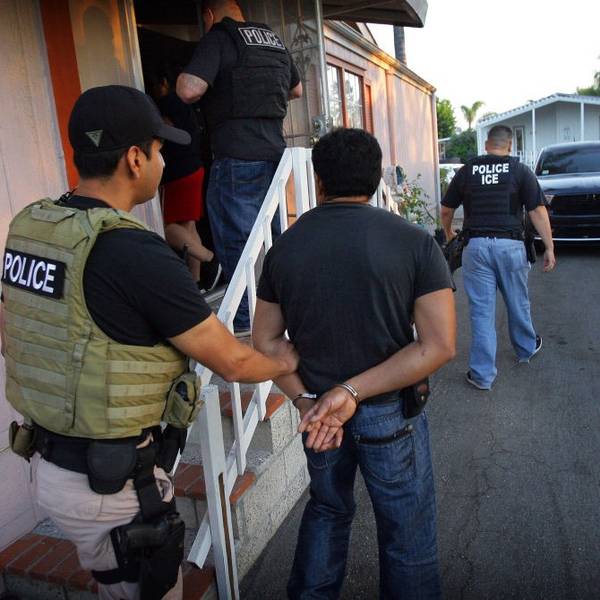

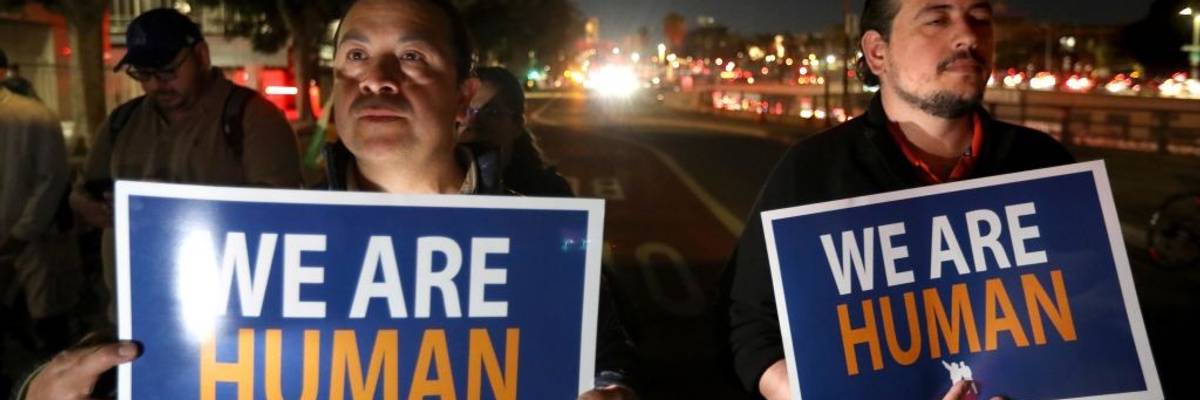
Gerald Diaz, left, and Abraham Roma join a march in support immigrant rights and against the possibility of mass deportation of immigrants on the streets of Los Angeles as part of International Day of Action and Solidarity with Migrants on December 18, 2024.
Corporations, Not Immigrants, Are Driving a US Crime Wave
Even the Cato Institute found that incarceration rates for immigrants are far lower than those for the native-born.
Fear of street crime and criminals is a politically charged issue. Politicians stoke that fear to gain the consent of voters, from the anti-Black Willie Horton commercial ads of US GOP President George H. W. Bush against Democrat Michael Dukakis in the presidential campaign of 1988 to President Donald Trump’s 2016 and 2024 successful runs for the White House. After decades of economic globalization and climate disruptions, the tough-on-crime platform has evolved from anti-Blackness to migrant demonization. While the former remains central to US politics, the latter demonizes the national origin of criminals, actual and fictional, right up to the president castigating immigration as an invasion creating social ruination at the United Nations recently.
How does such rhetoric match up with data on incarceration for immigrants and the native-born in the US.? We turn to a new study from the Cato Institute, a contributor to the Department of Government Efficiency, a wrecking ball on federal programs and workforce, and Project 2025, the Trump White House’s playbook for restructuring US democracy.
Cato scholars Alex Nowrasteh and Krit Chanwong analyzed annual data from the American Community Survey and found that incarceration rates for immigrants are far lower than those for the native-born.
To this end the duo plotted “the incarceration risk for individuals born in 1990 by immigration status. For the 1990 cohort, native-born Americans were 267% more likely to be incarcerated than immigrants by age 33. Eleven percent of native-born Americans in that year-born cohort have been incarcerated compared to just 3% of immigrants. Other countries really are sending their best.”
In contrast, White House border czar Tom Homan is involved with federal immigration raids that, according to him, are “targeting the worst of the worst.” Homan allegedly took $50,000 in a Federal Bureau of Investigation sting recently.
What about the incarceration risks for immigrants and native-born Americans who are Asian, Hispanic, Black, and white?
Immigrants born in 1990 had a significantly lower incarceration risk than native-born Americans for all races and ethnicities born in the same year. All (legal plus illegal) Hispanic, Asian, Black, and white immigrants as groups each have a lower incarceration rate than white native-born Americans. Asian illegal immigrants have the lowest incarceration risks at around 0.08%.
Here’s a reason why immigrants may have lower incarceration rates. “Noncitizen criminals who are incarcerated are deported after serving their sentences,” according to Alex Nowrasteh and Krit Chanwong, “which means they don’t respond to future American surveys because they are no longer on American soil. Put another way, our study measures whether the respondents have ever been incarcerated.”
All things equal, one thing is clear. Immigrants are not driving a crime wave in the US. There is a wave of corporate crime stateside, however, with companies such as Boeing and its 737 MAX aircraft crashes a case in point.
We are at a crossroads
This country and this world are at a monumental crossroads. In a few short weeks, US voters will have an opportunity to beat back the forces of fascism and confront the billionaires who are rigging the economy, our media system, and our democracy, making it increasingly impossible for ordinary people to get by. We’re not just talking about the election. We’re talking about what must be done once these fascist elements are vanquished from power. We need a bolder set of solutions than what either major party has so far been willing to offer and a working-class movement ready to fight like hell for it. Trump didn't emerge from nowhere. The conditions that fueled MAGA authoritarianism were created by decades of radical neoliberal economic policies and a corrupt political system dominated by corporate interests. They slashed taxes on the super-rich, promising that the benefits would trickle down. They said giveaways to the corporate titans would make life more affordable for the rest of us. It was all bullshit. And when a bitter, betrayed populace searches for someone to blame, right-wing demagogues have little trouble finding scapegoats. People know when they're being lied to, but you won't hear any of this from the corporate media. Only independent journalism—powered and funded by people who believe in building a better world—can deliver truly trustworthy daily news. Our Fall Campaign is underway, and we need your help. To power our newsroom through the rest of the year, we need to raise $125,000 by midnight on October 31. So if you share our vision, please contribute whatever you can to sustain our work. |
Fear of street crime and criminals is a politically charged issue. Politicians stoke that fear to gain the consent of voters, from the anti-Black Willie Horton commercial ads of US GOP President George H. W. Bush against Democrat Michael Dukakis in the presidential campaign of 1988 to President Donald Trump’s 2016 and 2024 successful runs for the White House. After decades of economic globalization and climate disruptions, the tough-on-crime platform has evolved from anti-Blackness to migrant demonization. While the former remains central to US politics, the latter demonizes the national origin of criminals, actual and fictional, right up to the president castigating immigration as an invasion creating social ruination at the United Nations recently.
How does such rhetoric match up with data on incarceration for immigrants and the native-born in the US.? We turn to a new study from the Cato Institute, a contributor to the Department of Government Efficiency, a wrecking ball on federal programs and workforce, and Project 2025, the Trump White House’s playbook for restructuring US democracy.
Cato scholars Alex Nowrasteh and Krit Chanwong analyzed annual data from the American Community Survey and found that incarceration rates for immigrants are far lower than those for the native-born.
To this end the duo plotted “the incarceration risk for individuals born in 1990 by immigration status. For the 1990 cohort, native-born Americans were 267% more likely to be incarcerated than immigrants by age 33. Eleven percent of native-born Americans in that year-born cohort have been incarcerated compared to just 3% of immigrants. Other countries really are sending their best.”
In contrast, White House border czar Tom Homan is involved with federal immigration raids that, according to him, are “targeting the worst of the worst.” Homan allegedly took $50,000 in a Federal Bureau of Investigation sting recently.
What about the incarceration risks for immigrants and native-born Americans who are Asian, Hispanic, Black, and white?
Immigrants born in 1990 had a significantly lower incarceration risk than native-born Americans for all races and ethnicities born in the same year. All (legal plus illegal) Hispanic, Asian, Black, and white immigrants as groups each have a lower incarceration rate than white native-born Americans. Asian illegal immigrants have the lowest incarceration risks at around 0.08%.
Here’s a reason why immigrants may have lower incarceration rates. “Noncitizen criminals who are incarcerated are deported after serving their sentences,” according to Alex Nowrasteh and Krit Chanwong, “which means they don’t respond to future American surveys because they are no longer on American soil. Put another way, our study measures whether the respondents have ever been incarcerated.”
All things equal, one thing is clear. Immigrants are not driving a crime wave in the US. There is a wave of corporate crime stateside, however, with companies such as Boeing and its 737 MAX aircraft crashes a case in point.
- ICE-IRS Deal Blasted as 'Bad Policy. Bad Economics. And Cruel.' ›
- While Immigrants Die to Repair Bridges, US Politicians Risk Lives by Building Walls ›
- Sen. Gallego’s Laken Riley Act Sponsorship Exemplifies the Dems’ Strategy Failures ›
- DHS Agents Treat Undocumented Immigrants as Criminals in Hospitals, Shackling Them to Beds and Impeding Care, Study Finds ›
- Jayapal Slams ICE for Targeting Law-Abiding 'Moms, Dads, Grandparents'—Not Criminals ›
Fear of street crime and criminals is a politically charged issue. Politicians stoke that fear to gain the consent of voters, from the anti-Black Willie Horton commercial ads of US GOP President George H. W. Bush against Democrat Michael Dukakis in the presidential campaign of 1988 to President Donald Trump’s 2016 and 2024 successful runs for the White House. After decades of economic globalization and climate disruptions, the tough-on-crime platform has evolved from anti-Blackness to migrant demonization. While the former remains central to US politics, the latter demonizes the national origin of criminals, actual and fictional, right up to the president castigating immigration as an invasion creating social ruination at the United Nations recently.
How does such rhetoric match up with data on incarceration for immigrants and the native-born in the US.? We turn to a new study from the Cato Institute, a contributor to the Department of Government Efficiency, a wrecking ball on federal programs and workforce, and Project 2025, the Trump White House’s playbook for restructuring US democracy.
Cato scholars Alex Nowrasteh and Krit Chanwong analyzed annual data from the American Community Survey and found that incarceration rates for immigrants are far lower than those for the native-born.
To this end the duo plotted “the incarceration risk for individuals born in 1990 by immigration status. For the 1990 cohort, native-born Americans were 267% more likely to be incarcerated than immigrants by age 33. Eleven percent of native-born Americans in that year-born cohort have been incarcerated compared to just 3% of immigrants. Other countries really are sending their best.”
In contrast, White House border czar Tom Homan is involved with federal immigration raids that, according to him, are “targeting the worst of the worst.” Homan allegedly took $50,000 in a Federal Bureau of Investigation sting recently.
What about the incarceration risks for immigrants and native-born Americans who are Asian, Hispanic, Black, and white?
Immigrants born in 1990 had a significantly lower incarceration risk than native-born Americans for all races and ethnicities born in the same year. All (legal plus illegal) Hispanic, Asian, Black, and white immigrants as groups each have a lower incarceration rate than white native-born Americans. Asian illegal immigrants have the lowest incarceration risks at around 0.08%.
Here’s a reason why immigrants may have lower incarceration rates. “Noncitizen criminals who are incarcerated are deported after serving their sentences,” according to Alex Nowrasteh and Krit Chanwong, “which means they don’t respond to future American surveys because they are no longer on American soil. Put another way, our study measures whether the respondents have ever been incarcerated.”
All things equal, one thing is clear. Immigrants are not driving a crime wave in the US. There is a wave of corporate crime stateside, however, with companies such as Boeing and its 737 MAX aircraft crashes a case in point.
- ICE-IRS Deal Blasted as 'Bad Policy. Bad Economics. And Cruel.' ›
- While Immigrants Die to Repair Bridges, US Politicians Risk Lives by Building Walls ›
- Sen. Gallego’s Laken Riley Act Sponsorship Exemplifies the Dems’ Strategy Failures ›
- DHS Agents Treat Undocumented Immigrants as Criminals in Hospitals, Shackling Them to Beds and Impeding Care, Study Finds ›
- Jayapal Slams ICE for Targeting Law-Abiding 'Moms, Dads, Grandparents'—Not Criminals ›