
SUBSCRIBE TO OUR FREE NEWSLETTER
Daily news & progressive opinion—funded by the people, not the corporations—delivered straight to your inbox.
5
#000000
#FFFFFF
To donate by check, phone, or other method, see our More Ways to Give page.


Daily news & progressive opinion—funded by the people, not the corporations—delivered straight to your inbox.
One governor called the defeat of right-wing President Javier Milei's party a "wake-up call from the citizenry."
Voters in Argentina's Buenos Aires province on Sunday sent a clear message to right-wing President Javier Milei, delivering a decisive defeat of his La Libertad Avanza party and forcing him to concede after his party's candidate to lead the country's most populous province won just 34% of the vote.
But even as Milei admitted LLA had suffered a "clear defeat," he suggested he'll do little in the way of course correction ahead of Argentina's midterm elections scheduled for October and will instead move full grospeed ahead with his so-called "chainsaw" economic austerity measures.
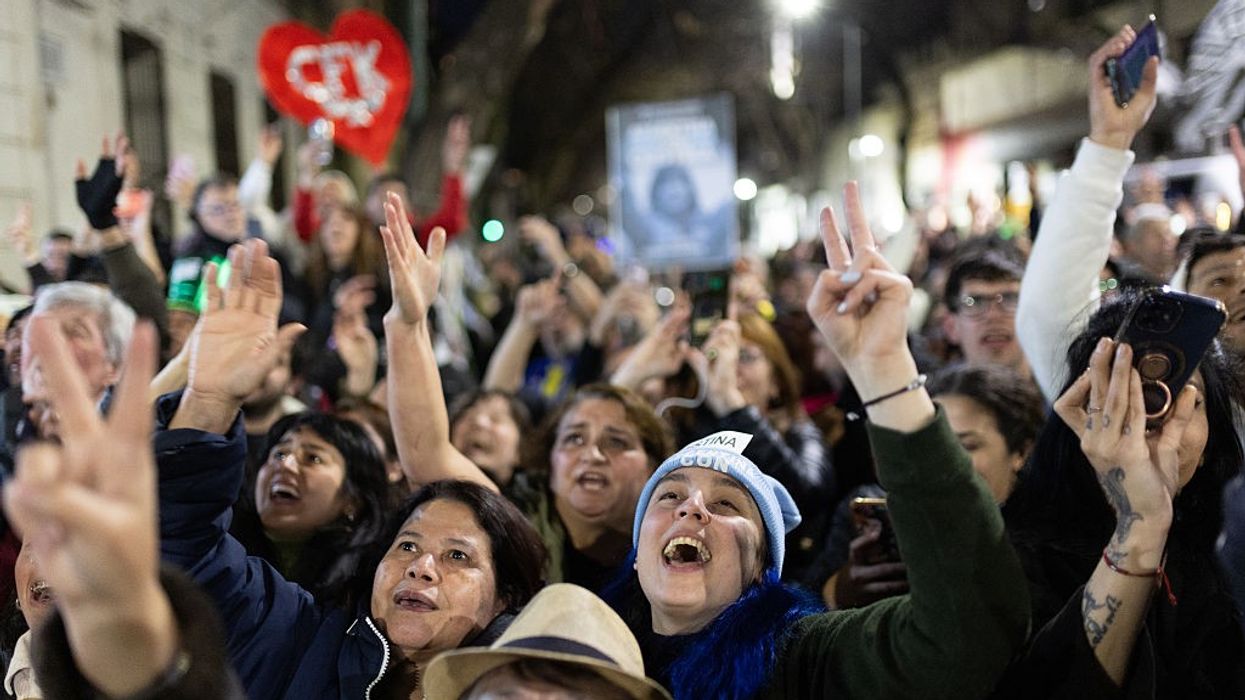
Former President Cristina Fernández de Kirchner advised the president, "Get out of your bubble, brother" as her progressive Peronist party's candidate, Gabriel Katapodis, won 47.4% of the vote.
"Did you see, Milei?" said Kirchner on social media. "Things are getting heavy."
But Milei said his party will not retreat "one millimeter" from its plans to slash public spending, and will "deepen and accelerate" its push for deregulation, which has also included the dismissal of tens of thousands of public employees.
Last month, the country saw mass protests after Milei vetoed a bill that would have increased pensions and disability spending. He said the legislation had been approved by Congress in an "irresponsible manner" and said the spending increases would amount to too much of the gross domestic product.
"The only way to make Argentina great again is with effort and honesty, not the same old recipes," said Milei at the time, echoing US President Donald Trump, who has also presided over mass firings of civil servants and demanded massive cuts to public spending to pay for tax cuts for the richest Americans.
While Argentina's inflation rate has gone down in the first two years of Milei's presidency, unemployment numbers are at their highest since 2021 and many Argentinians have trouble affording basics.
Axel Kicillof, the left-wing governor of Buenos Aires province, said Sunday's vote had sent an undeniable message to the president.
"The ballot boxes told Milei that public works cannot be halted. They explained to him that retirees cannot be beaten, that people with disabilities cannot be abandoned," said Kicillof.
Nacho Torres, governor of Chubut province, added that the election was a "wake-up call from the citizenry."
The Peronists now control the largest bloc in Argentina's Congress and have passed social spending measures, countering Milei' "chainsaw" agenda.
In order to make his desired cuts, Milei needs to expand his party's small minority in Congress next month. Half of the seats in the lower chamber and a third of Senate seats are in play in the upcoming elections.
Sunday's results represented "a key data point to understand the social mood—where the opposition stands, the state of Peronism, and the level of support for the government in Argentina's most important electoral district," Juan Cruz Díaz, the head of the consulting group Cefeidas Group, told The Associated Press.
How Milei reacts, Díaz added, "will be crucial to understanding the evolving political map."
"The Milei government has picked a fight with workers and pensioners, and now they will feel the full force of organized labor," said one union leader.
Increasingly fed up with economic policies under which poverty and inflation have soared while vital social services, wages, and the peso have taken huge hits, disaffected Argentinians took to the streets of cities across the South American nation Wednesday for the third general strike of right-wing President Javier Milei's tumultuous 16-month presidency.
Led by the General Confederation of Labor (CGT)—an umbrella group of Argentinian unions—the "paro general," or general stoppage, drew workers, the unemployed, pensioners, educators, students, and others affected by Milei's severe austerity measures and his administration's plans for more deep cuts. Demonstrations continued throughout Thursday.
"In the face of intolerable social inequality and a government that ignores calls for better wages and a dignified standard of living for all, the workers are going on strike," CGT explained ahead of the action.
Airlines canceled hundreds of flights as air traffic controllers and other airport workers joined the strike; many schools, banks, and other offices shut down; and ports, some public transport, and other services ground to a halt.
"The only thing the administration has brought is a wave of layoffs across state agencies, higher poverty rates, and international debts, which are the biggest scam in Argentina's history," the Association of Airline Pilots (APA) said.
Rodolfo Aguiar, secretary general of the Association of State Workers (ATE), said Wednesday that "after this strike, they have to turn off the chainsaw; there's no room for more cuts," a reference to both Milei's ubiquitous campaign prop and his gutting of public programs upon which millions of Argentinians rely.
"Right now, the crisis Argentina is facing is worsening," Aguiar added, warning about government talks with the International Monetary Fund. "The rise in the dollar will quickly translate into food prices, and the new deal with the IMF is nothing more than more debt and more austerity measures."
Milei's government is nearing agreement on a $20 million IMF bailout, a deeply unpopular proposition in a country left reeling by the U.S.-dominated institution's missteps and intentional policies that benefit foreign investors while causing acute suffering for millions of everyday Argentinians. Argentina already owes $44 billion to the IMF.
"We already have experience as Argentinians that no agreement has been beneficial for the people," retiree and striker Rezo Mossetti told Agence France-Press in Buenos Aires Thursday, lamenting that his country keeps getting into "worse and worse" debt.
CGT decided to launch the general strike during a March 20 meeting that followed a pensioner-led March 12 protest outside the National Congress in Buenos Aires. After fringe elements including rowdy soccer fans known as "barrabravas" joined the protests and committed acts of violence and vandalism, police responded by attacking demonstrators with "less-lethal" weapons including water cannons and tear gas. A gas canister struck freelance photojournalist Pablo Grillo in the head, causing a severe brain injury that required urgent surgery.
This, after Argentinian Security Minister Patricia Bullrich invoked controversial measure empowering more aggressive use of force against protesters and rescinding a ban on police use of tear gas canisters. The Security Ministry also filed a criminal complaint dubiously accusing organizers of the March 12 protest of sedition.
Milei and his supporters have portrayed the general strike as a treasonous assault on the fragile Argentinian economy and those taking part in the day of action as lazy and jobless.
When Clarín, the country's largest newspaper, cited a study by the Argentine University of Enterprise claiming that the general strike would cost the national economy around $185 million per day, University of Buenos Aires professor Sergio Wischñevsky retorted: "Very revealing. It means that's the magnitude of the wealth workers produce every day. It's the best argument to stop ignoring workers."
As he has done with past protests against his rule, Milei has also framed the general strike as "an attack against the republic" and repeated his threat that police would "crack down" on demonstrators.
Orwellian use of state infrastructure by Milei's "anarcho-capitalist" gvmnt. in Argentina. As the 36 hr. general strike begins, signs & loudspeakers at train stations across Buenos Aires read: "Attack against the republic! The syndicalist caste punishes millions of Argentines who want to work."
[image or embed]
— Batallon Bakunin ( @batallonbakunin.bsky.social) April 10, 2025 at 4:11 AM
General strikers largely shrugged off the threats of police violence and state repression.
"The right to strike is a worker right and I think there has to be more strikes because the situation with this government is unsustainable," Hugo Velazuez, a 62-year-old worker striking in Buenos Aires, told Reuters.
While the Argentinian mainstream media's coverage of the general strike was largely muted, images posted by independent progressive media showed parts of central Buenos Aires appearing practically empty.
Workers around the world showed solidarity with striking Argentinians.
"The Milei government has picked a fight with workers and pensioners, and now they will feel the full force of organized labor," said Paddy Crumlin, president of the London-based International Transport Workers' Federation (ITF), which boasts nearly 20 million members in 677 unions in 149 nations. "The international trade union movement stands ready to fight back with our Argentine comrades. We will not rest until these attacks on workers' rights are defeated."
ITF noted that various sectors of Argentina's transportation sector "are under direct threat of privatization," including the national commercial airline, Aerolíneas Argentinas, the National Highway Board, and the Argentinian Merchant Marine.
Milei—a self-described anarcho-capitalist who was elected in November 2023 on a wave of populist revulsion at the status quo—campaigned on a platform of repairing the moribund economy, tackling inflation, reducing poverty, and dismantling the state. He made wild promises including dollarizing Argentina's economy and abolishing the central bank.
However, the realities of leading South America's second-largest economy have forced Milei's administration to abandon or significantly curtail key agenda items, leading to accusations of neoliberalism and betrayal from the right and hypocrisy and rank incompetence from the left. According to most polling, Milei's approval rating has fallen from net positive to negative in just a few months.
Particularly galling to many left-of-center Argentinians is Milei's cozying up to far-right figures around the world, especially U.S. President Donald Trump.
Andrew Kennis, a Rutgers University media studies professor specializing in Latin America, noted similarities between the protests in Argentina and anti-Trump demonstrations in the United States.
"It's no coincidence that 5.2 million people were in the streets in all 50 states just this past Saturday and that the U.S. is now catching up with the mass resistance that's long been going on in Argentina," Kennis told Common Dreams Thursday.
Kennis—who this week published a deep dive on Milei's "destructive chainsaw theory" in Common Dreams—added that in the cases of both Milei and Trump, "there was no real honeymoon period, as there almost always is" for most new presidencies.
"In both countries, people were in the streets pretty damned fast and furiously," he added.
"In 40 years of democracy, there has never been such a frontal attack on the labor sector," said one union leader.
Many thousands of Argentine workers walked off their jobs and took to the streets Wednesday in a general strike led by the nation's largest labor unions against far-right President Javier Milei's all-out assault on worker rights, vital social programs, and the right to protest.
The opposition-aligned Confederación General del Trabajo (CGT), an umbrella labor group boasting about 7 million members, led the general strike against Milei, a 53-year-old self-described "anarcho-capitalist" who took office last month following his decisive victory in November's presidential runoff.
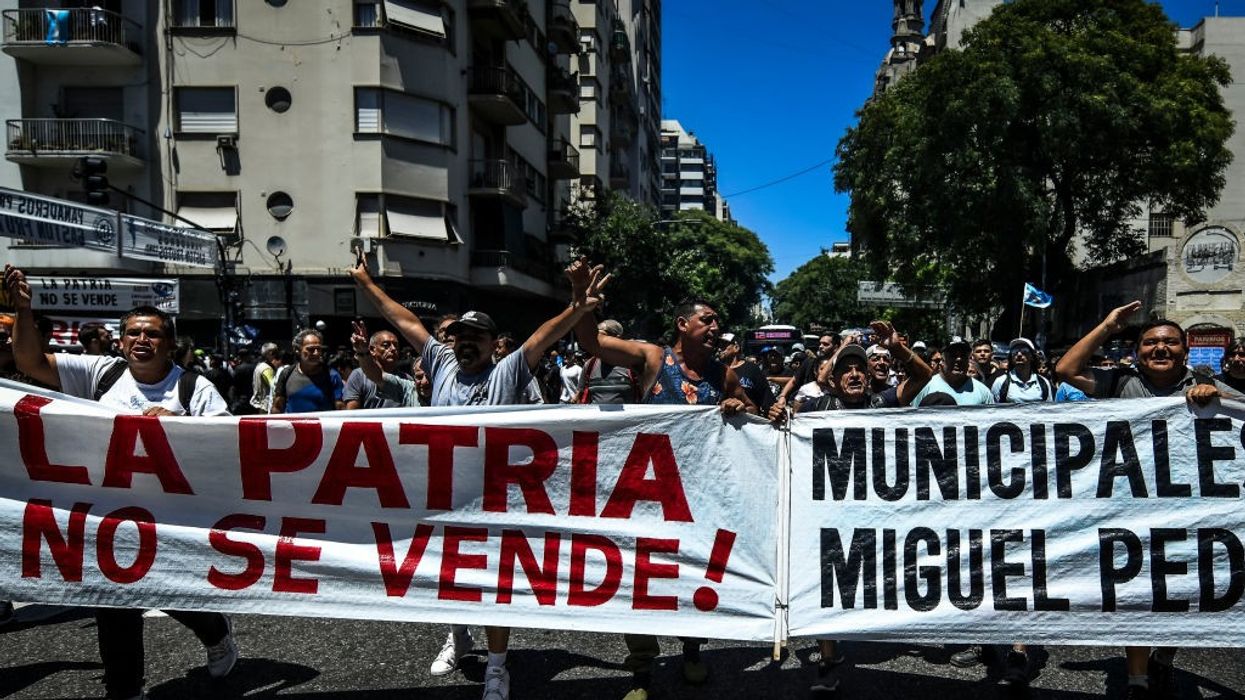
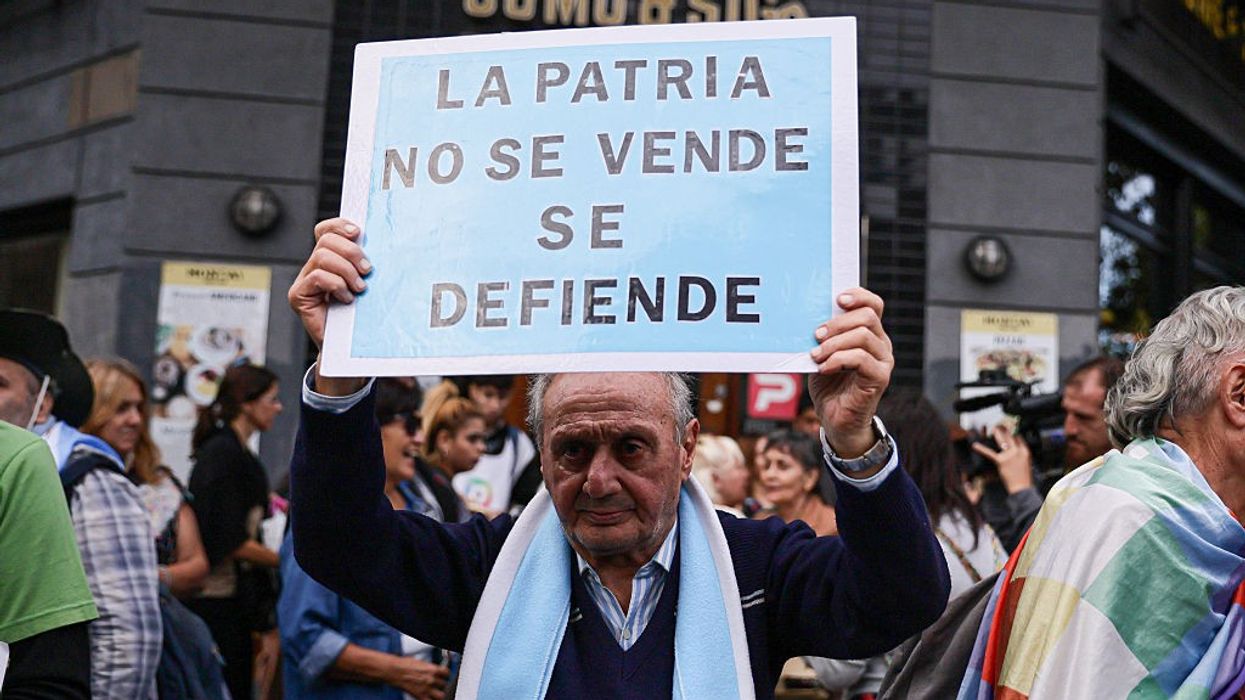
Marching under the slogan, "Our Homeland Is Not For Sale," the CGT-led demonstrators filled streets in the capital Buenos Aires and smaller cities around the South American country of nearly 46 million inhabitants.
"We called a march on [January] 24 to defend labor rights, severance pay, collective bargaining agreements, social security, and the right to protest, all of which have been attacked by the DNU," CGT explained on social media, referring to Milei's December 20 Decree of Necessity and Urgency.
CGT leader Pablo Moyano said Wednesday in Buenos Aires that "every time a [neoliberal] model wins, the first thing they target is the workers."
Martín Lucero, head of the private teachers' union in Rosario, Argentina's third-largest city, told La Capital that "in 40 years of democracy there has never been such a frontal attack on the labor sector" as there has been under Milei.
Estela De Carlotto, who leads the activist group Abuelas de Plaza de Mayo—founded by grandmothers searching for children kidnapped under Argentina's U.S.-backed 1976-83 military dictatorship, which Milei has praised—told Buenos Aires Times that the demonstration "is a way of giving support to this resolution from the people to form a protest and a call of attention for this whole situation we are living with this strange government."
Milei—who said he gets political advice from his dogs—has unleashed what critics have called "a textbook case of shock therapy" on the Argentine people and the country's moribund economy, devaluing the peso by 50%, slashing social spending, reducing government subsidies, and opening the nation to foreign capitalist exploitation.
According to Juan Cruz Ferre, a postdoctoral fellow at the Program in Latin American Studies at New Jersey's Princeton University:
The economic plan was followed by an all-encompassing presidential decree issued on December 20, affecting issues as diverse as labor law, healthcare, foreign trade, private property, and mining. The general thrust of it is very clear: an attack on workers' rights, the liberalization of the economy, the strengthening of big business through market deregulation and numerous incentives, and the erosion of protections for tenants, the environment, and small businesses.
Although courts have suspended parts of Milei's decree in response to legal challenges, Cruz Ferre explained, "attention has now shifted to a mirror bill presented to Congress, which includes all issues contained in the decree, plus a request of extraordinary powers to the executive for a period of four years."
Speaking at the World Economic Forum in Davos, Switzerland last week, Milei
hailed the corporate executives and wealthy global elites gathered there as "heroes" and "creators of the most extraordinary period of prosperity we've ever seen."
From November to December, prices in Argentina increased by more than one quarter, compared with just under 13% the previous month. Annual inflation now stands at 211%, with Argentina rivaling Lebanon for the dubious global top spot.
"In this government of Milei, all the food halls of all the social organizations, of the churches, have not received food [from the government]," one Buenos Aires protester said during Wednesday's march.
"There is no food; they told us that there is no money," the demonstrator added, even as the government adopts "measures in favor of the wealthy sector."
The CGT on Wednesday published a statement "in defense of the civil, social, and labor rights of our nation."
"Today we see how the government seeks to break the social contract through policies and reforms that only seek to subjugate the rights and achievements of the Argentine people," the statement asserted. "We reaffirm our conviction about the importance of social dialogue as the only tool to grow with equity, and that allows us to develop a 'sustainable strategy to achieve development, production, and decent work, with social justice.'"
Argentine Security Minister Patricia Bullrich
dismissed the strike as the work of "mafia unionists, poverty managers, complicit judges, and corrupt politicians, all defending their privileges, resisting the change that society decided democratically and that the president leads with determination."
From Brazil to Belgium, unions throughout the Americas and Europe staged solidarity rallies with Argentine workers.
"The [Argentine] government adopted a perverse combination of radical political authoritarianism with dictatorial tendencies and ultraliberal policies that mostly undermine workers," Unified Workers' Central, Brazil's largest trade union, said in a statement.
Myriam Bregman, a Socialist Workers' Party member of the Chamber of Deputies, the lower house of Argentina's National Congress, said in a Wednesday interview with Left Voice that "international solidarity is key to defeating Milei's attacks on the working class in Argentina."
"Milei, as he made clear at the annual meeting of the World Economic Forum, is a friend to the superrich, whom he treats as heroes," she added. "It is in the interests of the international working class that we prevent the government from moving forward with its anti-worker policies."
Cruz Ferre wrote that "the current [Argentine] government has declared war on workers, women, human rights activists, the environment, and more. The goal is clear: to make tabula rasa of all past gains and concessions to the working class, and reset the conditions for profits through the unrestrained exploitation of labor."
"A determined, organized, and massive resistance will be necessary to preserve the rights that are today under attack," he added. "The outcome of these battles will have implications for many years to come."
"The Argentine people chose Milei as president of the nation, not as emperor," asserted one Buenos Aires demonstrator.
Tens of thousands of Argentinians took to the streets of the capital Buenos Aires on Wednesday to protest recently inaugurated President Javier Milei's decree ushering in sweeping austerity and deregulation and to defy the new far-right administration's crackdown on demonstrations.
Led by labor union activists, the protesters railed against Decree of Necessity and Urgency 70/2023, announced last week by Milei, who is an economist. While the president's supporters argue the plan is needed to buoy the country's moribund economy, critics say the directive eviscerates workers' rights while dangerously accelerating economic deregulation.
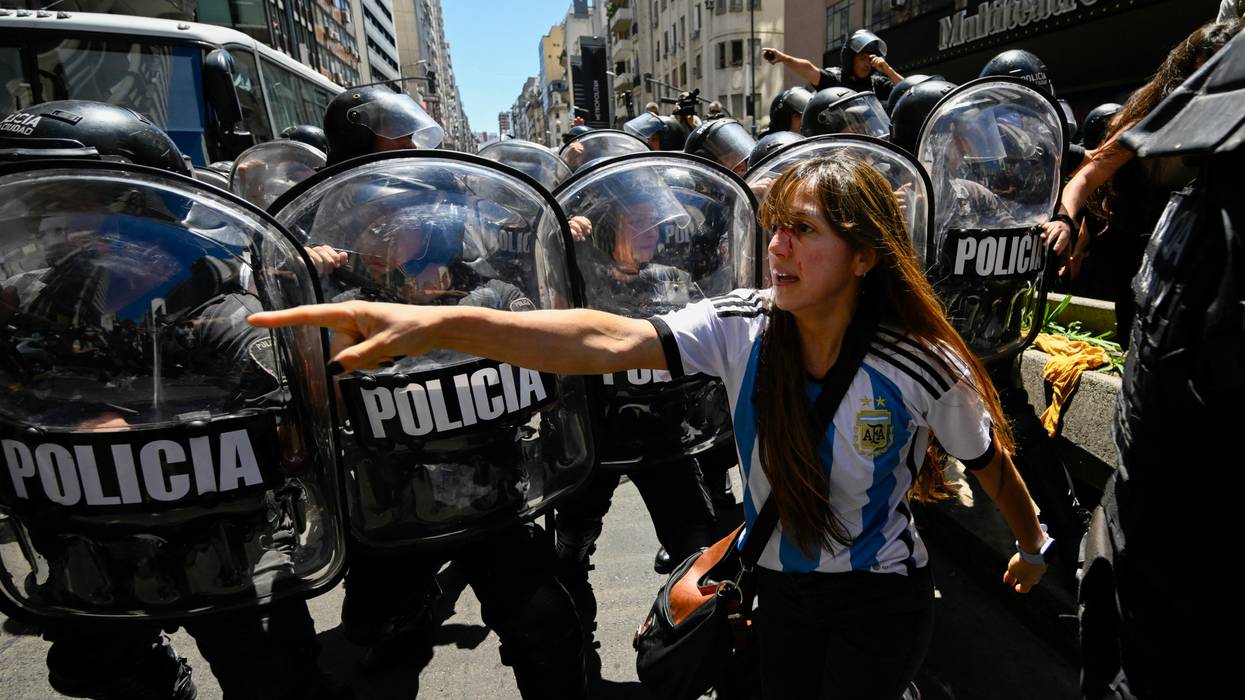
Some of the protesters—who chanted slogans including "the country is not for sale"—were attacked and bloodied by police.
"We want a president who respects the division of powers, who understands that workers have the need to defend themselves individually and within the framework of justice when there is unconstitutionality," protester Gerardo Martínez, general secretary of Argentina's construction workers' union, told The Associated Press.
Martin Lucero, a 45-year-old teacher who also took part in the protest, told Agence France-Presse: "The decree is destructive of all labor rights. The Argentine people chose Milei as president of the nation, not as emperor."
Milei—an admirer of former U.S. President Donald Trump who says that climate change is a "socialist lie" and seeks policy advice from his cloned dogs—pledged to take a "chainsaw" to social programs. He appears to be delivering on his promise.
As the AP reported:
Since taking office on December 10 following a landslide election victory, Milei has devalued the country's currency by 50%, cut transport and energy subsidies, said his government won't renew contracts for more than 5,000 recently hired state employees, and proposed repealing or modifying about 300 laws.
He says he wants to transform Argentina's economy and reduce the size of its state to address rising poverty and annual inflation expected to reach 200% by the end of the year.
Furthermore, the new government has announced that police would crack down on anyone who organizes or participates in protests that block roads.
Right-wing Argentine lawmaker José Luis Espert shocked human rights defenders earlier this month after declaring that protesters who violated the new policy had the choice of "prison or bullet."
"This country's problem is not protests," said one demonstrator. "The country's problem is that Milei took away 50% of our purchasing power overnight with a devaluation."
Days after Argentinian President Javier Milei's security minister announced that law enforcement would crack down on anyone who organizes or participates in protests that block roads, thousands of residents risked arrest and cuts to their social benefit payments by taking to the streets Wednesday night and into Thursday morning, rallying against Milei's latest package of austerity measures.
Buenos Aires residents responded to Milei's announcement of new anti-worker economic decrees on Wednesday by banging pots and pans on their balconies before congregating on streets across the capital and marching to the National Congress.
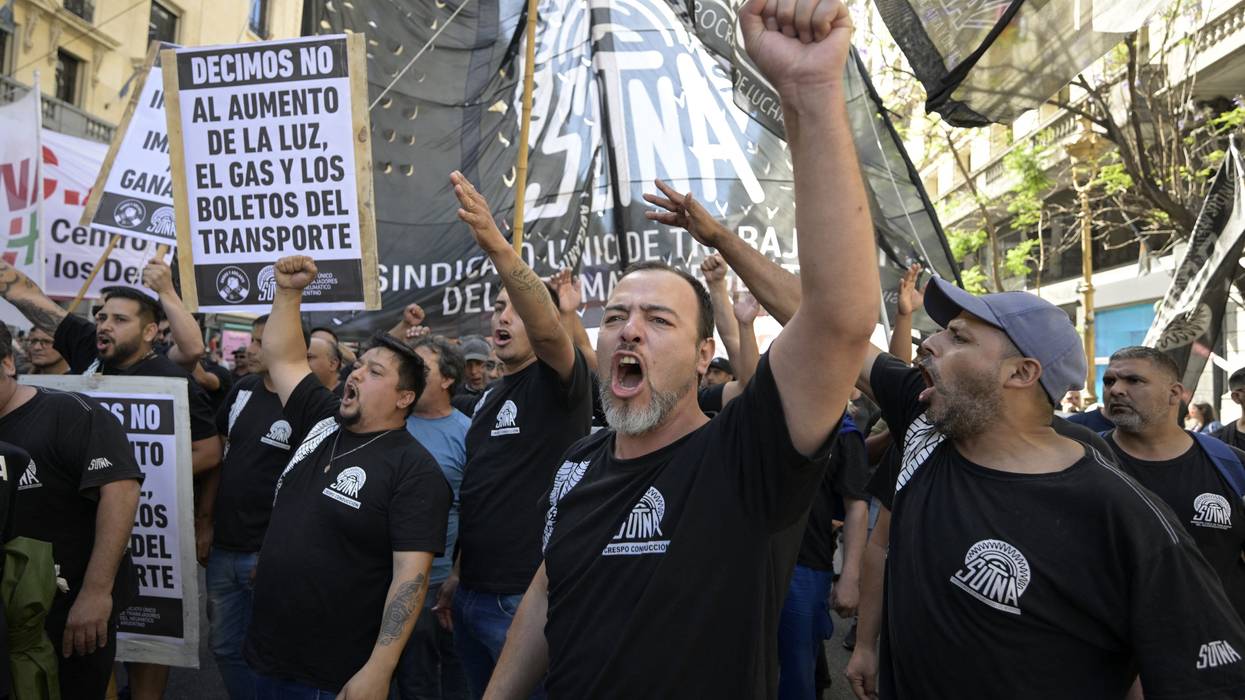
Protesters chanted, "Milei! You're garbage! You are the dictatorship!" and carried signs reading, "We say no to the increase in electricity, gas, and transport tickets"—a reference to measures the right-wing president unveiled earlier this month when he announced the devaluation of the peso by 50% and cuts to public spending and energy and transportation subsidies.
The measure announced Wednesday will further intensify Milei's austerity approach in a country where about 40% of residents live in poverty.
Milei's decree will pave the way for state-owned companies to be privatized, mining to be deregulated, firms to strip workers of rights including maternity leave, and foreign companies to invest in rental housing and land.
Critics including former presidential candidate Myriam Bregman of the progressive Workers' Left Front accused Milei of violating the Argentinian Constitution by bypassing Congress to introduce the new measures.
"There are so many illegalities here I don't know where to start," Bregman told The Guardian, saying the president had released a "battle plan against working people."
Hector Daer, secretary of the General Confederation of Labor, told Telesur English that Milei's announcement "subverts the democratic republican order and disrupts the division of powers."
"His unconstitutionality is evident," Daer said. "We will not tolerate an attack on social security and labor and social rights."
Protesters also took to the streets before Milei's announcement Wednesday, honoring the victims of the violent repression of former President Fernando de la Rúa's administration, which cracked down on mass protests on December 20, 2001. Nearly 40 people were killed in the clashes more than two decades ago and almost 500 were injured.
The protests on Wednesday were met with a show of force by police in riot gear, but El País reported that the mobilization proved too large for security forces to quell it.
Picketing—blocking streets and highways—is "one of Argentina's most common forms of protest," according to the newspaper, and too many demonstrators turned out to limit the protest to only sidewalks. El País reported that people rallied in city streets without blocking "main traffic arteries" and that only two arrests were made.
Protesters said Milei's administration is more concerned with pressuring people out of protesting than responding to the concerns of citizens who fear losing their pensions and jobs as a result of the austerity measures.
"This country's problem is not protests," Betina Sanchís, a retiree, told El País. "The country's problem is that Milei took away 50% of our purchasing power overnight with a devaluation."
The historic and scandal-prone Buenos Aires zoo is set to close and all animals transitioned to nature preserves because, as the city's Mayor Horacio Rodriguez Larreta put simply on Friday, "Captivity is degrading."
The 140-year-old zoo in Buenos Aires' Palermo neighborhood will be turned into an "ecopark" when it reopens later this year after its 2,500 animals are removed, although some of the older and infirm animals will remain on site, the Guardian reports. That includes the orangutan Sandra, who made headlines in 2014 when an unsuccessful bid to have her freed from captivity nonetheless resulted in her being termed a "non-human person" deserving of rights by a Buenos Aires court.
As an ecopark, the site will also provide "refuge and rehabilitation" for animals rescued from trafficking operations.
"This situation of captivity is degrading for the animals, it's not the way to take care of them," Larreta said Thursday during a press conference.
The ecopark will also serve as a venue "where children can learn how to take care of and relate with the different species," he continued. "What we have to value is the animals. The way they live here is definitely not the way to do that."
In recent years, the zoo has attracted criticism for its inadequate conditions, such as its handling of polar bears during the city's scorching hot summers.
Gerardo Biglia, an animal rights activist who has long pushed for the zoo's closure, said in a press release, "The most important thing is breaking with the model of captivity and exhibition. I think there is a change coming for which we are already prepared because kids nowadays consider it obvious that it's wrong for animals to be caged."
Famed Spanish judge Baltasar Garzon, known for having put Chilean dictator Augusto Pinochet on trial for genocide in 1998, has reportedly "set his sights on widening the definition of international law to target corporations that carry out economic or environmental crimes," the Guardian reported on Thursday.
Garzon--who has taken on alleged torture and ill-treatment of inmates at the U.S. prison of Guantanamo Bay, crimes committed during the reign of Francisco Franco, and the political persecution of WikiLeaks co-founder Julian Assange--will now turn his focus toward corporate crime.
Next month, according to the Guardian, he and other leading human rights activists, judges, and academics from a dozen countries will come together at a conference in Buenos Aires, Argentina, to push forward the idea that economic and environmental crimes be considered crimes against humanity, akin to torture or genocide.
The Guardian reports:
Actions that could be considered criminal, said Garzon, include those of the so-called vulture funds that undermine countries' debt restructuring, or companies that turn a blind eye to the abusive exploitation of natural resources such as coltan, used in mobile phones, digital cameras and computers.
These actions fit within the definition of crimes against humanity, as they affect certain sectors of the population and trample on human rights, he said. Referring to environmental crimes, he said: "We're seeing how climate change is connected to natural disasters and famines."
Garzon knows he will face an uphill battle. "The problems will come when this initiative affects powerful countries, such as the United States, China or Israel," he said. "But little by little, the path will be paved."
While prosecuting such crimes could be very difficult right now, he told EuroWeekly, "in 10 years, they will be at the center of debate."
A 24-hour general strike gripped Argentina on Thursday, bringing many public services to a halt.
Unions say over one million workers took part in this second strike the administration of Cristina Fernandez has faced. The strike's focus was to denounce the country's low wage increases in the face of high inflation, as well as other policies, like cuts in utility subsidies and salary caps, critics say are unfair to workers and are fomenting social unrest.
The strike stopped public transportation, forced the cancellation of flights, blockaded roads, and resulted in some clashes between police and protesters.
From Spanish news agency EFE:
"The strike has been a success from the outset," labor leader and congressman Nestor Pitrola said, adding that "a new stage has been launched" in the unions' struggle, "which began with the teachers strike and continues with this strike that seeks to define where the country is heading."
Spearheading the strike was Hugo Moyano, head of the General Confederation of Labor, and former Fernandez ally.
Moyano said the strike was a sign of people's "anger and disenchantment," and that the president must respond to this message from the people.
Euronews and TeleSur (in Spanish with English subtitles) have video below:
Argentina general strike brings Buenos Aires to a haltProtesters brought Buenos Aires to a standstill on Thursday during a 24 hour general strike against high inflation and taxes.
Strike in Argentina blocks access and paralyzes transport systemThe national strike in Argentina, which was organized by the main opposition unions and workers, began on Thursday at midnight ...