SUBSCRIBE TO OUR FREE NEWSLETTER
Daily news & progressive opinion—funded by the people, not the corporations—delivered straight to your inbox.
5
#000000
#FFFFFF
To donate by check, phone, or other method, see our More Ways to Give page.
Daily news & progressive opinion—funded by the people, not the corporations—delivered straight to your inbox.
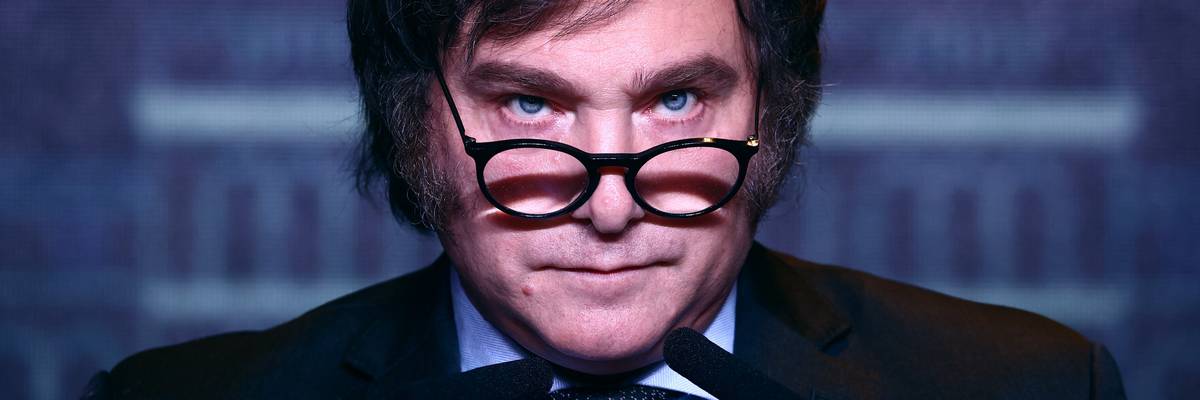
Argentinian President Javier Milei looks on after the polls close in the presidential runoff election on November 19, 2023 in Buenos Aires, Argentina.
"Protest is elemental to Argentine social and political life, so it's not difficult to imagine how this ends," said one journalist.
As the human impact of Argentinian President Javier Milei's "shock treatment" to the South American country's economy became increasingly clear with rising prices on Thursday, Security Minister Patricia Bullrich announced what one journalist said were doubtlessly "preemptive" new controls on protests to discourage a struggling population from speaking out.
Bullrich said four security forces—the Federal Police, the Gendarmerie, the Naval Prefecture, and the Airport Security Police—will work together to stop protests that block streets and suggested the protocol is aimed only at ensuring "that people can live in peace" without demonstrators blocking traffic.
But as Progressive International co-general coordinator David Adler and others noted, the measures also include calls for armed forces to break labor strikes, create a national registry of people who organize protests, and sanctions against parents who bring their children to demonstrations.
The new package amounts to "a total crackdown on Argentine civil society," Adler said.
Bullrich's announcement came days after Milei, a far-right libertarian economist who has called the climate crisis "a socialist lie" and has been compared to former U.S. President Donald Trump, announced in the first weeks of his presidency an economic "shock treatment" package including a devaluation of the peso by 50%, from 400 pesos to the U.S. dollar to 820 pesos.
The administration also said it would cut public spending by closing some government ministries, increasing retirements ordered by decree, reducing energy and transportation subsidies, and freezing public works, with further "profound" measures expected in the future.
Milei claimed that with the spending cuts, government revenues will ultimately increase by 2.2 points, helping to confront an economic crisis in which annual inflation exceeds 160%, the country has a trade deficit of $43 billion, and $45 billion is owed to the International Monetary Fund (IMF).
But as Milei's "open heart surgery of the economy," as El País called the package, took hold, prices of some goods and services rose by 100% and some commuters worried that they will no longer to be able to afford their daily commutes it transit agencies are forced to raise prices due to lost subsidies.
"If [the bus fare] goes up, my salary will be spent on transport," Julia González, who takes three buses and a train to her job in downtown Buenos Aires, told The Associated Press.
About 40% of Argentinians live below the poverty line and more than 9% are destitute, reported El País, with incomes insufficient to buy food.
Economist Juan Manuel Telechea told the outlet that monthly inflation could reach 30-40% due to the devaluation and that social aid will be "highly insufficient."
Presidential spokesperson Manuel Adorni said of the economy Wednesday that Milei "found a patient in intensive care about to die," but one trade unionist told El País the president is "exaggerating the inherited crisis situation to justify inadmissible measures, which will increase poverty levels in Argentina above 50% in a matter of days."
"The mega-devaluation that is being carried out is a matter of concern because it may devolve into hyperinflation," Pato Laterra, an economist at the National University of La Plata, told the newspaper.
Mark Weisbrot, co-director of the Center for Economic and Policy Research, said last month that Argentina's current economic crisis is the result of right-wing former President Mauricio Macri's administration, which took out the largest loan ever from the IMF and pushed the economy into a recession, with poverty and inflation rising by 50% or more.
"But a crazed, economically suicidal approach would only make things worse—and as Argentina has experienced, things can get a lot worse," said Weisbrot. "Milei displays a callous disregard for most people's living standards, values, and well-being, as well as a commitment to widely discredited economic policies, that is unprecedented."
Jacob Sugarman of the Buenos Aires Herald said Wednesday that it remains to be seen "how long Argentine society is willing to tolerate this kind of pain" and suggested that Bullrich's announcement of a crackdown on dissent is likely to further anger the public.
" Protest is elemental to Argentine social and political life, so it's not difficult to imagine how this ends," said Sugarman, "especially with Bullrich announcing that the government will use federal forces including the National Military Police to break picket lines."
Dear Common Dreams reader, It’s been nearly 30 years since I co-founded Common Dreams with my late wife, Lina Newhouser. We had the radical notion that journalism should serve the public good, not corporate profits. It was clear to us from the outset what it would take to build such a project. No paid advertisements. No corporate sponsors. No millionaire publisher telling us what to think or do. Many people said we wouldn't last a year, but we proved those doubters wrong. Together with a tremendous team of journalists and dedicated staff, we built an independent media outlet free from the constraints of profits and corporate control. Our mission has always been simple: To inform. To inspire. To ignite change for the common good. Building Common Dreams was not easy. Our survival was never guaranteed. When you take on the most powerful forces—Wall Street greed, fossil fuel industry destruction, Big Tech lobbyists, and uber-rich oligarchs who have spent billions upon billions rigging the economy and democracy in their favor—the only bulwark you have is supporters who believe in your work. But here’s the urgent message from me today. It's never been this bad out there. And it's never been this hard to keep us going. At the very moment Common Dreams is most needed, the threats we face are intensifying. We need your support now more than ever. We don't accept corporate advertising and never will. We don't have a paywall because we don't think people should be blocked from critical news based on their ability to pay. Everything we do is funded by the donations of readers like you. When everyone does the little they can afford, we are strong. But if that support retreats or dries up, so do we. Will you donate now to make sure Common Dreams not only survives but thrives? —Craig Brown, Co-founder |
As the human impact of Argentinian President Javier Milei's "shock treatment" to the South American country's economy became increasingly clear with rising prices on Thursday, Security Minister Patricia Bullrich announced what one journalist said were doubtlessly "preemptive" new controls on protests to discourage a struggling population from speaking out.
Bullrich said four security forces—the Federal Police, the Gendarmerie, the Naval Prefecture, and the Airport Security Police—will work together to stop protests that block streets and suggested the protocol is aimed only at ensuring "that people can live in peace" without demonstrators blocking traffic.
But as Progressive International co-general coordinator David Adler and others noted, the measures also include calls for armed forces to break labor strikes, create a national registry of people who organize protests, and sanctions against parents who bring their children to demonstrations.
The new package amounts to "a total crackdown on Argentine civil society," Adler said.
Bullrich's announcement came days after Milei, a far-right libertarian economist who has called the climate crisis "a socialist lie" and has been compared to former U.S. President Donald Trump, announced in the first weeks of his presidency an economic "shock treatment" package including a devaluation of the peso by 50%, from 400 pesos to the U.S. dollar to 820 pesos.
The administration also said it would cut public spending by closing some government ministries, increasing retirements ordered by decree, reducing energy and transportation subsidies, and freezing public works, with further "profound" measures expected in the future.
Milei claimed that with the spending cuts, government revenues will ultimately increase by 2.2 points, helping to confront an economic crisis in which annual inflation exceeds 160%, the country has a trade deficit of $43 billion, and $45 billion is owed to the International Monetary Fund (IMF).
But as Milei's "open heart surgery of the economy," as El País called the package, took hold, prices of some goods and services rose by 100% and some commuters worried that they will no longer to be able to afford their daily commutes it transit agencies are forced to raise prices due to lost subsidies.
"If [the bus fare] goes up, my salary will be spent on transport," Julia González, who takes three buses and a train to her job in downtown Buenos Aires, told The Associated Press.
About 40% of Argentinians live below the poverty line and more than 9% are destitute, reported El País, with incomes insufficient to buy food.
Economist Juan Manuel Telechea told the outlet that monthly inflation could reach 30-40% due to the devaluation and that social aid will be "highly insufficient."
Presidential spokesperson Manuel Adorni said of the economy Wednesday that Milei "found a patient in intensive care about to die," but one trade unionist told El País the president is "exaggerating the inherited crisis situation to justify inadmissible measures, which will increase poverty levels in Argentina above 50% in a matter of days."
"The mega-devaluation that is being carried out is a matter of concern because it may devolve into hyperinflation," Pato Laterra, an economist at the National University of La Plata, told the newspaper.
Mark Weisbrot, co-director of the Center for Economic and Policy Research, said last month that Argentina's current economic crisis is the result of right-wing former President Mauricio Macri's administration, which took out the largest loan ever from the IMF and pushed the economy into a recession, with poverty and inflation rising by 50% or more.
"But a crazed, economically suicidal approach would only make things worse—and as Argentina has experienced, things can get a lot worse," said Weisbrot. "Milei displays a callous disregard for most people's living standards, values, and well-being, as well as a commitment to widely discredited economic policies, that is unprecedented."
Jacob Sugarman of the Buenos Aires Herald said Wednesday that it remains to be seen "how long Argentine society is willing to tolerate this kind of pain" and suggested that Bullrich's announcement of a crackdown on dissent is likely to further anger the public.
" Protest is elemental to Argentine social and political life, so it's not difficult to imagine how this ends," said Sugarman, "especially with Bullrich announcing that the government will use federal forces including the National Military Police to break picket lines."
As the human impact of Argentinian President Javier Milei's "shock treatment" to the South American country's economy became increasingly clear with rising prices on Thursday, Security Minister Patricia Bullrich announced what one journalist said were doubtlessly "preemptive" new controls on protests to discourage a struggling population from speaking out.
Bullrich said four security forces—the Federal Police, the Gendarmerie, the Naval Prefecture, and the Airport Security Police—will work together to stop protests that block streets and suggested the protocol is aimed only at ensuring "that people can live in peace" without demonstrators blocking traffic.
But as Progressive International co-general coordinator David Adler and others noted, the measures also include calls for armed forces to break labor strikes, create a national registry of people who organize protests, and sanctions against parents who bring their children to demonstrations.
The new package amounts to "a total crackdown on Argentine civil society," Adler said.
Bullrich's announcement came days after Milei, a far-right libertarian economist who has called the climate crisis "a socialist lie" and has been compared to former U.S. President Donald Trump, announced in the first weeks of his presidency an economic "shock treatment" package including a devaluation of the peso by 50%, from 400 pesos to the U.S. dollar to 820 pesos.
The administration also said it would cut public spending by closing some government ministries, increasing retirements ordered by decree, reducing energy and transportation subsidies, and freezing public works, with further "profound" measures expected in the future.
Milei claimed that with the spending cuts, government revenues will ultimately increase by 2.2 points, helping to confront an economic crisis in which annual inflation exceeds 160%, the country has a trade deficit of $43 billion, and $45 billion is owed to the International Monetary Fund (IMF).
But as Milei's "open heart surgery of the economy," as El País called the package, took hold, prices of some goods and services rose by 100% and some commuters worried that they will no longer to be able to afford their daily commutes it transit agencies are forced to raise prices due to lost subsidies.
"If [the bus fare] goes up, my salary will be spent on transport," Julia González, who takes three buses and a train to her job in downtown Buenos Aires, told The Associated Press.
About 40% of Argentinians live below the poverty line and more than 9% are destitute, reported El País, with incomes insufficient to buy food.
Economist Juan Manuel Telechea told the outlet that monthly inflation could reach 30-40% due to the devaluation and that social aid will be "highly insufficient."
Presidential spokesperson Manuel Adorni said of the economy Wednesday that Milei "found a patient in intensive care about to die," but one trade unionist told El País the president is "exaggerating the inherited crisis situation to justify inadmissible measures, which will increase poverty levels in Argentina above 50% in a matter of days."
"The mega-devaluation that is being carried out is a matter of concern because it may devolve into hyperinflation," Pato Laterra, an economist at the National University of La Plata, told the newspaper.
Mark Weisbrot, co-director of the Center for Economic and Policy Research, said last month that Argentina's current economic crisis is the result of right-wing former President Mauricio Macri's administration, which took out the largest loan ever from the IMF and pushed the economy into a recession, with poverty and inflation rising by 50% or more.
"But a crazed, economically suicidal approach would only make things worse—and as Argentina has experienced, things can get a lot worse," said Weisbrot. "Milei displays a callous disregard for most people's living standards, values, and well-being, as well as a commitment to widely discredited economic policies, that is unprecedented."
Jacob Sugarman of the Buenos Aires Herald said Wednesday that it remains to be seen "how long Argentine society is willing to tolerate this kind of pain" and suggested that Bullrich's announcement of a crackdown on dissent is likely to further anger the public.
" Protest is elemental to Argentine social and political life, so it's not difficult to imagine how this ends," said Sugarman, "especially with Bullrich announcing that the government will use federal forces including the National Military Police to break picket lines."