

SUBSCRIBE TO OUR FREE NEWSLETTER
Daily news & progressive opinion—funded by the people, not the corporations—delivered straight to your inbox.
5
#000000
#FFFFFF
To donate by check, phone, or other method, see our More Ways to Give page.
Daily news & progressive opinion—funded by the people, not the corporations—delivered straight to your inbox.
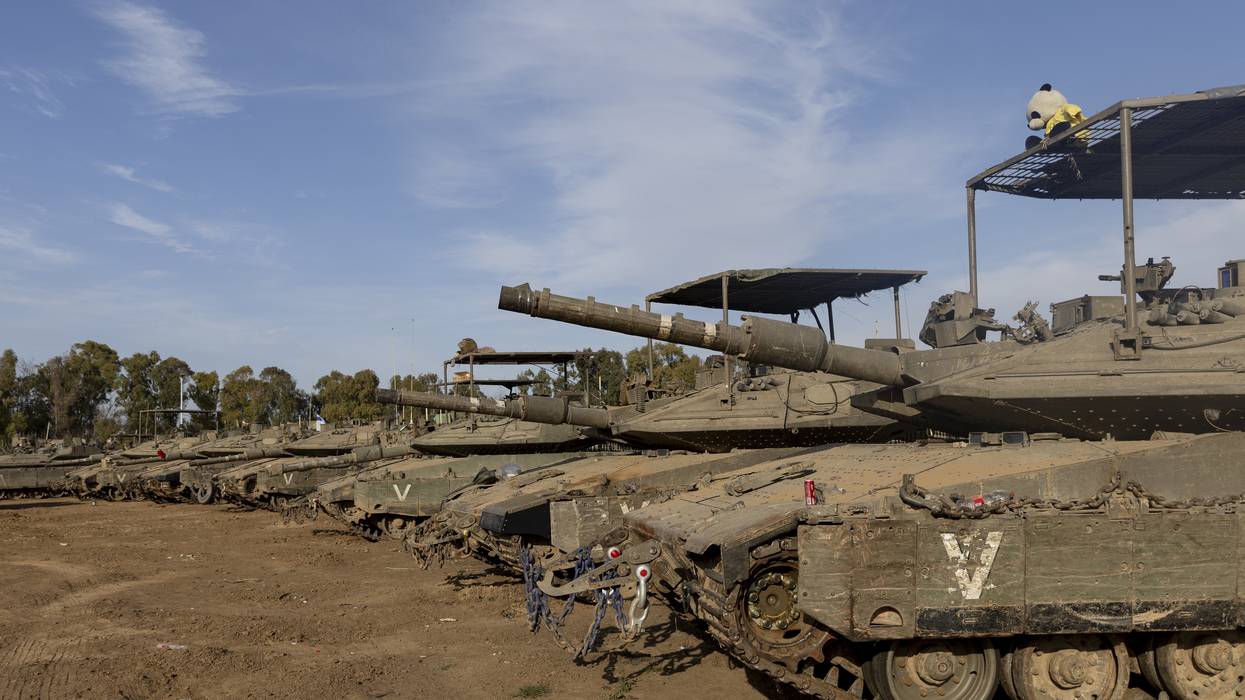
"The U.S. should not provide another nickel for Netanyahu's war machine," said Sen. Bernie Sanders.
U.S. Sen. Bernie Sanders said Tuesday that the Biden administration must follow Canada's government in halting arms exports to Israel, a call that came after humanitarian groups refuted the Israeli government's claim that its use of American weaponry in Gaza has been in line with international law.
Sanders (I-Vt.) said the Canadian Parliament was "absolutely right" to vote to stop weapons exports to Israel, whose military has killed more than 31,800 people in Gaza in less than six months—often using explosives, ammunition, and other equipment supplied by the U.S., Canada, Germany, and other countries.
"Given the humanitarian catastrophe in Gaza, including widespread and growing starvation, the U.S. should not provide another nickel for [Israeli Prime Minister Benjamin] Netanyahu's war machine," said Sanders.
Canadian lawmakers on Monday approved a nonbinding motion calling on the Liberal government of Prime Minister Justin Trudeau to "cease the further authorization and transfer of arms exports to Israel to ensure compliance with Canada's arms export regime."
Shortly following the vote, Canadian Foreign Affairs Minister Mélanie Joly told the Toronto Star that the government would stop exporting arms to Israel in line with the motion's demand. In the three months after the Hamas-led attack on October 7, Canada exported at least $28.5 million worth of military equipment to Israel, according to Global Affairs Canada.
"This is an important step," Canadians for Justice and Peace in the Middle East wrote in response to Joly, "but we need to make sure that Canada stops the transfer of all military exports, period, without any loopholes."
The U.S. is a far bigger weapons supplier for Israel than Canada. Since October 7, the Biden administration has approved more than 100 separate arms sales—collectively worth billions of dollars—to Israel even amid massive and growing evidence that the country's military is using American-made weapons to commit atrocities against civilians in Gaza.
In a new memo to the Biden administration, Oxfam and Human Rights Watch noted that Israeli forces "routinely" drop "2,000-pound bombs on densely populated areas in Gaza."
"According to The Washington Post," the memo states, "Israeli forces dropped over 22,000 U.S.-origin munitions on Gaza during the first 45 days of the hostilities. The United States has reportedly transferred at least 5,000 2,000-pound 'dumb bombs' to Israel since October 7."
Last week, prompted by a new Biden administration policy, Israel's defense minister reportedly provided the White House with a written assurance that "Israel will use U.S. weapons according to international law and allow U.S.-supported humanitarian aid into Gaza." Critics dismissed Israel's pledge as a "sick joke."
But at least one key Biden administration official appears satisfied. HuffPost's Akbar Shahid Ahmed reported that U.S. Ambassador to Israel Jacob Lew on Tuesday "privately endorsed Israel's claims it's abiding by U.S. law in using American weapons [and] sending aid to Gaza."
According to Ahmed, Lew's move alarmed U.S. officials who believe the Israeli government's claims are untrue.
"I used to advise the U.S. State Department on law of war assurances," Brian Finucane of the International Crisis Group wrote in response to Ahmed's reporting. "If Ambassador Lew buys these Israeli assurances, I have a bridge he'll also be interested in purchasing."

"While imperfect, this is a tangible victory on the road to a Canadian two-way arms embargo with Israel," said one advocacy group.
Canada's Parliament on Monday approved a nonbinding resolution calling on the government of Prime Minister Justin Trudeau to cut off the country's arms exports to Israel, demand an immediate cease-fire and the release of hostages, and support international legal efforts to hold perpetrators of war crimes accountable.
The measure, led by Canada's New Democratic Party (NDP), passed in a 204-to-117 vote after private negotiations between Trudeau's Liberal government and the NDP produced significant changes to the original text, including the removal of language calling for "sanctions on Israeli officials who incite genocide."
The final motion, which Conservatives opposed, calls on Trudeau's government to "cease the further authorization and transfer of arms exports to Israel to ensure compliance with Canada's arms export regime," "sanction extremist settlers from Canada," and "demand unimpeded humanitarian access to Gaza," among other steps.
"We are dismayed by the failure of Canada's Liberal government to stand up for what is right, for the rule of international law, for humanity, for peace," NDP MP Heather McPherson, the lead sponsor of the original motion, said in a speech ahead of Monday's vote. "Canadians are horrified by a brutal assault on Gaza where over 30,000 civilians have been killed, they were horrified on October 7 by the vile terrorist attack on innocent civilians in Israel by Hamas terrorists, and they are horrified now by the way [Israeli Prime Minister Benjamin] Netanyahu's extremist government has responded."
2/14
Today, the Liberals and Conservatives have an opportunity to join the NDP and uphold the values of Canadians – to show that Palestinian lives matter as much as any other lives. That Palestinian rights are human rights. And that children – all children - deserve peace. pic.twitter.com/RhtowYsEDp
— Heather McPherson (@HMcPhersonMP) March 18, 2024
Michael Bueckert, vice president of Canadians for Justice and Peace in the Middle East (CJPME), said in a statement that the amended measure does not "go nearly as far as we had hoped for, but it is nonetheless a small step forward for ending Canadian complicity in Israel's genocidal war in Gaza."
"The watering down of the NDP resolution weakens the significance of Parliament's vote, even if it was a major concession forced by the Liberal government to ensure its passage," Bueckert added. "With the passage of this motion, the government has effectively promised to adopt a clear policy to restrict exports, including for already-issued permits, not just a temporary pause on approvals. While imperfect, this is a tangible victory on the road to a Canadian two-way arms embargo with Israel. The NDP must not rest on its laurels and continue to fight Canada's relationship with the Israeli military-industrial complex."
Bueckert said Trudeau's government "must immediately implement the democratic will of Parliament by adopting these demands, and ignore the backlash from those who seek to vilify this motion, including the far-right Israeli government itself."
The motion's passage comes days after the Toronto Star reported that the Trudeau government "stopped approving exports of non-lethal military goods and technology to Israel two months ago amid deepening concerns about possible human rights violations."
"Since Jan. 8, applications for permits to allow Canadian companies to ship tens of millions of dollars worth of non-lethal goods and technology, such as night vision goggles, have been temporarily put on hold because of the difficulty in establishing whether the material could be used in human rights violations," the Star reported, citing unnamed senior government officials.
Data from Global Affairs Canada indicates that Canada exported at least $28.5 million worth of military equipment to Israel in the three months after October 7. A coalition of human rights groups noted in a letter last month to Canada's foreign affairs minister that Canada has exported more than $140 million worth of military goods to Israel over the past decade, "including military aerospace components as well as bombs, missiles, explosives, and associated parts."
"There is substantial concern that some of these weapons could be enabling Israel's operation in Gaza," the groups wrote. "In addition to direct exports, Canadian-produced technology has also been supplied to Israel by first being integrated into US-produced systems, including components incorporated into the F-35 Joint Strike Fighter, which Israel has used in its bombing campaign across Gaza."
United Nations experts have called for an immediate arms embargo on Israel, warning last month that "state officials involved in arms exports may be individually criminally liable for aiding and abetting any war crimes, crimes against humanity, or acts of genocide."
The National Council of Canadian Muslims said Monday that it is "pleased to see that a historic vote on the NDP motion on Palestine is likely going to result in historic change for Canada."
"While we recognize that some would have liked the original motion to stay fully together," the group added, "we believe that the NDP did the right thing by tabling the original motion and pushing to make sure that Canada voted in favor of Palestine today. That is history."
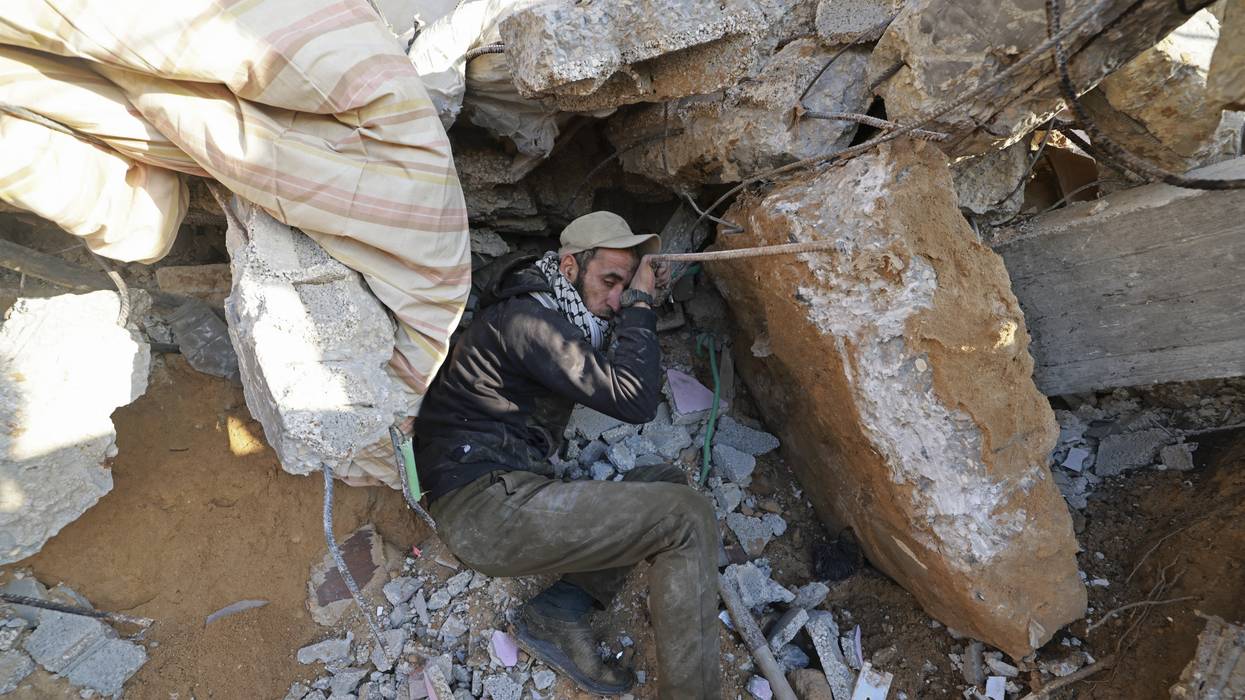
"State officials involved in arms exports may be individually criminally liable for aiding and abetting any war crimes, crimes against humanity, or acts of genocide."
Dozens of United Nations experts on Friday called for an immediate arms embargo on Israel and warned that countries and private companies still sending weapons to the Israeli military during its assault on Gaza could be complicit in crimes against humanity.
The experts—including special rapporteurs on education and the rights of displaced people—said in a joint statement that "any transfer of weapons or ammunition to Israel that would be used in Gaza is likely to violate international humanitarian law and must cease immediately."
"Such transfers are prohibited even if the exporting state does not intend the arms to be used in violation of the law—or does not know with certainty that they would be used in such a way—as long as there is a clear risk," they said. "State officials involved in arms exports may be individually criminally liable for aiding and abetting any war crimes, crimes against humanity, or acts of genocide."
The U.N. experts noted that the United States and Germany are "by far" Israel's largest arms suppliers, though France, the United Kingdom, Canada, and Australia also export weapons to the Israeli government, which the International Court of Justice (ICJ) ruled is plausibly committing genocide in the Gaza Strip.
The ICJ's interim ruling, which Israel has disregarded, has "heightened" the need for an arms embargo, the experts said, noting that compliance with the Genocide Convention of 1948 "requires states parties to employ all means reasonably available to them to prevent genocide in another state as far as possible."
The experts also said that "arms companies contributing to the production and transfer of arms to Israel and businesses investing in those companies bear their own responsibility to respect human rights, international humanitarian law and international criminal law."
"They have not publicly demonstrated the heightened human rights due diligence required of them and accordingly risk complicity in violations," they said.
"All states must not be complicit in international crimes through arms transfers. They must do their part to urgently end the unrelenting humanitarian catastrophe in Gaza."
The statement comes two weeks after a Dutch court ordered the Netherlands' government to stop exporting jet parts to Israel, citing the "clear risk" that the aircraft might be used to "commit serious violations of international humanitarian law." The government is appealing the ruling.
Other countries, including Italy and Spain, have said they have suspended arms sales to Israel since its latest assault on Gaza began—though a Spanish newspaper reported earlier this month that the country exported $1.1 million worth of ammunition to Israel in November.
The U.S., meanwhile, is reportedly planning to send additional weaponry to Israel and has refused to attach conditions to its arms exports even as top officials—including President Joe Biden—publicly voice concerns about the rising death toll in Gaza and Israel's looming ground invasion of Rafah, where more than half of the enclave's population is currently sheltering.
According to The Wall Street Journal, the latest proposed arms shipment "includes roughly a thousand each of MK-82 bombs, KMU-572 Joint Direct Attack Munitions that add precision guidance to bombs, and FMU-139 bomb fuses."
"The arms are estimated to be worth tens of millions of dollars," the Journal added. "The proposed delivery is still being reviewed internally by the administration, a U.S. official said, and the details of the proposal could change before the Biden administration notifies congressional committee leaders who would need to approve the transfer."
Israel has used U.S. weaponry to commit atrocities in the Gaza Strip, including airstrikes on homes full of children. An Amnesty International investigation released earlier this month found that a January 9 Israeli airstrike on a residential building in southern Gaza killed 18 civilians, including 10 children.
Based on ordnance fragments recovered from the rubble, the weapon used in the attack was identified as a GBU-39 Small Diameter Bomb—made by the U.S. company Boeing.
On Friday, Gaza's health ministry said that Israeli airstrikes killed more than 100 people over the past 24 hours and injured at least 160 more. Israeli strikes on the severely overcrowded city of Rafah on Thursday destroyed a mosque and several homes, killing or wounding many people and leaving others trapped under the rubble.
"International law does not enforce itself," the U.N. experts said Friday. "All states must not be complicit in international crimes through arms transfers. They must do their part to urgently end the unrelenting humanitarian catastrophe in Gaza."

"Surely it's time to stop all arm shipments to Israel," said one British lawmaker, "and implement targeted sanctions against members of the Israeli leadership."
While the White House has claimed U.S. President Joe Biden is growing increasingly "frustrated" with Israel's bombardment of Gaza—largely made possible by U.S. military aid—calls are growing in Europe for governments to halt arms exports to stop their own contributions to the mass killing.
After a Dutch court ordered the Netherlands to stop exporting F-35 fighter jet parts to Israel on Monday, ruling that the country was running a "clear risk" of helping Israel to violate international human rights law, several British lawmakers intensified their demands that the U.K. also halt arms exports.
"Selling arms to Israel for its war on Gaza is incompatible with U.K. and international law," said Diane Abbott, a Labour Party member in British Parliament. "[Prime Minister Rishi] Sunak should follow suit and ban weapon sales to Israel."
Natalie Bennett, a member of the Green Party in the British House of Lords, spoke on Tuesday about six-year-old Hind Rajab, whose body was found last week in a car in which her family members had tried to flee Gaza City. The car was riddled with bullet holes, and an ambulance nearby, which paramedics had sent to rescue Hind, had been bombed.
"Is the government challenging the Israeli government about risks to hundreds of thousands of children in Rafah, now in the path of the Israeli offensive?" said Bennett. "Surely it's time to stop all arm shipments to Israel... and implement targeted sanctions against members of the Israeli leadership."
The U.K. provides about 15% of the components of Israel's F-35 bombers—the Israeli Air Force's "flagship asset," according to the Royal United Services Institute—and has licensed more than $594 million in military exports to Israel since 2015.
While the U.S. Senate on Tuesday passed a $95 billion foreign aid bill, including $14.1 billion for Israel, some European governments are working to end their complicity in Israel's mass killing of at least 28,576 Palestinians so far in attacks that have also wounded at least 68,291 and left at least 17,000 children orphaned.
On February 6, the Walloon regional government in Belgium suspended two licenses for the export gunpowder to Israel, citing the International Court of Justice's (ICJ) interim ruling last month which found that Israel is "plausibly" committing a genocide in Gaza.
Italian Foreign Minister Antonio Tajani said in late January that the government had halted all arms sales to Israel in October, when Israel began its bombardment of Gaza in retaliation for a Hamas-led attack on October 7.
José Albares, Spain's foreign minister, also said last month that the Spanish government had done the same, but El Diario reported on Sunday that the country had actually exported $1.1 million in ammunition to Israel in November.
"The suspension of arms transfers to Israel must be comprehensive and permanent, and not just temporary," said Alberto Estévez, a spokesperson on weapons issues at Amnesty International Spain. "The Spanish government has wanted to be an example in this crisis in the face of other much more complicit governments, but it must be more forceful to promote a European arms embargo on Israel and Hamas and other Palestinian armed groups, in addition to pressuring the United States to stop the supply of arms to Israel and support the imposition of a global embargo on the U.N. Security Council."
On Wednesday, Spanish Prime Minister Pedro Sánchez joined Irish Prime Minister Leo Varadkar in writing to European Commission President Ursula von der Leyen and demanding an "urgent review" of Israel's compliance with human rights obligations under its trade deal with the European Union.
"Against the background of the risk of an even greater humanitarian catastrophe posed by the imminent threat of Israeli military operations in Rafah, and given what has occurred, and continues to occur in Gaza since October 2023, including widespread concern about possible breaches of international humanitarian law and international human rights laws by Israel, we ask that the Commission undertake an urgent review of whether Israel is complying with its obligations, including under the E.U./Israel Association Agreement, which makes respect for human rights and democratic principles an essential element of the relationship," wrote Sánchez and Varadkar.
The two leaders reiterated their call for an immediate humanitarian cease-fire, which was supported by a large majority of countries in a vote at the U.N. General Assembly in December, "including by 17 E.U. member states."
Varadkar and Sánchez also pointed to the ICJ's interim ruling in South Africa's case last month, in which the country accused Israel of genocidal violence against Palestinians.
The orders of the ICJ, which demanded that Israel ensure that humanitarian aid can reach Gaza residents and that its military is not committing acts of genocide, "are binding," the leaders reminded the European Union.

Praising the U.S. arms industry as the “arsenal of democracy” obscures the numerous ways it undermines our security and wastes our tax dollars.
The New York Times headline said it all: “Middle East War Adds to Surge in International Arms Sales.” The conflicts in Gaza, Ukraine, and beyond may be causing immense and unconscionable human suffering, but they are also boosting the bottom lines of the world’s arms manufacturers. There was a time when such weapons sales at least sparked talk of “the merchants of death” or of “war profiteers.” Now, however, is distinctly not that time, given the treatment of the industry by the mainstream media and the Washington establishment, as well as the nature of current conflicts. Mind you, the American arms industry already dominates the international market in a staggering fashion, controlling 45% of all such sales globally, a gap only likely to grow more extreme in the rush to further arm allies in Europe and the Middle East in the context of the ongoing wars in those regions.
In his nationally televised address about the Israel-Hamas and Russia-Ukraine wars, President Biden described the American arms industry in remarkably glowing terms, noting that, “just as in World War II, today patriotic American workers are building the arsenal of democracy and serving the cause of freedom.” From a political and messaging perspective, the president cleverly focused on the workers involved in producing such weaponry rather than the giant corporations that profit from arming Israel, Ukraine, and other nations at war. But profit they do and, even more strikingly, much of the revenues that flow to those firms is pocketed as staggering executive salaries and stock buybacks that only boost shareholder earnings further.
Rather than romanticizing the military-industrial complex, isn’t it time to place it under greater democratic control?
President Biden also used that speech as an opportunity to tout the benefits of military aid and weapons sales to the U.S. economy:
“We send Ukraine equipment sitting in our stockpiles. And when we use the money allocated by Congress, we use it to replenish our own stores, our own stockpiles, with new equipment. Equipment that defends America and is made in America. Patriot missiles for air defense batteries, made in Arizona. Artillery shells manufactured in 12 states across the country, in Pennsylvania, Ohio, Texas. And so much more.”
In short, the military-industrial complex is riding high, with revenues pouring in and accolades emanating from the top political levels in Washington. But is it, in fact, an arsenal of democracy? Or is it an amoral enterprise, willing to sell to any nation, whether a democracy, an autocracy, or anything in between?
Arming Current Conflicts
The U.S. should certainly provide Ukraine with what it needs to defend itself from Russia’s invasion. Sending arms alone, however, without an accompanying diplomatic strategy is a recipe for an endless, grinding war (and endless profits for those arms makers) that could always escalate into a far more direct and devastating conflict between the U.S., NATO, and Russia. Nevertheless, given the current urgent need to keep supplying Ukraine, the sources of the relevant weapons systems are bound to be corporate giants like Raytheon and Lockheed Martin. No surprise there, but keep in mind that they’re not doing any of this out of charity.
Raytheon CEO Gregory Hayes acknowledged as much, however modestly, in an interview with the Harvard Business Review early in the Ukraine War:
“[W]e don’t apologize for making these systems, making these weapons… the fact is eventually we will see some benefit in the business over time. Everything that’s being shipped into Ukraine today, of course, is coming out of stockpiles, either at DoD [the Department of Defense] or from our NATO allies, and that’s all great news. Eventually we’ll have to replenish it and we will see a benefit to the business over the next coming years.”
Hayes made a similar point recently in response to a question from a researcher at Morgan Stanley on a call with Wall Street analysts. The researcher noted that President Biden’s proposed multi-billion-dollar package of military aid for Israel and Ukraine “seems to fit quite nicely with Raytheon’s defense portfolio.” Hayes responded that “across the entire Raytheon portfolio you’re going to see a benefit of this restocking on top of what we think will be an increase in the DoD topline as we continue to replenish these stocks.” Supplying Ukraine alone, he suggested, would yield billions in revenues over the coming few years with profit margins of 10% to 12%.
Beyond such direct profits, there’s a larger issue here: the way this country’s arms lobby is using the war to argue for a variety of favorable actions that go well beyond anything needed to support Ukraine. Those include less restrictive, multi-year contracts; reductions in protections against price gouging; faster approval of foreign sales; and the construction of new weapons plants. And keep in mind that all of this is happening as a soaring Pentagon budget threatens to hit an astonishing $1 trillion within the next few years.
As for arming Israel, including $14 billion in emergency military aid recently proposed by President Biden, the horrific attacks perpetrated by Hamas simply don’t justify the all-out war President Benjamin Netanyahu’s government has launched against more than two million inhabitants of the Gaza Strip, with so many thousands of lives already lost and untold additional casualties to come. That devastating approach to Gaza in no way fits the category of defending democracy, which means that weapons companies profiting from it will be complicit in the unfolding humanitarian catastrophe.
Repression Enabled, Democracy Denied
Over the years, far from being a reliable arsenal of democracy, American arms manufacturers have often helped undermine democracy globally, while enabling ever greater repression and conflict — a fact largely ignored in recent mainstream coverage of the industry. For example, in a 2022 report for the Quincy Institute, I noted that, of the 46 then-active conflicts globally, 34 involved one or more parties armed by the United States. In some cases, American arms supplies were modest, but in many other conflicts such weaponry was central to the military capabilities of one or more of the warring parties
Nor do such weapons sales promote democracy over autocracy, a watchword of the Biden administration’s approach to foreign policy. In 2021, the most recent year for which full statistics are available, the U.S. armed 31 nations that Freedom House, a non-profit that tracks global trends in democracy, political freedom, and human rights, designated as “not free.”
The most egregious recent example in which the American arms industry is distinctly culpable when it comes to staggering numbers of civilian deaths would be the Saudi Arabian/United Arab Emirates (UAE)-led coalition’s intervention in Yemen, which began in March 2015 and has yet to truly end. Although the active military part of the conflict is now in relative abeyance, a partial blockade of that country continues to cause needless suffering for millions of Yemenis. Between bombing, fighting on the ground, and the impact of that blockade, there have been nearly 400,000 casualties. Saudi air strikes, using American-produced planes and weaponry, caused the bulk of civilian deaths from direct military action.
Congress did make unprecedented efforts to block specific arms sales to Saudi Arabia and rein in the American role in the conflict via a War Powers Resolution, only to see legislation vetoed by President Donald Trump. Meanwhile, bombs provided by Raytheon and Lockheed Martin were routinely used to target civilians, destroying residential neighborhoods, factories, hospitals, a wedding, and even a school bus.
When questioned about whether they feel any responsibility for how their weapons have been used, arms companies generally pose as passive bystanders, arguing that all they’re doing is following policies made in Washington. At the height of the Yemen war, Amnesty International asked firms that were supplying military equipment and services to the Saudi/UAE coalition whether they were ensuring that their weaponry wouldn’t be used for egregious human rights abuses. Lockheed Martin typically offered a robotic response, asserting that “defense exports are regulated by the U.S. government and approved by both the Executive Branch and Congress to ensure that they support U.S. national security and foreign policy objectives.” Raytheon simply stated that its sales “of precision-guided munitions to Saudi Arabia have been and remain in compliance with U.S. law.”
How the Arms Industry Shapes Policy
Of course, weapons firms are not merely subject to U.S. laws, but actively seek to shape them, including exerting considerable effort to block legislative efforts to limit arms sales. Raytheon typically put major behind-the-scenes effort into keeping a significant sale of precision-guided bombs to Saudi Arabia on track. In May 2018, then-CEO Thomas Kennedy even personally visited the office of Senate Foreign Relations Committee chair Robert Menendez (D-NJ) to (unsuccessfully) press him to drop a hold on that deal. That firm also cultivated close ties with the Trump administration, including presidential trade adviser Peter Navarro, to ensure its support for continuing sales to the Saudi regime even after the murder of prominent Saudi journalist and U.S. resident Jamal Khashoggi.
The list of major human rights abusers that receive U.S.-supplied weaponry is long and includes (but isn’t faintly limited to) Saudi Arabia, the UAE, Bahrain, Egypt, Turkey, Nigeria, and the Philippines. Such sales can have devastating human consequences. They also support regimes that all too often destabilize their regions and risk embroiling the United States directly in conflicts.
U.S.-supplied arms also far too regularly fall into the hands of Washington’s adversaries. As an example consider the way the UAE transferred small arms and armored vehicles produced by American weapons makers to extremist militias in Yemen, with no apparent consequences, even though such acts clearly violated American arms export laws. Sometimes, recipients of such weaponry even end up fighting each other, as when Turkey used U.S.-supplied F-16s in 2019 to bomb U.S.-backed Syrian forces involved in the fight against Islamic State terrorists.
Such examples underscore the need to scrutinize U.S. arms exports far more carefully. Instead, the arms industry has promoted an increasingly “streamlined” process of approval of such weapons sales, campaigning for numerous measures that would make it even easier to arm foreign regimes regardless of their human-rights records or support for the interests Washington theoretically promotes. These have included an “Export Control Reform Initiative” heavily promoted by the industry during the Obama and Trump administrations that ended up ensuring a further relaxation of scrutiny over firearms exports. It has, in fact, eased the way for sales that, in the future, could put U.S.-produced weaponry in the hands of tyrants, terrorists, and criminal organizations.
Now, the industry is promoting efforts to get weapons out the door ever more quickly through “reforms” to the Foreign Military Sales program in which the Pentagon essentially serves as an arms broker between those weapons corporations and foreign governments.
Reining in the MIC
The impetus to move ever more quickly on arms exports and so further supersize this country’s already staggering weapons manufacturing base will only lead to yet more price gouging by arms corporations. It should be a government imperative to guard against such a future, rather than fuel it. Alleged security concerns, whether in Ukraine, Israel, or elsewhere, shouldn’t stand in the way of vigorous congressional oversight. Even at the height of World War II, a time of daunting challenges to American security, then-Senator Harry Truman established a committee to root out war profiteering.
Yes, your tax dollars are being squandered in the rush to build and sell ever more weaponry abroad. Worse yet, for every arms transfer that serves a legitimate defensive purpose, there is another — not to say others — that fuels conflict and repression, while only increasing the risk that, as the giant weapons corporations and their executives make fortunes, this country will become embroiled in more costly foreign conflicts.
One possible way to at least slow that rush to sell would be to “flip the script” on how Congress reviews weapons exports. Current law requires a veto-proof majority of both houses of Congress to block a questionable sale. That standard — perhaps you won’t be surprised to learn — has never (yes, never!) been met, thanks to the millions of dollars in annual election financial support that the weapons companies offer our congressional representatives. Flipping the script would mean requiring affirmative congressional approval of any major sales to key nations, greatly increasing the chances of stopping dangerous deals before they reach completion.
Praising the U.S. arms industry as the “arsenal of democracy” obscures the numerous ways it undermines our security and wastes our tax dollars. Rather than romanticizing the military-industrial complex, isn’t it time to place it under greater democratic control? After all, so many lives depend on it.

"While accountability is critical to democracy, a democratic system of government alone is insufficient to fend off impunity."
The United States' contributions to the climate crisis and its perpetuation of violence, particularly abroad, resulted in a score on a newly launched "Atlas of Impunity" that placed the country well below other wealthy nations in terms of the government's willingness to be accountable for its impact both on U.S. residents and the global community.
Spearheaded by former U.K. Foreign Secretary David Miliband, the inaugural Atlas of Impunity was released Friday, the result of a collaboration between the Eurasia Group and the Chicago Council on Foreign Relations.
The groups ranked 163 countries from across the globe, scoring their level of impunity based on five factors: conflict and violence, both within the countries and perpetrated against other nations; environmental degradation; unaccountable governance; economic exploitation; and abuse of human rights.
Miliband, now the president and CEO of the International Rescue Committee, called the ranking of the U.S. at 118 "one of the major takeaways" of the index.
The countries were ranked on a scale of 0-5, with Afghanistan given the highest score for impunity at 5.00. Finland was ranked the most accountable nation, with a score of 0.29.
With a score of 1.91, the U.S. was ranked five places higher than Hungary, where President Viktor Orbán's far-right government has been denounced as autocratic.
The U.S. was found to act with the most impunity in the area of environmental degradation, scoring a 3.02 in that category. The U.S. is biggest historical emitter of greenhouse gases, but President Joe Biden's administration continues to approve fossil fuel extraction projects that are contributing to planetary heating and polluting communities.
"Impunity is the growing instinct of choice in the global order. It represents a dangerous world view that laws and norms are for suckers."
The country's "conflict and violence" score of 2.62 also contributed to its high cumulative score.
"The country's arms exports are an even bigger negative factor" than the economic inequality, racial injustice, and restrictions that Republican policymakers use to cut off democratic access, the report stated.
The U.S. is the world's largest arms exporter and has helped fuel the ongoing humanitarian crises in Yemen and the occupied Palestinian territories by supplying weapons to Saudi Arabia and Israel, respectively.
The country's impunity score was also driven up by "a small number of ratified human rights treaties" and "its history of racial discrimination, particularly against Black Americans." The authors noted that it performed well below other wealthy countries in terms of its efforts to ensure Americans are given equal economic opportunities:
While the U.S. performs well on most measures of economic exploitation, there is a higher degree of class inequality compared to similarly ranked countries. This likely stems from a long history of strike-breaking and union-busting that has undermined the power of organized labor. Individuals and corporate entities—both companies and labor unions—have a constitutionally protected right to petition the government, creating a robust lobbying landscape that allows the two major political parties to be very responsive to narrow interest group needs. This has contributed to low levels of taxation of capital income, a tax system with high levels of compliance but inconsistent enforcement, and a national minimum wage that has not risen with inflation.
"Impunity is the growing instinct of choice in the global order," said Miliband in a statement. "It represents a dangerous world view that laws and norms are for suckers."
Miliband noted in a New York Times op-ed on Friday that the Atlas illustrates how countries that are recognized as democracies are not immune from acting without accountability.
"While the fight for democracy is real, dividing the world into democracies and autocracies does not capture key aspects of the global power balance," he wrote. "While accountability is critical to democracy, a democratic system of government alone is insufficient to fend off impunity. Several democratic countries, including the United States, underperform against the highest standards to which they are committed on measures of human rights and conflict and violence."
"The most powerful countries in the international system are part of the problem," he added. "China and Russia both score among the 50 worst ranking countries on impunity. The United States performs much better, but still scores worse than economic and Global North peers. There is a quantitative evidence in our project for the adage that power corrupts and absolute power corrupts absolutely."
According to a report released this week by the Stockholm International Peace Research Institute (SIPRI), arms deliveries to Saudi Arabia have increased by an astonishing 279% between 2011 and 2015, compared with the prior five-year period. Over three-quarters of the weaponry came from the U.S. and the United Kingdom.
"Common sense and simple justice demand that the United States and its European allies acknowledge the disastrous results of pumping up an increasingly aggressive Saudi regime."
There was a time when sales to the Saudis were more about money and politics than fighting conflicts. Multi-billion dollar sales from the Nixon administration onward were seen as a way to bolster U.S. weapons contractors and "recycle petrodollars"--earn back some of the funds that flowed out of the U.S. to purchase Saudi oil. It didn't hurt that Saudi officials frequently skimmed off funds for their use as part of these mega-deals.
Until recently, the military relevance of sending weapons to Saudi Arabia had less to do with the Saudis using U.S.-supplied arms than it did with cementing ties with Washington. The implicit understanding was that the purchase of large quantities of U.S. armaments was a form of payback for Washington's commitment to come to the rescue of the Saudi regime in a crisis.
Ronald Reagan expressed this policy most openly in the wake of the Iranian revolution when he said, "Saudi Arabia . . . we will not allow to become another Iran." Reagan backed up his words with action when he pushed a controversial deal for AWACS radar planes through the Senate by a narrow margin as part of an effort to make it easier for the United States to come to the Saudis' aid in the event of a war. The deal made it easier for the Saudis to help coordinate U.S. air strikes in the region. However, as Scott Armstrong of The Washington Post pointed out at the time, it also involved an extensive buildup of Saudi military and communications facilities that would make it easier for U.S. forces to use the kingdom as a base for intervention in the region.
The Conflict in Yemen
The idea that the Saudis were unlikely to use their U.S.-supplied arms went out the window with the 2015 intervention in Yemen. The Saudis are the key players in a coalition that has caused thousands of civilian casualties while bombing everything from hospitals and markets to water supply systems. Coupled with a naval blockade that has made it extremely difficult to get food and medicine into the country, the Saudi intervention has caused a humanitarian catastrophe in Yemen. Amnesty International and Human Rights Watch have described the use of U.S.-supplied cluster bombs in civilian neighborhoods by the Saudi coalition as possible war crimes.
The Saudis' stated rationale for intervening in Yemen has been to block Iranian influence. This is a weak argument, however, given that the Houthi rebels that the Saudis are intervening against have longstanding grievances that have nothing to do with Iran. Moreover, Iranian involvement has been modest relative to Saudi Arabia's military overkill.
Last but not least, the Saudi-Houthi struggle has left al-Qaeda in the Arabian Peninsula and the Islamic State relatively unscathed, freeing these groups up to expand their presence in Yemen.
The Yemen case puts the lie to Washington's claim that sales to Saudi Arabia help "promote stability" in the region. Although the Obama administration has called for diplomacy and restraint, these words ring hollow, given the centrality of U.S. arms and logistical support to the Saudi military campaign.
Upsurge in Arms Exports
If anything, U.S. policy has firmly favored a more militarized Saudi policy. As a fact sheet by the Security Assistance Monitor documents, U.S. arms deliveries to Saudi Arabia have increased by 96% compared to the Bush years. The Monitor also notes that in 2014 alone, more than 2,500 Saudi military personnel received training in the United States.
Given its behavior in Yemen, the last thing the region needs is a more active military role in the region on the part of the Saudis and their allies in the Gulf Cooperation Council. But that's just what the Saudis have pledged to do. In December, the Saudis announced the formation of a 34-nation anti-terror coalition, and earlier this month, there was a 20-nation military exercise in the kingdom that the official Saudi news agency dubbed "the largest in the region's history."
How much of this newfound assertiveness is bluff remains to be seen. A number of the partners in the 34-nation coalition said they had never discussed the issue with the Saudis. Getting that many countries to operate in a coordinated fashion would be no small feat. But, in addition to its recent dispatch of military aircraft to Turkey for possible use in air strikes in Syria, the Saudi leadership is seeking to make its country a regional military power.
Given its current behavior, all of the above brings us back to whether it makes sense to arm Saudi Arabia. Last year, Oxfam America led an unsuccessful effort to block a $1.29 billion offer of U.S. bombs and missiles to the kingdom. Oxfam has continued its work by pressing the Obama administration to call for an immediate ceasefire in Yemen and a negotiated settlement. But the issue is unlikely to go away. And several members of Congress have begun to raise questions about how U.S. weapons are being used in Yemen.
Activists in Europe have also spoken out against arming the Saudi regime. In January, the London-based Campaign Against the Arms Trade threatened to sue the UK government if it didn't suspend existing and future licenses to sell arms to Saudi Arabia until it investigated whether the regime's use of UK weapons in Yemen violated international humanitarian law and British government policy. And on February 25, the European Parliament called for an arms embargo on Saudi Arabia over its bombing campaign and blockade of Yemen.
Common sense and simple justice demand that the United States and its European allies acknowledge the disastrous results of pumping up an increasingly aggressive Saudi regime. The next step is to stop arming it. The sooner this happens, the better it will be for the region's security.