5
#000000
#FFFFFF
To donate by check, phone, or other method, see our More Ways to Give page.
Daily news & progressive opinion—funded by the people, not the corporations—delivered straight to your inbox.
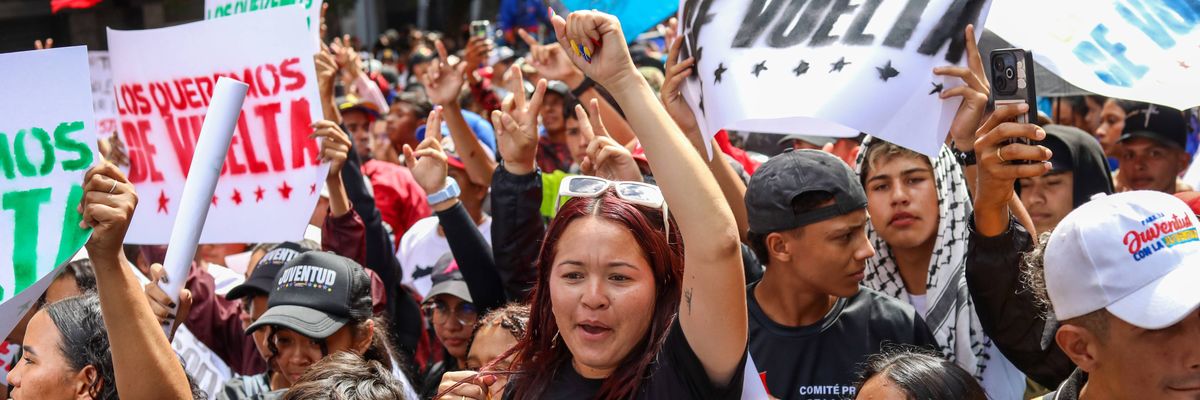
Supporters of Venezuelan President Nicolas Maduro and his wife, Cilia Flores, gather during a demonstration, expressing solidarity with the government, in Caracas, Venezuela, on January 8, 2026.
The question is not whether a particular president’s motives are sincere, nor whether a foreign government is flawed. The question is whether the United States will remain governed by law―or by precedent accumulated through silence.
The recent Senate debate over U.S. military action in Venezuela exposes a fundamental rupture in American constitutional governance: who has the authority to initiate war. The Constitution answers that question plainly. Yet modern practice―and the arguments advanced in defense of it―have drifted dangerously far from that design. Alongside this constitutional crisis stands a second, inseparable issue: whether the United States may lawfully claim control over the natural resources of another sovereign nation, specifically Venezuela’s oil, under the threat of force.
These questions are not abstract. They determine whether the United States remains governed by law or by precedent accumulated through executive action and congressional silence.
At the center of the debate are two sharply opposed views articulated on the Senate floor. One asserts that the President, as Commander in Chief, may unilaterally use military force whenever he deems it necessary to advance national interests, with Congress relegated to the limited roles of funding restriction or impeachment after the fact. The other insists that the power to initiate war belongs exclusively to Congress, not as a technicality, but as a deliberate constitutional safeguard against impulsive, personalized, or imperial war-making.
Constitutional design and deliberate restraint lie at the heart of the Framers’ intent. Article I of the Constitution vests in Congress―not the President―the power to declare war. Article II assigns the President the authority to command the armed forces once war is authorized and to repel sudden attacks. This division was not accidental. It reflected deep skepticism, shared across the Founding generation, that executives are structurally inclined toward war. James Madison warned that the executive branch is “most prone to it,” driven by secrecy, ambition, and the temptation of unilateral action.
Bombing a foreign capital, removing a sitting head of state, and threatening prolonged military occupation are acts of war by any ordinary, historical, or legal definition. The Constitution does not permit semantic evasions to substitute for authorization.
The Framers, therefore, made war intentionally difficult to launch. They placed the decision in a deliberative body accountable to the people, requiring public debate, recorded votes, and political responsibility. That Congress has too often failed to exercise this duty does not diminish the Constitution’s command. Repeated violations do not convert usurpation into legality. Historical drift explains how power migrated; it does not justify why it should remain there.
Attempts to rebrand large-scale military operations as “law enforcement,” “arrest warrants,” or “limited actions” do not change their substance. Bombing a foreign capital, removing a sitting head of state, and threatening prolonged military occupation are acts of war by any ordinary, historical, or legal definition. The Constitution does not permit semantic evasions to substitute for authorization.
The War Powers Resolution―and the myth of congressional overreach is often invoked as the supposed villain. Critics claim that the 1973 War Powers Resolution is unconstitutional because it allegedly transforms Congress into “535 commanders-in-chief.” This argument inverts constitutional logic. The Resolution does not empower Congress to command troops; it reasserts Congress’s authority to decide whether hostilities initiated by the executive may lawfully continue. It exists precisely because Congress had been sidelined, not because it had seized power.
The statute’s reporting requirements and time limits are accountability mechanisms, not vetoes of military command. Congress’s true failure has not been excessive interference but persistent abdication―avoiding the political responsibility of authorizing war while permitting presidents to act first and justify later. That abdication corrodes checks and balances and transfers the gravest decision a democracy can make into the hands of one person.
Sovereignty, coercion, and Venezuela’s oil bring the constitutional crisis into sharp international focus. The claim that the United States may seize, sell, or administer Venezuelan oil for “mutual benefit” or reconstruction collapses under legal scrutiny. As reaffirmed by the United Nations Secretary-General, Venezuela’s oil belongs to the Venezuelan people. This is not rhetoric; it is a cornerstone principle of international law grounded in state sovereignty and permanent sovereignty over natural resources.
Any alleged “agreement” cited by the Trump administration with a Venezuelan interim authority cannot be credibly described as a genuine agreement at all. Consent extracted under duress is not consent. When a population faces a clear and present threat of escalating military force―further ground operations, hundreds more civilian deaths, and a highly probable invasion―what follows is not agreement but coerced acquiescence. Allowing foreign control of national resources under the shadow of overwhelming military power is not voluntary cooperation; it is survival under threat.
The decision to go to war is not merely strategic. It is moral, constitutional, and irrevocable.
International law does not recognize resource transfers imposed by force or intimidation as legitimate. To do so would resurrect a doctrine of conquest the modern international order was built to reject. If oil may be seized in Venezuela today because military pressure makes resistance impossible, it may be seized anywhere tomorrow by any power willing to invoke its own version of “national interest.”
Such actions erode not only international norms but the United States’ own legal and moral standing. They convert foreign policy from diplomacy into extraction and military power from defense into appropriation.
Democratic accountability and the cost of war demand a return to constitutional first principles. The decision to go to war is not merely strategic. It is moral, constitutional, and irrevocable. It places citizens in harm’s way, reshapes international relations, and unleashes consequences that last generations. That is precisely why the Constitution assigns the initiation of war to Congress.
Congressional authorization does not weaken national security; it strengthens it by conferring legitimacy, public consent, and strategic clarity. History shows that when the United States has truly been attacked, Congress has acted swiftly and decisively. What the Framers sought to prevent was not defense, but adventurism―wars launched without deliberation, accountability, or consent.
Allowing one individual to initiate war, seize foreign leaders, and appropriate another nation’s resources without congressional approval collapses the separation of powers and invites abuse. It replaces law with discretion, deliberation with impulse, and sovereignty with force.
In the end, the question is not whether a particular president’s motives are sincere, nor whether a foreign government is flawed. The question is whether the United States will remain governed by law―or by precedent accumulated through silence. On that question, the Constitution is unambiguous.
War begins with Congress.
And Venezuela’s oil belongs to Venezuelans.
Dear Common Dreams reader, The U.S. is on a fast track to authoritarianism like nothing I've ever seen. Meanwhile, corporate news outlets are utterly capitulating to Trump, twisting their coverage to avoid drawing his ire while lining up to stuff cash in his pockets. That's why I believe that Common Dreams is doing the best and most consequential reporting that we've ever done. Our small but mighty team is a progressive reporting powerhouse, covering the news every day that the corporate media never will. Our mission has always been simple: To inform. To inspire. And to ignite change for the common good. Now here's the key piece that I want all our readers to understand: None of this would be possible without your financial support. That's not just some fundraising cliche. It's the absolute and literal truth. We don't accept corporate advertising and never will. We don't have a paywall because we don't think people should be blocked from critical news based on their ability to pay. Everything we do is funded by the donations of readers like you. Will you donate now to help power the nonprofit, independent reporting of Common Dreams? Thank you for being a vital member of our community. Together, we can keep independent journalism alive when it’s needed most. - Craig Brown, Co-founder |
The recent Senate debate over U.S. military action in Venezuela exposes a fundamental rupture in American constitutional governance: who has the authority to initiate war. The Constitution answers that question plainly. Yet modern practice―and the arguments advanced in defense of it―have drifted dangerously far from that design. Alongside this constitutional crisis stands a second, inseparable issue: whether the United States may lawfully claim control over the natural resources of another sovereign nation, specifically Venezuela’s oil, under the threat of force.
These questions are not abstract. They determine whether the United States remains governed by law or by precedent accumulated through executive action and congressional silence.
At the center of the debate are two sharply opposed views articulated on the Senate floor. One asserts that the President, as Commander in Chief, may unilaterally use military force whenever he deems it necessary to advance national interests, with Congress relegated to the limited roles of funding restriction or impeachment after the fact. The other insists that the power to initiate war belongs exclusively to Congress, not as a technicality, but as a deliberate constitutional safeguard against impulsive, personalized, or imperial war-making.
Constitutional design and deliberate restraint lie at the heart of the Framers’ intent. Article I of the Constitution vests in Congress―not the President―the power to declare war. Article II assigns the President the authority to command the armed forces once war is authorized and to repel sudden attacks. This division was not accidental. It reflected deep skepticism, shared across the Founding generation, that executives are structurally inclined toward war. James Madison warned that the executive branch is “most prone to it,” driven by secrecy, ambition, and the temptation of unilateral action.
Bombing a foreign capital, removing a sitting head of state, and threatening prolonged military occupation are acts of war by any ordinary, historical, or legal definition. The Constitution does not permit semantic evasions to substitute for authorization.
The Framers, therefore, made war intentionally difficult to launch. They placed the decision in a deliberative body accountable to the people, requiring public debate, recorded votes, and political responsibility. That Congress has too often failed to exercise this duty does not diminish the Constitution’s command. Repeated violations do not convert usurpation into legality. Historical drift explains how power migrated; it does not justify why it should remain there.
Attempts to rebrand large-scale military operations as “law enforcement,” “arrest warrants,” or “limited actions” do not change their substance. Bombing a foreign capital, removing a sitting head of state, and threatening prolonged military occupation are acts of war by any ordinary, historical, or legal definition. The Constitution does not permit semantic evasions to substitute for authorization.
The War Powers Resolution―and the myth of congressional overreach is often invoked as the supposed villain. Critics claim that the 1973 War Powers Resolution is unconstitutional because it allegedly transforms Congress into “535 commanders-in-chief.” This argument inverts constitutional logic. The Resolution does not empower Congress to command troops; it reasserts Congress’s authority to decide whether hostilities initiated by the executive may lawfully continue. It exists precisely because Congress had been sidelined, not because it had seized power.
The statute’s reporting requirements and time limits are accountability mechanisms, not vetoes of military command. Congress’s true failure has not been excessive interference but persistent abdication―avoiding the political responsibility of authorizing war while permitting presidents to act first and justify later. That abdication corrodes checks and balances and transfers the gravest decision a democracy can make into the hands of one person.
Sovereignty, coercion, and Venezuela’s oil bring the constitutional crisis into sharp international focus. The claim that the United States may seize, sell, or administer Venezuelan oil for “mutual benefit” or reconstruction collapses under legal scrutiny. As reaffirmed by the United Nations Secretary-General, Venezuela’s oil belongs to the Venezuelan people. This is not rhetoric; it is a cornerstone principle of international law grounded in state sovereignty and permanent sovereignty over natural resources.
Any alleged “agreement” cited by the Trump administration with a Venezuelan interim authority cannot be credibly described as a genuine agreement at all. Consent extracted under duress is not consent. When a population faces a clear and present threat of escalating military force―further ground operations, hundreds more civilian deaths, and a highly probable invasion―what follows is not agreement but coerced acquiescence. Allowing foreign control of national resources under the shadow of overwhelming military power is not voluntary cooperation; it is survival under threat.
The decision to go to war is not merely strategic. It is moral, constitutional, and irrevocable.
International law does not recognize resource transfers imposed by force or intimidation as legitimate. To do so would resurrect a doctrine of conquest the modern international order was built to reject. If oil may be seized in Venezuela today because military pressure makes resistance impossible, it may be seized anywhere tomorrow by any power willing to invoke its own version of “national interest.”
Such actions erode not only international norms but the United States’ own legal and moral standing. They convert foreign policy from diplomacy into extraction and military power from defense into appropriation.
Democratic accountability and the cost of war demand a return to constitutional first principles. The decision to go to war is not merely strategic. It is moral, constitutional, and irrevocable. It places citizens in harm’s way, reshapes international relations, and unleashes consequences that last generations. That is precisely why the Constitution assigns the initiation of war to Congress.
Congressional authorization does not weaken national security; it strengthens it by conferring legitimacy, public consent, and strategic clarity. History shows that when the United States has truly been attacked, Congress has acted swiftly and decisively. What the Framers sought to prevent was not defense, but adventurism―wars launched without deliberation, accountability, or consent.
Allowing one individual to initiate war, seize foreign leaders, and appropriate another nation’s resources without congressional approval collapses the separation of powers and invites abuse. It replaces law with discretion, deliberation with impulse, and sovereignty with force.
In the end, the question is not whether a particular president’s motives are sincere, nor whether a foreign government is flawed. The question is whether the United States will remain governed by law―or by precedent accumulated through silence. On that question, the Constitution is unambiguous.
War begins with Congress.
And Venezuela’s oil belongs to Venezuelans.
The recent Senate debate over U.S. military action in Venezuela exposes a fundamental rupture in American constitutional governance: who has the authority to initiate war. The Constitution answers that question plainly. Yet modern practice―and the arguments advanced in defense of it―have drifted dangerously far from that design. Alongside this constitutional crisis stands a second, inseparable issue: whether the United States may lawfully claim control over the natural resources of another sovereign nation, specifically Venezuela’s oil, under the threat of force.
These questions are not abstract. They determine whether the United States remains governed by law or by precedent accumulated through executive action and congressional silence.
At the center of the debate are two sharply opposed views articulated on the Senate floor. One asserts that the President, as Commander in Chief, may unilaterally use military force whenever he deems it necessary to advance national interests, with Congress relegated to the limited roles of funding restriction or impeachment after the fact. The other insists that the power to initiate war belongs exclusively to Congress, not as a technicality, but as a deliberate constitutional safeguard against impulsive, personalized, or imperial war-making.
Constitutional design and deliberate restraint lie at the heart of the Framers’ intent. Article I of the Constitution vests in Congress―not the President―the power to declare war. Article II assigns the President the authority to command the armed forces once war is authorized and to repel sudden attacks. This division was not accidental. It reflected deep skepticism, shared across the Founding generation, that executives are structurally inclined toward war. James Madison warned that the executive branch is “most prone to it,” driven by secrecy, ambition, and the temptation of unilateral action.
Bombing a foreign capital, removing a sitting head of state, and threatening prolonged military occupation are acts of war by any ordinary, historical, or legal definition. The Constitution does not permit semantic evasions to substitute for authorization.
The Framers, therefore, made war intentionally difficult to launch. They placed the decision in a deliberative body accountable to the people, requiring public debate, recorded votes, and political responsibility. That Congress has too often failed to exercise this duty does not diminish the Constitution’s command. Repeated violations do not convert usurpation into legality. Historical drift explains how power migrated; it does not justify why it should remain there.
Attempts to rebrand large-scale military operations as “law enforcement,” “arrest warrants,” or “limited actions” do not change their substance. Bombing a foreign capital, removing a sitting head of state, and threatening prolonged military occupation are acts of war by any ordinary, historical, or legal definition. The Constitution does not permit semantic evasions to substitute for authorization.
The War Powers Resolution―and the myth of congressional overreach is often invoked as the supposed villain. Critics claim that the 1973 War Powers Resolution is unconstitutional because it allegedly transforms Congress into “535 commanders-in-chief.” This argument inverts constitutional logic. The Resolution does not empower Congress to command troops; it reasserts Congress’s authority to decide whether hostilities initiated by the executive may lawfully continue. It exists precisely because Congress had been sidelined, not because it had seized power.
The statute’s reporting requirements and time limits are accountability mechanisms, not vetoes of military command. Congress’s true failure has not been excessive interference but persistent abdication―avoiding the political responsibility of authorizing war while permitting presidents to act first and justify later. That abdication corrodes checks and balances and transfers the gravest decision a democracy can make into the hands of one person.
Sovereignty, coercion, and Venezuela’s oil bring the constitutional crisis into sharp international focus. The claim that the United States may seize, sell, or administer Venezuelan oil for “mutual benefit” or reconstruction collapses under legal scrutiny. As reaffirmed by the United Nations Secretary-General, Venezuela’s oil belongs to the Venezuelan people. This is not rhetoric; it is a cornerstone principle of international law grounded in state sovereignty and permanent sovereignty over natural resources.
Any alleged “agreement” cited by the Trump administration with a Venezuelan interim authority cannot be credibly described as a genuine agreement at all. Consent extracted under duress is not consent. When a population faces a clear and present threat of escalating military force―further ground operations, hundreds more civilian deaths, and a highly probable invasion―what follows is not agreement but coerced acquiescence. Allowing foreign control of national resources under the shadow of overwhelming military power is not voluntary cooperation; it is survival under threat.
The decision to go to war is not merely strategic. It is moral, constitutional, and irrevocable.
International law does not recognize resource transfers imposed by force or intimidation as legitimate. To do so would resurrect a doctrine of conquest the modern international order was built to reject. If oil may be seized in Venezuela today because military pressure makes resistance impossible, it may be seized anywhere tomorrow by any power willing to invoke its own version of “national interest.”
Such actions erode not only international norms but the United States’ own legal and moral standing. They convert foreign policy from diplomacy into extraction and military power from defense into appropriation.
Democratic accountability and the cost of war demand a return to constitutional first principles. The decision to go to war is not merely strategic. It is moral, constitutional, and irrevocable. It places citizens in harm’s way, reshapes international relations, and unleashes consequences that last generations. That is precisely why the Constitution assigns the initiation of war to Congress.
Congressional authorization does not weaken national security; it strengthens it by conferring legitimacy, public consent, and strategic clarity. History shows that when the United States has truly been attacked, Congress has acted swiftly and decisively. What the Framers sought to prevent was not defense, but adventurism―wars launched without deliberation, accountability, or consent.
Allowing one individual to initiate war, seize foreign leaders, and appropriate another nation’s resources without congressional approval collapses the separation of powers and invites abuse. It replaces law with discretion, deliberation with impulse, and sovereignty with force.
In the end, the question is not whether a particular president’s motives are sincere, nor whether a foreign government is flawed. The question is whether the United States will remain governed by law―or by precedent accumulated through silence. On that question, the Constitution is unambiguous.
War begins with Congress.
And Venezuela’s oil belongs to Venezuelans.