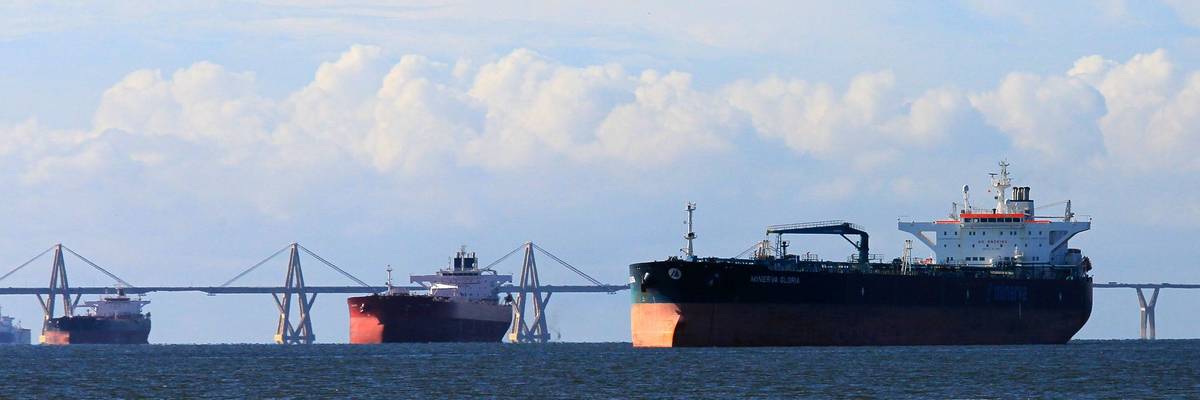
Oil tankers are seen anchored in Lake Maracaibo after loading crude oil at the Bajo Grande Refinery port. The Trump administration seized an oil tanker off the coast of Venezuela, which was on the Treasury Department's sanctions list and was sailing under the Guyanese flag. The US president threatened to confiscate all hydrocarbon-laden vessels in the Venezuelan oil-producing nation.
Unchecked Waters: The Constitutional Crisis of Trump’s Venezuela Oil Blockade
A naval blockade—regardless of whether it is met with armed resistance—qualifies under both domestic and international law as a use of force.
On 16 December, 2025, President Donald Trump announced what he called a “total and complete blockade” of oil tankers entering or leaving Venezuela. Delivered via his personal media platform, the statement was sweeping in its implications. Trump declared that Venezuela was “completely surrounded by the largest Armada ever assembled in the History of South America,” and he made clear this would not end until all Venezuelan “oil, land, and other assets” were returned to the United States. But beneath the dramatic language lies a far more dangerous truth: this action marks a breach of US constitutional limits, a perilous expansion of executive authority, and a break with both legal precedent and historical norms of dispute resolution.
At its core, this naval blockade—undeclared, unauthorized, and now operational—poses a direct challenge to the War Powers Resolution, a congressional statute designed specifically to prevent precisely this kind of unilateral military escalation. While prior administrations have used sanctions, diplomatic pressure, and limited enforcement actions to manage foreign resource disputes, President Trump’s move replaces law with coercion, and diplomacy with force.
The Constitutional Line That Has Been Crossed
Under Article I of the US Constitution, the power to declare war, or to authorize acts tantamount to war, lies exclusively with Congress. While Article II grants the President authority as Commander-in-Chief, it does not permit sustained, coercive military operations absent legislative consent. The War Powers Resolution of 1973 was enacted to enforce this distinction, requiring the President to seek congressional authorization for any use of armed forces likely to involve hostilities or imminent risk thereof.
The blockade announced by President Trump is not merely a foreign policy maneuver; it is a constitutional violation in motion.
A naval blockade—regardless of whether it is met with armed resistance—qualifies under both domestic and international law as a use of force. It is, by nature, confrontational, involving the assertion of control over international waters and the denial of access to maritime commerce by a sovereign state. As such, the blockade announced by President Trump is not merely a foreign policy maneuver; it is a constitutional violation in motion.
The Fallacy of “Stolen Oil”: A Historical and Legal Fiction
Trump’s central justification for the blockade—that Venezuela “stole” American oil—is not supported by historical fact or legal doctrine. Venezuela’s oil sector was nationalized in 1976, with the creation of the state company Petróleos de Venezuela, S.A. (PDVSA). Over the years, foreign firms—including US giants like ExxonMobil and ConocoPhillips—were permitted to operate under negotiated terms. In the early 2000s, Venezuela reasserted control over key assets, converting foreign-controlled projects into joint ventures in which the state held majority ownership.
These actions were not acts of piracy, but sovereign decisions—ones that fall well within Venezuela’s rights under international law. The resulting disputes were not settled by force, but through arbitration and negotiation. Indeed, many of the affected companies sought recourse through investor-state arbitration mechanisms, challenging compensation levels or contract terms—not the fundamental legality of nationalization itself.
Even as tensions grew, the United States relied on sanctions, licensing restrictions, and diplomatic tools. Not once, in decades of resource disputes throughout Latin America—including in Mexico, Bolivia, and El Salvador—did the US resort to blockades or military coercion to assert commercial claims. The shift to force in the Venezuelan context is therefore not only unprecedented but also deeply destabilizing to the established order.
Sanctions Are Not a Blank Check
The distinction between sanctions enforcement and military action is not academic. Sanctions, as administered by the Office of Foreign Assets Control (OFAC), regulate economic conduct—typically prohibiting certain transactions by US persons. They do not authorize armed interdiction of foreign-flagged vessels on the high seas. While isolated tanker seizures have been justified through civil forfeiture statutes—sometimes involving alleged ties to terrorism or sanctions evasion—the transition to a systematic maritime blockade is an escalation into armed coercion.
This is not simply a technical legal issue. It is a constitutional crisis in real time.
Under the War Powers Resolution and the 1980 Office of Legal Counsel opinion, even emergency military deployments must terminate within 60 days without congressional approval. The blockade’s indefinite duration, announced expansion, and linkage to political demands—such as the return of assets—place it well outside the legal bounds of executive discretion.
This is not simply a technical legal issue. It is a constitutional crisis in real time.
A Dangerous Precedent
If a President can declare and execute a naval blockade without congressional approval—based on economic grievances, political claims, or allegations of foreign misconduct—then the separation of powers itself is under siege. Today, it is Venezuela. Tomorrow, it could be any other state or region where American commercial or political interests are challenged.
Even more alarming is the potential precedent this sets for private claims to become triggers for military action. By framing a dispute over oil contracts as a matter of theft, the administration recasts a regulatory disagreement as grounds for warlike engagement. This upends international norms, threatens global maritime order, and encourages future executives to substitute force for law in matters of foreign commerce.
The Legal and Diplomatic Path Forward
It is not too late to reverse course. The solutions are neither exotic nor novel. They are grounded in law, history, and precedent:
Congress must reassert its constitutional role. Whether through resolutions like House Concurrent Resolution 64 or emergency oversight hearings, the legislative branch must enforce the War Powers Resolution and prohibit unauthorized hostilities.
The Executive must return to lawful enforcement mechanisms. This includes relying on civil forfeiture, targeted sanctions, and international arbitration—not coercive naval operations.
When the President crosses a constitutional red line and no one pushes back, it is not just a policy failure—it is a signal that the balance of powers has tilted dangerously toward autocracy.
Diplomatic engagement must be restored as the core modality. Disputes over Venezuela’s resource management must be addressed through negotiation, licensing frameworks, and international claims processes—not unilateral blockade.
For decades, the United States has held itself as a champion of a rule-based international order. That order cannot be maintained abroad if it is being subverted at home.
The High Cost of Erosion
The blockade of Venezuelan oil tankers may appear to some as a show of strength or a necessary escalation. But in truth, it is a dangerous erosion—of law, of precedent, and of constitutional governance. It represents not the defense of American interests, but the abandonment of the constitutional boundaries that define the Republic.
When the President crosses a constitutional red line and no one pushes back, it is not just a policy failure—it is a signal that the balance of powers has tilted dangerously toward autocracy. Congress must act, the courts must scrutinize, and the public must demand that power be wielded not in anger or impulse, but in accordance with the law.
Because once the executive can blockade without approval, the Constitution becomes not a safeguard, but a suggestion.
We are at a crossroads
This country and this world are at a monumental crossroads. In a few short weeks, US voters will have an opportunity to beat back the forces of fascism and confront the billionaires who are rigging the economy, our media system, and our democracy, making it increasingly impossible for ordinary people to get by. We’re not just talking about the election. We’re talking about what must be done once these fascist elements are vanquished from power. We need a bolder set of solutions than what either major party has so far been willing to offer and a working-class movement ready to fight like hell for it. Trump didn't emerge from nowhere. The conditions that fueled MAGA authoritarianism were created by decades of radical neoliberal economic policies and a corrupt political system dominated by corporate interests. They slashed taxes on the super-rich, promising that the benefits would trickle down. They said giveaways to the corporate titans would make life more affordable for the rest of us. It was all bullshit. And when a bitter, betrayed populace searches for someone to blame, right-wing demagogues have little trouble finding scapegoats. People know when they're being lied to, but you won't hear any of this from the corporate media. Only independent journalism—powered and funded by people who believe in building a better world—can deliver truly trustworthy daily news. Our Fall Campaign is underway, and we need your help. To power our newsroom through the rest of the year, we need to raise $125,000 by midnight on October 31. So if you share our vision, please contribute whatever you can to sustain our work. |
On 16 December, 2025, President Donald Trump announced what he called a “total and complete blockade” of oil tankers entering or leaving Venezuela. Delivered via his personal media platform, the statement was sweeping in its implications. Trump declared that Venezuela was “completely surrounded by the largest Armada ever assembled in the History of South America,” and he made clear this would not end until all Venezuelan “oil, land, and other assets” were returned to the United States. But beneath the dramatic language lies a far more dangerous truth: this action marks a breach of US constitutional limits, a perilous expansion of executive authority, and a break with both legal precedent and historical norms of dispute resolution.
At its core, this naval blockade—undeclared, unauthorized, and now operational—poses a direct challenge to the War Powers Resolution, a congressional statute designed specifically to prevent precisely this kind of unilateral military escalation. While prior administrations have used sanctions, diplomatic pressure, and limited enforcement actions to manage foreign resource disputes, President Trump’s move replaces law with coercion, and diplomacy with force.
The Constitutional Line That Has Been Crossed
Under Article I of the US Constitution, the power to declare war, or to authorize acts tantamount to war, lies exclusively with Congress. While Article II grants the President authority as Commander-in-Chief, it does not permit sustained, coercive military operations absent legislative consent. The War Powers Resolution of 1973 was enacted to enforce this distinction, requiring the President to seek congressional authorization for any use of armed forces likely to involve hostilities or imminent risk thereof.
The blockade announced by President Trump is not merely a foreign policy maneuver; it is a constitutional violation in motion.
A naval blockade—regardless of whether it is met with armed resistance—qualifies under both domestic and international law as a use of force. It is, by nature, confrontational, involving the assertion of control over international waters and the denial of access to maritime commerce by a sovereign state. As such, the blockade announced by President Trump is not merely a foreign policy maneuver; it is a constitutional violation in motion.
The Fallacy of “Stolen Oil”: A Historical and Legal Fiction
Trump’s central justification for the blockade—that Venezuela “stole” American oil—is not supported by historical fact or legal doctrine. Venezuela’s oil sector was nationalized in 1976, with the creation of the state company Petróleos de Venezuela, S.A. (PDVSA). Over the years, foreign firms—including US giants like ExxonMobil and ConocoPhillips—were permitted to operate under negotiated terms. In the early 2000s, Venezuela reasserted control over key assets, converting foreign-controlled projects into joint ventures in which the state held majority ownership.
These actions were not acts of piracy, but sovereign decisions—ones that fall well within Venezuela’s rights under international law. The resulting disputes were not settled by force, but through arbitration and negotiation. Indeed, many of the affected companies sought recourse through investor-state arbitration mechanisms, challenging compensation levels or contract terms—not the fundamental legality of nationalization itself.
Even as tensions grew, the United States relied on sanctions, licensing restrictions, and diplomatic tools. Not once, in decades of resource disputes throughout Latin America—including in Mexico, Bolivia, and El Salvador—did the US resort to blockades or military coercion to assert commercial claims. The shift to force in the Venezuelan context is therefore not only unprecedented but also deeply destabilizing to the established order.
Sanctions Are Not a Blank Check
The distinction between sanctions enforcement and military action is not academic. Sanctions, as administered by the Office of Foreign Assets Control (OFAC), regulate economic conduct—typically prohibiting certain transactions by US persons. They do not authorize armed interdiction of foreign-flagged vessels on the high seas. While isolated tanker seizures have been justified through civil forfeiture statutes—sometimes involving alleged ties to terrorism or sanctions evasion—the transition to a systematic maritime blockade is an escalation into armed coercion.
This is not simply a technical legal issue. It is a constitutional crisis in real time.
Under the War Powers Resolution and the 1980 Office of Legal Counsel opinion, even emergency military deployments must terminate within 60 days without congressional approval. The blockade’s indefinite duration, announced expansion, and linkage to political demands—such as the return of assets—place it well outside the legal bounds of executive discretion.
This is not simply a technical legal issue. It is a constitutional crisis in real time.
A Dangerous Precedent
If a President can declare and execute a naval blockade without congressional approval—based on economic grievances, political claims, or allegations of foreign misconduct—then the separation of powers itself is under siege. Today, it is Venezuela. Tomorrow, it could be any other state or region where American commercial or political interests are challenged.
Even more alarming is the potential precedent this sets for private claims to become triggers for military action. By framing a dispute over oil contracts as a matter of theft, the administration recasts a regulatory disagreement as grounds for warlike engagement. This upends international norms, threatens global maritime order, and encourages future executives to substitute force for law in matters of foreign commerce.
The Legal and Diplomatic Path Forward
It is not too late to reverse course. The solutions are neither exotic nor novel. They are grounded in law, history, and precedent:
Congress must reassert its constitutional role. Whether through resolutions like House Concurrent Resolution 64 or emergency oversight hearings, the legislative branch must enforce the War Powers Resolution and prohibit unauthorized hostilities.
The Executive must return to lawful enforcement mechanisms. This includes relying on civil forfeiture, targeted sanctions, and international arbitration—not coercive naval operations.
When the President crosses a constitutional red line and no one pushes back, it is not just a policy failure—it is a signal that the balance of powers has tilted dangerously toward autocracy.
Diplomatic engagement must be restored as the core modality. Disputes over Venezuela’s resource management must be addressed through negotiation, licensing frameworks, and international claims processes—not unilateral blockade.
For decades, the United States has held itself as a champion of a rule-based international order. That order cannot be maintained abroad if it is being subverted at home.
The High Cost of Erosion
The blockade of Venezuelan oil tankers may appear to some as a show of strength or a necessary escalation. But in truth, it is a dangerous erosion—of law, of precedent, and of constitutional governance. It represents not the defense of American interests, but the abandonment of the constitutional boundaries that define the Republic.
When the President crosses a constitutional red line and no one pushes back, it is not just a policy failure—it is a signal that the balance of powers has tilted dangerously toward autocracy. Congress must act, the courts must scrutinize, and the public must demand that power be wielded not in anger or impulse, but in accordance with the law.
Because once the executive can blockade without approval, the Constitution becomes not a safeguard, but a suggestion.
On 16 December, 2025, President Donald Trump announced what he called a “total and complete blockade” of oil tankers entering or leaving Venezuela. Delivered via his personal media platform, the statement was sweeping in its implications. Trump declared that Venezuela was “completely surrounded by the largest Armada ever assembled in the History of South America,” and he made clear this would not end until all Venezuelan “oil, land, and other assets” were returned to the United States. But beneath the dramatic language lies a far more dangerous truth: this action marks a breach of US constitutional limits, a perilous expansion of executive authority, and a break with both legal precedent and historical norms of dispute resolution.
At its core, this naval blockade—undeclared, unauthorized, and now operational—poses a direct challenge to the War Powers Resolution, a congressional statute designed specifically to prevent precisely this kind of unilateral military escalation. While prior administrations have used sanctions, diplomatic pressure, and limited enforcement actions to manage foreign resource disputes, President Trump’s move replaces law with coercion, and diplomacy with force.
The Constitutional Line That Has Been Crossed
Under Article I of the US Constitution, the power to declare war, or to authorize acts tantamount to war, lies exclusively with Congress. While Article II grants the President authority as Commander-in-Chief, it does not permit sustained, coercive military operations absent legislative consent. The War Powers Resolution of 1973 was enacted to enforce this distinction, requiring the President to seek congressional authorization for any use of armed forces likely to involve hostilities or imminent risk thereof.
The blockade announced by President Trump is not merely a foreign policy maneuver; it is a constitutional violation in motion.
A naval blockade—regardless of whether it is met with armed resistance—qualifies under both domestic and international law as a use of force. It is, by nature, confrontational, involving the assertion of control over international waters and the denial of access to maritime commerce by a sovereign state. As such, the blockade announced by President Trump is not merely a foreign policy maneuver; it is a constitutional violation in motion.
The Fallacy of “Stolen Oil”: A Historical and Legal Fiction
Trump’s central justification for the blockade—that Venezuela “stole” American oil—is not supported by historical fact or legal doctrine. Venezuela’s oil sector was nationalized in 1976, with the creation of the state company Petróleos de Venezuela, S.A. (PDVSA). Over the years, foreign firms—including US giants like ExxonMobil and ConocoPhillips—were permitted to operate under negotiated terms. In the early 2000s, Venezuela reasserted control over key assets, converting foreign-controlled projects into joint ventures in which the state held majority ownership.
These actions were not acts of piracy, but sovereign decisions—ones that fall well within Venezuela’s rights under international law. The resulting disputes were not settled by force, but through arbitration and negotiation. Indeed, many of the affected companies sought recourse through investor-state arbitration mechanisms, challenging compensation levels or contract terms—not the fundamental legality of nationalization itself.
Even as tensions grew, the United States relied on sanctions, licensing restrictions, and diplomatic tools. Not once, in decades of resource disputes throughout Latin America—including in Mexico, Bolivia, and El Salvador—did the US resort to blockades or military coercion to assert commercial claims. The shift to force in the Venezuelan context is therefore not only unprecedented but also deeply destabilizing to the established order.
Sanctions Are Not a Blank Check
The distinction between sanctions enforcement and military action is not academic. Sanctions, as administered by the Office of Foreign Assets Control (OFAC), regulate economic conduct—typically prohibiting certain transactions by US persons. They do not authorize armed interdiction of foreign-flagged vessels on the high seas. While isolated tanker seizures have been justified through civil forfeiture statutes—sometimes involving alleged ties to terrorism or sanctions evasion—the transition to a systematic maritime blockade is an escalation into armed coercion.
This is not simply a technical legal issue. It is a constitutional crisis in real time.
Under the War Powers Resolution and the 1980 Office of Legal Counsel opinion, even emergency military deployments must terminate within 60 days without congressional approval. The blockade’s indefinite duration, announced expansion, and linkage to political demands—such as the return of assets—place it well outside the legal bounds of executive discretion.
This is not simply a technical legal issue. It is a constitutional crisis in real time.
A Dangerous Precedent
If a President can declare and execute a naval blockade without congressional approval—based on economic grievances, political claims, or allegations of foreign misconduct—then the separation of powers itself is under siege. Today, it is Venezuela. Tomorrow, it could be any other state or region where American commercial or political interests are challenged.
Even more alarming is the potential precedent this sets for private claims to become triggers for military action. By framing a dispute over oil contracts as a matter of theft, the administration recasts a regulatory disagreement as grounds for warlike engagement. This upends international norms, threatens global maritime order, and encourages future executives to substitute force for law in matters of foreign commerce.
The Legal and Diplomatic Path Forward
It is not too late to reverse course. The solutions are neither exotic nor novel. They are grounded in law, history, and precedent:
Congress must reassert its constitutional role. Whether through resolutions like House Concurrent Resolution 64 or emergency oversight hearings, the legislative branch must enforce the War Powers Resolution and prohibit unauthorized hostilities.
The Executive must return to lawful enforcement mechanisms. This includes relying on civil forfeiture, targeted sanctions, and international arbitration—not coercive naval operations.
When the President crosses a constitutional red line and no one pushes back, it is not just a policy failure—it is a signal that the balance of powers has tilted dangerously toward autocracy.
Diplomatic engagement must be restored as the core modality. Disputes over Venezuela’s resource management must be addressed through negotiation, licensing frameworks, and international claims processes—not unilateral blockade.
For decades, the United States has held itself as a champion of a rule-based international order. That order cannot be maintained abroad if it is being subverted at home.
The High Cost of Erosion
The blockade of Venezuelan oil tankers may appear to some as a show of strength or a necessary escalation. But in truth, it is a dangerous erosion—of law, of precedent, and of constitutional governance. It represents not the defense of American interests, but the abandonment of the constitutional boundaries that define the Republic.
When the President crosses a constitutional red line and no one pushes back, it is not just a policy failure—it is a signal that the balance of powers has tilted dangerously toward autocracy. Congress must act, the courts must scrutinize, and the public must demand that power be wielded not in anger or impulse, but in accordance with the law.
Because once the executive can blockade without approval, the Constitution becomes not a safeguard, but a suggestion.