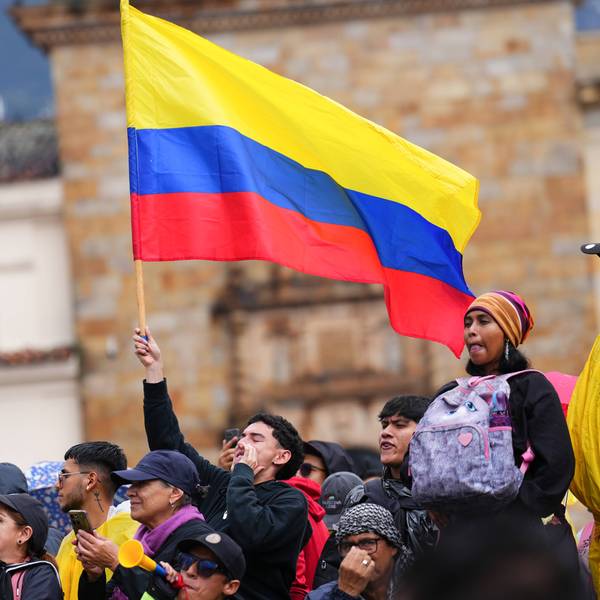
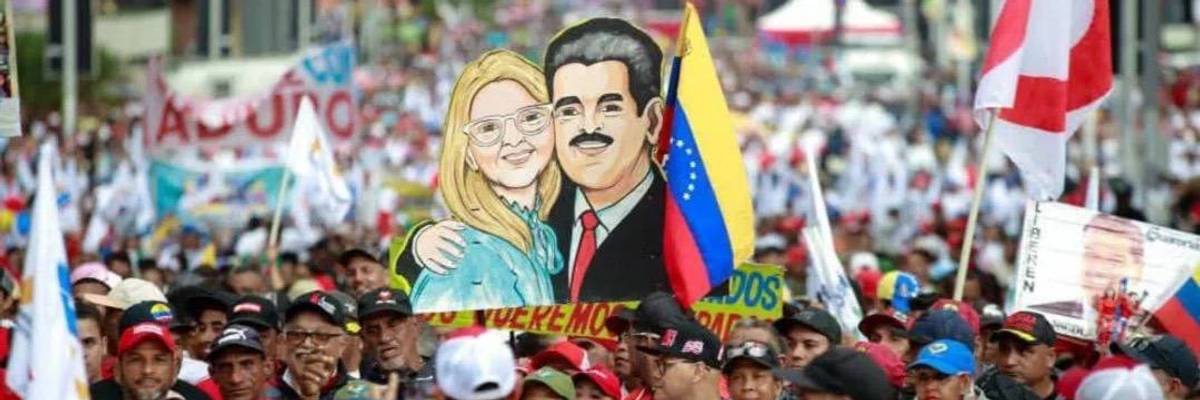
Venezuelans march to denounce the US kidnapping of their president, Nicolas Maduro, and his wife Cilia Flores.
Venezuela After January 3: A Nation Standing in the Storm
In Caracas, the situation is tangled, contradictory, and volatile. But amid the uncertainty, one thing felt clear: the Venezuelan left is not collapsing. It is recalibrating.
On our recent delegation to Venezuela, one quote echoed again and again — a warning written nearly two centuries ago by Simón Bolívar in 1829:
“The United States appears destined by Providence to plague America with misery in the name of liberty.”
For many Venezuelans, that line no longer feels like history. It feels like the present.
The January 3 US military operation that seized President Nicolás Maduro and First Lady Cilia Flores marked a dramatic escalation in a conflict that Venezuelans describe not as sudden but as cumulative—the culmination of decades of pressure, sanctions, and attempts at isolation. “We still haven’t totally processed what happened on January 3,” sanctions expert William Castillo told us. “But it was the culmination of over 25 years of aggression and 11 years of resisting devastating sanctions. A 20-year-old today has lived half his life in a blockaded country.”
Carlos Ron, former deputy foreign minister and now with the Tricontinental Institute for Social Research, described the buildup to the invasion as the result of a carefully constructed narrative. “First there was the dangerous rhetoric describing Venezuelans in the United States as criminals,” he said. “Then endless references to the Tren de Aragua gang. Then the boat strikes blowing up alleged smugglers. Then the oil tanker seizures and naval blockade. The pressure wasn’t working, so they escalated to the January 3 invasion and kidnapping of President Maduro and his wife, Cilia Flores, and the deaths of over 100 people.”
While in the United States the events of January 3 have largely been forgotten, replaced by a devastating war with Iran, in Venezuela the reminders are everywhere. Huge banners draped from apartment buildings demand: “Bring them home.” Weekly protests call for their release.
In the Tiuna neighborhood of Caracas, we met Mileidy Chirinos, who lives in an apartment complex overlooking the site where Maduro was captured. From her rooftop, she told us about that dreadful night, when the sky lit up with explosions so loud her building shook and everyone ran outside screaming.
“Have your children ever woken up terrified to the sound of bombs?” she asked.
We shook our heads.
“Ours have,” she said. “And they are US bombs. Now we understand what Palestinians in Gaza feel every day.”
She told us psychologists now visit weekly to help residents cope with the trauma.
Within days of the US invasion, the National Assembly swore in Vice President Delcy Rodríguez as acting president. President Trump publicly praised Rodríguez for “doing a good job,” emphasizing his strong relationship with her. But from the beginning, she has been negotiating with the United States with a gun to her head. She was told that any refusal to compromise would result not in the kidnapping of her and her team, but death and the continued bombing of Venezuela.
The presence of US power looms large. Nuclear submarines still patrol offshore. Thousands of troops remain positioned nearby. Every statement and decision made by the government is scrutinized. And on February 2, despite Trump’s praise for Delcy Rodríguez, he renewed the 2015 executive order declaring Venezuela an “unusual and extraordinary threat” to US national security.
The visits from the heads of the CIA and Southern Command have undoubtedly been difficult for the government to swallow. Delcy’s revolutionary father was tortured to death in 1976 by a Venezuelan government that worked closely with the CIA. The US Southern Command coordinated the January 3 attack.
But the government is not without leverage.
“The United States thought the state was weak, that it didn’t have popular support, that the military was divided,” said Tania Díaz of the ruling PSUV party. “January 3rd could have triggered looting, military defections, or widespread destabilization. None of that happened.”
The United States has overwhelming military dominance, but it was also aware that millions of Venezuelans signed up to be part of the people’s militia. This militia, along with the army that remained loyal to the government, gave Washington pause about launching a prolonged war and attempting to replace Delcy Rodríguez with opposition leader María Corina Machado.
While Machado enjoys enthusiastic support among Venezuelan exiles in Miami and the Trump administration recognized her movement as the winner of the 2024 election, the picture inside Venezuela is very different. The opposition remains deeply divided and Trump realized there was no viable faction ready to assume power.
Besides, as William Castillo put it bluntly: “Trump does not care about elections or human rights or political prisoners. He cares about three other things: oil, oil, and oil.” To that, we can add gold, where the US just pushed Venezuela to provide direct access to gold exports and investment opportunities in the country’s gold and mineral sector,
Certainly, under the circumstances, the Venezuelan leadership has had little choice but to grant the United States significant influence over its oil exports. But while Trump boasts that this is the fruit of his “spectacular assault,” Maduro had long been open to cooperation with US oil companies.
“Maduro was well aware that Venezuela needed investment in its oil facilities,” Castillo told us, “but the lack of investment is because of US sanctions, not because of Maduro. Venezuela never stopped selling to the US.; it is the US that stopped buying. And it also stopped selling spare parts needed to repair the infrastructure. So the US started the fire that decimated our oil industry and now acts as if it’s the firefighter coming to the rescue.”
In any case, the easing of oil sanctions—the only sanctions that have been partially lifted—is already bringing an infusion of much-needed dollars, and the government has been able to use these funds to support social programs.
But in Venezuela the conflict is not seen as simply about oil. Blanca Eekhout, head of the Simon Bolivar Institute, says US actions represent a brazen return to the 1823 Monroe Doctrine. The doctrine originally warned European powers not to interfere in the Western Hemisphere, but over time it became a justification for repeated US interventions across the region.
“We have gone back 200 years,” she said. “All rules of sovereignty have been violated. But while the Trump administration thinks it can control the hemisphere by force, it can’t.”
The historical contradiction is stark. In 1823, the young United States declared Latin America its sphere of influence. A year earlier, Bolívar envisioned a powerful, sovereign Latin America capable of charting its own destiny. That tension still echoes through the present.
Bolívar’s dream is also being battered by the resurgence of the right across the region. The left in Latin America is far weaker than during the days of Hugo Chávez. Bolivia’s Evo Morales and Ecuador’s Rafael Correa have been replaced by conservative leaders. Cuba remains under a suffocating US siege. Progressive regional institutions like CELAC and ALBA have faded, and the vision of Latin American unity that once seemed within reach now feels far more fragile.
In Caracas, the situation is tangled, contradictory, and volatile. But amid the uncertainty, one thing felt clear: the Venezuelan left is not collapsing. It is recalibrating.
As Blanca told us before we left:
“They thought we would fall apart. But we are still here.”
And in the background, Bolívar’s warning continues to drift through the air—like a storm that never quite passes.
We are at a crossroads
This country and this world are at a monumental crossroads. In a few short weeks, US voters will have an opportunity to beat back the forces of fascism and confront the billionaires who are rigging the economy, our media system, and our democracy, making it increasingly impossible for ordinary people to get by. We’re not just talking about the election. We’re talking about what must be done once these fascist elements are vanquished from power. We need a bolder set of solutions than what either major party has so far been willing to offer and a working-class movement ready to fight like hell for it. Trump didn't emerge from nowhere. The conditions that fueled MAGA authoritarianism were created by decades of radical neoliberal economic policies and a corrupt political system dominated by corporate interests. They slashed taxes on the super-rich, promising that the benefits would trickle down. They said giveaways to the corporate titans would make life more affordable for the rest of us. It was all bullshit. And when a bitter, betrayed populace searches for someone to blame, right-wing demagogues have little trouble finding scapegoats. People know when they're being lied to, but you won't hear any of this from the corporate media. Only independent journalism—powered and funded by people who believe in building a better world—can deliver truly trustworthy daily news. Our Fall Campaign is underway, and we need your help. To power our newsroom through the rest of the year, we need to raise $125,000 by midnight on October 31. So if you share our vision, please contribute whatever you can to sustain our work. |
On our recent delegation to Venezuela, one quote echoed again and again — a warning written nearly two centuries ago by Simón Bolívar in 1829:
“The United States appears destined by Providence to plague America with misery in the name of liberty.”
For many Venezuelans, that line no longer feels like history. It feels like the present.
The January 3 US military operation that seized President Nicolás Maduro and First Lady Cilia Flores marked a dramatic escalation in a conflict that Venezuelans describe not as sudden but as cumulative—the culmination of decades of pressure, sanctions, and attempts at isolation. “We still haven’t totally processed what happened on January 3,” sanctions expert William Castillo told us. “But it was the culmination of over 25 years of aggression and 11 years of resisting devastating sanctions. A 20-year-old today has lived half his life in a blockaded country.”
Carlos Ron, former deputy foreign minister and now with the Tricontinental Institute for Social Research, described the buildup to the invasion as the result of a carefully constructed narrative. “First there was the dangerous rhetoric describing Venezuelans in the United States as criminals,” he said. “Then endless references to the Tren de Aragua gang. Then the boat strikes blowing up alleged smugglers. Then the oil tanker seizures and naval blockade. The pressure wasn’t working, so they escalated to the January 3 invasion and kidnapping of President Maduro and his wife, Cilia Flores, and the deaths of over 100 people.”
While in the United States the events of January 3 have largely been forgotten, replaced by a devastating war with Iran, in Venezuela the reminders are everywhere. Huge banners draped from apartment buildings demand: “Bring them home.” Weekly protests call for their release.
In the Tiuna neighborhood of Caracas, we met Mileidy Chirinos, who lives in an apartment complex overlooking the site where Maduro was captured. From her rooftop, she told us about that dreadful night, when the sky lit up with explosions so loud her building shook and everyone ran outside screaming.
“Have your children ever woken up terrified to the sound of bombs?” she asked.
We shook our heads.
“Ours have,” she said. “And they are US bombs. Now we understand what Palestinians in Gaza feel every day.”
She told us psychologists now visit weekly to help residents cope with the trauma.
Within days of the US invasion, the National Assembly swore in Vice President Delcy Rodríguez as acting president. President Trump publicly praised Rodríguez for “doing a good job,” emphasizing his strong relationship with her. But from the beginning, she has been negotiating with the United States with a gun to her head. She was told that any refusal to compromise would result not in the kidnapping of her and her team, but death and the continued bombing of Venezuela.
The presence of US power looms large. Nuclear submarines still patrol offshore. Thousands of troops remain positioned nearby. Every statement and decision made by the government is scrutinized. And on February 2, despite Trump’s praise for Delcy Rodríguez, he renewed the 2015 executive order declaring Venezuela an “unusual and extraordinary threat” to US national security.
The visits from the heads of the CIA and Southern Command have undoubtedly been difficult for the government to swallow. Delcy’s revolutionary father was tortured to death in 1976 by a Venezuelan government that worked closely with the CIA. The US Southern Command coordinated the January 3 attack.
But the government is not without leverage.
“The United States thought the state was weak, that it didn’t have popular support, that the military was divided,” said Tania Díaz of the ruling PSUV party. “January 3rd could have triggered looting, military defections, or widespread destabilization. None of that happened.”
The United States has overwhelming military dominance, but it was also aware that millions of Venezuelans signed up to be part of the people’s militia. This militia, along with the army that remained loyal to the government, gave Washington pause about launching a prolonged war and attempting to replace Delcy Rodríguez with opposition leader María Corina Machado.
While Machado enjoys enthusiastic support among Venezuelan exiles in Miami and the Trump administration recognized her movement as the winner of the 2024 election, the picture inside Venezuela is very different. The opposition remains deeply divided and Trump realized there was no viable faction ready to assume power.
Besides, as William Castillo put it bluntly: “Trump does not care about elections or human rights or political prisoners. He cares about three other things: oil, oil, and oil.” To that, we can add gold, where the US just pushed Venezuela to provide direct access to gold exports and investment opportunities in the country’s gold and mineral sector,
Certainly, under the circumstances, the Venezuelan leadership has had little choice but to grant the United States significant influence over its oil exports. But while Trump boasts that this is the fruit of his “spectacular assault,” Maduro had long been open to cooperation with US oil companies.
“Maduro was well aware that Venezuela needed investment in its oil facilities,” Castillo told us, “but the lack of investment is because of US sanctions, not because of Maduro. Venezuela never stopped selling to the US.; it is the US that stopped buying. And it also stopped selling spare parts needed to repair the infrastructure. So the US started the fire that decimated our oil industry and now acts as if it’s the firefighter coming to the rescue.”
In any case, the easing of oil sanctions—the only sanctions that have been partially lifted—is already bringing an infusion of much-needed dollars, and the government has been able to use these funds to support social programs.
But in Venezuela the conflict is not seen as simply about oil. Blanca Eekhout, head of the Simon Bolivar Institute, says US actions represent a brazen return to the 1823 Monroe Doctrine. The doctrine originally warned European powers not to interfere in the Western Hemisphere, but over time it became a justification for repeated US interventions across the region.
“We have gone back 200 years,” she said. “All rules of sovereignty have been violated. But while the Trump administration thinks it can control the hemisphere by force, it can’t.”
The historical contradiction is stark. In 1823, the young United States declared Latin America its sphere of influence. A year earlier, Bolívar envisioned a powerful, sovereign Latin America capable of charting its own destiny. That tension still echoes through the present.
Bolívar’s dream is also being battered by the resurgence of the right across the region. The left in Latin America is far weaker than during the days of Hugo Chávez. Bolivia’s Evo Morales and Ecuador’s Rafael Correa have been replaced by conservative leaders. Cuba remains under a suffocating US siege. Progressive regional institutions like CELAC and ALBA have faded, and the vision of Latin American unity that once seemed within reach now feels far more fragile.
In Caracas, the situation is tangled, contradictory, and volatile. But amid the uncertainty, one thing felt clear: the Venezuelan left is not collapsing. It is recalibrating.
As Blanca told us before we left:
“They thought we would fall apart. But we are still here.”
And in the background, Bolívar’s warning continues to drift through the air—like a storm that never quite passes.
On our recent delegation to Venezuela, one quote echoed again and again — a warning written nearly two centuries ago by Simón Bolívar in 1829:
“The United States appears destined by Providence to plague America with misery in the name of liberty.”
For many Venezuelans, that line no longer feels like history. It feels like the present.
The January 3 US military operation that seized President Nicolás Maduro and First Lady Cilia Flores marked a dramatic escalation in a conflict that Venezuelans describe not as sudden but as cumulative—the culmination of decades of pressure, sanctions, and attempts at isolation. “We still haven’t totally processed what happened on January 3,” sanctions expert William Castillo told us. “But it was the culmination of over 25 years of aggression and 11 years of resisting devastating sanctions. A 20-year-old today has lived half his life in a blockaded country.”
Carlos Ron, former deputy foreign minister and now with the Tricontinental Institute for Social Research, described the buildup to the invasion as the result of a carefully constructed narrative. “First there was the dangerous rhetoric describing Venezuelans in the United States as criminals,” he said. “Then endless references to the Tren de Aragua gang. Then the boat strikes blowing up alleged smugglers. Then the oil tanker seizures and naval blockade. The pressure wasn’t working, so they escalated to the January 3 invasion and kidnapping of President Maduro and his wife, Cilia Flores, and the deaths of over 100 people.”
While in the United States the events of January 3 have largely been forgotten, replaced by a devastating war with Iran, in Venezuela the reminders are everywhere. Huge banners draped from apartment buildings demand: “Bring them home.” Weekly protests call for their release.
In the Tiuna neighborhood of Caracas, we met Mileidy Chirinos, who lives in an apartment complex overlooking the site where Maduro was captured. From her rooftop, she told us about that dreadful night, when the sky lit up with explosions so loud her building shook and everyone ran outside screaming.
“Have your children ever woken up terrified to the sound of bombs?” she asked.
We shook our heads.
“Ours have,” she said. “And they are US bombs. Now we understand what Palestinians in Gaza feel every day.”
She told us psychologists now visit weekly to help residents cope with the trauma.
Within days of the US invasion, the National Assembly swore in Vice President Delcy Rodríguez as acting president. President Trump publicly praised Rodríguez for “doing a good job,” emphasizing his strong relationship with her. But from the beginning, she has been negotiating with the United States with a gun to her head. She was told that any refusal to compromise would result not in the kidnapping of her and her team, but death and the continued bombing of Venezuela.
The presence of US power looms large. Nuclear submarines still patrol offshore. Thousands of troops remain positioned nearby. Every statement and decision made by the government is scrutinized. And on February 2, despite Trump’s praise for Delcy Rodríguez, he renewed the 2015 executive order declaring Venezuela an “unusual and extraordinary threat” to US national security.
The visits from the heads of the CIA and Southern Command have undoubtedly been difficult for the government to swallow. Delcy’s revolutionary father was tortured to death in 1976 by a Venezuelan government that worked closely with the CIA. The US Southern Command coordinated the January 3 attack.
But the government is not without leverage.
“The United States thought the state was weak, that it didn’t have popular support, that the military was divided,” said Tania Díaz of the ruling PSUV party. “January 3rd could have triggered looting, military defections, or widespread destabilization. None of that happened.”
The United States has overwhelming military dominance, but it was also aware that millions of Venezuelans signed up to be part of the people’s militia. This militia, along with the army that remained loyal to the government, gave Washington pause about launching a prolonged war and attempting to replace Delcy Rodríguez with opposition leader María Corina Machado.
While Machado enjoys enthusiastic support among Venezuelan exiles in Miami and the Trump administration recognized her movement as the winner of the 2024 election, the picture inside Venezuela is very different. The opposition remains deeply divided and Trump realized there was no viable faction ready to assume power.
Besides, as William Castillo put it bluntly: “Trump does not care about elections or human rights or political prisoners. He cares about three other things: oil, oil, and oil.” To that, we can add gold, where the US just pushed Venezuela to provide direct access to gold exports and investment opportunities in the country’s gold and mineral sector,
Certainly, under the circumstances, the Venezuelan leadership has had little choice but to grant the United States significant influence over its oil exports. But while Trump boasts that this is the fruit of his “spectacular assault,” Maduro had long been open to cooperation with US oil companies.
“Maduro was well aware that Venezuela needed investment in its oil facilities,” Castillo told us, “but the lack of investment is because of US sanctions, not because of Maduro. Venezuela never stopped selling to the US.; it is the US that stopped buying. And it also stopped selling spare parts needed to repair the infrastructure. So the US started the fire that decimated our oil industry and now acts as if it’s the firefighter coming to the rescue.”
In any case, the easing of oil sanctions—the only sanctions that have been partially lifted—is already bringing an infusion of much-needed dollars, and the government has been able to use these funds to support social programs.
But in Venezuela the conflict is not seen as simply about oil. Blanca Eekhout, head of the Simon Bolivar Institute, says US actions represent a brazen return to the 1823 Monroe Doctrine. The doctrine originally warned European powers not to interfere in the Western Hemisphere, but over time it became a justification for repeated US interventions across the region.
“We have gone back 200 years,” she said. “All rules of sovereignty have been violated. But while the Trump administration thinks it can control the hemisphere by force, it can’t.”
The historical contradiction is stark. In 1823, the young United States declared Latin America its sphere of influence. A year earlier, Bolívar envisioned a powerful, sovereign Latin America capable of charting its own destiny. That tension still echoes through the present.
Bolívar’s dream is also being battered by the resurgence of the right across the region. The left in Latin America is far weaker than during the days of Hugo Chávez. Bolivia’s Evo Morales and Ecuador’s Rafael Correa have been replaced by conservative leaders. Cuba remains under a suffocating US siege. Progressive regional institutions like CELAC and ALBA have faded, and the vision of Latin American unity that once seemed within reach now feels far more fragile.
In Caracas, the situation is tangled, contradictory, and volatile. But amid the uncertainty, one thing felt clear: the Venezuelan left is not collapsing. It is recalibrating.
As Blanca told us before we left:
“They thought we would fall apart. But we are still here.”
And in the background, Bolívar’s warning continues to drift through the air—like a storm that never quite passes.