SUBSCRIBE TO OUR FREE NEWSLETTER
Daily news & progressive opinion—funded by the people, not the corporations—delivered straight to your inbox.
5
#000000
#FFFFFF
To donate by check, phone, or other method, see our More Ways to Give page.
Daily news & progressive opinion—funded by the people, not the corporations—delivered straight to your inbox.
Musk and Trump claim to be sage businessmen, but it would be hard to find a business owner in America that would dismantle their accounts receivable department when their wealthiest clients still owe them money.
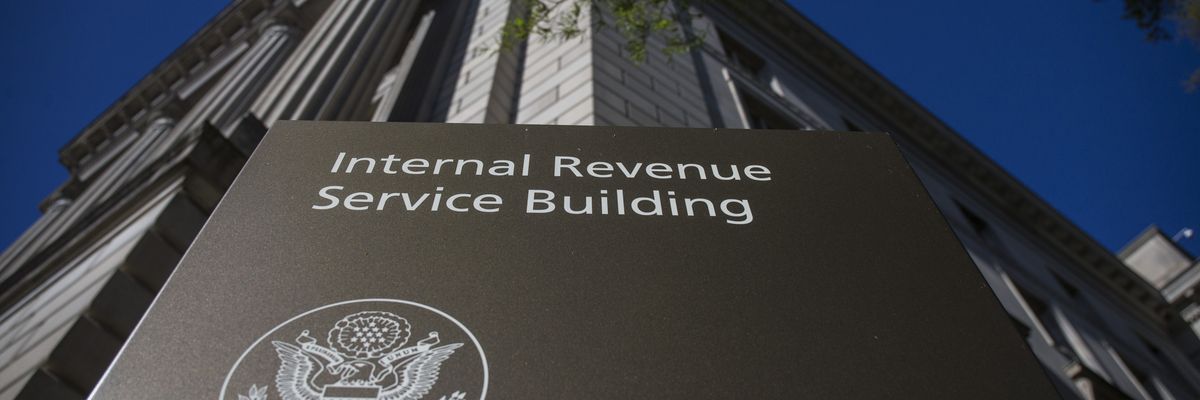
The Trump administration and Elon Musk’s DOGE have begun dismantling the Internal Revenue Service, or IRS, beginning with 6,700 layoffs. Their stated plan is to cut half of the agency’s workforce.
Their biggest cuts appear to be in the Large Business and International division, which audits wealthy individuals and companies with more than $10 million in assets. These are essentially the workers that make sure billionaires and corporations pay their taxes.
Musk and President Donald Trump claim to be sage businessmen, but it would be hard to find a business owner in America that would dismantle their accounts receivable department when their wealthiest clients still owe them money.
The real beneficiaries of a weak IRS are billionaires and large global corporations.
So make no mistake: These cuts will cost taxpayers a lot more than they save.
Gutting the IRS will hurt the middle class by reducing the taxes billionaires and corporations pay for our public services. It passes the bill to working class taxpayers to cover veteran’s services, infrastructure, national parks, and defense.
When it comes to taxes, the wealthy aren’t like you or me. Most wage earners have our state and federal taxes withheld from our monthly paychecks. Ninety percent of taxpayers use the simple standard deduction filing and hope we get a refund.
But billionaires and multimillionaires are different. Their income comes mostly from investments and assets—which they can hide. They hire experts from the “wealth defense industry”—an armada of tax lawyers, accountants, and wealth managers—to minimize their taxes and maximize inheritances for their fortunate children.
They deploy anonymous shell companies, complex trusts, and bank accounts in tax havens like Bermuda, Cayman Islands, and South Dakota to aid their clients in minimizing taxes—tools not available to ordinary taxpayers. According to the Tax Justice Network, over $21 trillion is now hidden in tax havens like these.
A 2021 exposé by ProPublica found that more than half of the 100 wealthiest U.S. billionaires use a complex trust system to avoid estate taxes, which at the current level only kicks in for people with wealth over $13.99 million.
This aggressive tax dodging by the superrich has resulted in an enormous “tax gap” between what they owe and what’s collected. For the last few years, this gap is estimated at $700 billion a year—almost the size of the Pentagon budget.
Working and middle class taxpayers will pick up the slack, or see their services cut. Most likely some of this gap will be added to the $36 trillion national debt, requiring us to pay on an installment plan.
In previous decades, the IRS had the expertise to keep up with the schemes that billionaires and transnational corporations use to dodge their taxes. But over the last two decades, their capacity to catch wealthy crooks and grifters has been decimated by cuts.
Things started to turn around again in 2021, when Congress voted to invest in enforcement. And already, the investment was starting to pay off. A year ago, the IRS announced they’d recovered $482 million from millionaires who hadn’t paid their debts.
Trump and Musk are now reversing these modest gains.
As the agency people love to hate, the IRS was an easy target for Trump’s anti-government attacks. But the real beneficiaries of a weak IRS are billionaires and large global corporations. With an understaffed IRS, their tax shell games can operate without scrutiny—something seven previous IRS commissioners from both parties recently spoke out against.
We may not agree about everything in the federal budget, but most people agree the wealthy should pay their fair share of whatever expenses we share. And it’s hard to catch the criminals if you remove all the cops on the beat.
The billionaires will be popping their champagne bottles. Even with the higher tariffs on European bubbly, they can afford the best.
Dear Common Dreams reader, It’s been nearly 30 years since I co-founded Common Dreams with my late wife, Lina Newhouser. We had the radical notion that journalism should serve the public good, not corporate profits. It was clear to us from the outset what it would take to build such a project. No paid advertisements. No corporate sponsors. No millionaire publisher telling us what to think or do. Many people said we wouldn't last a year, but we proved those doubters wrong. Together with a tremendous team of journalists and dedicated staff, we built an independent media outlet free from the constraints of profits and corporate control. Our mission has always been simple: To inform. To inspire. To ignite change for the common good. Building Common Dreams was not easy. Our survival was never guaranteed. When you take on the most powerful forces—Wall Street greed, fossil fuel industry destruction, Big Tech lobbyists, and uber-rich oligarchs who have spent billions upon billions rigging the economy and democracy in their favor—the only bulwark you have is supporters who believe in your work. But here’s the urgent message from me today. It's never been this bad out there. And it's never been this hard to keep us going. At the very moment Common Dreams is most needed, the threats we face are intensifying. We need your support now more than ever. We don't accept corporate advertising and never will. We don't have a paywall because we don't think people should be blocked from critical news based on their ability to pay. Everything we do is funded by the donations of readers like you. When everyone does the little they can afford, we are strong. But if that support retreats or dries up, so do we. Will you donate now to make sure Common Dreams not only survives but thrives? —Craig Brown, Co-founder |
The Trump administration and Elon Musk’s DOGE have begun dismantling the Internal Revenue Service, or IRS, beginning with 6,700 layoffs. Their stated plan is to cut half of the agency’s workforce.
Their biggest cuts appear to be in the Large Business and International division, which audits wealthy individuals and companies with more than $10 million in assets. These are essentially the workers that make sure billionaires and corporations pay their taxes.
Musk and President Donald Trump claim to be sage businessmen, but it would be hard to find a business owner in America that would dismantle their accounts receivable department when their wealthiest clients still owe them money.
The real beneficiaries of a weak IRS are billionaires and large global corporations.
So make no mistake: These cuts will cost taxpayers a lot more than they save.
Gutting the IRS will hurt the middle class by reducing the taxes billionaires and corporations pay for our public services. It passes the bill to working class taxpayers to cover veteran’s services, infrastructure, national parks, and defense.
When it comes to taxes, the wealthy aren’t like you or me. Most wage earners have our state and federal taxes withheld from our monthly paychecks. Ninety percent of taxpayers use the simple standard deduction filing and hope we get a refund.
But billionaires and multimillionaires are different. Their income comes mostly from investments and assets—which they can hide. They hire experts from the “wealth defense industry”—an armada of tax lawyers, accountants, and wealth managers—to minimize their taxes and maximize inheritances for their fortunate children.
They deploy anonymous shell companies, complex trusts, and bank accounts in tax havens like Bermuda, Cayman Islands, and South Dakota to aid their clients in minimizing taxes—tools not available to ordinary taxpayers. According to the Tax Justice Network, over $21 trillion is now hidden in tax havens like these.
A 2021 exposé by ProPublica found that more than half of the 100 wealthiest U.S. billionaires use a complex trust system to avoid estate taxes, which at the current level only kicks in for people with wealth over $13.99 million.
This aggressive tax dodging by the superrich has resulted in an enormous “tax gap” between what they owe and what’s collected. For the last few years, this gap is estimated at $700 billion a year—almost the size of the Pentagon budget.
Working and middle class taxpayers will pick up the slack, or see their services cut. Most likely some of this gap will be added to the $36 trillion national debt, requiring us to pay on an installment plan.
In previous decades, the IRS had the expertise to keep up with the schemes that billionaires and transnational corporations use to dodge their taxes. But over the last two decades, their capacity to catch wealthy crooks and grifters has been decimated by cuts.
Things started to turn around again in 2021, when Congress voted to invest in enforcement. And already, the investment was starting to pay off. A year ago, the IRS announced they’d recovered $482 million from millionaires who hadn’t paid their debts.
Trump and Musk are now reversing these modest gains.
As the agency people love to hate, the IRS was an easy target for Trump’s anti-government attacks. But the real beneficiaries of a weak IRS are billionaires and large global corporations. With an understaffed IRS, their tax shell games can operate without scrutiny—something seven previous IRS commissioners from both parties recently spoke out against.
We may not agree about everything in the federal budget, but most people agree the wealthy should pay their fair share of whatever expenses we share. And it’s hard to catch the criminals if you remove all the cops on the beat.
The billionaires will be popping their champagne bottles. Even with the higher tariffs on European bubbly, they can afford the best.
The Trump administration and Elon Musk’s DOGE have begun dismantling the Internal Revenue Service, or IRS, beginning with 6,700 layoffs. Their stated plan is to cut half of the agency’s workforce.
Their biggest cuts appear to be in the Large Business and International division, which audits wealthy individuals and companies with more than $10 million in assets. These are essentially the workers that make sure billionaires and corporations pay their taxes.
Musk and President Donald Trump claim to be sage businessmen, but it would be hard to find a business owner in America that would dismantle their accounts receivable department when their wealthiest clients still owe them money.
The real beneficiaries of a weak IRS are billionaires and large global corporations.
So make no mistake: These cuts will cost taxpayers a lot more than they save.
Gutting the IRS will hurt the middle class by reducing the taxes billionaires and corporations pay for our public services. It passes the bill to working class taxpayers to cover veteran’s services, infrastructure, national parks, and defense.
When it comes to taxes, the wealthy aren’t like you or me. Most wage earners have our state and federal taxes withheld from our monthly paychecks. Ninety percent of taxpayers use the simple standard deduction filing and hope we get a refund.
But billionaires and multimillionaires are different. Their income comes mostly from investments and assets—which they can hide. They hire experts from the “wealth defense industry”—an armada of tax lawyers, accountants, and wealth managers—to minimize their taxes and maximize inheritances for their fortunate children.
They deploy anonymous shell companies, complex trusts, and bank accounts in tax havens like Bermuda, Cayman Islands, and South Dakota to aid their clients in minimizing taxes—tools not available to ordinary taxpayers. According to the Tax Justice Network, over $21 trillion is now hidden in tax havens like these.
A 2021 exposé by ProPublica found that more than half of the 100 wealthiest U.S. billionaires use a complex trust system to avoid estate taxes, which at the current level only kicks in for people with wealth over $13.99 million.
This aggressive tax dodging by the superrich has resulted in an enormous “tax gap” between what they owe and what’s collected. For the last few years, this gap is estimated at $700 billion a year—almost the size of the Pentagon budget.
Working and middle class taxpayers will pick up the slack, or see their services cut. Most likely some of this gap will be added to the $36 trillion national debt, requiring us to pay on an installment plan.
In previous decades, the IRS had the expertise to keep up with the schemes that billionaires and transnational corporations use to dodge their taxes. But over the last two decades, their capacity to catch wealthy crooks and grifters has been decimated by cuts.
Things started to turn around again in 2021, when Congress voted to invest in enforcement. And already, the investment was starting to pay off. A year ago, the IRS announced they’d recovered $482 million from millionaires who hadn’t paid their debts.
Trump and Musk are now reversing these modest gains.
As the agency people love to hate, the IRS was an easy target for Trump’s anti-government attacks. But the real beneficiaries of a weak IRS are billionaires and large global corporations. With an understaffed IRS, their tax shell games can operate without scrutiny—something seven previous IRS commissioners from both parties recently spoke out against.
We may not agree about everything in the federal budget, but most people agree the wealthy should pay their fair share of whatever expenses we share. And it’s hard to catch the criminals if you remove all the cops on the beat.
The billionaires will be popping their champagne bottles. Even with the higher tariffs on European bubbly, they can afford the best.