SUBSCRIBE TO OUR FREE NEWSLETTER
Daily news & progressive opinion—funded by the people, not the corporations—delivered straight to your inbox.
5
#000000
#FFFFFF
To donate by check, phone, or other method, see our More Ways to Give page.
Daily news & progressive opinion—funded by the people, not the corporations—delivered straight to your inbox.
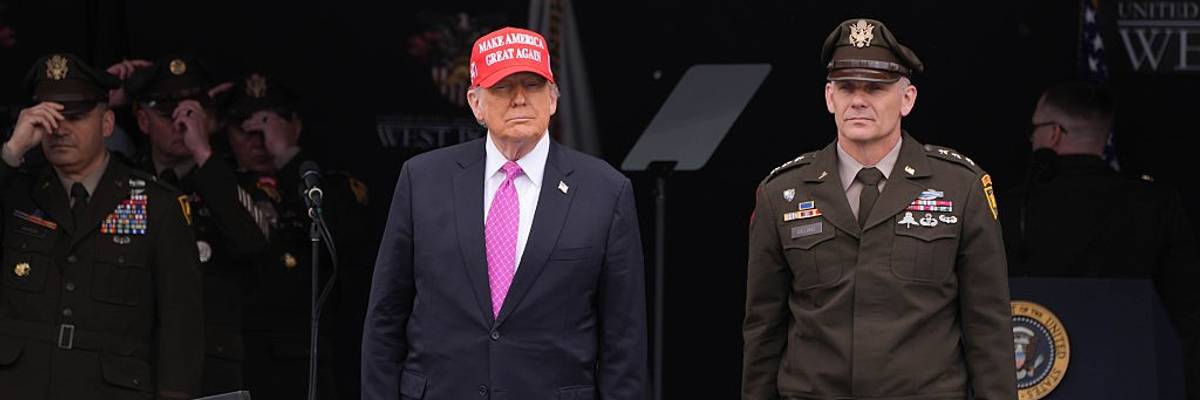
US President Donald Trump delivers his first military commencement speech since returning to office, congratulating the 2024 graduating class of the US Military Academy at West Point and emphasizing his administration's efforts to strengthen the armed forces, on May 24, 2025, in West Point, New York, United States.
During his first term, Donald Trump was reportedly dissuaded from invoking the act by former Joint Chiefs of Staff Chairman Gen. Mark Milley and other “grown-ups” in his first administration; this time around, there are no grown-ups in the building.
Donald Trump hasn’t forgotten about the Insurrection Act, and neither should you. In the face of plummeting poll numbers and public outcry over the deaths of Renée Nicole Good and Alex Pretti, Trump may appear to be retreating from his threats to deploy the military to Minneapolis and other blue state cities, but any retreat is likely to prove temporary and tactical rather than a reversal of policy.
Throughout his career, Trump has been guided by the “lessons” he learned as a young real estate hustler from his odious one-time mentor and fixer Roy Cohn: Never retreat, apologize, or admit wrongdoing, and always remain on the offensive. In keeping with Cohn’s teachings, Trump has made threats to invoke the Insurrection Act dating to June 2020, when he vowed to use it to quell mass demonstrations related to the murder of George Floyd. He was reportedly restrained at the time by former Joint Chiefs of Staff Chairman Gen. Mark Milley and other “grown-ups” in his first administration.
This time around, there are no grown-ups in the building.
Since retaking the White House, Trump has doubled down on this threat. On the first day of his second term, he issued a presidential proclamation declaring a state of emergency at the southern border that directed Defense Secretary Pete Hegseth and Homeland Security head Kristi Noem to develop plans, including using the Insurrection Act, to combat the now-familiar fantasy “invasion” of “cartels, criminal gangs, known terrorists, human traffickers, smugglers, and unvetted military-age males from foreign adversaries.” The proclamation laid the groundwork for Trump’s mass-deportation program and for giving US Immigration and Customs Enforcement and the Border Patrol the largest budgets of any police agencies in the country.
Invoking the Insurrection Act would be the biggest gambit of all, likely resulting in a historic showdown before the Supreme Court.
Trump again threatened to invoke the Insurrection Act last June, in response to protests in Los Angeles, and then again in October over demonstrations in Chicago. Although he stopped short in both instances, he has ramped up the rhetoric to new heights in reaction to the growing resistance movement in Minneapolis. Taking to Truth Social on January 15, he warned:
If the corrupt politicians of Minnesota don’t obey the law and stop the professional agitators and insurrectionists from attacking the Patriots of I.C.E., who are only trying to do their job, I will institute the INSURRECTION ACT, which many Presidents have done before me, and quickly put an end to the travesty that is taking place in that once great State.
Despite removing Border Patrol “commander at large” Greg Bovino from Minneapolis on January 26 in a gesture some observers saw as a modest measure of conciliation, the threats have escalated.
On January 27, Trump received a letter from the House Freedom Caucus, urging him to use ”all tools necessary,” including the Insurrection Act, “to maintain order in the face of unlawful obstructions and assemblages that prevent the enforcement of the laws of the United States.” Bolstered by the endorsement, Trump returned to Truth Social three days later to denounce Pretti as an “Agitator and, perhaps, insurrectionist.” And in another Truth Social screed on January 31, he pledged to “guard, and very powerfully so, any and all Federal Buildings that are being attacked by these highly paid Lunatics, Agitators, and Insurrectionists.” In a veiled reference to Pretti, he added that anyone caught “punching or kicking the headlights of our cars” or throwing bricks or rocks “at our vehicles, or at our Patriot Warriors […] will suffer an equal, or more, consequence.”
Whether Trump ultimately pulls the Insurrection Act trigger may depend on how he applies another of Roy Cohn’s lessons: Use the legal system to crush critics and opponents. Trump’s affinity for litigation is legendary. He has been involved in over 4,000 lawsuits, including several defamation actions taken against major media outlets like the New York Times, ABC, and CBS. In his second term, he has transformed the Department of Justice into his personal law firm, imposing sanctions on liberal law firms and elite universities by executive orders, and launching prosecutions against former FBI Director James Comey, New York Attorney General Letitia James, journalists Don Lemon and Georgia Fort, and scores of rank-and-file anti-ICE protesters across the country. Even when the gambits fail, as they have with Comey and James, they send the chilling message that no one who defies or offends the president is safe.
Invoking the Insurrection Act would be the biggest gambit of all, likely resulting in a historic showdown before the Supreme Court. Trump has enjoyed extraordinary success in his Supreme Court cases, and with three of his nominees on the bench, he has reason to be optimistic about any final confrontation. Still, the outcome of any such move is uncertain.
In December, the court dealt Trump a surprising setback with an interim “shadow-docket” ruling (Trump v. Illinois) that blocked him from deploying National Guard troops in and around Chicago. The ruling was widely praised by liberal legal commentators, who saw it as a hopeful sign that the nation’s highest judicial body was willing to stand up to Trump’s incessant power grabs, at least on the use of the military for domestic law-enforcement purposes.
Unfortunately, the decision was temporary—all interim orders are—and narrow. It was also a split decision, with Justices Samuel Alito, Clarence Thomas, and Neil Gorsuch dissenting.
At issue in the case was the administration’s interpretation of a vague phrase in a statute that empowers the president to federalize members of the Guard if he is “unable with the regular forces to execute the laws of the United States.” The administration argued the phrase referred to the inability of federal civilian law enforcement to maintain order during protests. The majority ruled instead that the phrase referred to the regular military, and that because Trump had not attempted to deploy the military and shown that it was unable to maintain order, he had not met the statute’s requirements.
As Justice Brett Kavanaugh noted in a concurring opinion, the decision said nothing about the president’s authority to invoke the Insurrection Act. Rather, Kavanaugh suggested, it opened the door for Trump to proceed. “One apparent ramification of the court’s opinion is that it could cause the president to use the US military more than the National Guard to protect federal personnel and property in the United States,” Kavanaugh wrote.
To be sure, any invocation of the Insurrection Act would face legal challenges over whether the country is facing an actual rebellion, and the extent to which the military, if activated, is subject to the same constitutional restraints as civilian law enforcement. The challenges could succeed at the district court level, but from there, all bets would be off. The mad king would no doubt follow the advice of his erstwhile mentor, refuse to retreat, and ask his friends on the Supreme Court to intervene and allow his attacks to continue.
Dear Common Dreams reader, It’s been nearly 30 years since I co-founded Common Dreams with my late wife, Lina Newhouser. We had the radical notion that journalism should serve the public good, not corporate profits. It was clear to us from the outset what it would take to build such a project. No paid advertisements. No corporate sponsors. No millionaire publisher telling us what to think or do. Many people said we wouldn't last a year, but we proved those doubters wrong. Together with a tremendous team of journalists and dedicated staff, we built an independent media outlet free from the constraints of profits and corporate control. Our mission has always been simple: To inform. To inspire. To ignite change for the common good. Building Common Dreams was not easy. Our survival was never guaranteed. When you take on the most powerful forces—Wall Street greed, fossil fuel industry destruction, Big Tech lobbyists, and uber-rich oligarchs who have spent billions upon billions rigging the economy and democracy in their favor—the only bulwark you have is supporters who believe in your work. But here’s the urgent message from me today. It's never been this bad out there. And it's never been this hard to keep us going. At the very moment Common Dreams is most needed, the threats we face are intensifying. We need your support now more than ever. We don't accept corporate advertising and never will. We don't have a paywall because we don't think people should be blocked from critical news based on their ability to pay. Everything we do is funded by the donations of readers like you. When everyone does the little they can afford, we are strong. But if that support retreats or dries up, so do we. Will you donate now to make sure Common Dreams not only survives but thrives? —Craig Brown, Co-founder |
Donald Trump hasn’t forgotten about the Insurrection Act, and neither should you. In the face of plummeting poll numbers and public outcry over the deaths of Renée Nicole Good and Alex Pretti, Trump may appear to be retreating from his threats to deploy the military to Minneapolis and other blue state cities, but any retreat is likely to prove temporary and tactical rather than a reversal of policy.
Throughout his career, Trump has been guided by the “lessons” he learned as a young real estate hustler from his odious one-time mentor and fixer Roy Cohn: Never retreat, apologize, or admit wrongdoing, and always remain on the offensive. In keeping with Cohn’s teachings, Trump has made threats to invoke the Insurrection Act dating to June 2020, when he vowed to use it to quell mass demonstrations related to the murder of George Floyd. He was reportedly restrained at the time by former Joint Chiefs of Staff Chairman Gen. Mark Milley and other “grown-ups” in his first administration.
This time around, there are no grown-ups in the building.
Since retaking the White House, Trump has doubled down on this threat. On the first day of his second term, he issued a presidential proclamation declaring a state of emergency at the southern border that directed Defense Secretary Pete Hegseth and Homeland Security head Kristi Noem to develop plans, including using the Insurrection Act, to combat the now-familiar fantasy “invasion” of “cartels, criminal gangs, known terrorists, human traffickers, smugglers, and unvetted military-age males from foreign adversaries.” The proclamation laid the groundwork for Trump’s mass-deportation program and for giving US Immigration and Customs Enforcement and the Border Patrol the largest budgets of any police agencies in the country.
Invoking the Insurrection Act would be the biggest gambit of all, likely resulting in a historic showdown before the Supreme Court.
Trump again threatened to invoke the Insurrection Act last June, in response to protests in Los Angeles, and then again in October over demonstrations in Chicago. Although he stopped short in both instances, he has ramped up the rhetoric to new heights in reaction to the growing resistance movement in Minneapolis. Taking to Truth Social on January 15, he warned:
If the corrupt politicians of Minnesota don’t obey the law and stop the professional agitators and insurrectionists from attacking the Patriots of I.C.E., who are only trying to do their job, I will institute the INSURRECTION ACT, which many Presidents have done before me, and quickly put an end to the travesty that is taking place in that once great State.
Despite removing Border Patrol “commander at large” Greg Bovino from Minneapolis on January 26 in a gesture some observers saw as a modest measure of conciliation, the threats have escalated.
On January 27, Trump received a letter from the House Freedom Caucus, urging him to use ”all tools necessary,” including the Insurrection Act, “to maintain order in the face of unlawful obstructions and assemblages that prevent the enforcement of the laws of the United States.” Bolstered by the endorsement, Trump returned to Truth Social three days later to denounce Pretti as an “Agitator and, perhaps, insurrectionist.” And in another Truth Social screed on January 31, he pledged to “guard, and very powerfully so, any and all Federal Buildings that are being attacked by these highly paid Lunatics, Agitators, and Insurrectionists.” In a veiled reference to Pretti, he added that anyone caught “punching or kicking the headlights of our cars” or throwing bricks or rocks “at our vehicles, or at our Patriot Warriors […] will suffer an equal, or more, consequence.”
Whether Trump ultimately pulls the Insurrection Act trigger may depend on how he applies another of Roy Cohn’s lessons: Use the legal system to crush critics and opponents. Trump’s affinity for litigation is legendary. He has been involved in over 4,000 lawsuits, including several defamation actions taken against major media outlets like the New York Times, ABC, and CBS. In his second term, he has transformed the Department of Justice into his personal law firm, imposing sanctions on liberal law firms and elite universities by executive orders, and launching prosecutions against former FBI Director James Comey, New York Attorney General Letitia James, journalists Don Lemon and Georgia Fort, and scores of rank-and-file anti-ICE protesters across the country. Even when the gambits fail, as they have with Comey and James, they send the chilling message that no one who defies or offends the president is safe.
Invoking the Insurrection Act would be the biggest gambit of all, likely resulting in a historic showdown before the Supreme Court. Trump has enjoyed extraordinary success in his Supreme Court cases, and with three of his nominees on the bench, he has reason to be optimistic about any final confrontation. Still, the outcome of any such move is uncertain.
In December, the court dealt Trump a surprising setback with an interim “shadow-docket” ruling (Trump v. Illinois) that blocked him from deploying National Guard troops in and around Chicago. The ruling was widely praised by liberal legal commentators, who saw it as a hopeful sign that the nation’s highest judicial body was willing to stand up to Trump’s incessant power grabs, at least on the use of the military for domestic law-enforcement purposes.
Unfortunately, the decision was temporary—all interim orders are—and narrow. It was also a split decision, with Justices Samuel Alito, Clarence Thomas, and Neil Gorsuch dissenting.
At issue in the case was the administration’s interpretation of a vague phrase in a statute that empowers the president to federalize members of the Guard if he is “unable with the regular forces to execute the laws of the United States.” The administration argued the phrase referred to the inability of federal civilian law enforcement to maintain order during protests. The majority ruled instead that the phrase referred to the regular military, and that because Trump had not attempted to deploy the military and shown that it was unable to maintain order, he had not met the statute’s requirements.
As Justice Brett Kavanaugh noted in a concurring opinion, the decision said nothing about the president’s authority to invoke the Insurrection Act. Rather, Kavanaugh suggested, it opened the door for Trump to proceed. “One apparent ramification of the court’s opinion is that it could cause the president to use the US military more than the National Guard to protect federal personnel and property in the United States,” Kavanaugh wrote.
To be sure, any invocation of the Insurrection Act would face legal challenges over whether the country is facing an actual rebellion, and the extent to which the military, if activated, is subject to the same constitutional restraints as civilian law enforcement. The challenges could succeed at the district court level, but from there, all bets would be off. The mad king would no doubt follow the advice of his erstwhile mentor, refuse to retreat, and ask his friends on the Supreme Court to intervene and allow his attacks to continue.
Donald Trump hasn’t forgotten about the Insurrection Act, and neither should you. In the face of plummeting poll numbers and public outcry over the deaths of Renée Nicole Good and Alex Pretti, Trump may appear to be retreating from his threats to deploy the military to Minneapolis and other blue state cities, but any retreat is likely to prove temporary and tactical rather than a reversal of policy.
Throughout his career, Trump has been guided by the “lessons” he learned as a young real estate hustler from his odious one-time mentor and fixer Roy Cohn: Never retreat, apologize, or admit wrongdoing, and always remain on the offensive. In keeping with Cohn’s teachings, Trump has made threats to invoke the Insurrection Act dating to June 2020, when he vowed to use it to quell mass demonstrations related to the murder of George Floyd. He was reportedly restrained at the time by former Joint Chiefs of Staff Chairman Gen. Mark Milley and other “grown-ups” in his first administration.
This time around, there are no grown-ups in the building.
Since retaking the White House, Trump has doubled down on this threat. On the first day of his second term, he issued a presidential proclamation declaring a state of emergency at the southern border that directed Defense Secretary Pete Hegseth and Homeland Security head Kristi Noem to develop plans, including using the Insurrection Act, to combat the now-familiar fantasy “invasion” of “cartels, criminal gangs, known terrorists, human traffickers, smugglers, and unvetted military-age males from foreign adversaries.” The proclamation laid the groundwork for Trump’s mass-deportation program and for giving US Immigration and Customs Enforcement and the Border Patrol the largest budgets of any police agencies in the country.
Invoking the Insurrection Act would be the biggest gambit of all, likely resulting in a historic showdown before the Supreme Court.
Trump again threatened to invoke the Insurrection Act last June, in response to protests in Los Angeles, and then again in October over demonstrations in Chicago. Although he stopped short in both instances, he has ramped up the rhetoric to new heights in reaction to the growing resistance movement in Minneapolis. Taking to Truth Social on January 15, he warned:
If the corrupt politicians of Minnesota don’t obey the law and stop the professional agitators and insurrectionists from attacking the Patriots of I.C.E., who are only trying to do their job, I will institute the INSURRECTION ACT, which many Presidents have done before me, and quickly put an end to the travesty that is taking place in that once great State.
Despite removing Border Patrol “commander at large” Greg Bovino from Minneapolis on January 26 in a gesture some observers saw as a modest measure of conciliation, the threats have escalated.
On January 27, Trump received a letter from the House Freedom Caucus, urging him to use ”all tools necessary,” including the Insurrection Act, “to maintain order in the face of unlawful obstructions and assemblages that prevent the enforcement of the laws of the United States.” Bolstered by the endorsement, Trump returned to Truth Social three days later to denounce Pretti as an “Agitator and, perhaps, insurrectionist.” And in another Truth Social screed on January 31, he pledged to “guard, and very powerfully so, any and all Federal Buildings that are being attacked by these highly paid Lunatics, Agitators, and Insurrectionists.” In a veiled reference to Pretti, he added that anyone caught “punching or kicking the headlights of our cars” or throwing bricks or rocks “at our vehicles, or at our Patriot Warriors […] will suffer an equal, or more, consequence.”
Whether Trump ultimately pulls the Insurrection Act trigger may depend on how he applies another of Roy Cohn’s lessons: Use the legal system to crush critics and opponents. Trump’s affinity for litigation is legendary. He has been involved in over 4,000 lawsuits, including several defamation actions taken against major media outlets like the New York Times, ABC, and CBS. In his second term, he has transformed the Department of Justice into his personal law firm, imposing sanctions on liberal law firms and elite universities by executive orders, and launching prosecutions against former FBI Director James Comey, New York Attorney General Letitia James, journalists Don Lemon and Georgia Fort, and scores of rank-and-file anti-ICE protesters across the country. Even when the gambits fail, as they have with Comey and James, they send the chilling message that no one who defies or offends the president is safe.
Invoking the Insurrection Act would be the biggest gambit of all, likely resulting in a historic showdown before the Supreme Court. Trump has enjoyed extraordinary success in his Supreme Court cases, and with three of his nominees on the bench, he has reason to be optimistic about any final confrontation. Still, the outcome of any such move is uncertain.
In December, the court dealt Trump a surprising setback with an interim “shadow-docket” ruling (Trump v. Illinois) that blocked him from deploying National Guard troops in and around Chicago. The ruling was widely praised by liberal legal commentators, who saw it as a hopeful sign that the nation’s highest judicial body was willing to stand up to Trump’s incessant power grabs, at least on the use of the military for domestic law-enforcement purposes.
Unfortunately, the decision was temporary—all interim orders are—and narrow. It was also a split decision, with Justices Samuel Alito, Clarence Thomas, and Neil Gorsuch dissenting.
At issue in the case was the administration’s interpretation of a vague phrase in a statute that empowers the president to federalize members of the Guard if he is “unable with the regular forces to execute the laws of the United States.” The administration argued the phrase referred to the inability of federal civilian law enforcement to maintain order during protests. The majority ruled instead that the phrase referred to the regular military, and that because Trump had not attempted to deploy the military and shown that it was unable to maintain order, he had not met the statute’s requirements.
As Justice Brett Kavanaugh noted in a concurring opinion, the decision said nothing about the president’s authority to invoke the Insurrection Act. Rather, Kavanaugh suggested, it opened the door for Trump to proceed. “One apparent ramification of the court’s opinion is that it could cause the president to use the US military more than the National Guard to protect federal personnel and property in the United States,” Kavanaugh wrote.
To be sure, any invocation of the Insurrection Act would face legal challenges over whether the country is facing an actual rebellion, and the extent to which the military, if activated, is subject to the same constitutional restraints as civilian law enforcement. The challenges could succeed at the district court level, but from there, all bets would be off. The mad king would no doubt follow the advice of his erstwhile mentor, refuse to retreat, and ask his friends on the Supreme Court to intervene and allow his attacks to continue.