5
#000000
#FFFFFF
To donate by check, phone, or other method, see our More Ways to Give page.
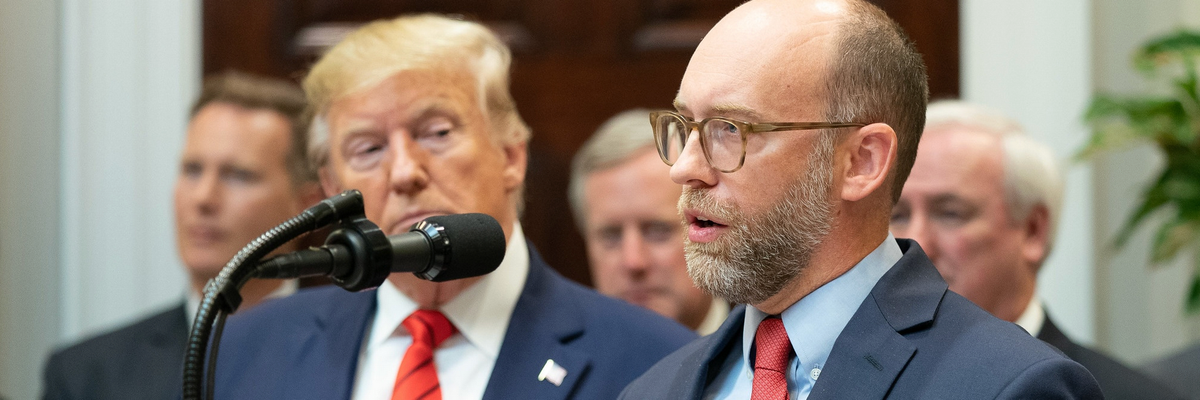
Although the 2026 midterm elections present the most immediate opportunity for Democrats to capitalize on widespread public discontent with the current Republican-controlled Congress, unofficial preparation for the 2028 presidential race has already started to take shape.
Gavin Newsom is rallying Democrats in Texas; Josh Shapiro is flexing his battleground state bona fides across Pennsylvania; Pete Buttigieg is headlining town halls in Iowa; while Ro Khanna and AOC are jockeying to consolidate the progressive lane.
Whatever their differences on policy and posture, these candidates share a common blind spot: they are not talking nearly enough about Russell Vought.
Whether we’re recounting the Department of Government Efficiency’s infiltration of the federal government or tracking the day-to-day material harms created by Trump administration policymaking, RDP has urgently sought to classify Vought as Trump 2.0’s top villain.
Democrats, however, have badly underinvested in making Vought as infamous as Elon Musk, his former DOGE co-lead. Our Kenny Stancil recently examined this reality in a Talking Points Memo op-ed, where he observed that:
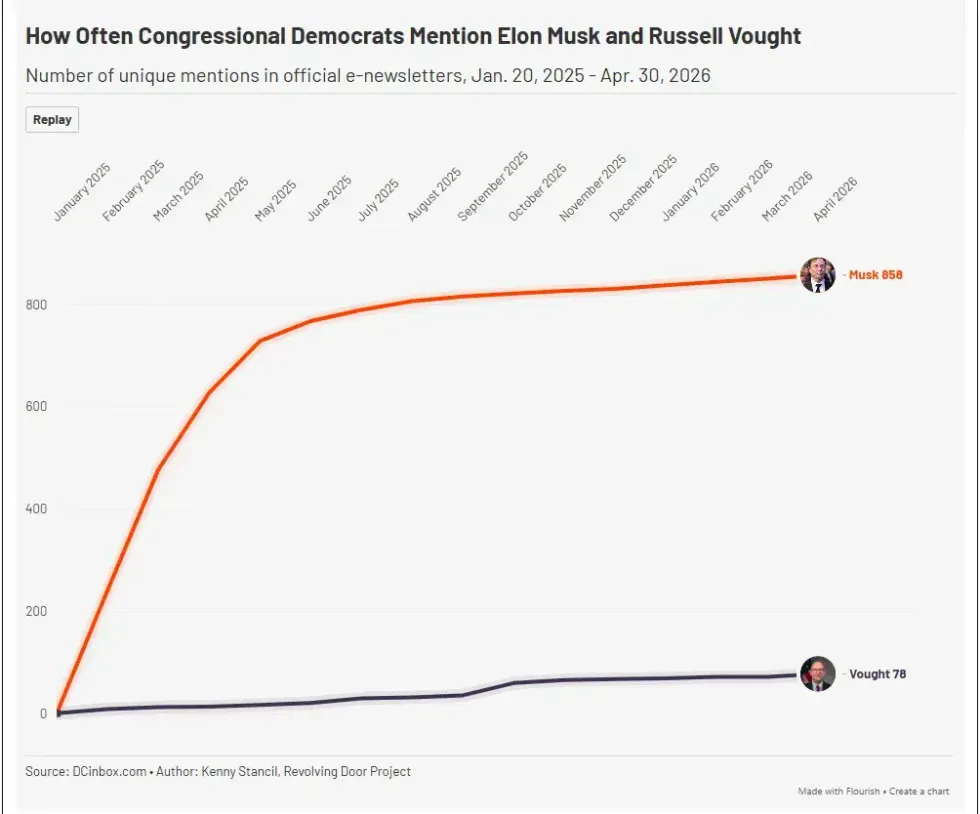
“Democrats sent 478 unique emails mentioning Musk from January 27 to March 31, 2025—including 91 sent during the week of January 31 to February 7, the zenith of Musk’s D.C. rampage when DOGE infiltrated the Treasury Department and shuttered the U.S. Agency for International Development. In comparison, Democrats mentioned Vought in just 28 emails between October 1 and November 12, 2025, even as the OMB director used the government shutdown to intensify his longstanding efforts to gut federal agencies and block the disbursement of congressionally appropriated funds [...] In all, Democratic lawmakers mentioned Vought in just 78 e-newsletters sent between January 20, 2025 and April 30, 2026. Musk, by contrast, was invoked in 858 emails during the same period—11 times more often.”
The ambitious politicians quietly auditioning for the Democratic presidential nomination have no reason to continue making this mistake. Any candidate serious about their presidential bid has both a strategic and moral imperative to build a coherent narrative against Vought—the main engineer behind the GOP’s government power grab.
The case for candidates to make Vought a central villain in their 2028 campaigns is not merely because he deserves the attention. It’s also a political layup hiding in plain sight.
Presidential campaigns are, at their core, exercises in narrative construction. The most durable campaigns provide a compelling explanation of what went wrong and—most importantly—who’s at fault. FDR had his “economic royalists;” Obama had the financial industry that cratered the economy; and Biden had the chaotic Trump 1.0 administration and its lethal mishandling of the Covid-19 pandemic and economic crisis.
The 2028 Democratic presidential nominee will need a similarly coherent villain. Vought embodies that role more completely than any other figure in the Trump administration, including Trump himself.
What makes Vought so uniquely suited for this role is his position as both the connective tissue between Trump’s two terms and the architect of a right-wing political project that will outlast Trump. Vought was a principal architect of Project 2025, the Heritage Foundation-led blueprint for restructuring the executive branch around (Trump’s) unchecked presidential power. Vought’s fingerprints are on the document’s most radical chapters, including the one laying out a strategy to dismantle the administrative state. When Trump is gone, the devastation Vought wrought—gutted agencies, traumatized civil servants, impounded funds, weakened congressional oversight—will remain.
The 2028 Democratic nominee will be running, in part, on a platform of de-Trumpification and pro-democracy reconstruction. To make that transformative project tangible, voters need to understand what was destroyed, how systematically it was destroyed, and by whom. Vought is the answer to all three questions.
Moreover, the Republican nominee will be able to point to the fact that they are (presumably!) not Trump and seek to distance themselves from Trump. But Vought, the glue that binds each of the disparate elements of the GOP together, and Voughtism will still be around. The Republican party is not going to disavow corporate funded right wing think tanks, Christian nationalism, or boring but incredibly powerful white guys. Vought and Voughtism, unlike Trump, will not be disavowed.
One advantage that 2028 candidates have over their counterparts in prior cycles is that the evidence against Vought is not abstract or speculative; it is documented, voluminous, and in many cases already adjudicated as illegal.
Consider the impoundment campaign alone. Since the start of Trump’s second term, the Government Accountability Office has identified at least six instances in which the administration committed clear violations of the Impoundment Control Act—the post-Nixon law passed specifically to prevent presidents from unilaterally withholding congressionally approved spending.
When Vought isn’t handwaving away these violations as “non-events with no consequence,” he’s blatantly lying to the American public about his illegal activity. At his April 2026 Senate Budget Committee testimony, Vought flatly denied having impounded any funds.
2028 hopefuls should be rallying around the negative consequences of Vought’s efforts to veto socially useful spending and harm government workers:
None of this is the product of partisan gridlock or legislative failure. It is the deliberate handiwork of one man operating with a coherent ideological agenda, largely outside public view. Presidential campaigns exist to bring that kind of structural harm into public view.
Another aspect of Vought’s record that has direct implications for 2028 campaign strategy is what historian Colin Gordon calls “vindictive federalism:” the systematic withholding of federal funds from Democratic-led states and cities as a coercive tool to force compliance with the administration’s agenda. Our Aya Dardari explores this topic in detail in a new report.
This is not a peripheral concern for governors like Newsom or Shapiro. It is a direct attack on their executive authority and their constituents’ livelihoods. When Vought’s OMB freezes Medicaid reimbursements in California, or holds up SNAP payments in Pennsylvania, he isn’t engaging in abstract federal policy disputes. Vought’s actions inflict tangible harm upon real communities, which governors eyeing a 2028 run are well-positioned to document, personalize, and prosecute politically.
Any governor in the field should be holding press conferences that connect Vought’s funding maneuvers to closed roads, delayed medical treatments, and disrupted social services in their states. The argument writes itself: this is what a shadow president operating without accountability looks like, and this is what a Democratic administration will undo.
The 2026 midterms will consume most of the political oxygen between now and the formal start of the 2028 presidential race. But the pre-campaign period is precisely when narratives get built. Voters aren’t introduced to presidential candidates fresh in a general election; they encounter them having already absorbed years of framing and counter-framing about the state of the country.
The framing that will serve Democrats best in 2028 is one that identifies the damage, names the responsible party, and makes a credible case for restoration—and Vought gives the 2028 field everything they need to construct that framing:
The political process for building that case is not glamorous. It requires sustained attention to a man who is deliberately uncharismatic and strategically obscure. It also requires candidates to make the OMB directorship feel as urgent as any Cabinet post with a higher public profile.
But the alternative—arriving at the 2028 general election without having made Russell Vought a known, notorious quantity—is a gift to the Republican Party and the man who has spent decades reshaping the federal government in ways that no single election can easily reverse.
The 2028 Democratic nominee will be asking voters to believe that government can work for them again. The most compelling version of that argument starts with explaining, in detail, who broke it.
Although the 2026 midterm elections present the most immediate opportunity for Democrats to capitalize on widespread public discontent with the current Republican-controlled Congress, unofficial preparation for the 2028 presidential race has already started to take shape.
Gavin Newsom is rallying Democrats in Texas; Josh Shapiro is flexing his battleground state bona fides across Pennsylvania; Pete Buttigieg is headlining town halls in Iowa; while Ro Khanna and AOC are jockeying to consolidate the progressive lane.
Whatever their differences on policy and posture, these candidates share a common blind spot: they are not talking nearly enough about Russell Vought.
Whether we’re recounting the Department of Government Efficiency’s infiltration of the federal government or tracking the day-to-day material harms created by Trump administration policymaking, RDP has urgently sought to classify Vought as Trump 2.0’s top villain.
Democrats, however, have badly underinvested in making Vought as infamous as Elon Musk, his former DOGE co-lead. Our Kenny Stancil recently examined this reality in a Talking Points Memo op-ed, where he observed that:
“Democrats sent 478 unique emails mentioning Musk from January 27 to March 31, 2025—including 91 sent during the week of January 31 to February 7, the zenith of Musk’s D.C. rampage when DOGE infiltrated the Treasury Department and shuttered the U.S. Agency for International Development. In comparison, Democrats mentioned Vought in just 28 emails between October 1 and November 12, 2025, even as the OMB director used the government shutdown to intensify his longstanding efforts to gut federal agencies and block the disbursement of congressionally appropriated funds [...] In all, Democratic lawmakers mentioned Vought in just 78 e-newsletters sent between January 20, 2025 and April 30, 2026. Musk, by contrast, was invoked in 858 emails during the same period—11 times more often.”
The ambitious politicians quietly auditioning for the Democratic presidential nomination have no reason to continue making this mistake. Any candidate serious about their presidential bid has both a strategic and moral imperative to build a coherent narrative against Vought—the main engineer behind the GOP’s government power grab.
The case for candidates to make Vought a central villain in their 2028 campaigns is not merely because he deserves the attention. It’s also a political layup hiding in plain sight.
Presidential campaigns are, at their core, exercises in narrative construction. The most durable campaigns provide a compelling explanation of what went wrong and—most importantly—who’s at fault. FDR had his “economic royalists;” Obama had the financial industry that cratered the economy; and Biden had the chaotic Trump 1.0 administration and its lethal mishandling of the Covid-19 pandemic and economic crisis.
The 2028 Democratic presidential nominee will need a similarly coherent villain. Vought embodies that role more completely than any other figure in the Trump administration, including Trump himself.
What makes Vought so uniquely suited for this role is his position as both the connective tissue between Trump’s two terms and the architect of a right-wing political project that will outlast Trump. Vought was a principal architect of Project 2025, the Heritage Foundation-led blueprint for restructuring the executive branch around (Trump’s) unchecked presidential power. Vought’s fingerprints are on the document’s most radical chapters, including the one laying out a strategy to dismantle the administrative state. When Trump is gone, the devastation Vought wrought—gutted agencies, traumatized civil servants, impounded funds, weakened congressional oversight—will remain.
The 2028 Democratic nominee will be running, in part, on a platform of de-Trumpification and pro-democracy reconstruction. To make that transformative project tangible, voters need to understand what was destroyed, how systematically it was destroyed, and by whom. Vought is the answer to all three questions.
Moreover, the Republican nominee will be able to point to the fact that they are (presumably!) not Trump and seek to distance themselves from Trump. But Vought, the glue that binds each of the disparate elements of the GOP together, and Voughtism will still be around. The Republican party is not going to disavow corporate funded right wing think tanks, Christian nationalism, or boring but incredibly powerful white guys. Vought and Voughtism, unlike Trump, will not be disavowed.
One advantage that 2028 candidates have over their counterparts in prior cycles is that the evidence against Vought is not abstract or speculative; it is documented, voluminous, and in many cases already adjudicated as illegal.
Consider the impoundment campaign alone. Since the start of Trump’s second term, the Government Accountability Office has identified at least six instances in which the administration committed clear violations of the Impoundment Control Act—the post-Nixon law passed specifically to prevent presidents from unilaterally withholding congressionally approved spending.
When Vought isn’t handwaving away these violations as “non-events with no consequence,” he’s blatantly lying to the American public about his illegal activity. At his April 2026 Senate Budget Committee testimony, Vought flatly denied having impounded any funds.
2028 hopefuls should be rallying around the negative consequences of Vought’s efforts to veto socially useful spending and harm government workers:
None of this is the product of partisan gridlock or legislative failure. It is the deliberate handiwork of one man operating with a coherent ideological agenda, largely outside public view. Presidential campaigns exist to bring that kind of structural harm into public view.
Another aspect of Vought’s record that has direct implications for 2028 campaign strategy is what historian Colin Gordon calls “vindictive federalism:” the systematic withholding of federal funds from Democratic-led states and cities as a coercive tool to force compliance with the administration’s agenda. Our Aya Dardari explores this topic in detail in a new report.
This is not a peripheral concern for governors like Newsom or Shapiro. It is a direct attack on their executive authority and their constituents’ livelihoods. When Vought’s OMB freezes Medicaid reimbursements in California, or holds up SNAP payments in Pennsylvania, he isn’t engaging in abstract federal policy disputes. Vought’s actions inflict tangible harm upon real communities, which governors eyeing a 2028 run are well-positioned to document, personalize, and prosecute politically.
Any governor in the field should be holding press conferences that connect Vought’s funding maneuvers to closed roads, delayed medical treatments, and disrupted social services in their states. The argument writes itself: this is what a shadow president operating without accountability looks like, and this is what a Democratic administration will undo.
The 2026 midterms will consume most of the political oxygen between now and the formal start of the 2028 presidential race. But the pre-campaign period is precisely when narratives get built. Voters aren’t introduced to presidential candidates fresh in a general election; they encounter them having already absorbed years of framing and counter-framing about the state of the country.
The framing that will serve Democrats best in 2028 is one that identifies the damage, names the responsible party, and makes a credible case for restoration—and Vought gives the 2028 field everything they need to construct that framing:
The political process for building that case is not glamorous. It requires sustained attention to a man who is deliberately uncharismatic and strategically obscure. It also requires candidates to make the OMB directorship feel as urgent as any Cabinet post with a higher public profile.
But the alternative—arriving at the 2028 general election without having made Russell Vought a known, notorious quantity—is a gift to the Republican Party and the man who has spent decades reshaping the federal government in ways that no single election can easily reverse.
The 2028 Democratic nominee will be asking voters to believe that government can work for them again. The most compelling version of that argument starts with explaining, in detail, who broke it.
Although the 2026 midterm elections present the most immediate opportunity for Democrats to capitalize on widespread public discontent with the current Republican-controlled Congress, unofficial preparation for the 2028 presidential race has already started to take shape.
Gavin Newsom is rallying Democrats in Texas; Josh Shapiro is flexing his battleground state bona fides across Pennsylvania; Pete Buttigieg is headlining town halls in Iowa; while Ro Khanna and AOC are jockeying to consolidate the progressive lane.
Whatever their differences on policy and posture, these candidates share a common blind spot: they are not talking nearly enough about Russell Vought.
Whether we’re recounting the Department of Government Efficiency’s infiltration of the federal government or tracking the day-to-day material harms created by Trump administration policymaking, RDP has urgently sought to classify Vought as Trump 2.0’s top villain.
Democrats, however, have badly underinvested in making Vought as infamous as Elon Musk, his former DOGE co-lead. Our Kenny Stancil recently examined this reality in a Talking Points Memo op-ed, where he observed that:
“Democrats sent 478 unique emails mentioning Musk from January 27 to March 31, 2025—including 91 sent during the week of January 31 to February 7, the zenith of Musk’s D.C. rampage when DOGE infiltrated the Treasury Department and shuttered the U.S. Agency for International Development. In comparison, Democrats mentioned Vought in just 28 emails between October 1 and November 12, 2025, even as the OMB director used the government shutdown to intensify his longstanding efforts to gut federal agencies and block the disbursement of congressionally appropriated funds [...] In all, Democratic lawmakers mentioned Vought in just 78 e-newsletters sent between January 20, 2025 and April 30, 2026. Musk, by contrast, was invoked in 858 emails during the same period—11 times more often.”
The ambitious politicians quietly auditioning for the Democratic presidential nomination have no reason to continue making this mistake. Any candidate serious about their presidential bid has both a strategic and moral imperative to build a coherent narrative against Vought—the main engineer behind the GOP’s government power grab.
The case for candidates to make Vought a central villain in their 2028 campaigns is not merely because he deserves the attention. It’s also a political layup hiding in plain sight.
Presidential campaigns are, at their core, exercises in narrative construction. The most durable campaigns provide a compelling explanation of what went wrong and—most importantly—who’s at fault. FDR had his “economic royalists;” Obama had the financial industry that cratered the economy; and Biden had the chaotic Trump 1.0 administration and its lethal mishandling of the Covid-19 pandemic and economic crisis.
The 2028 Democratic presidential nominee will need a similarly coherent villain. Vought embodies that role more completely than any other figure in the Trump administration, including Trump himself.
What makes Vought so uniquely suited for this role is his position as both the connective tissue between Trump’s two terms and the architect of a right-wing political project that will outlast Trump. Vought was a principal architect of Project 2025, the Heritage Foundation-led blueprint for restructuring the executive branch around (Trump’s) unchecked presidential power. Vought’s fingerprints are on the document’s most radical chapters, including the one laying out a strategy to dismantle the administrative state. When Trump is gone, the devastation Vought wrought—gutted agencies, traumatized civil servants, impounded funds, weakened congressional oversight—will remain.
The 2028 Democratic nominee will be running, in part, on a platform of de-Trumpification and pro-democracy reconstruction. To make that transformative project tangible, voters need to understand what was destroyed, how systematically it was destroyed, and by whom. Vought is the answer to all three questions.
Moreover, the Republican nominee will be able to point to the fact that they are (presumably!) not Trump and seek to distance themselves from Trump. But Vought, the glue that binds each of the disparate elements of the GOP together, and Voughtism will still be around. The Republican party is not going to disavow corporate funded right wing think tanks, Christian nationalism, or boring but incredibly powerful white guys. Vought and Voughtism, unlike Trump, will not be disavowed.
One advantage that 2028 candidates have over their counterparts in prior cycles is that the evidence against Vought is not abstract or speculative; it is documented, voluminous, and in many cases already adjudicated as illegal.
Consider the impoundment campaign alone. Since the start of Trump’s second term, the Government Accountability Office has identified at least six instances in which the administration committed clear violations of the Impoundment Control Act—the post-Nixon law passed specifically to prevent presidents from unilaterally withholding congressionally approved spending.
When Vought isn’t handwaving away these violations as “non-events with no consequence,” he’s blatantly lying to the American public about his illegal activity. At his April 2026 Senate Budget Committee testimony, Vought flatly denied having impounded any funds.
2028 hopefuls should be rallying around the negative consequences of Vought’s efforts to veto socially useful spending and harm government workers:
None of this is the product of partisan gridlock or legislative failure. It is the deliberate handiwork of one man operating with a coherent ideological agenda, largely outside public view. Presidential campaigns exist to bring that kind of structural harm into public view.
Another aspect of Vought’s record that has direct implications for 2028 campaign strategy is what historian Colin Gordon calls “vindictive federalism:” the systematic withholding of federal funds from Democratic-led states and cities as a coercive tool to force compliance with the administration’s agenda. Our Aya Dardari explores this topic in detail in a new report.
This is not a peripheral concern for governors like Newsom or Shapiro. It is a direct attack on their executive authority and their constituents’ livelihoods. When Vought’s OMB freezes Medicaid reimbursements in California, or holds up SNAP payments in Pennsylvania, he isn’t engaging in abstract federal policy disputes. Vought’s actions inflict tangible harm upon real communities, which governors eyeing a 2028 run are well-positioned to document, personalize, and prosecute politically.
Any governor in the field should be holding press conferences that connect Vought’s funding maneuvers to closed roads, delayed medical treatments, and disrupted social services in their states. The argument writes itself: this is what a shadow president operating without accountability looks like, and this is what a Democratic administration will undo.
The 2026 midterms will consume most of the political oxygen between now and the formal start of the 2028 presidential race. But the pre-campaign period is precisely when narratives get built. Voters aren’t introduced to presidential candidates fresh in a general election; they encounter them having already absorbed years of framing and counter-framing about the state of the country.
The framing that will serve Democrats best in 2028 is one that identifies the damage, names the responsible party, and makes a credible case for restoration—and Vought gives the 2028 field everything they need to construct that framing:
The political process for building that case is not glamorous. It requires sustained attention to a man who is deliberately uncharismatic and strategically obscure. It also requires candidates to make the OMB directorship feel as urgent as any Cabinet post with a higher public profile.
But the alternative—arriving at the 2028 general election without having made Russell Vought a known, notorious quantity—is a gift to the Republican Party and the man who has spent decades reshaping the federal government in ways that no single election can easily reverse.
The 2028 Democratic nominee will be asking voters to believe that government can work for them again. The most compelling version of that argument starts with explaining, in detail, who broke it.