SUBSCRIBE TO OUR FREE NEWSLETTER
Daily news & progressive opinion—funded by the people, not the corporations—delivered straight to your inbox.
5
#000000
#FFFFFF
To donate by check, phone, or other method, see our More Ways to Give page.
Daily news & progressive opinion—funded by the people, not the corporations—delivered straight to your inbox.
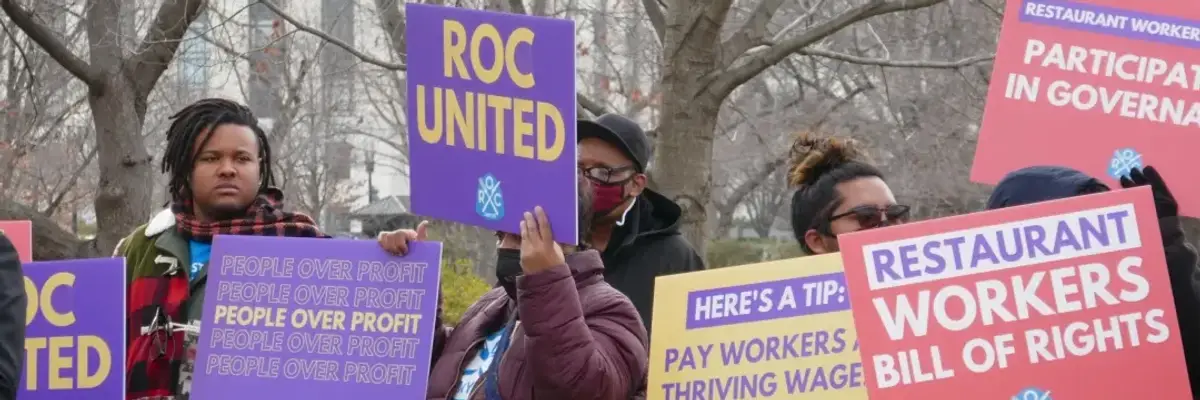
Restaurant workers rally for a living wage in Washington, D.C. in 2022.
This movement is growing rapidly as workers across the country demand livable wages.
Growing up, I looked up to my father and aunt, who began restaurant industry careers after immigrating from Eritrea in the 1970s. When I started working, a restaurant job was a natural choice.
While I took great pride in my work, I struggled with the conditions. I was often on my feet for 10-12 hour shifts six days a week, had no access to affordable healthcare, was wholly unaware of my worker rights, and constantly worried about money.
Through laws rooted in slavery, employers are allowed to pay restaurant servers a sub-minimum wage. At the federal level, this wage has been stuck at $2.13 per hour since 1991. If tips don’t raise your hourly pay to at least the regular minimum wage, your employer is supposed to make up the difference. But non-compliance is rampant.
A recent report by the Institute for Policy Studies and Americans for Tax Fairness shows that while Darden was fighting minimum wage increases for their servers, they paid their top five executives a total of $120 million between 2018 and 2022.
When I started as a server in 2018, my hourly wage was $3.89. During the five-month off season, I struggled to make the regular minimum wage, especially if I had a section with empty tables. When I got injured on the job and asked about workers compensation, my manager fired me.
I later experienced what I believed to be wage theft and workplace discrimination. That’s when I joined the movement to end restaurant worker exploitation.
This movement is growing rapidly as workers across the country demand livable wages. Organizers are working to put minimum wage hikes for tipped workers on November ballots in several states, including Ohio, Maine, Maryland, and Massachusetts. A dozen states are considering legislation to do the same.
I can tell you the opposition to these efforts will be fierce.
I live in Washington, D.C. In 2018, I cheered when D.C. voters passed a ballot initiative to phase out the local sub-minimum wage for tipped workers. But the city council blocked the wage hike, forcing organizers to mount another successful ballot initiative in 2022.
D.C. finally began phasing out the sub-minimum tipped wage in 2023. And yet many restaurant owners are still undercutting workers by charging 20% “service fees” that most customers mistakenly think go to their servers, so they’re likely to tip less.
The National Restaurant Association, with affiliates in every state, is the leading driver of these anti-worker efforts. The lobby group’s members include powerful corporations intent on shifting business risks and costs onto employees, customers, and taxpayers.
I used to work for one of them. In 2019, I had a job at Yard House, which is part of the Darden empire along with Olive Garden and seven other chains.
I faced a common challenge for sports bar servers: Groups would come in to watch a game for several hours, only to leave a modest tip on a $30 bill. Inexperienced managers would also often send me home as soon as I arrived because of overstaffing. On those nights, my pay would be less than my transportation cost.
A recent report by the Institute for Policy Studies and Americans for Tax Fairness shows that while Darden was fighting minimum wage increases for their servers, they paid their top five executives a total of $120 million between 2018 and 2022. That’s four times as much as they paid in federal taxes, despite strong profits.
After college graduation, I decided to work full-time as a labor organizer. With so many immigrants relying on restaurants for jobs, this struggle feels personal. But we’d all be better off if corporations like Darden had to share their profits more equitably.
Workers could achieve a better life and restaurants would have less turnover. And for customers, the food will taste even better if they know the hard-working professionals who serve their meals are treated with respect.
Dear Common Dreams reader, It’s been nearly 30 years since I co-founded Common Dreams with my late wife, Lina Newhouser. We had the radical notion that journalism should serve the public good, not corporate profits. It was clear to us from the outset what it would take to build such a project. No paid advertisements. No corporate sponsors. No millionaire publisher telling us what to think or do. Many people said we wouldn't last a year, but we proved those doubters wrong. Together with a tremendous team of journalists and dedicated staff, we built an independent media outlet free from the constraints of profits and corporate control. Our mission has always been simple: To inform. To inspire. To ignite change for the common good. Building Common Dreams was not easy. Our survival was never guaranteed. When you take on the most powerful forces—Wall Street greed, fossil fuel industry destruction, Big Tech lobbyists, and uber-rich oligarchs who have spent billions upon billions rigging the economy and democracy in their favor—the only bulwark you have is supporters who believe in your work. But here’s the urgent message from me today. It's never been this bad out there. And it's never been this hard to keep us going. At the very moment Common Dreams is most needed, the threats we face are intensifying. We need your support now more than ever. We don't accept corporate advertising and never will. We don't have a paywall because we don't think people should be blocked from critical news based on their ability to pay. Everything we do is funded by the donations of readers like you. When everyone does the little they can afford, we are strong. But if that support retreats or dries up, so do we. Will you donate now to make sure Common Dreams not only survives but thrives? —Craig Brown, Co-founder |
Growing up, I looked up to my father and aunt, who began restaurant industry careers after immigrating from Eritrea in the 1970s. When I started working, a restaurant job was a natural choice.
While I took great pride in my work, I struggled with the conditions. I was often on my feet for 10-12 hour shifts six days a week, had no access to affordable healthcare, was wholly unaware of my worker rights, and constantly worried about money.
Through laws rooted in slavery, employers are allowed to pay restaurant servers a sub-minimum wage. At the federal level, this wage has been stuck at $2.13 per hour since 1991. If tips don’t raise your hourly pay to at least the regular minimum wage, your employer is supposed to make up the difference. But non-compliance is rampant.
A recent report by the Institute for Policy Studies and Americans for Tax Fairness shows that while Darden was fighting minimum wage increases for their servers, they paid their top five executives a total of $120 million between 2018 and 2022.
When I started as a server in 2018, my hourly wage was $3.89. During the five-month off season, I struggled to make the regular minimum wage, especially if I had a section with empty tables. When I got injured on the job and asked about workers compensation, my manager fired me.
I later experienced what I believed to be wage theft and workplace discrimination. That’s when I joined the movement to end restaurant worker exploitation.
This movement is growing rapidly as workers across the country demand livable wages. Organizers are working to put minimum wage hikes for tipped workers on November ballots in several states, including Ohio, Maine, Maryland, and Massachusetts. A dozen states are considering legislation to do the same.
I can tell you the opposition to these efforts will be fierce.
I live in Washington, D.C. In 2018, I cheered when D.C. voters passed a ballot initiative to phase out the local sub-minimum wage for tipped workers. But the city council blocked the wage hike, forcing organizers to mount another successful ballot initiative in 2022.
D.C. finally began phasing out the sub-minimum tipped wage in 2023. And yet many restaurant owners are still undercutting workers by charging 20% “service fees” that most customers mistakenly think go to their servers, so they’re likely to tip less.
The National Restaurant Association, with affiliates in every state, is the leading driver of these anti-worker efforts. The lobby group’s members include powerful corporations intent on shifting business risks and costs onto employees, customers, and taxpayers.
I used to work for one of them. In 2019, I had a job at Yard House, which is part of the Darden empire along with Olive Garden and seven other chains.
I faced a common challenge for sports bar servers: Groups would come in to watch a game for several hours, only to leave a modest tip on a $30 bill. Inexperienced managers would also often send me home as soon as I arrived because of overstaffing. On those nights, my pay would be less than my transportation cost.
A recent report by the Institute for Policy Studies and Americans for Tax Fairness shows that while Darden was fighting minimum wage increases for their servers, they paid their top five executives a total of $120 million between 2018 and 2022. That’s four times as much as they paid in federal taxes, despite strong profits.
After college graduation, I decided to work full-time as a labor organizer. With so many immigrants relying on restaurants for jobs, this struggle feels personal. But we’d all be better off if corporations like Darden had to share their profits more equitably.
Workers could achieve a better life and restaurants would have less turnover. And for customers, the food will taste even better if they know the hard-working professionals who serve their meals are treated with respect.
Growing up, I looked up to my father and aunt, who began restaurant industry careers after immigrating from Eritrea in the 1970s. When I started working, a restaurant job was a natural choice.
While I took great pride in my work, I struggled with the conditions. I was often on my feet for 10-12 hour shifts six days a week, had no access to affordable healthcare, was wholly unaware of my worker rights, and constantly worried about money.
Through laws rooted in slavery, employers are allowed to pay restaurant servers a sub-minimum wage. At the federal level, this wage has been stuck at $2.13 per hour since 1991. If tips don’t raise your hourly pay to at least the regular minimum wage, your employer is supposed to make up the difference. But non-compliance is rampant.
A recent report by the Institute for Policy Studies and Americans for Tax Fairness shows that while Darden was fighting minimum wage increases for their servers, they paid their top five executives a total of $120 million between 2018 and 2022.
When I started as a server in 2018, my hourly wage was $3.89. During the five-month off season, I struggled to make the regular minimum wage, especially if I had a section with empty tables. When I got injured on the job and asked about workers compensation, my manager fired me.
I later experienced what I believed to be wage theft and workplace discrimination. That’s when I joined the movement to end restaurant worker exploitation.
This movement is growing rapidly as workers across the country demand livable wages. Organizers are working to put minimum wage hikes for tipped workers on November ballots in several states, including Ohio, Maine, Maryland, and Massachusetts. A dozen states are considering legislation to do the same.
I can tell you the opposition to these efforts will be fierce.
I live in Washington, D.C. In 2018, I cheered when D.C. voters passed a ballot initiative to phase out the local sub-minimum wage for tipped workers. But the city council blocked the wage hike, forcing organizers to mount another successful ballot initiative in 2022.
D.C. finally began phasing out the sub-minimum tipped wage in 2023. And yet many restaurant owners are still undercutting workers by charging 20% “service fees” that most customers mistakenly think go to their servers, so they’re likely to tip less.
The National Restaurant Association, with affiliates in every state, is the leading driver of these anti-worker efforts. The lobby group’s members include powerful corporations intent on shifting business risks and costs onto employees, customers, and taxpayers.
I used to work for one of them. In 2019, I had a job at Yard House, which is part of the Darden empire along with Olive Garden and seven other chains.
I faced a common challenge for sports bar servers: Groups would come in to watch a game for several hours, only to leave a modest tip on a $30 bill. Inexperienced managers would also often send me home as soon as I arrived because of overstaffing. On those nights, my pay would be less than my transportation cost.
A recent report by the Institute for Policy Studies and Americans for Tax Fairness shows that while Darden was fighting minimum wage increases for their servers, they paid their top five executives a total of $120 million between 2018 and 2022. That’s four times as much as they paid in federal taxes, despite strong profits.
After college graduation, I decided to work full-time as a labor organizer. With so many immigrants relying on restaurants for jobs, this struggle feels personal. But we’d all be better off if corporations like Darden had to share their profits more equitably.
Workers could achieve a better life and restaurants would have less turnover. And for customers, the food will taste even better if they know the hard-working professionals who serve their meals are treated with respect.