SUBSCRIBE TO OUR FREE NEWSLETTER
Daily news & progressive opinion—funded by the people, not the corporations—delivered straight to your inbox.
5
#000000
#FFFFFF
To donate by check, phone, or other method, see our More Ways to Give page.
Daily news & progressive opinion—funded by the people, not the corporations—delivered straight to your inbox.
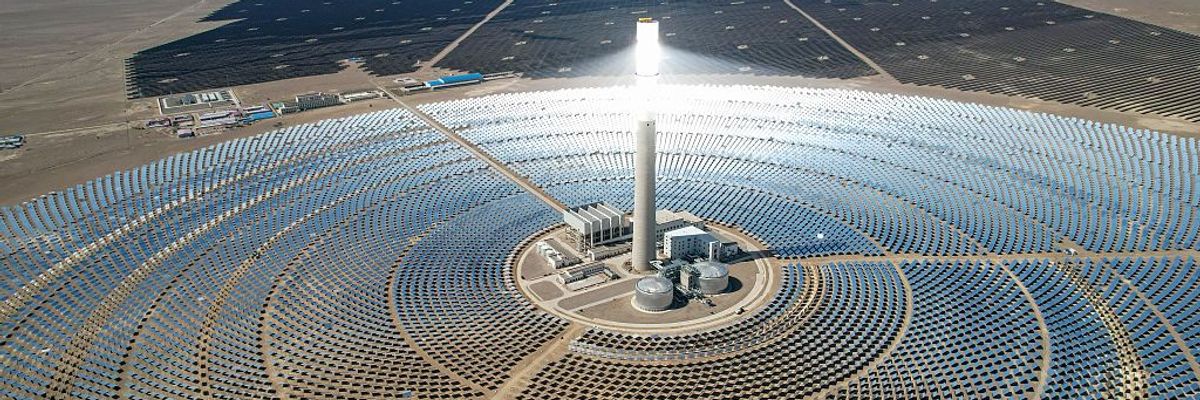
An aerial view shows the 100-megawatt solar thermal project at Jinta multi-energy complementary base, developed by China Green Development Investment Group (CGDG), on August 1, 2025 in Jiuquan, Gansu Province of China.
By every measure, shifting from fossil fuels to electrification, renewables, and energy efficiency and conservation is far more beneficial to most people than following the same fossil-fueled road.
There’s good news and bad news on the climate front. Unfortunately, the bad news is horrific, as accelerating extreme weather-related events and other unfolding climate catastrophes show. But there are signs of hope. We just have to stop dragging our feet.
“We are already facing danger,” a scientists’ statement from the November COP30 climate summit in Belém, Brazil warned, adding, “COP30 has a choice—to protect people and life or the fossil fuel industry.”
Too many governments, including Canada’s, appear to be leaning toward the latter.
“We need to start, now, to reduce CO2 emissions from fossil fuels, by at least 5% per year,” the scientists wrote. “This must happen in order to have a chance to avoid unmanageable and extremely costly climate impacts affecting all people in the world.”
The only ones who benefit from continuing to exploit polluting, climate-altering fossil fuels are greedy industry profiteers and short-sighted politicians who would trade human health, economic resilience, and survivability for a handful of short-term jobs and limited economic boosts.
Studies show that “rising heat is killing roughly one person per minute, and air pollution from the burning of fossil fuels claims an estimated 2.5 million lives every year,” DW news reports. It was also “costing as much as $304 billion in global economic losses last year.”
We’ve already passed one climate “tipping point,” with warming oceans causing irreversible mass coral reef die-offs, and we’re nearing others, including Amazon rainforest devastation and collapse of crucial ocean currents.
Coral reefs support one-quarter of all marine life, and the Amazon rainforest has more animal and plant species than any other terrestrial ecosystem. It also regulates global climate and weather and holds one-quarter of the planet’s available freshwater. Ocean currents also regulate global climate and weather.
Even though emissions continue to rise as the world refuses to halt fossil fuel development and forest and wetland destruction, investments in and growth of renewable energy technology are exceeding expectations, now outpacing fossil fuel investments.
DW reports that “in 2024, the world experienced its largest-ever increase in renewable energy generation, which now provides 40% of global electricity. In the first half of this year solar and wind exceeded all demand growth for electricity, surpassing coal for the first time.” Solar capacity is doubling every three years. Wind power has tripled since 2015. The International Energy Agency reports that global renewable energy investments exceeded US$2 trillion last year, double the amounts committed to coal, oil, and gas.
To increase energy security in the face of a growing global energy crisis and reduce their reliance on increasingly expensive, inefficient fossil fuels, countries that import oil, gas, and coal are rapidly advancing electrification and renewables.
Analysis from COP30 also shows that “sticking to three key climate promises—on renewables, energy efficiency, and methane—would avoid nearly 1°C of global heating and give the world hope of avoiding climate breakdown,” the Guardian reports.
But the world continues to burn dirty, polluting coal, gas, and oil at deadly rates and has increased subsidies to the fossil fuel industry—the most profitable enterprise in history!
Canada has failed to live up to its promise to phase out fossil fuel subsidies. The federal and provincial governments are supporting expanded development of methane gas exploitation and liquefaction, and are proposing pipelines to ship more dirty bitumen from the Alberta oil sands to British Columbia ports for export, where it will be burned in other countries and not counted in our emissions reporting.
Canada’s expansion of liquefied “natural” gas production is not only economically suspect, it also makes methane-reduction pledges more difficult to meet, as LNG is almost entirely methane, and leaks and emissions occur at every step of the process, from fracked extraction and transport to liquefaction and burning.
Although 160 countries, including Canada, have signed a Global Methane Pledge, promising to cut methane emissions by 30% from 2020 levels by 2030, emissions continue to rise and countries, including Canada, continue to underreport them.
By every measure, shifting from fossil fuels to electrification, renewables, and energy efficiency and conservation is far more beneficial to most people than following the same fossil-fueled road. The only ones who benefit from continuing to exploit polluting, climate-altering fossil fuels are greedy industry profiteers and short-sighted politicians who would trade human health, economic resilience, and survivability for a handful of short-term jobs and limited economic boosts.
Regardless of what roadblocks fossil-fuelled governments throw in the way, the renewable energy revolution is unstoppable.
Dear Common Dreams reader, It’s been nearly 30 years since I co-founded Common Dreams with my late wife, Lina Newhouser. We had the radical notion that journalism should serve the public good, not corporate profits. It was clear to us from the outset what it would take to build such a project. No paid advertisements. No corporate sponsors. No millionaire publisher telling us what to think or do. Many people said we wouldn't last a year, but we proved those doubters wrong. Together with a tremendous team of journalists and dedicated staff, we built an independent media outlet free from the constraints of profits and corporate control. Our mission has always been simple: To inform. To inspire. To ignite change for the common good. Building Common Dreams was not easy. Our survival was never guaranteed. When you take on the most powerful forces—Wall Street greed, fossil fuel industry destruction, Big Tech lobbyists, and uber-rich oligarchs who have spent billions upon billions rigging the economy and democracy in their favor—the only bulwark you have is supporters who believe in your work. But here’s the urgent message from me today. It's never been this bad out there. And it's never been this hard to keep us going. At the very moment Common Dreams is most needed, the threats we face are intensifying. We need your support now more than ever. We don't accept corporate advertising and never will. We don't have a paywall because we don't think people should be blocked from critical news based on their ability to pay. Everything we do is funded by the donations of readers like you. When everyone does the little they can afford, we are strong. But if that support retreats or dries up, so do we. Will you donate now to make sure Common Dreams not only survives but thrives? —Craig Brown, Co-founder |
There’s good news and bad news on the climate front. Unfortunately, the bad news is horrific, as accelerating extreme weather-related events and other unfolding climate catastrophes show. But there are signs of hope. We just have to stop dragging our feet.
“We are already facing danger,” a scientists’ statement from the November COP30 climate summit in Belém, Brazil warned, adding, “COP30 has a choice—to protect people and life or the fossil fuel industry.”
Too many governments, including Canada’s, appear to be leaning toward the latter.
“We need to start, now, to reduce CO2 emissions from fossil fuels, by at least 5% per year,” the scientists wrote. “This must happen in order to have a chance to avoid unmanageable and extremely costly climate impacts affecting all people in the world.”
The only ones who benefit from continuing to exploit polluting, climate-altering fossil fuels are greedy industry profiteers and short-sighted politicians who would trade human health, economic resilience, and survivability for a handful of short-term jobs and limited economic boosts.
Studies show that “rising heat is killing roughly one person per minute, and air pollution from the burning of fossil fuels claims an estimated 2.5 million lives every year,” DW news reports. It was also “costing as much as $304 billion in global economic losses last year.”
We’ve already passed one climate “tipping point,” with warming oceans causing irreversible mass coral reef die-offs, and we’re nearing others, including Amazon rainforest devastation and collapse of crucial ocean currents.
Coral reefs support one-quarter of all marine life, and the Amazon rainforest has more animal and plant species than any other terrestrial ecosystem. It also regulates global climate and weather and holds one-quarter of the planet’s available freshwater. Ocean currents also regulate global climate and weather.
Even though emissions continue to rise as the world refuses to halt fossil fuel development and forest and wetland destruction, investments in and growth of renewable energy technology are exceeding expectations, now outpacing fossil fuel investments.
DW reports that “in 2024, the world experienced its largest-ever increase in renewable energy generation, which now provides 40% of global electricity. In the first half of this year solar and wind exceeded all demand growth for electricity, surpassing coal for the first time.” Solar capacity is doubling every three years. Wind power has tripled since 2015. The International Energy Agency reports that global renewable energy investments exceeded US$2 trillion last year, double the amounts committed to coal, oil, and gas.
To increase energy security in the face of a growing global energy crisis and reduce their reliance on increasingly expensive, inefficient fossil fuels, countries that import oil, gas, and coal are rapidly advancing electrification and renewables.
Analysis from COP30 also shows that “sticking to three key climate promises—on renewables, energy efficiency, and methane—would avoid nearly 1°C of global heating and give the world hope of avoiding climate breakdown,” the Guardian reports.
But the world continues to burn dirty, polluting coal, gas, and oil at deadly rates and has increased subsidies to the fossil fuel industry—the most profitable enterprise in history!
Canada has failed to live up to its promise to phase out fossil fuel subsidies. The federal and provincial governments are supporting expanded development of methane gas exploitation and liquefaction, and are proposing pipelines to ship more dirty bitumen from the Alberta oil sands to British Columbia ports for export, where it will be burned in other countries and not counted in our emissions reporting.
Canada’s expansion of liquefied “natural” gas production is not only economically suspect, it also makes methane-reduction pledges more difficult to meet, as LNG is almost entirely methane, and leaks and emissions occur at every step of the process, from fracked extraction and transport to liquefaction and burning.
Although 160 countries, including Canada, have signed a Global Methane Pledge, promising to cut methane emissions by 30% from 2020 levels by 2030, emissions continue to rise and countries, including Canada, continue to underreport them.
By every measure, shifting from fossil fuels to electrification, renewables, and energy efficiency and conservation is far more beneficial to most people than following the same fossil-fueled road. The only ones who benefit from continuing to exploit polluting, climate-altering fossil fuels are greedy industry profiteers and short-sighted politicians who would trade human health, economic resilience, and survivability for a handful of short-term jobs and limited economic boosts.
Regardless of what roadblocks fossil-fuelled governments throw in the way, the renewable energy revolution is unstoppable.
There’s good news and bad news on the climate front. Unfortunately, the bad news is horrific, as accelerating extreme weather-related events and other unfolding climate catastrophes show. But there are signs of hope. We just have to stop dragging our feet.
“We are already facing danger,” a scientists’ statement from the November COP30 climate summit in Belém, Brazil warned, adding, “COP30 has a choice—to protect people and life or the fossil fuel industry.”
Too many governments, including Canada’s, appear to be leaning toward the latter.
“We need to start, now, to reduce CO2 emissions from fossil fuels, by at least 5% per year,” the scientists wrote. “This must happen in order to have a chance to avoid unmanageable and extremely costly climate impacts affecting all people in the world.”
The only ones who benefit from continuing to exploit polluting, climate-altering fossil fuels are greedy industry profiteers and short-sighted politicians who would trade human health, economic resilience, and survivability for a handful of short-term jobs and limited economic boosts.
Studies show that “rising heat is killing roughly one person per minute, and air pollution from the burning of fossil fuels claims an estimated 2.5 million lives every year,” DW news reports. It was also “costing as much as $304 billion in global economic losses last year.”
We’ve already passed one climate “tipping point,” with warming oceans causing irreversible mass coral reef die-offs, and we’re nearing others, including Amazon rainforest devastation and collapse of crucial ocean currents.
Coral reefs support one-quarter of all marine life, and the Amazon rainforest has more animal and plant species than any other terrestrial ecosystem. It also regulates global climate and weather and holds one-quarter of the planet’s available freshwater. Ocean currents also regulate global climate and weather.
Even though emissions continue to rise as the world refuses to halt fossil fuel development and forest and wetland destruction, investments in and growth of renewable energy technology are exceeding expectations, now outpacing fossil fuel investments.
DW reports that “in 2024, the world experienced its largest-ever increase in renewable energy generation, which now provides 40% of global electricity. In the first half of this year solar and wind exceeded all demand growth for electricity, surpassing coal for the first time.” Solar capacity is doubling every three years. Wind power has tripled since 2015. The International Energy Agency reports that global renewable energy investments exceeded US$2 trillion last year, double the amounts committed to coal, oil, and gas.
To increase energy security in the face of a growing global energy crisis and reduce their reliance on increasingly expensive, inefficient fossil fuels, countries that import oil, gas, and coal are rapidly advancing electrification and renewables.
Analysis from COP30 also shows that “sticking to three key climate promises—on renewables, energy efficiency, and methane—would avoid nearly 1°C of global heating and give the world hope of avoiding climate breakdown,” the Guardian reports.
But the world continues to burn dirty, polluting coal, gas, and oil at deadly rates and has increased subsidies to the fossil fuel industry—the most profitable enterprise in history!
Canada has failed to live up to its promise to phase out fossil fuel subsidies. The federal and provincial governments are supporting expanded development of methane gas exploitation and liquefaction, and are proposing pipelines to ship more dirty bitumen from the Alberta oil sands to British Columbia ports for export, where it will be burned in other countries and not counted in our emissions reporting.
Canada’s expansion of liquefied “natural” gas production is not only economically suspect, it also makes methane-reduction pledges more difficult to meet, as LNG is almost entirely methane, and leaks and emissions occur at every step of the process, from fracked extraction and transport to liquefaction and burning.
Although 160 countries, including Canada, have signed a Global Methane Pledge, promising to cut methane emissions by 30% from 2020 levels by 2030, emissions continue to rise and countries, including Canada, continue to underreport them.
By every measure, shifting from fossil fuels to electrification, renewables, and energy efficiency and conservation is far more beneficial to most people than following the same fossil-fueled road. The only ones who benefit from continuing to exploit polluting, climate-altering fossil fuels are greedy industry profiteers and short-sighted politicians who would trade human health, economic resilience, and survivability for a handful of short-term jobs and limited economic boosts.
Regardless of what roadblocks fossil-fuelled governments throw in the way, the renewable energy revolution is unstoppable.