

SUBSCRIBE TO OUR FREE NEWSLETTER
Daily news & progressive opinion—funded by the people, not the corporations—delivered straight to your inbox.
5
#000000
#FFFFFF
To donate by check, phone, or other method, see our More Ways to Give page.
Daily news & progressive opinion—funded by the people, not the corporations—delivered straight to your inbox.
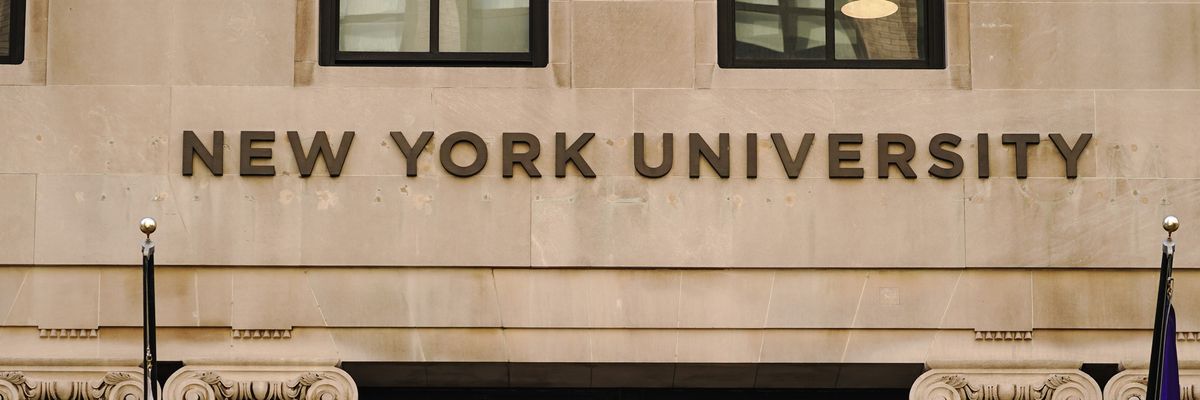
The New York University sign is shown on a campus building.
Students first launched an NYU divestment campaign in 2004, but for years the board insisted that divestment was not the way forward.
Nearly two decades after students first raised the issue, New York University will divest from fossil fuels.
The announcement came in a letter that chair of the NYU board of trustees William R. Berkley sent to student activist group Sunrise NYU in August, which was first reported by The Guardian Tuesday.
"This is a huge win for climate justice!" Sunrise NYU wrote on social media as it shared the news. "Congratulations to every student organizer who made this happen."
Students first launched an NYU divestment campaign in 2004. However, for years the board insisted that divestment was not the way forward. Ten years after the campaign began, it had around 4% of its endowment, or $139 million, invested in fossil fuels, as Politico reported at the time.
"Back when I was at NYU… we were not exactly met with open arms," Sophie Lasoff, who co-founded one campaign in 2012, told The Guardian.
The University Senate did pass a resolution in 2015 urging the endowment not to invest any more in fossil fuels going forward, but the board rejected the idea. In a very different letter in 2016, Berkley and university President Andrew Hamilton wrote that "we do not believe divestment is the proper action to take."
"This decision has been a long time coming and is thanks to a decade of tireless organizing on campus."
Fast forward to 2023, and Berkley wrote that "New York University commits to avoid any direct investments in any company whose primary business is the exploration or extraction of fossil fuels, including all forms of coal, oil, and natural gas, and not to renew or seek out any dedicated private funds whose primary aim is to invest in the exploration or extraction of fossil fuels," as The Guardian reported.
Berkley said the endowment did not currently own any fossil fuel securities. In the future, the school will not invest any new funds in the largest 200 oil, gas, and coal companies, The Guardian reported.
What changed? In part, it's the fact that fossil fuel companies didn't, Sunrise NYU co-founder Dylan Wahbe, who has since graduated, told The Guardian.
In the 2016 letter, Berkley and Hamilton stated that investing in renewable energy was not "mutually exclusive" from investing in fossil fuels and that "many of the fossil fuel companies listed on the 'Fossil Fuel 200' are major investors in alternative energy research and ventures."
Since then, many major fossil fuel companies have stepped back from their Paris agreement pledges or their alternative energy programs, and their investments still skew heavily in the direction of climate-warming fuels.
"It would be hard to make those arguments today," Wahbe said.
When Wahbe, fellow Sunrise NYU co-founder Alicia Colomer, and their fellow student activists started a renewed divestment push in 2021, they had much more success. They gathered more than 2,000 petition signatures leading up to a meeting with the board in February 2022 that paved the way for the August letter.
"The board was very pleased with the tenor of its conversations with the students and the letter arose from those exchanges," NYU spokesperson Joseph Tirella told The Guardian. "The University is glad to know the students were also pleased by the outcome of those conversations and by the letter."
In a statement posted on social media, Colomer wrote that she was "so proud that in just a few short years we've built an unstoppable student movement that just won divestment at NYU."
The university now joins the 250 or so U.S. educational establishments that have divested their endowments from fossil fuels, and the news was welcomed by long-time climate campaigners.
"The fight to divest NYU has been ongoing for a decade—so grateful to the generations of students, faculty, and alumni who made it happen!! Beautiful work y'all!" 350.org and Third Act founder Bill McKibbenposted on social media.
Fellow 350.org co-founder Jamie Henn also celebrated the news.
"This decision has been a long time coming and is thanks to a decade of tireless organizing on campus," Henn tweeted. "Congratulations [to] all the students who made this possible!"
This country and this world are at a monumental crossroads. US voters have an opportunity to beat back the forces of fascism and confront the billionaires who are rigging the economy, our media system, and our democracy, making it increasingly impossible for ordinary people to get by. We’re not just talking about the election. We’re talking about what must be done once these fascist elements are vanquished from power. We need a bolder set of solutions than what either major party has so far been willing to offer and a working-class movement ready to fight like hell for it. Trump didn't emerge from nowhere. The conditions that fueled MAGA authoritarianism were created by decades of radical neoliberal economic policies and a corrupt political system dominated by corporate interests. They slashed taxes on the super-rich, promising that the benefits would trickle down. They said giveaways to the corporate titans would make life more affordable for the rest of us. It was all bullshit. And when a bitter, betrayed populace searches for someone to blame, right-wing demagogues have little trouble finding scapegoats. People know when they're being lied to, but you won't hear any of this from the corporate media. Only independent journalism—powered and funded by people who believe in building a better world—can deliver truly trustworthy daily news. If you share our vision, please contribute whatever you can to sustain our work. |
Nearly two decades after students first raised the issue, New York University will divest from fossil fuels.
The announcement came in a letter that chair of the NYU board of trustees William R. Berkley sent to student activist group Sunrise NYU in August, which was first reported by The Guardian Tuesday.
"This is a huge win for climate justice!" Sunrise NYU wrote on social media as it shared the news. "Congratulations to every student organizer who made this happen."
Students first launched an NYU divestment campaign in 2004. However, for years the board insisted that divestment was not the way forward. Ten years after the campaign began, it had around 4% of its endowment, or $139 million, invested in fossil fuels, as Politico reported at the time.
"Back when I was at NYU… we were not exactly met with open arms," Sophie Lasoff, who co-founded one campaign in 2012, told The Guardian.
The University Senate did pass a resolution in 2015 urging the endowment not to invest any more in fossil fuels going forward, but the board rejected the idea. In a very different letter in 2016, Berkley and university President Andrew Hamilton wrote that "we do not believe divestment is the proper action to take."
"This decision has been a long time coming and is thanks to a decade of tireless organizing on campus."
Fast forward to 2023, and Berkley wrote that "New York University commits to avoid any direct investments in any company whose primary business is the exploration or extraction of fossil fuels, including all forms of coal, oil, and natural gas, and not to renew or seek out any dedicated private funds whose primary aim is to invest in the exploration or extraction of fossil fuels," as The Guardian reported.
Berkley said the endowment did not currently own any fossil fuel securities. In the future, the school will not invest any new funds in the largest 200 oil, gas, and coal companies, The Guardian reported.
What changed? In part, it's the fact that fossil fuel companies didn't, Sunrise NYU co-founder Dylan Wahbe, who has since graduated, told The Guardian.
In the 2016 letter, Berkley and Hamilton stated that investing in renewable energy was not "mutually exclusive" from investing in fossil fuels and that "many of the fossil fuel companies listed on the 'Fossil Fuel 200' are major investors in alternative energy research and ventures."
Since then, many major fossil fuel companies have stepped back from their Paris agreement pledges or their alternative energy programs, and their investments still skew heavily in the direction of climate-warming fuels.
"It would be hard to make those arguments today," Wahbe said.
When Wahbe, fellow Sunrise NYU co-founder Alicia Colomer, and their fellow student activists started a renewed divestment push in 2021, they had much more success. They gathered more than 2,000 petition signatures leading up to a meeting with the board in February 2022 that paved the way for the August letter.
"The board was very pleased with the tenor of its conversations with the students and the letter arose from those exchanges," NYU spokesperson Joseph Tirella told The Guardian. "The University is glad to know the students were also pleased by the outcome of those conversations and by the letter."
In a statement posted on social media, Colomer wrote that she was "so proud that in just a few short years we've built an unstoppable student movement that just won divestment at NYU."
The university now joins the 250 or so U.S. educational establishments that have divested their endowments from fossil fuels, and the news was welcomed by long-time climate campaigners.
"The fight to divest NYU has been ongoing for a decade—so grateful to the generations of students, faculty, and alumni who made it happen!! Beautiful work y'all!" 350.org and Third Act founder Bill McKibbenposted on social media.
Fellow 350.org co-founder Jamie Henn also celebrated the news.
"This decision has been a long time coming and is thanks to a decade of tireless organizing on campus," Henn tweeted. "Congratulations [to] all the students who made this possible!"

