
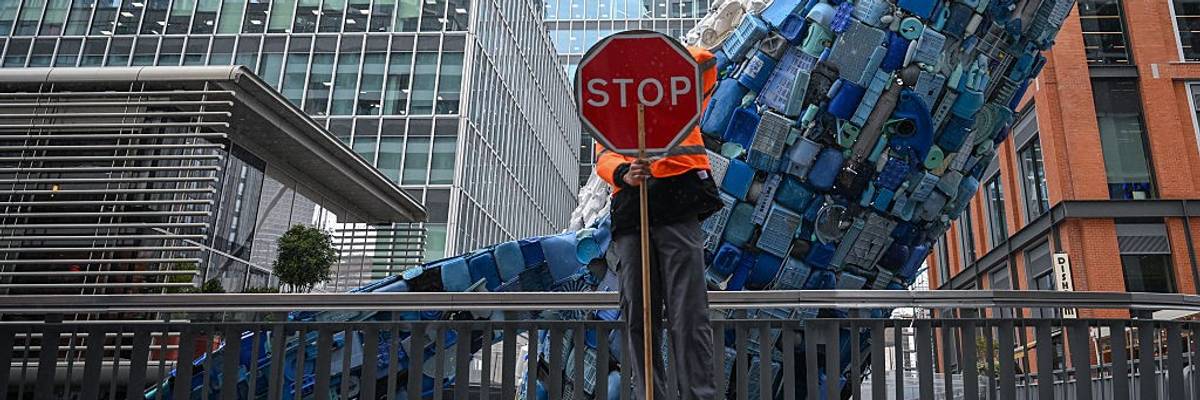
A giant 11-meter-long whale sculpture called "Whale on the Wharf," made of recycled plastic waste, is placed in the Canary Wharf area of London, United Kingdom, to draw attention to plastic pollution in the oceans on April 15, 2025.
Reclaiming a Disposable Planet
Tossing out the trash is something you’re just supposed to do, no questions asked, at least if you want to live a normal, respected life. But what if you're missing something wondrous?
Hey, want to read a poem with me? Warning: It opens several disturbing doors, the least disturbing of which is the “crazy old coot” part, i.e., me. Once you start getting lost in the paradoxes of life, you need to watch out. They could start coming after you.
But more disturbing is the paradox itself, which is both environmental and spiritual. And it’s right there on my front lawn. The life I’ve been given—the lives we’ve been given—are partially disposable, apparently. Mostly I took this for granted, but suddenly one summer afternoon, as I was pushing my hand mower up and down the lawn, something shifted in me. I started feeling... reverence for garbage? Tossing out the trash is something you’re just supposed to do, no questions asked, at least if you want to live a normal, respected life. Doubting this could be a tad problematic.
The poem is called “Buddha’s Lawn.” I wrote it a decade ago. Back when I still had a lawn to mow.
I mow the lawn and feel gratitude
my neighbors
haven’t pigeonholed me as a crazy old coot.
I’m stalled in my transition
from a lifestyle and sense of order based on
killing things,
like weeds, mice, whatever,
to one based on reverence for all stuff,
however weird.
It’s a cool day but
I work up a sweat.
On the lawn, I pick up a shred
of burst red balloon, a used napkin,
a transparent plastic juice container.
This stuff is all just litter
and the weeds are still weeds.
If I really let myself
see them differently,
I’d be the crazy neighbor, right?
Well, sorry (I apologize to myself.) I can’t help it. Once the door opens and a ray of awareness shines in, burst balloons, tossed straws, plastic grocery bags, discarded pop bottles, etc., etc., aren’t what they used to be. There’s an inner awareness that won’t go away. You might call it “litteracy”—an awareness of what happens next.
For instance, according to the Center for Biological Diversity: “In the first decade of this century, we made more plastic than all the plastic in history up to the year 2000. And every year, billions of pounds of more plastic end up in the world’s oceans. Studies estimate there are now 15-51 trillion pieces of plastic in the world’s oceans—from the equator to the poles, from Arctic ice sheets to the sea floor. Not one square mile of surface ocean anywhere on Earth is free of plastic pollution...”
The analysis goes on:
Thousands of animals, from small finches to blue whales, die grisly deaths from eating and getting caught in plastic...
Hundreds of thousands of seabirds ingest plastic every year. Plastic ingestion reduces the storage volume of the stomach, causing starvation. It’s estimated that 60% of all seabird species have eaten pieces of plastic, with that number predicted to increase to 99% by 2050. Dead seabirds are often found with stomachs full of plastic, reflecting how the amount of garbage in our oceans has rapidly increased in the past 40 years...
Dead whales have been found with bellies full of plastic.
I can’t dismiss this with a shrug... just toss the plastic in the trash and go on mowing my lawn, being normal. I start to stare with curiosity and wonderment at the litter. And this is where the old coot starts looking, or at least feeling, crazy, at least until his sense of awareness expands: “The word ‘garbage’ means a resource nobody is smart enough to use yet.”
Hmmm. Really? I quoted these words in a column I wrote in 2013. Called (I kid you not) “Reverence for Garbage,” it talks abouts the documentary Landfill Harmonic, about a Paraguayan village built on a landfill. Reclaiming and reselling the trash was the residents’ primary means of survival. But they did something else as well. Inspired by a local musician, the residents also started making musical instruments out of the trash: “violins and cellos from oil drums, flutes from water pipes and spoons, guitars from packing crates.”
Real instruments were beyond expensive, far more costly than anyone there could afford. But children in the village learned to play the instruments hand-crafted from the landfill trash. And what was worthless became heavenly.
Is there a larger cultural takeaway pulsating in this story? Could it be that we value too little of our own planet? I wonder if maybe.. maybe... we should begin crumpling up our certainties and tossing them in the trash.
We are at a crossroads
This country and this world are at a monumental crossroads. In a few short weeks, US voters will have an opportunity to beat back the forces of fascism and confront the billionaires who are rigging the economy, our media system, and our democracy, making it increasingly impossible for ordinary people to get by. We’re not just talking about the election. We’re talking about what must be done once these fascist elements are vanquished from power. We need a bolder set of solutions than what either major party has so far been willing to offer and a working-class movement ready to fight like hell for it. Trump didn't emerge from nowhere. The conditions that fueled MAGA authoritarianism were created by decades of radical neoliberal economic policies and a corrupt political system dominated by corporate interests. They slashed taxes on the super-rich, promising that the benefits would trickle down. They said giveaways to the corporate titans would make life more affordable for the rest of us. It was all bullshit. And when a bitter, betrayed populace searches for someone to blame, right-wing demagogues have little trouble finding scapegoats. People know when they're being lied to, but you won't hear any of this from the corporate media. Only independent journalism—powered and funded by people who believe in building a better world—can deliver truly trustworthy daily news. Our Fall Campaign is underway, and we need your help. To power our newsroom through the rest of the year, we need to raise $125,000 by midnight on October 31. So if you share our vision, please contribute whatever you can to sustain our work. |
Hey, want to read a poem with me? Warning: It opens several disturbing doors, the least disturbing of which is the “crazy old coot” part, i.e., me. Once you start getting lost in the paradoxes of life, you need to watch out. They could start coming after you.
But more disturbing is the paradox itself, which is both environmental and spiritual. And it’s right there on my front lawn. The life I’ve been given—the lives we’ve been given—are partially disposable, apparently. Mostly I took this for granted, but suddenly one summer afternoon, as I was pushing my hand mower up and down the lawn, something shifted in me. I started feeling... reverence for garbage? Tossing out the trash is something you’re just supposed to do, no questions asked, at least if you want to live a normal, respected life. Doubting this could be a tad problematic.
The poem is called “Buddha’s Lawn.” I wrote it a decade ago. Back when I still had a lawn to mow.
I mow the lawn and feel gratitude
my neighbors
haven’t pigeonholed me as a crazy old coot.
I’m stalled in my transition
from a lifestyle and sense of order based on
killing things,
like weeds, mice, whatever,
to one based on reverence for all stuff,
however weird.
It’s a cool day but
I work up a sweat.
On the lawn, I pick up a shred
of burst red balloon, a used napkin,
a transparent plastic juice container.
This stuff is all just litter
and the weeds are still weeds.
If I really let myself
see them differently,
I’d be the crazy neighbor, right?
Well, sorry (I apologize to myself.) I can’t help it. Once the door opens and a ray of awareness shines in, burst balloons, tossed straws, plastic grocery bags, discarded pop bottles, etc., etc., aren’t what they used to be. There’s an inner awareness that won’t go away. You might call it “litteracy”—an awareness of what happens next.
For instance, according to the Center for Biological Diversity: “In the first decade of this century, we made more plastic than all the plastic in history up to the year 2000. And every year, billions of pounds of more plastic end up in the world’s oceans. Studies estimate there are now 15-51 trillion pieces of plastic in the world’s oceans—from the equator to the poles, from Arctic ice sheets to the sea floor. Not one square mile of surface ocean anywhere on Earth is free of plastic pollution...”
The analysis goes on:
Thousands of animals, from small finches to blue whales, die grisly deaths from eating and getting caught in plastic...
Hundreds of thousands of seabirds ingest plastic every year. Plastic ingestion reduces the storage volume of the stomach, causing starvation. It’s estimated that 60% of all seabird species have eaten pieces of plastic, with that number predicted to increase to 99% by 2050. Dead seabirds are often found with stomachs full of plastic, reflecting how the amount of garbage in our oceans has rapidly increased in the past 40 years...
Dead whales have been found with bellies full of plastic.
I can’t dismiss this with a shrug... just toss the plastic in the trash and go on mowing my lawn, being normal. I start to stare with curiosity and wonderment at the litter. And this is where the old coot starts looking, or at least feeling, crazy, at least until his sense of awareness expands: “The word ‘garbage’ means a resource nobody is smart enough to use yet.”
Hmmm. Really? I quoted these words in a column I wrote in 2013. Called (I kid you not) “Reverence for Garbage,” it talks abouts the documentary Landfill Harmonic, about a Paraguayan village built on a landfill. Reclaiming and reselling the trash was the residents’ primary means of survival. But they did something else as well. Inspired by a local musician, the residents also started making musical instruments out of the trash: “violins and cellos from oil drums, flutes from water pipes and spoons, guitars from packing crates.”
Real instruments were beyond expensive, far more costly than anyone there could afford. But children in the village learned to play the instruments hand-crafted from the landfill trash. And what was worthless became heavenly.
Is there a larger cultural takeaway pulsating in this story? Could it be that we value too little of our own planet? I wonder if maybe.. maybe... we should begin crumpling up our certainties and tossing them in the trash.
Hey, want to read a poem with me? Warning: It opens several disturbing doors, the least disturbing of which is the “crazy old coot” part, i.e., me. Once you start getting lost in the paradoxes of life, you need to watch out. They could start coming after you.
But more disturbing is the paradox itself, which is both environmental and spiritual. And it’s right there on my front lawn. The life I’ve been given—the lives we’ve been given—are partially disposable, apparently. Mostly I took this for granted, but suddenly one summer afternoon, as I was pushing my hand mower up and down the lawn, something shifted in me. I started feeling... reverence for garbage? Tossing out the trash is something you’re just supposed to do, no questions asked, at least if you want to live a normal, respected life. Doubting this could be a tad problematic.
The poem is called “Buddha’s Lawn.” I wrote it a decade ago. Back when I still had a lawn to mow.
I mow the lawn and feel gratitude
my neighbors
haven’t pigeonholed me as a crazy old coot.
I’m stalled in my transition
from a lifestyle and sense of order based on
killing things,
like weeds, mice, whatever,
to one based on reverence for all stuff,
however weird.
It’s a cool day but
I work up a sweat.
On the lawn, I pick up a shred
of burst red balloon, a used napkin,
a transparent plastic juice container.
This stuff is all just litter
and the weeds are still weeds.
If I really let myself
see them differently,
I’d be the crazy neighbor, right?
Well, sorry (I apologize to myself.) I can’t help it. Once the door opens and a ray of awareness shines in, burst balloons, tossed straws, plastic grocery bags, discarded pop bottles, etc., etc., aren’t what they used to be. There’s an inner awareness that won’t go away. You might call it “litteracy”—an awareness of what happens next.
For instance, according to the Center for Biological Diversity: “In the first decade of this century, we made more plastic than all the plastic in history up to the year 2000. And every year, billions of pounds of more plastic end up in the world’s oceans. Studies estimate there are now 15-51 trillion pieces of plastic in the world’s oceans—from the equator to the poles, from Arctic ice sheets to the sea floor. Not one square mile of surface ocean anywhere on Earth is free of plastic pollution...”
The analysis goes on:
Thousands of animals, from small finches to blue whales, die grisly deaths from eating and getting caught in plastic...
Hundreds of thousands of seabirds ingest plastic every year. Plastic ingestion reduces the storage volume of the stomach, causing starvation. It’s estimated that 60% of all seabird species have eaten pieces of plastic, with that number predicted to increase to 99% by 2050. Dead seabirds are often found with stomachs full of plastic, reflecting how the amount of garbage in our oceans has rapidly increased in the past 40 years...
Dead whales have been found with bellies full of plastic.
I can’t dismiss this with a shrug... just toss the plastic in the trash and go on mowing my lawn, being normal. I start to stare with curiosity and wonderment at the litter. And this is where the old coot starts looking, or at least feeling, crazy, at least until his sense of awareness expands: “The word ‘garbage’ means a resource nobody is smart enough to use yet.”
Hmmm. Really? I quoted these words in a column I wrote in 2013. Called (I kid you not) “Reverence for Garbage,” it talks abouts the documentary Landfill Harmonic, about a Paraguayan village built on a landfill. Reclaiming and reselling the trash was the residents’ primary means of survival. But they did something else as well. Inspired by a local musician, the residents also started making musical instruments out of the trash: “violins and cellos from oil drums, flutes from water pipes and spoons, guitars from packing crates.”
Real instruments were beyond expensive, far more costly than anyone there could afford. But children in the village learned to play the instruments hand-crafted from the landfill trash. And what was worthless became heavenly.
Is there a larger cultural takeaway pulsating in this story? Could it be that we value too little of our own planet? I wonder if maybe.. maybe... we should begin crumpling up our certainties and tossing them in the trash.