

SUBSCRIBE TO OUR FREE NEWSLETTER
Daily news & progressive opinion—funded by the people, not the corporations—delivered straight to your inbox.
5
#000000
#FFFFFF
To donate by check, phone, or other method, see our More Ways to Give page.
Daily news & progressive opinion—funded by the people, not the corporations—delivered straight to your inbox.
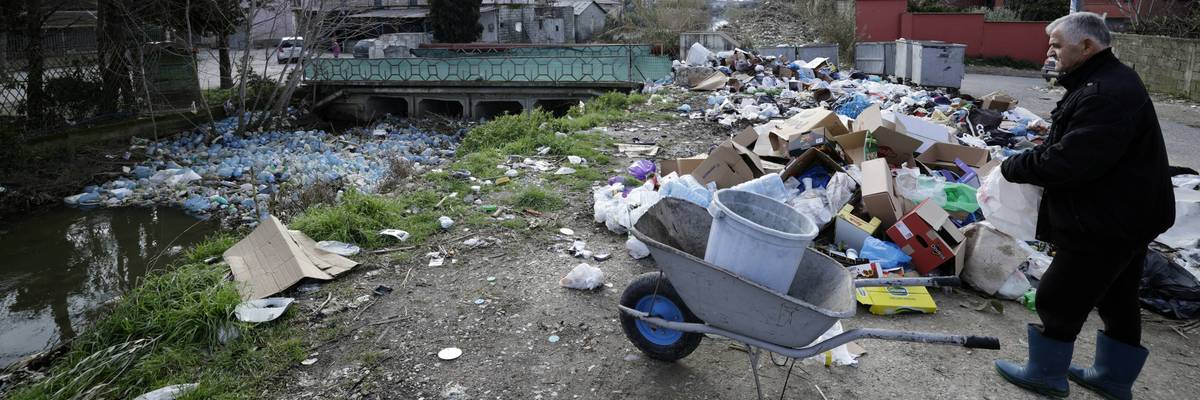
A man looks for goods to retrieve in a dumping area near plastic trash-filled floodwaters following heavy rains, in Durres, Albania on January 13, 2026.
"Systemic change is needed 'from the cradle to the grave' of plastic production, use, and disposal," said the lead author, calling for "ambitious action from governments and industry transparency."
A study published Tuesday in the Lancet Planetary Health highlights how humanity's continued reliance on plastics—which are primarily derived from planet-heating fossil fuels—is expected to harm global health over the next couple of decades.
"Plastics life cycles emit a range of gases and pollutants that contribute to the global burden of disease, including greenhouse gases that drive climate change, air pollutants linked to respiratory illnesses, and hazardous chemicals associated with cancers and other noncommunicable diseases," the study explains.
"These emissions occur across all stages of the plastics value chain: from oil and gas extraction, which provides the feedstocks for more than 90% of global plastics; to polymer production and product manufacturing, global transportation, recycling, and formal or informal waste management and mismanagement; to the gradual degradation of plastics in the environment," the publication continues.
Researchers from the London School of Hygiene and Tropical Medicine (LSHTM) and University of Exeter in the United Kingdom, as well as France's University of Toulouse, modeled various scenarios of plastics production, consumption, and disposal from 2016-40.
"The study is the first of its kind to assess the number of healthy years of life lost ('disability-adjusted life years' or 'DALYS'—a measure of harm) due to greenhouse gases, air pollutants, and toxic chemicals emitted across the life cycle of plastics at a global scale," according to LSHTM.
The team estimated that without any changes in global plastics policies and practices, annual health impacts would soar from 2.1 million DALYs in 2016 to 4.5 million DALYs by 2040—with a total of 83 million healthy years of life lost over the full study period. Under a business-as-usual scenario, 40% of the health harms would be tied to rising temperatures, nearly a third to air pollution, and over a quarter to toxic chemicals.
Because of limited data—particularly on the use stage of plastics and the chemicals they contain—lead author Megan Deeney of LSHTM told Agence France-Presse that "this is undoubtedly a vast underestimate of the total human health impacts."
new paper in @thelancet.com estimating the global health burdens of plasticsI think this is one of the first analyses that quantifies the impacts of plastics across its entire lifecycle (from extraction to waste) and highlights the pretty staggering health effects of our current economic system
[image or embed]
— Rob Ralston (@policyrelevant.bsky.social) January 27, 2026 at 6:54 AM
Still, the researchers were able to offer some insight into the adverse health impacts—thanks to their repurposing of modeling methods typically used to evaluate the environmental footprint of individual products and technologies.
These methods "are an increasingly important tool to tackle sustainability questions at a much larger scale," study co-author and Exeter professor Xiaoyu Yan said in a statement. "Our study shows that this approach can help uncover the massive impacts of plastics on human health throughout the life cycle. We now need urgent action to reduce the impacts of plastics on the environment and ultimately human health."
Deeney stressed that such action can't be restricted to consumers. As she put it, "Our research shows that the adverse health impacts of plastics stretch far beyond the point at which we buy a plastic product or put plastic items in a recycling bin."
In the US alone, government data suggests that just 5% of plastic waste is recycled annually, according to a Greenpeace report published last month. The advocacy group also noted that only a fifth of the 8.8 million tons of the most commonly produced types of plastics are even recyclable.
"Often the blame is put on us as individual consumers of plastics to solve the problem, but while we all have an important role to play in reducing the use of plastics, our analysis shows systemic change is needed 'from the cradle to the grave' of plastic production, use, and disposal," Deeney said Tuesday. "Much more ambitious action from governments and industry transparency is needed to curb this growing global plastics public health crisis."
The lead author said that the most effective measure is slashing the production of "unnecessary" plastic. She also pointed out that lack of data doesn't just impact studies like this one: "Industry nondisclosure and inconsistent reporting of plastics' chemical composition is severely limiting the ability of life cycle assessments (LCAs) to inform effective policy to protect humans, ecosystems, and the environment."
The study comes after the latest round of global plastics treaty negotiations stalled in August—which environmentalists called an "abject failure" that should be blamed on the Trump administration, Saudi Arabia, and other major governments opposed to curbing production.
"The inability to reach an agreement in Geneva must be a wake-up call for the world: Ending plastic pollution means confronting fossil fuel interests head-on," Greenpeace USA's Graham Forbes said at the time. "The vast majority of governments want a strong agreement, yet a handful of bad actors were allowed to use process to drive such ambition into the ground."
Dear Common Dreams reader, It’s been nearly 30 years since I co-founded Common Dreams with my late wife, Lina Newhouser. We had the radical notion that journalism should serve the public good, not corporate profits. It was clear to us from the outset what it would take to build such a project. No paid advertisements. No corporate sponsors. No millionaire publisher telling us what to think or do. Many people said we wouldn't last a year, but we proved those doubters wrong. Together with a tremendous team of journalists and dedicated staff, we built an independent media outlet free from the constraints of profits and corporate control. Our mission has always been simple: To inform. To inspire. To ignite change for the common good. Building Common Dreams was not easy. Our survival was never guaranteed. When you take on the most powerful forces—Wall Street greed, fossil fuel industry destruction, Big Tech lobbyists, and uber-rich oligarchs who have spent billions upon billions rigging the economy and democracy in their favor—the only bulwark you have is supporters who believe in your work. But here’s the urgent message from me today. It's never been this bad out there. And it's never been this hard to keep us going. At the very moment Common Dreams is most needed, the threats we face are intensifying. We need your support now more than ever. We don't accept corporate advertising and never will. We don't have a paywall because we don't think people should be blocked from critical news based on their ability to pay. Everything we do is funded by the donations of readers like you. When everyone does the little they can afford, we are strong. But if that support retreats or dries up, so do we. Will you donate now to make sure Common Dreams not only survives but thrives? —Craig Brown, Co-founder |
A study published Tuesday in the Lancet Planetary Health highlights how humanity's continued reliance on plastics—which are primarily derived from planet-heating fossil fuels—is expected to harm global health over the next couple of decades.
"Plastics life cycles emit a range of gases and pollutants that contribute to the global burden of disease, including greenhouse gases that drive climate change, air pollutants linked to respiratory illnesses, and hazardous chemicals associated with cancers and other noncommunicable diseases," the study explains.
"These emissions occur across all stages of the plastics value chain: from oil and gas extraction, which provides the feedstocks for more than 90% of global plastics; to polymer production and product manufacturing, global transportation, recycling, and formal or informal waste management and mismanagement; to the gradual degradation of plastics in the environment," the publication continues.
Researchers from the London School of Hygiene and Tropical Medicine (LSHTM) and University of Exeter in the United Kingdom, as well as France's University of Toulouse, modeled various scenarios of plastics production, consumption, and disposal from 2016-40.
"The study is the first of its kind to assess the number of healthy years of life lost ('disability-adjusted life years' or 'DALYS'—a measure of harm) due to greenhouse gases, air pollutants, and toxic chemicals emitted across the life cycle of plastics at a global scale," according to LSHTM.
The team estimated that without any changes in global plastics policies and practices, annual health impacts would soar from 2.1 million DALYs in 2016 to 4.5 million DALYs by 2040—with a total of 83 million healthy years of life lost over the full study period. Under a business-as-usual scenario, 40% of the health harms would be tied to rising temperatures, nearly a third to air pollution, and over a quarter to toxic chemicals.
Because of limited data—particularly on the use stage of plastics and the chemicals they contain—lead author Megan Deeney of LSHTM told Agence France-Presse that "this is undoubtedly a vast underestimate of the total human health impacts."
new paper in @thelancet.com estimating the global health burdens of plasticsI think this is one of the first analyses that quantifies the impacts of plastics across its entire lifecycle (from extraction to waste) and highlights the pretty staggering health effects of our current economic system
[image or embed]
— Rob Ralston (@policyrelevant.bsky.social) January 27, 2026 at 6:54 AM
Still, the researchers were able to offer some insight into the adverse health impacts—thanks to their repurposing of modeling methods typically used to evaluate the environmental footprint of individual products and technologies.
These methods "are an increasingly important tool to tackle sustainability questions at a much larger scale," study co-author and Exeter professor Xiaoyu Yan said in a statement. "Our study shows that this approach can help uncover the massive impacts of plastics on human health throughout the life cycle. We now need urgent action to reduce the impacts of plastics on the environment and ultimately human health."
Deeney stressed that such action can't be restricted to consumers. As she put it, "Our research shows that the adverse health impacts of plastics stretch far beyond the point at which we buy a plastic product or put plastic items in a recycling bin."
In the US alone, government data suggests that just 5% of plastic waste is recycled annually, according to a Greenpeace report published last month. The advocacy group also noted that only a fifth of the 8.8 million tons of the most commonly produced types of plastics are even recyclable.
"Often the blame is put on us as individual consumers of plastics to solve the problem, but while we all have an important role to play in reducing the use of plastics, our analysis shows systemic change is needed 'from the cradle to the grave' of plastic production, use, and disposal," Deeney said Tuesday. "Much more ambitious action from governments and industry transparency is needed to curb this growing global plastics public health crisis."
The lead author said that the most effective measure is slashing the production of "unnecessary" plastic. She also pointed out that lack of data doesn't just impact studies like this one: "Industry nondisclosure and inconsistent reporting of plastics' chemical composition is severely limiting the ability of life cycle assessments (LCAs) to inform effective policy to protect humans, ecosystems, and the environment."
The study comes after the latest round of global plastics treaty negotiations stalled in August—which environmentalists called an "abject failure" that should be blamed on the Trump administration, Saudi Arabia, and other major governments opposed to curbing production.
"The inability to reach an agreement in Geneva must be a wake-up call for the world: Ending plastic pollution means confronting fossil fuel interests head-on," Greenpeace USA's Graham Forbes said at the time. "The vast majority of governments want a strong agreement, yet a handful of bad actors were allowed to use process to drive such ambition into the ground."
A study published Tuesday in the Lancet Planetary Health highlights how humanity's continued reliance on plastics—which are primarily derived from planet-heating fossil fuels—is expected to harm global health over the next couple of decades.
"Plastics life cycles emit a range of gases and pollutants that contribute to the global burden of disease, including greenhouse gases that drive climate change, air pollutants linked to respiratory illnesses, and hazardous chemicals associated with cancers and other noncommunicable diseases," the study explains.
"These emissions occur across all stages of the plastics value chain: from oil and gas extraction, which provides the feedstocks for more than 90% of global plastics; to polymer production and product manufacturing, global transportation, recycling, and formal or informal waste management and mismanagement; to the gradual degradation of plastics in the environment," the publication continues.
Researchers from the London School of Hygiene and Tropical Medicine (LSHTM) and University of Exeter in the United Kingdom, as well as France's University of Toulouse, modeled various scenarios of plastics production, consumption, and disposal from 2016-40.
"The study is the first of its kind to assess the number of healthy years of life lost ('disability-adjusted life years' or 'DALYS'—a measure of harm) due to greenhouse gases, air pollutants, and toxic chemicals emitted across the life cycle of plastics at a global scale," according to LSHTM.
The team estimated that without any changes in global plastics policies and practices, annual health impacts would soar from 2.1 million DALYs in 2016 to 4.5 million DALYs by 2040—with a total of 83 million healthy years of life lost over the full study period. Under a business-as-usual scenario, 40% of the health harms would be tied to rising temperatures, nearly a third to air pollution, and over a quarter to toxic chemicals.
Because of limited data—particularly on the use stage of plastics and the chemicals they contain—lead author Megan Deeney of LSHTM told Agence France-Presse that "this is undoubtedly a vast underestimate of the total human health impacts."
new paper in @thelancet.com estimating the global health burdens of plasticsI think this is one of the first analyses that quantifies the impacts of plastics across its entire lifecycle (from extraction to waste) and highlights the pretty staggering health effects of our current economic system
[image or embed]
— Rob Ralston (@policyrelevant.bsky.social) January 27, 2026 at 6:54 AM
Still, the researchers were able to offer some insight into the adverse health impacts—thanks to their repurposing of modeling methods typically used to evaluate the environmental footprint of individual products and technologies.
These methods "are an increasingly important tool to tackle sustainability questions at a much larger scale," study co-author and Exeter professor Xiaoyu Yan said in a statement. "Our study shows that this approach can help uncover the massive impacts of plastics on human health throughout the life cycle. We now need urgent action to reduce the impacts of plastics on the environment and ultimately human health."
Deeney stressed that such action can't be restricted to consumers. As she put it, "Our research shows that the adverse health impacts of plastics stretch far beyond the point at which we buy a plastic product or put plastic items in a recycling bin."
In the US alone, government data suggests that just 5% of plastic waste is recycled annually, according to a Greenpeace report published last month. The advocacy group also noted that only a fifth of the 8.8 million tons of the most commonly produced types of plastics are even recyclable.
"Often the blame is put on us as individual consumers of plastics to solve the problem, but while we all have an important role to play in reducing the use of plastics, our analysis shows systemic change is needed 'from the cradle to the grave' of plastic production, use, and disposal," Deeney said Tuesday. "Much more ambitious action from governments and industry transparency is needed to curb this growing global plastics public health crisis."
The lead author said that the most effective measure is slashing the production of "unnecessary" plastic. She also pointed out that lack of data doesn't just impact studies like this one: "Industry nondisclosure and inconsistent reporting of plastics' chemical composition is severely limiting the ability of life cycle assessments (LCAs) to inform effective policy to protect humans, ecosystems, and the environment."
The study comes after the latest round of global plastics treaty negotiations stalled in August—which environmentalists called an "abject failure" that should be blamed on the Trump administration, Saudi Arabia, and other major governments opposed to curbing production.
"The inability to reach an agreement in Geneva must be a wake-up call for the world: Ending plastic pollution means confronting fossil fuel interests head-on," Greenpeace USA's Graham Forbes said at the time. "The vast majority of governments want a strong agreement, yet a handful of bad actors were allowed to use process to drive such ambition into the ground."

