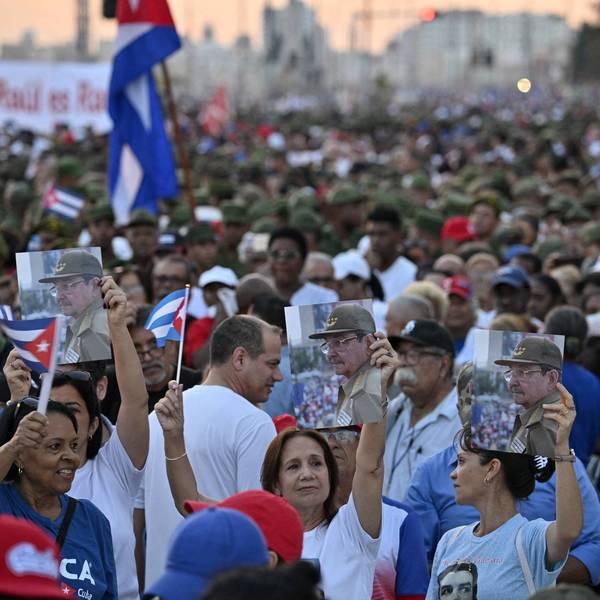
5
#000000
#FFFFFF
To donate by check, phone, or other method, see our More Ways to Give page.
Daily news & progressive opinion—funded by the people, not the corporations—delivered straight to your inbox.
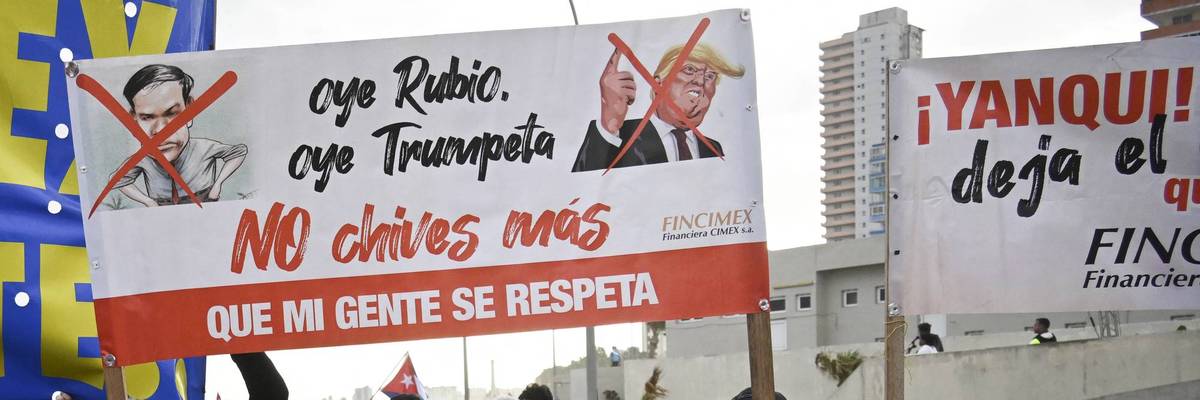
Cubans hold a banner against US President Donald Trump and Secretary of State Marco Rubio during an "Anti-Imperialist" protest in front of the US Embassy against the US incursion in Venezuela, where 32 Cuban soldiers lost their lives, in Havana on January 16, 2026.
Cuba looks set to see a repeat of the Venezuelan playbook, as President Donald Trump has said he will be "the one" to finally act on Cuba. The message from Washington is clear: Cuba is next.
The United States has indicted Cuba's former president Raúl Castro on murder charges, deployed a carrier strike group to the Caribbean, and issued explicit threats of military intervention. Is the US moving toward another regime change operation in the Western Hemisphere? The rhetoric coming out of Washington suggests very much so.
Cuba looks set to see a repeat of the Venezuelan playbook. President Donald Trump has said he will be "the one" to finally act on Cuba. The message from Washington is clear. Cuba is next.
Latin America is empire's favorite backyard, where the United States has consistently moved to remove governments that pursue independent foreign and economic policies not in line with American interests. From the ouster of Guatemala's Jacobo Árbenz in 1954 to the CIA-backed overthrow of Chile's Salvador Allende in 1973, the region bears a long scar map of US interference.
But Cuba is an interesting case. Since the Bay of Pigs invasion in 1961, the island has managed to stave off the empire. Fidel Castro faced over 600 assassination attempts by the CIA. Despite that, the island survived, 90 miles from Florida, outlasting every American president who tried to bring it down.
Trump's ratings have fallen considerably due to the interventionism in Venezuela and Iran. Further adventurism is only going to dent them further.
So why the sudden push for military action now? The US under Trump is following a ruthless foreign policy where the rules-based order, in whatever form it existed, has been buried. Just like Venezuela and Iran, the US believes it has the right to subdue Cuba by continuing the momentum it has built, as Cuba has always been a symbol of resistance to American imperialism.
Anti-Cuba narratives have served American presidents well when it comes to securing political capital. For Trump, this is an opportunity to reassert US power and influence in the region, as he has stated himself: "Other presidents have looked at this for 50, 60 years. It looks like I'll be the one that does it." And most importantly, the move speaks directly to his voter base in Florida, which has a large and politically powerful Cuban-American population.
More than Trump though is the role and influence of Marco Rubio. A Cuban-American born in Miami, Rubio has crafted his entire political identity around the promise of a free Cuba.
He opposed former President Barack Obama's 2014 decision to restore diplomatic relations with Havana more loudly than almost any other politician in Washington, swearing to do "everything possible" to obstruct and reverse that policy. He pushed successfully to reverse it under Trump's first term and has consistently lobbied for tighter sanctions, stricter travel restrictions, and maximum pressure on the island and in 2024 introduced legislation to ensure Cuba remained on the US State Sponsors of Terrorism list.
On Cuba's Independence Day, Rubio delivered a video message to the Cuban people blaming their suffering entirely on a military conglomerate called GAESA without once mentioning the fuel blockade his own administration imposed. It was a telling omission.
That blockade is producing real humanitarian crisis. Blackouts last up to 22 hours a day. The health system carries a backlog of over 96,000 surgeries including 11,000 for children. United Nations human rights experts have described the situation as "energy starvation" and said it violates international human rights law. Prolonged sanctions and economic pressure are deepening this crisis while doing little to produce meaningful political change.
Mr. Rubio should be reminded that it is not for the US to deliver freedom to the Cuban people, just as it is not for the US to deliver freedom to the people of Venezuela or Iran. Changing regimes under the guise of freedom and democracy is the old playbook of empire. It has nothing to do with the interests of ordinary people and everything to do with American vested interests.
The Cuban socialist regime may have a thousand flaws, just like the regimes in Venezuela or Iran. But that does not give any state the right to intervene and impose regime change.
The US should also be wary of its ambitions and remember that Cuba is not Venezuela. While it may not possess the ability to retaliate like Iran or block strategic choke points, the Cuban nation has a fighting spirit that should not be underestimated. Cuba's defense doctrine envisions the entire civilian population mobilized for resistance; every Cuban citizen receives military training. The country's official motto says it all: "Patria o muerte, venceremos." Homeland or death, we will prevail.
At the same time, Trump's ratings have fallen considerably due to the interventionism in Venezuela and Iran. Further adventurism is only going to dent them further, particularly if an attack on Cuba triggers a refugee crisis on Florida's doorstep.
If Rubio is genuinely concerned about the Cuban people, lifting the fuel blockade would be a meaningful first step, one that would ease humanitarian suffering and open space for de-escalation. Another US-driven regime change in the hemisphere would not liberate Cubans. It would likely deepen instability across the Caribbean and Latin America at a moment when the region can least afford it.
Dear Common Dreams reader, It’s been nearly 30 years since I co-founded Common Dreams with my late wife, Lina Newhouser. We had the radical notion that journalism should serve the public good, not corporate profits. It was clear to us from the outset what it would take to build such a project. No paid advertisements. No corporate sponsors. No millionaire publisher telling us what to think or do. Many people said we wouldn't last a year, but we proved those doubters wrong. Together with a tremendous team of journalists and dedicated staff, we built an independent media outlet free from the constraints of profits and corporate control. Our mission has always been simple: To inform. To inspire. To ignite change for the common good. Building Common Dreams was not easy. Our survival was never guaranteed. When you take on the most powerful forces—Wall Street greed, fossil fuel industry destruction, Big Tech lobbyists, and uber-rich oligarchs who have spent billions upon billions rigging the economy and democracy in their favor—the only bulwark you have is supporters who believe in your work. But here’s the urgent message from me today. It's never been this bad out there. And it's never been this hard to keep us going. At the very moment Common Dreams is most needed, the threats we face are intensifying. We need your support now more than ever. We don't accept corporate advertising and never will. We don't have a paywall because we don't think people should be blocked from critical news based on their ability to pay. Everything we do is funded by the donations of readers like you. When everyone does the little they can afford, we are strong. But if that support retreats or dries up, so do we. Will you donate now to make sure Common Dreams not only survives but thrives? —Craig Brown, Co-founder |
The United States has indicted Cuba's former president Raúl Castro on murder charges, deployed a carrier strike group to the Caribbean, and issued explicit threats of military intervention. Is the US moving toward another regime change operation in the Western Hemisphere? The rhetoric coming out of Washington suggests very much so.
Cuba looks set to see a repeat of the Venezuelan playbook. President Donald Trump has said he will be "the one" to finally act on Cuba. The message from Washington is clear. Cuba is next.
Latin America is empire's favorite backyard, where the United States has consistently moved to remove governments that pursue independent foreign and economic policies not in line with American interests. From the ouster of Guatemala's Jacobo Árbenz in 1954 to the CIA-backed overthrow of Chile's Salvador Allende in 1973, the region bears a long scar map of US interference.
But Cuba is an interesting case. Since the Bay of Pigs invasion in 1961, the island has managed to stave off the empire. Fidel Castro faced over 600 assassination attempts by the CIA. Despite that, the island survived, 90 miles from Florida, outlasting every American president who tried to bring it down.
Trump's ratings have fallen considerably due to the interventionism in Venezuela and Iran. Further adventurism is only going to dent them further.
So why the sudden push for military action now? The US under Trump is following a ruthless foreign policy where the rules-based order, in whatever form it existed, has been buried. Just like Venezuela and Iran, the US believes it has the right to subdue Cuba by continuing the momentum it has built, as Cuba has always been a symbol of resistance to American imperialism.
Anti-Cuba narratives have served American presidents well when it comes to securing political capital. For Trump, this is an opportunity to reassert US power and influence in the region, as he has stated himself: "Other presidents have looked at this for 50, 60 years. It looks like I'll be the one that does it." And most importantly, the move speaks directly to his voter base in Florida, which has a large and politically powerful Cuban-American population.
More than Trump though is the role and influence of Marco Rubio. A Cuban-American born in Miami, Rubio has crafted his entire political identity around the promise of a free Cuba.
He opposed former President Barack Obama's 2014 decision to restore diplomatic relations with Havana more loudly than almost any other politician in Washington, swearing to do "everything possible" to obstruct and reverse that policy. He pushed successfully to reverse it under Trump's first term and has consistently lobbied for tighter sanctions, stricter travel restrictions, and maximum pressure on the island and in 2024 introduced legislation to ensure Cuba remained on the US State Sponsors of Terrorism list.
On Cuba's Independence Day, Rubio delivered a video message to the Cuban people blaming their suffering entirely on a military conglomerate called GAESA without once mentioning the fuel blockade his own administration imposed. It was a telling omission.
That blockade is producing real humanitarian crisis. Blackouts last up to 22 hours a day. The health system carries a backlog of over 96,000 surgeries including 11,000 for children. United Nations human rights experts have described the situation as "energy starvation" and said it violates international human rights law. Prolonged sanctions and economic pressure are deepening this crisis while doing little to produce meaningful political change.
Mr. Rubio should be reminded that it is not for the US to deliver freedom to the Cuban people, just as it is not for the US to deliver freedom to the people of Venezuela or Iran. Changing regimes under the guise of freedom and democracy is the old playbook of empire. It has nothing to do with the interests of ordinary people and everything to do with American vested interests.
The Cuban socialist regime may have a thousand flaws, just like the regimes in Venezuela or Iran. But that does not give any state the right to intervene and impose regime change.
The US should also be wary of its ambitions and remember that Cuba is not Venezuela. While it may not possess the ability to retaliate like Iran or block strategic choke points, the Cuban nation has a fighting spirit that should not be underestimated. Cuba's defense doctrine envisions the entire civilian population mobilized for resistance; every Cuban citizen receives military training. The country's official motto says it all: "Patria o muerte, venceremos." Homeland or death, we will prevail.
At the same time, Trump's ratings have fallen considerably due to the interventionism in Venezuela and Iran. Further adventurism is only going to dent them further, particularly if an attack on Cuba triggers a refugee crisis on Florida's doorstep.
If Rubio is genuinely concerned about the Cuban people, lifting the fuel blockade would be a meaningful first step, one that would ease humanitarian suffering and open space for de-escalation. Another US-driven regime change in the hemisphere would not liberate Cubans. It would likely deepen instability across the Caribbean and Latin America at a moment when the region can least afford it.
The United States has indicted Cuba's former president Raúl Castro on murder charges, deployed a carrier strike group to the Caribbean, and issued explicit threats of military intervention. Is the US moving toward another regime change operation in the Western Hemisphere? The rhetoric coming out of Washington suggests very much so.
Cuba looks set to see a repeat of the Venezuelan playbook. President Donald Trump has said he will be "the one" to finally act on Cuba. The message from Washington is clear. Cuba is next.
Latin America is empire's favorite backyard, where the United States has consistently moved to remove governments that pursue independent foreign and economic policies not in line with American interests. From the ouster of Guatemala's Jacobo Árbenz in 1954 to the CIA-backed overthrow of Chile's Salvador Allende in 1973, the region bears a long scar map of US interference.
But Cuba is an interesting case. Since the Bay of Pigs invasion in 1961, the island has managed to stave off the empire. Fidel Castro faced over 600 assassination attempts by the CIA. Despite that, the island survived, 90 miles from Florida, outlasting every American president who tried to bring it down.
Trump's ratings have fallen considerably due to the interventionism in Venezuela and Iran. Further adventurism is only going to dent them further.
So why the sudden push for military action now? The US under Trump is following a ruthless foreign policy where the rules-based order, in whatever form it existed, has been buried. Just like Venezuela and Iran, the US believes it has the right to subdue Cuba by continuing the momentum it has built, as Cuba has always been a symbol of resistance to American imperialism.
Anti-Cuba narratives have served American presidents well when it comes to securing political capital. For Trump, this is an opportunity to reassert US power and influence in the region, as he has stated himself: "Other presidents have looked at this for 50, 60 years. It looks like I'll be the one that does it." And most importantly, the move speaks directly to his voter base in Florida, which has a large and politically powerful Cuban-American population.
More than Trump though is the role and influence of Marco Rubio. A Cuban-American born in Miami, Rubio has crafted his entire political identity around the promise of a free Cuba.
He opposed former President Barack Obama's 2014 decision to restore diplomatic relations with Havana more loudly than almost any other politician in Washington, swearing to do "everything possible" to obstruct and reverse that policy. He pushed successfully to reverse it under Trump's first term and has consistently lobbied for tighter sanctions, stricter travel restrictions, and maximum pressure on the island and in 2024 introduced legislation to ensure Cuba remained on the US State Sponsors of Terrorism list.
On Cuba's Independence Day, Rubio delivered a video message to the Cuban people blaming their suffering entirely on a military conglomerate called GAESA without once mentioning the fuel blockade his own administration imposed. It was a telling omission.
That blockade is producing real humanitarian crisis. Blackouts last up to 22 hours a day. The health system carries a backlog of over 96,000 surgeries including 11,000 for children. United Nations human rights experts have described the situation as "energy starvation" and said it violates international human rights law. Prolonged sanctions and economic pressure are deepening this crisis while doing little to produce meaningful political change.
Mr. Rubio should be reminded that it is not for the US to deliver freedom to the Cuban people, just as it is not for the US to deliver freedom to the people of Venezuela or Iran. Changing regimes under the guise of freedom and democracy is the old playbook of empire. It has nothing to do with the interests of ordinary people and everything to do with American vested interests.
The Cuban socialist regime may have a thousand flaws, just like the regimes in Venezuela or Iran. But that does not give any state the right to intervene and impose regime change.
The US should also be wary of its ambitions and remember that Cuba is not Venezuela. While it may not possess the ability to retaliate like Iran or block strategic choke points, the Cuban nation has a fighting spirit that should not be underestimated. Cuba's defense doctrine envisions the entire civilian population mobilized for resistance; every Cuban citizen receives military training. The country's official motto says it all: "Patria o muerte, venceremos." Homeland or death, we will prevail.
At the same time, Trump's ratings have fallen considerably due to the interventionism in Venezuela and Iran. Further adventurism is only going to dent them further, particularly if an attack on Cuba triggers a refugee crisis on Florida's doorstep.
If Rubio is genuinely concerned about the Cuban people, lifting the fuel blockade would be a meaningful first step, one that would ease humanitarian suffering and open space for de-escalation. Another US-driven regime change in the hemisphere would not liberate Cubans. It would likely deepen instability across the Caribbean and Latin America at a moment when the region can least afford it.