SUBSCRIBE TO OUR FREE NEWSLETTER
Daily news & progressive opinion—funded by the people, not the corporations—delivered straight to your inbox.
5
#000000
#FFFFFF
To donate by check, phone, or other method, see our More Ways to Give page.
Daily news & progressive opinion—funded by the people, not the corporations—delivered straight to your inbox.
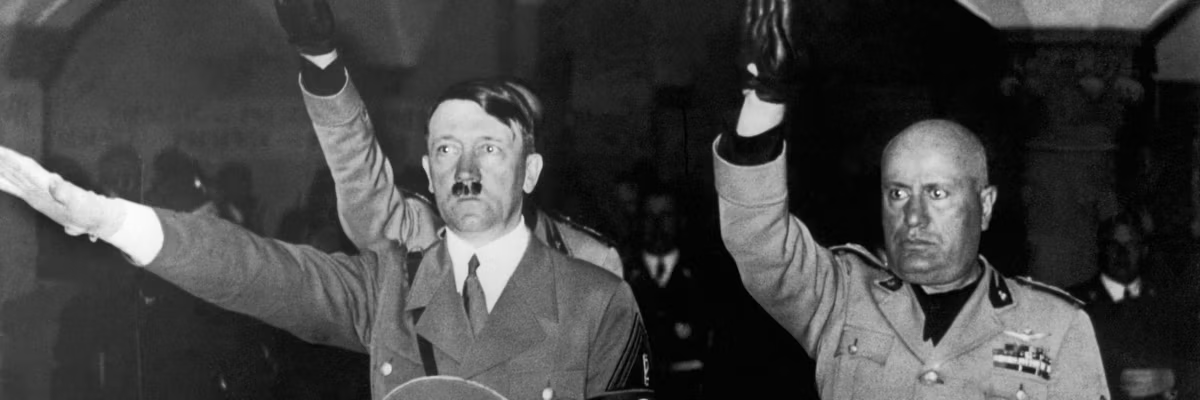
German chancellor Adolf Hitler and the Italian dictator Benito Mussolini in Florence, Italy on October 28, 1940.
If history proves anything when it comes to authoritarian fascists, it’s that patient optimism is not a virtue.
Ruth Ben-Ghiat is a professor of history at New York University; her Wikipedia biography describes her as “a scholar on fascism and authoritarian leaders.” With these credentials, she has written an opinion piece in the New York Times telling us that dictators and would-be dictators generally make their economies worse and lead a precarious existence. Their efforts often “backfire,” as she puts it.
While this theory might seem like comforting evidence that history “proves” that dictators will get their comeuppance, it is actually a counsel of passively sitting on our hands and waiting out the authoritarian leader: either to await his death, or hang on till he’s ousted from power by his own miscarrying plans. If history proves anything, it’s that patient optimism is not a virtue.
Ben-Ghiat's area of expertise is Benito Mussolini and the fascist era in Italy, and she uses him as an example of a dictator getting what’s coming to him. After surrounding himself with sycophants and employing consistently disastrous military strategies, Mussolini was deposed in 1943 by the Fascist Grand Council: “He spent his last years as the head of the Nazi puppet state the Republic of Salò, his phone tapped by the Germans. He was killed by anti-Fascist partisans in April 1945.”
His demise—being strung up like a side of beef at a Milan filling station—may have been poetic justice, but wasn’t the cost just a little too high? He ruled Italy for 21 years until he was deposed, and by the time of his death, much of the country was in ruins. Italian campaign veteran and Stars and Stripes cartoonist Bill Mauldin described the landscape as “ghostlike,” recalling walls standing in the moonlight surrounded by rubble, with empty, "single unblinking" windows looking out like eyes. That’s what tends to happen when a dictator’s plans backfire – he pulls the whole country down with him.
The author’s more contemporary example is Vladimir Putin. At the beginning of 2022, she says, Putin had it all, including gold toilet seats in his Crimean palace. But according to Ben-Ghiat, he invaded Ukraine to shore up his waning popularity, a move that did not work out as planned. The Russian dead have piled up, Russia has become more dependent on China, and the economy has sputtered under the burden of the war.
If the cultural constellation provides a measure of both elite and popular support, the dictator can endure for years.
But so what? Putin has been in power for 25 years, and shows no sign of going anywhere soon. Perhaps some faction in the army or the FSB might “terminate him with extreme prejudice” (as the phrase in Apocalypse Now termed an assassination), because they would be the only ones with the firepower to do so, but I suspect Putin’s likely successors would not transform Russia into another Denmark. And Ben-Ghiat undermines her own thesis by reminding us that Donald Trump shows every sign of being willing to bail Putin out of his international difficulties.
Unfortunately, dictatorial systems tend to be more durable than she thinks. How many times in the last four decades have we heard that the Iranian regime is on the point of collapse? Even a usually savvy observer of international relations like Lawrence Freedman has flatly claimed “the regime is doomed.” Perhaps in the long run Freedman will be proved right, but the people in Iran have to live in the short run.
And sometimes the long run is very long. North Korea, possibly the most repressive regime on the planet, has been run as a family business by the Kim dynasty for 78 years. With a per capita GDP that is less than one-sixtieth (note: not one-sixth, one sixtieth!) of South Korea’s, it is the most spectacular example in the world of how dictatorships ruin economies. It also experiences periodic famines. Famine is the single biggest marker for the total failure of a governing system; historically, the one thing any regime wanted to avoid was bread riots in the big cities. Ask the shades of Louis XVI or Tsar Nicholas about it.
Yet, if the regime is repressive enough, as North Korea’s is, it can use lack of food as a regime stabilizer. The army, the secret police, and the regime’s vocal supporters get food as a reward; access to enough calories to survive becomes the reward for loyalty. The rest, as in North Korea or China during the Great Leap Forward, can subsist on grass, wood shavings, and potato peels, and will be too physically debilitated to overthrow the system, even if a comprehensive system of surveillance and informers did not exist.
Donald Trump certainly does not have a hold on the United States like that of Kim Jong-un on North Korea, or Putin on Russia. But even in a “mild” dictatorship, the odds are high that living standards for the average person will decline, free speech will be stifled, and culture will stagnate into regime propaganda and kitsch. Social trust, already in steady decline in the United States since the 1960s, will crater to the levels of Somalia or Yemen.
Without social trust, the economy cannot be entrepreneurial and innovative (as opposed to crony-ridden and subsisting on government favoritism), and our civil society cannot be vibrant and voluntaristic with so many informers about. Art and intellectual activity will wither; our public universities, once the best in the world, will decline to the level of Bob Jones U. or Trump’s own fake university.
I believe that Ben-Ghiat fundamentally errs in emphasizing the dictator, rather than the political and social culture that allows a dictator to reach the top, and that can sustain him in power despite his disastrous mistakes. If the cultural constellation provides a measure of both elite and popular support, the dictator can endure for years.
There is a solid American base of popular backing for fascism, and Trump’s departure from the scene will not cause these people to come to their senses as if by magic.
As in all dictatorships, Trump has a circle of elite supporters. Only in this case, the extent of their international influence is orders of magnitude greater than any previous group of oligarchs. Our American class of billionaires, deci-billionaires, and centi-billionaires dearly loves Trump for the fact that the bribes they render unto him are smaller than the taxes they would have to pay in normal circumstances.
As a bonus, the billionaires receive no-bid contracts; the return on their investment is so great that the public groveling they must periodically perform is well worth it. These malefactors of great wealth will stand like a praetorian guard to protect the privileges they have received under Trump. Any attempt to return America to a functioning representative democracy under the rule of law cannot succeed over the long term unless there is a firm reckoning with our billionaire class.
Finally, dictators must have at least some popular support. Trump’s opponents must contend with the uncomfortable fact that in three consecutive presidential elections, the number of Americans who voted for him grew each time. There is a solid American base of popular backing for fascism, and Trump’s departure from the scene will not cause these people to come to their senses as if by magic.
Ben-Ghiat is trafficking in platitudes by saying that dictators make decisions that are terrible for their countries. That is the nature of dictators and the sycophants who fawn over them; competent and moral people are systematically weeded out of the governmental apparatus and replaced by yes-men. As Hannah Arendt observed 75 years ago:
Totalitarianism in power invariably replaces all first-rate talents, regardless of their sympathies, with those crackpots and fools whose lack of intelligence and creativity is still the best guarantee of their loyalty.
None of this is to say that Trump and his goons cannot be levered out of power. But there is no basis for us to complacently wait for his mistakes to cause the scales to fall from the eyes of his supporters in a miraculous fashion. Making America a decent society will require a tough-mindedness and unflinching determination that Merrick Garland so conspicuously lacked when he had the chance. We must not fail the next chance.
Dear Common Dreams reader, It’s been nearly 30 years since I co-founded Common Dreams with my late wife, Lina Newhouser. We had the radical notion that journalism should serve the public good, not corporate profits. It was clear to us from the outset what it would take to build such a project. No paid advertisements. No corporate sponsors. No millionaire publisher telling us what to think or do. Many people said we wouldn't last a year, but we proved those doubters wrong. Together with a tremendous team of journalists and dedicated staff, we built an independent media outlet free from the constraints of profits and corporate control. Our mission has always been simple: To inform. To inspire. To ignite change for the common good. Building Common Dreams was not easy. Our survival was never guaranteed. When you take on the most powerful forces—Wall Street greed, fossil fuel industry destruction, Big Tech lobbyists, and uber-rich oligarchs who have spent billions upon billions rigging the economy and democracy in their favor—the only bulwark you have is supporters who believe in your work. But here’s the urgent message from me today. It's never been this bad out there. And it's never been this hard to keep us going. At the very moment Common Dreams is most needed, the threats we face are intensifying. We need your support now more than ever. We don't accept corporate advertising and never will. We don't have a paywall because we don't think people should be blocked from critical news based on their ability to pay. Everything we do is funded by the donations of readers like you. When everyone does the little they can afford, we are strong. But if that support retreats or dries up, so do we. Will you donate now to make sure Common Dreams not only survives but thrives? —Craig Brown, Co-founder |
Ruth Ben-Ghiat is a professor of history at New York University; her Wikipedia biography describes her as “a scholar on fascism and authoritarian leaders.” With these credentials, she has written an opinion piece in the New York Times telling us that dictators and would-be dictators generally make their economies worse and lead a precarious existence. Their efforts often “backfire,” as she puts it.
While this theory might seem like comforting evidence that history “proves” that dictators will get their comeuppance, it is actually a counsel of passively sitting on our hands and waiting out the authoritarian leader: either to await his death, or hang on till he’s ousted from power by his own miscarrying plans. If history proves anything, it’s that patient optimism is not a virtue.
Ben-Ghiat's area of expertise is Benito Mussolini and the fascist era in Italy, and she uses him as an example of a dictator getting what’s coming to him. After surrounding himself with sycophants and employing consistently disastrous military strategies, Mussolini was deposed in 1943 by the Fascist Grand Council: “He spent his last years as the head of the Nazi puppet state the Republic of Salò, his phone tapped by the Germans. He was killed by anti-Fascist partisans in April 1945.”
His demise—being strung up like a side of beef at a Milan filling station—may have been poetic justice, but wasn’t the cost just a little too high? He ruled Italy for 21 years until he was deposed, and by the time of his death, much of the country was in ruins. Italian campaign veteran and Stars and Stripes cartoonist Bill Mauldin described the landscape as “ghostlike,” recalling walls standing in the moonlight surrounded by rubble, with empty, "single unblinking" windows looking out like eyes. That’s what tends to happen when a dictator’s plans backfire – he pulls the whole country down with him.
The author’s more contemporary example is Vladimir Putin. At the beginning of 2022, she says, Putin had it all, including gold toilet seats in his Crimean palace. But according to Ben-Ghiat, he invaded Ukraine to shore up his waning popularity, a move that did not work out as planned. The Russian dead have piled up, Russia has become more dependent on China, and the economy has sputtered under the burden of the war.
If the cultural constellation provides a measure of both elite and popular support, the dictator can endure for years.
But so what? Putin has been in power for 25 years, and shows no sign of going anywhere soon. Perhaps some faction in the army or the FSB might “terminate him with extreme prejudice” (as the phrase in Apocalypse Now termed an assassination), because they would be the only ones with the firepower to do so, but I suspect Putin’s likely successors would not transform Russia into another Denmark. And Ben-Ghiat undermines her own thesis by reminding us that Donald Trump shows every sign of being willing to bail Putin out of his international difficulties.
Unfortunately, dictatorial systems tend to be more durable than she thinks. How many times in the last four decades have we heard that the Iranian regime is on the point of collapse? Even a usually savvy observer of international relations like Lawrence Freedman has flatly claimed “the regime is doomed.” Perhaps in the long run Freedman will be proved right, but the people in Iran have to live in the short run.
And sometimes the long run is very long. North Korea, possibly the most repressive regime on the planet, has been run as a family business by the Kim dynasty for 78 years. With a per capita GDP that is less than one-sixtieth (note: not one-sixth, one sixtieth!) of South Korea’s, it is the most spectacular example in the world of how dictatorships ruin economies. It also experiences periodic famines. Famine is the single biggest marker for the total failure of a governing system; historically, the one thing any regime wanted to avoid was bread riots in the big cities. Ask the shades of Louis XVI or Tsar Nicholas about it.
Yet, if the regime is repressive enough, as North Korea’s is, it can use lack of food as a regime stabilizer. The army, the secret police, and the regime’s vocal supporters get food as a reward; access to enough calories to survive becomes the reward for loyalty. The rest, as in North Korea or China during the Great Leap Forward, can subsist on grass, wood shavings, and potato peels, and will be too physically debilitated to overthrow the system, even if a comprehensive system of surveillance and informers did not exist.
Donald Trump certainly does not have a hold on the United States like that of Kim Jong-un on North Korea, or Putin on Russia. But even in a “mild” dictatorship, the odds are high that living standards for the average person will decline, free speech will be stifled, and culture will stagnate into regime propaganda and kitsch. Social trust, already in steady decline in the United States since the 1960s, will crater to the levels of Somalia or Yemen.
Without social trust, the economy cannot be entrepreneurial and innovative (as opposed to crony-ridden and subsisting on government favoritism), and our civil society cannot be vibrant and voluntaristic with so many informers about. Art and intellectual activity will wither; our public universities, once the best in the world, will decline to the level of Bob Jones U. or Trump’s own fake university.
I believe that Ben-Ghiat fundamentally errs in emphasizing the dictator, rather than the political and social culture that allows a dictator to reach the top, and that can sustain him in power despite his disastrous mistakes. If the cultural constellation provides a measure of both elite and popular support, the dictator can endure for years.
There is a solid American base of popular backing for fascism, and Trump’s departure from the scene will not cause these people to come to their senses as if by magic.
As in all dictatorships, Trump has a circle of elite supporters. Only in this case, the extent of their international influence is orders of magnitude greater than any previous group of oligarchs. Our American class of billionaires, deci-billionaires, and centi-billionaires dearly loves Trump for the fact that the bribes they render unto him are smaller than the taxes they would have to pay in normal circumstances.
As a bonus, the billionaires receive no-bid contracts; the return on their investment is so great that the public groveling they must periodically perform is well worth it. These malefactors of great wealth will stand like a praetorian guard to protect the privileges they have received under Trump. Any attempt to return America to a functioning representative democracy under the rule of law cannot succeed over the long term unless there is a firm reckoning with our billionaire class.
Finally, dictators must have at least some popular support. Trump’s opponents must contend with the uncomfortable fact that in three consecutive presidential elections, the number of Americans who voted for him grew each time. There is a solid American base of popular backing for fascism, and Trump’s departure from the scene will not cause these people to come to their senses as if by magic.
Ben-Ghiat is trafficking in platitudes by saying that dictators make decisions that are terrible for their countries. That is the nature of dictators and the sycophants who fawn over them; competent and moral people are systematically weeded out of the governmental apparatus and replaced by yes-men. As Hannah Arendt observed 75 years ago:
Totalitarianism in power invariably replaces all first-rate talents, regardless of their sympathies, with those crackpots and fools whose lack of intelligence and creativity is still the best guarantee of their loyalty.
None of this is to say that Trump and his goons cannot be levered out of power. But there is no basis for us to complacently wait for his mistakes to cause the scales to fall from the eyes of his supporters in a miraculous fashion. Making America a decent society will require a tough-mindedness and unflinching determination that Merrick Garland so conspicuously lacked when he had the chance. We must not fail the next chance.
Ruth Ben-Ghiat is a professor of history at New York University; her Wikipedia biography describes her as “a scholar on fascism and authoritarian leaders.” With these credentials, she has written an opinion piece in the New York Times telling us that dictators and would-be dictators generally make their economies worse and lead a precarious existence. Their efforts often “backfire,” as she puts it.
While this theory might seem like comforting evidence that history “proves” that dictators will get their comeuppance, it is actually a counsel of passively sitting on our hands and waiting out the authoritarian leader: either to await his death, or hang on till he’s ousted from power by his own miscarrying plans. If history proves anything, it’s that patient optimism is not a virtue.
Ben-Ghiat's area of expertise is Benito Mussolini and the fascist era in Italy, and she uses him as an example of a dictator getting what’s coming to him. After surrounding himself with sycophants and employing consistently disastrous military strategies, Mussolini was deposed in 1943 by the Fascist Grand Council: “He spent his last years as the head of the Nazi puppet state the Republic of Salò, his phone tapped by the Germans. He was killed by anti-Fascist partisans in April 1945.”
His demise—being strung up like a side of beef at a Milan filling station—may have been poetic justice, but wasn’t the cost just a little too high? He ruled Italy for 21 years until he was deposed, and by the time of his death, much of the country was in ruins. Italian campaign veteran and Stars and Stripes cartoonist Bill Mauldin described the landscape as “ghostlike,” recalling walls standing in the moonlight surrounded by rubble, with empty, "single unblinking" windows looking out like eyes. That’s what tends to happen when a dictator’s plans backfire – he pulls the whole country down with him.
The author’s more contemporary example is Vladimir Putin. At the beginning of 2022, she says, Putin had it all, including gold toilet seats in his Crimean palace. But according to Ben-Ghiat, he invaded Ukraine to shore up his waning popularity, a move that did not work out as planned. The Russian dead have piled up, Russia has become more dependent on China, and the economy has sputtered under the burden of the war.
If the cultural constellation provides a measure of both elite and popular support, the dictator can endure for years.
But so what? Putin has been in power for 25 years, and shows no sign of going anywhere soon. Perhaps some faction in the army or the FSB might “terminate him with extreme prejudice” (as the phrase in Apocalypse Now termed an assassination), because they would be the only ones with the firepower to do so, but I suspect Putin’s likely successors would not transform Russia into another Denmark. And Ben-Ghiat undermines her own thesis by reminding us that Donald Trump shows every sign of being willing to bail Putin out of his international difficulties.
Unfortunately, dictatorial systems tend to be more durable than she thinks. How many times in the last four decades have we heard that the Iranian regime is on the point of collapse? Even a usually savvy observer of international relations like Lawrence Freedman has flatly claimed “the regime is doomed.” Perhaps in the long run Freedman will be proved right, but the people in Iran have to live in the short run.
And sometimes the long run is very long. North Korea, possibly the most repressive regime on the planet, has been run as a family business by the Kim dynasty for 78 years. With a per capita GDP that is less than one-sixtieth (note: not one-sixth, one sixtieth!) of South Korea’s, it is the most spectacular example in the world of how dictatorships ruin economies. It also experiences periodic famines. Famine is the single biggest marker for the total failure of a governing system; historically, the one thing any regime wanted to avoid was bread riots in the big cities. Ask the shades of Louis XVI or Tsar Nicholas about it.
Yet, if the regime is repressive enough, as North Korea’s is, it can use lack of food as a regime stabilizer. The army, the secret police, and the regime’s vocal supporters get food as a reward; access to enough calories to survive becomes the reward for loyalty. The rest, as in North Korea or China during the Great Leap Forward, can subsist on grass, wood shavings, and potato peels, and will be too physically debilitated to overthrow the system, even if a comprehensive system of surveillance and informers did not exist.
Donald Trump certainly does not have a hold on the United States like that of Kim Jong-un on North Korea, or Putin on Russia. But even in a “mild” dictatorship, the odds are high that living standards for the average person will decline, free speech will be stifled, and culture will stagnate into regime propaganda and kitsch. Social trust, already in steady decline in the United States since the 1960s, will crater to the levels of Somalia or Yemen.
Without social trust, the economy cannot be entrepreneurial and innovative (as opposed to crony-ridden and subsisting on government favoritism), and our civil society cannot be vibrant and voluntaristic with so many informers about. Art and intellectual activity will wither; our public universities, once the best in the world, will decline to the level of Bob Jones U. or Trump’s own fake university.
I believe that Ben-Ghiat fundamentally errs in emphasizing the dictator, rather than the political and social culture that allows a dictator to reach the top, and that can sustain him in power despite his disastrous mistakes. If the cultural constellation provides a measure of both elite and popular support, the dictator can endure for years.
There is a solid American base of popular backing for fascism, and Trump’s departure from the scene will not cause these people to come to their senses as if by magic.
As in all dictatorships, Trump has a circle of elite supporters. Only in this case, the extent of their international influence is orders of magnitude greater than any previous group of oligarchs. Our American class of billionaires, deci-billionaires, and centi-billionaires dearly loves Trump for the fact that the bribes they render unto him are smaller than the taxes they would have to pay in normal circumstances.
As a bonus, the billionaires receive no-bid contracts; the return on their investment is so great that the public groveling they must periodically perform is well worth it. These malefactors of great wealth will stand like a praetorian guard to protect the privileges they have received under Trump. Any attempt to return America to a functioning representative democracy under the rule of law cannot succeed over the long term unless there is a firm reckoning with our billionaire class.
Finally, dictators must have at least some popular support. Trump’s opponents must contend with the uncomfortable fact that in three consecutive presidential elections, the number of Americans who voted for him grew each time. There is a solid American base of popular backing for fascism, and Trump’s departure from the scene will not cause these people to come to their senses as if by magic.
Ben-Ghiat is trafficking in platitudes by saying that dictators make decisions that are terrible for their countries. That is the nature of dictators and the sycophants who fawn over them; competent and moral people are systematically weeded out of the governmental apparatus and replaced by yes-men. As Hannah Arendt observed 75 years ago:
Totalitarianism in power invariably replaces all first-rate talents, regardless of their sympathies, with those crackpots and fools whose lack of intelligence and creativity is still the best guarantee of their loyalty.
None of this is to say that Trump and his goons cannot be levered out of power. But there is no basis for us to complacently wait for his mistakes to cause the scales to fall from the eyes of his supporters in a miraculous fashion. Making America a decent society will require a tough-mindedness and unflinching determination that Merrick Garland so conspicuously lacked when he had the chance. We must not fail the next chance.