SUBSCRIBE TO OUR FREE NEWSLETTER
Daily news & progressive opinion—funded by the people, not the corporations—delivered straight to your inbox.
5
#000000
#FFFFFF
To donate by check, phone, or other method, see our More Ways to Give page.
Daily news & progressive opinion—funded by the people, not the corporations—delivered straight to your inbox.
A view from the front of a college classroom amid fresh carnage both near and far.
I write this from the front of a Columbia classroom in which about 60 first-year college students are taking the final exam for Frontiers of Science. Yes, it’s a Sunday, but the class is required of all Columbia College students and so having the exam on the weekend ensures that there won’t be conflicts with the exams for other courses they are taking. The 60 students in my classroom are a fraction of the nearly 740 taking the course this semester.
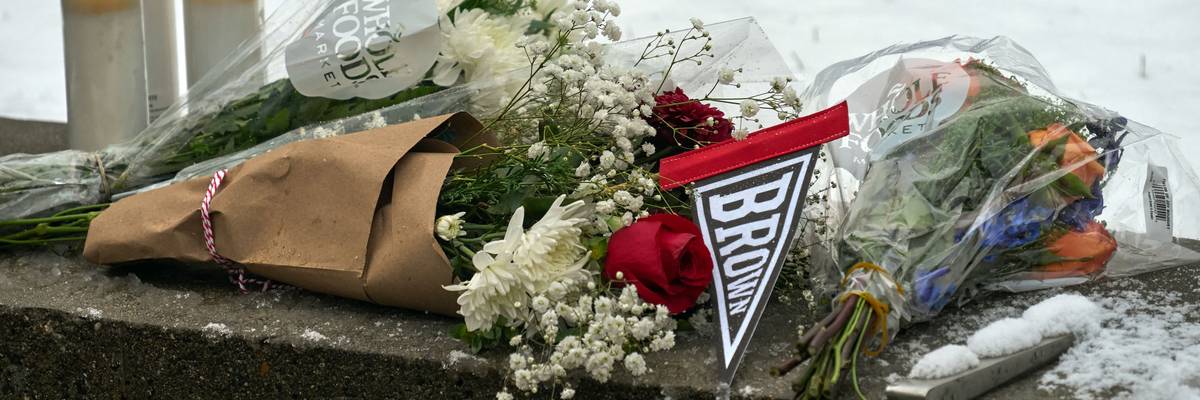
The exam began at 2 pm, less than 24 hours after the shooting at Brown University, and just hours after many of us learned about the shooting in Sydney, Australia. Given these devastating events, I offered this morning that anyone who was adversely affected could take the exam later in the week or take what at Columbia is called an incomplete, which means that they would take the final exam at the start of next semester and only then be assigned a grade. Only about two dozen students took this offer, some sharing personal stories about having close friends from childhood or high school among the victims at Brown. It makes sense that the high-achieving students that Columbia attracts would have high-achieving friends at Brown. Some also hail from Providence and have had impacted family members.
It's hard to process now, as my students are going through a 30-page exam (there are lots of figures and tables in it, plus spaces for them to add their answers, but yes, it’s a long exam) the senselessness of mass shootings in general, with the one in a classroom full of primarily first-year college students going through a Saturday afternoon final exam review for Principles of Economics weighing heavily as I sit here. Many of the students in Frontiers of Science also take a course here named Principles of Economics. The parallel is heartbreaking. I cannot imagine what I would have done had a shooter walked in on the review I held just a few days ago. I don’t think any of us can, except for those who have experienced mass shootings themselves. Sadly, it seems that at Brown there are two students with such prior experiences.
As I look at my students, still busily working on the exam, and recall the joys I’ve experienced teaching them and getting to know them this semester, I feel that we owe them so much more than what’s on offer at the moment.
As is typical in American society, there will be thoughts and prayers, and arguments about gun control and how we haven’t done enough to ensure that the incomprehensible violence does not happen again. I was in my final year of college when Columbine happened in 1999. I remember seeing the news in the townhouse near the Caltech campus that I shared with three housemates. We were devastated then. More than 25 years after Columbine, the feeling of devastation is sadly familiar, but also insidious.
The fact that the second shooting of the weekend took place in Australia, a country with strict gun laws, complicates the debate somewhat, demonstrating that this is not just about gun control. Sure, more gun control in the US would help; after all, our rate of mass shootings per capita is far higher than in all of the other developed countries. But I think that the problem is far deeper than lack of gun control. The problem lies in having a state, a society, a world, in which violence is not only excused and sanctioned on a regular basis, but celebrated both as a matter of history, but also the present and the future.
We salute our troops, flaunt our deadliest weapons as a matter of pride, justify wars in the name of democracy, and applaud leaders who may have committed war crimes and belong in courtrooms rather than in polite society. Journalist Glenn Greenwald recently made this last point when discussing why so many young people are buying what Nick Fuentes is selling and not what many in the mainstream media would want them to buy.
It is a sick society that spends far more on the military than on diplomacy, education, its veterans, and infrastructure combined. In their recent book, The Trillion Dollar War Machine, William Hartung and Ben Freeman demonstrate not only that most of the defense budget ends up in the pockets of the arms manufacturers, but that the funds have also been allocated to projects that have put our troops in harm’s way. Our investment in the military is costly all around, while it elevates violence here and abroad as the ultimate arbiter of disputes and disagreements. The US President John F. Kennedy once said that we will have war as long as the conscientious objectors are treated as traitors, while people who kill during times of war are treated as heroes.
The pinnacle of this sickness is the possession of nuclear weapons, a constant threat to ourselves and our so-called adversaries, but also the rest of the world. The belief that nuclear weapons keep us safe runs deep through society, and elevates the risk of ultimate annihilation at any moment. Buried deep in this narrative is the justification of the atomic bombings as the tool that brought World War II to a close, while historical analysis demonstrates that Japan would have surrendered without its citizens being incinerated, blown apart, and sickened by the power unleashed from the atom. Justifying the murder of innocent civilians can only beget more violence in the long run, whether in Gaza, or at Brown, or at Bondi Beach.
There are more forms of sanctioned violence, including torture of prisoners, the death penalty, and the killing of suspects at the hands of police. As it is now, these examples send a message that even beyond war, violence and death are the answer. As shocking and horrifying as it is, it is perhaps not surprising that there are individuals, many likely with mental illness, that take this message to heart and commit senseless violence themselves.
As I look at my students, still busily working on the exam, and recall the joys I’ve experienced teaching them and getting to know them this semester, I feel that we owe them so much more than what’s on offer at the moment. Not only do they deserve not to be thinking of mass shootings while studying for their college exams, but they definitely deserve to inherit a world in which peace is sacrosanct and sanctioned violence is not the answer.
Dear Common Dreams reader, It’s been nearly 30 years since I co-founded Common Dreams with my late wife, Lina Newhouser. We had the radical notion that journalism should serve the public good, not corporate profits. It was clear to us from the outset what it would take to build such a project. No paid advertisements. No corporate sponsors. No millionaire publisher telling us what to think or do. Many people said we wouldn't last a year, but we proved those doubters wrong. Together with a tremendous team of journalists and dedicated staff, we built an independent media outlet free from the constraints of profits and corporate control. Our mission has always been simple: To inform. To inspire. To ignite change for the common good. Building Common Dreams was not easy. Our survival was never guaranteed. When you take on the most powerful forces—Wall Street greed, fossil fuel industry destruction, Big Tech lobbyists, and uber-rich oligarchs who have spent billions upon billions rigging the economy and democracy in their favor—the only bulwark you have is supporters who believe in your work. But here’s the urgent message from me today. It's never been this bad out there. And it's never been this hard to keep us going. At the very moment Common Dreams is most needed, the threats we face are intensifying. We need your support now more than ever. We don't accept corporate advertising and never will. We don't have a paywall because we don't think people should be blocked from critical news based on their ability to pay. Everything we do is funded by the donations of readers like you. When everyone does the little they can afford, we are strong. But if that support retreats or dries up, so do we. Will you donate now to make sure Common Dreams not only survives but thrives? —Craig Brown, Co-founder |
I write this from the front of a Columbia classroom in which about 60 first-year college students are taking the final exam for Frontiers of Science. Yes, it’s a Sunday, but the class is required of all Columbia College students and so having the exam on the weekend ensures that there won’t be conflicts with the exams for other courses they are taking. The 60 students in my classroom are a fraction of the nearly 740 taking the course this semester.
The exam began at 2 pm, less than 24 hours after the shooting at Brown University, and just hours after many of us learned about the shooting in Sydney, Australia. Given these devastating events, I offered this morning that anyone who was adversely affected could take the exam later in the week or take what at Columbia is called an incomplete, which means that they would take the final exam at the start of next semester and only then be assigned a grade. Only about two dozen students took this offer, some sharing personal stories about having close friends from childhood or high school among the victims at Brown. It makes sense that the high-achieving students that Columbia attracts would have high-achieving friends at Brown. Some also hail from Providence and have had impacted family members.
It's hard to process now, as my students are going through a 30-page exam (there are lots of figures and tables in it, plus spaces for them to add their answers, but yes, it’s a long exam) the senselessness of mass shootings in general, with the one in a classroom full of primarily first-year college students going through a Saturday afternoon final exam review for Principles of Economics weighing heavily as I sit here. Many of the students in Frontiers of Science also take a course here named Principles of Economics. The parallel is heartbreaking. I cannot imagine what I would have done had a shooter walked in on the review I held just a few days ago. I don’t think any of us can, except for those who have experienced mass shootings themselves. Sadly, it seems that at Brown there are two students with such prior experiences.
As I look at my students, still busily working on the exam, and recall the joys I’ve experienced teaching them and getting to know them this semester, I feel that we owe them so much more than what’s on offer at the moment.
As is typical in American society, there will be thoughts and prayers, and arguments about gun control and how we haven’t done enough to ensure that the incomprehensible violence does not happen again. I was in my final year of college when Columbine happened in 1999. I remember seeing the news in the townhouse near the Caltech campus that I shared with three housemates. We were devastated then. More than 25 years after Columbine, the feeling of devastation is sadly familiar, but also insidious.
The fact that the second shooting of the weekend took place in Australia, a country with strict gun laws, complicates the debate somewhat, demonstrating that this is not just about gun control. Sure, more gun control in the US would help; after all, our rate of mass shootings per capita is far higher than in all of the other developed countries. But I think that the problem is far deeper than lack of gun control. The problem lies in having a state, a society, a world, in which violence is not only excused and sanctioned on a regular basis, but celebrated both as a matter of history, but also the present and the future.
We salute our troops, flaunt our deadliest weapons as a matter of pride, justify wars in the name of democracy, and applaud leaders who may have committed war crimes and belong in courtrooms rather than in polite society. Journalist Glenn Greenwald recently made this last point when discussing why so many young people are buying what Nick Fuentes is selling and not what many in the mainstream media would want them to buy.
It is a sick society that spends far more on the military than on diplomacy, education, its veterans, and infrastructure combined. In their recent book, The Trillion Dollar War Machine, William Hartung and Ben Freeman demonstrate not only that most of the defense budget ends up in the pockets of the arms manufacturers, but that the funds have also been allocated to projects that have put our troops in harm’s way. Our investment in the military is costly all around, while it elevates violence here and abroad as the ultimate arbiter of disputes and disagreements. The US President John F. Kennedy once said that we will have war as long as the conscientious objectors are treated as traitors, while people who kill during times of war are treated as heroes.
The pinnacle of this sickness is the possession of nuclear weapons, a constant threat to ourselves and our so-called adversaries, but also the rest of the world. The belief that nuclear weapons keep us safe runs deep through society, and elevates the risk of ultimate annihilation at any moment. Buried deep in this narrative is the justification of the atomic bombings as the tool that brought World War II to a close, while historical analysis demonstrates that Japan would have surrendered without its citizens being incinerated, blown apart, and sickened by the power unleashed from the atom. Justifying the murder of innocent civilians can only beget more violence in the long run, whether in Gaza, or at Brown, or at Bondi Beach.
There are more forms of sanctioned violence, including torture of prisoners, the death penalty, and the killing of suspects at the hands of police. As it is now, these examples send a message that even beyond war, violence and death are the answer. As shocking and horrifying as it is, it is perhaps not surprising that there are individuals, many likely with mental illness, that take this message to heart and commit senseless violence themselves.
As I look at my students, still busily working on the exam, and recall the joys I’ve experienced teaching them and getting to know them this semester, I feel that we owe them so much more than what’s on offer at the moment. Not only do they deserve not to be thinking of mass shootings while studying for their college exams, but they definitely deserve to inherit a world in which peace is sacrosanct and sanctioned violence is not the answer.
I write this from the front of a Columbia classroom in which about 60 first-year college students are taking the final exam for Frontiers of Science. Yes, it’s a Sunday, but the class is required of all Columbia College students and so having the exam on the weekend ensures that there won’t be conflicts with the exams for other courses they are taking. The 60 students in my classroom are a fraction of the nearly 740 taking the course this semester.
The exam began at 2 pm, less than 24 hours after the shooting at Brown University, and just hours after many of us learned about the shooting in Sydney, Australia. Given these devastating events, I offered this morning that anyone who was adversely affected could take the exam later in the week or take what at Columbia is called an incomplete, which means that they would take the final exam at the start of next semester and only then be assigned a grade. Only about two dozen students took this offer, some sharing personal stories about having close friends from childhood or high school among the victims at Brown. It makes sense that the high-achieving students that Columbia attracts would have high-achieving friends at Brown. Some also hail from Providence and have had impacted family members.
It's hard to process now, as my students are going through a 30-page exam (there are lots of figures and tables in it, plus spaces for them to add their answers, but yes, it’s a long exam) the senselessness of mass shootings in general, with the one in a classroom full of primarily first-year college students going through a Saturday afternoon final exam review for Principles of Economics weighing heavily as I sit here. Many of the students in Frontiers of Science also take a course here named Principles of Economics. The parallel is heartbreaking. I cannot imagine what I would have done had a shooter walked in on the review I held just a few days ago. I don’t think any of us can, except for those who have experienced mass shootings themselves. Sadly, it seems that at Brown there are two students with such prior experiences.
As I look at my students, still busily working on the exam, and recall the joys I’ve experienced teaching them and getting to know them this semester, I feel that we owe them so much more than what’s on offer at the moment.
As is typical in American society, there will be thoughts and prayers, and arguments about gun control and how we haven’t done enough to ensure that the incomprehensible violence does not happen again. I was in my final year of college when Columbine happened in 1999. I remember seeing the news in the townhouse near the Caltech campus that I shared with three housemates. We were devastated then. More than 25 years after Columbine, the feeling of devastation is sadly familiar, but also insidious.
The fact that the second shooting of the weekend took place in Australia, a country with strict gun laws, complicates the debate somewhat, demonstrating that this is not just about gun control. Sure, more gun control in the US would help; after all, our rate of mass shootings per capita is far higher than in all of the other developed countries. But I think that the problem is far deeper than lack of gun control. The problem lies in having a state, a society, a world, in which violence is not only excused and sanctioned on a regular basis, but celebrated both as a matter of history, but also the present and the future.
We salute our troops, flaunt our deadliest weapons as a matter of pride, justify wars in the name of democracy, and applaud leaders who may have committed war crimes and belong in courtrooms rather than in polite society. Journalist Glenn Greenwald recently made this last point when discussing why so many young people are buying what Nick Fuentes is selling and not what many in the mainstream media would want them to buy.
It is a sick society that spends far more on the military than on diplomacy, education, its veterans, and infrastructure combined. In their recent book, The Trillion Dollar War Machine, William Hartung and Ben Freeman demonstrate not only that most of the defense budget ends up in the pockets of the arms manufacturers, but that the funds have also been allocated to projects that have put our troops in harm’s way. Our investment in the military is costly all around, while it elevates violence here and abroad as the ultimate arbiter of disputes and disagreements. The US President John F. Kennedy once said that we will have war as long as the conscientious objectors are treated as traitors, while people who kill during times of war are treated as heroes.
The pinnacle of this sickness is the possession of nuclear weapons, a constant threat to ourselves and our so-called adversaries, but also the rest of the world. The belief that nuclear weapons keep us safe runs deep through society, and elevates the risk of ultimate annihilation at any moment. Buried deep in this narrative is the justification of the atomic bombings as the tool that brought World War II to a close, while historical analysis demonstrates that Japan would have surrendered without its citizens being incinerated, blown apart, and sickened by the power unleashed from the atom. Justifying the murder of innocent civilians can only beget more violence in the long run, whether in Gaza, or at Brown, or at Bondi Beach.
There are more forms of sanctioned violence, including torture of prisoners, the death penalty, and the killing of suspects at the hands of police. As it is now, these examples send a message that even beyond war, violence and death are the answer. As shocking and horrifying as it is, it is perhaps not surprising that there are individuals, many likely with mental illness, that take this message to heart and commit senseless violence themselves.
As I look at my students, still busily working on the exam, and recall the joys I’ve experienced teaching them and getting to know them this semester, I feel that we owe them so much more than what’s on offer at the moment. Not only do they deserve not to be thinking of mass shootings while studying for their college exams, but they definitely deserve to inherit a world in which peace is sacrosanct and sanctioned violence is not the answer.