SUBSCRIBE TO OUR FREE NEWSLETTER
Daily news & progressive opinion—funded by the people, not the corporations—delivered straight to your inbox.
5
#000000
#FFFFFF
To donate by check, phone, or other method, see our More Ways to Give page.
Daily news & progressive opinion—funded by the people, not the corporations—delivered straight to your inbox.
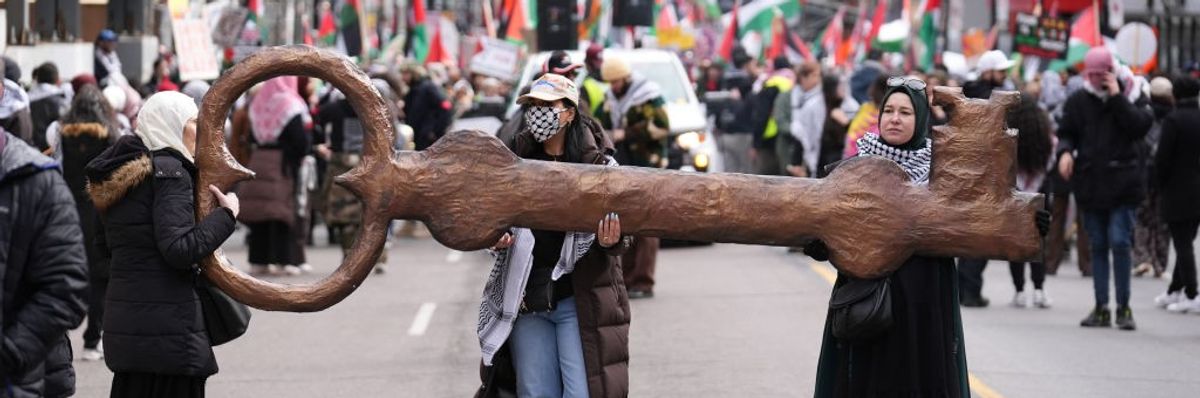
Pro-Palestinian demonstrators march during a rally, on the 48th anniversary of the March 30 Palestinian Land Day, in Toronto, Ontario on March 30, 2023.
Every year since 1976, these March 30th Land Day protests have not only continued, but also spread throughout all of Palestine and in communities across the globe.
Land has always been central to the Palestinian national identity. I learned this lesson in 1971 when I spent time in Palestinian refugee camps in Lebanon and Jordan collecting people’s stories of the Nakbah. Their memories of the homes and lands they left behind, their deep longing to return, and their determination to keep alive their village culture was deeply moving. The powerful connection of Palestinians to their land became even more clear when I got to know and learn from the works of some of the great Palestinian poets like Tawfiq Zayad and Mahmoud Darwish or the Palestinian artists like Ismail Shamout and Kamal Boulatta. The images they created and the feelings they evoked have inspired generations.
You can learn more about a people through the songs they sing, the stories they tell, or the art they love than you can from the political speeches of their leaders. In all of these forms of Palestinian popular culture, attachment to land looms large. Palestinian refugees will recall their ancestral homes. Those whose lands have been confiscated by the Israelis will recall the simplicity of their village lives. The land they nourished was where their histories are buried under the earth waiting for a new spring in which to be born again. In short, their past lives, their present sorrows. and their hopes for the future are bound up in their attachment to their land.
Given this, it should be no surprise that Land Day (or Day in Defense of the Land) has become so important to Palestinians worldwide.
The history of this day is important. The first Land Day was called in 1976 in response to Israeli government plans to seize control of large areas of the Galilee region in order to expand the area’s Jewish population. Such seizures of Arab-owned lands to make way for Jewish immigration had been Israel’s modus operandi from the beginning of the state. In the three decades before 1976, Israel had laid the foundation for their fledging “Jewish state” by confiscating one and a half million acres of Arab-owned land and demolishing some 500 Palestinian villages – from which most of the Arab inhabitants had been expelled during the 1948 Nakbah.
During those same three decades, the Palestinian citizens of Israel faced other significant hardships. They had emerged from the 1948 War shell-shocked from the horrors of the Nakbah during which so many members of their families were forced to flee, so many others died, and much of their land, homes, and businesses had been seized. Following the war, these Palestinians were subjected to restrictive Emergency Defense Laws under which the Israeli government imposed curfews, collective punishment, detention without charge, and expulsion. Though nominally citizens of Israel, these Palestinians were, in reality, living under occupation in their own country. [It’s important to note that after the 1967 war, Israel applied these very same Emergency Defense Laws to the newly occupied territories.]
Despite the hardships imposed upon them, the Palestinian citizens of Israel grew in confidence, political capacity, and attachment to their Arab and Palestinian identity. They joined the Israeli political parties that would include them. They ran for and won elective office in the Arab towns and villages, and organized in their own self-defense. And so, when, in 1976, the government announced plans to issue new land expropriation orders in an effort to “Judaize” the Galilee, it was the proverbial “straw that broke the camel’s back.” They reacted by planning a massive nationwide general strike and protest march that would say “Enough!” Because the Israelis were deathly afraid of all forms of Arab resistance, they declared the protests to be illegal. Nevertheless, tens of thousands went on strike and peacefully marched. The day was marred by Israel’s violent response in which six Palestinian citizens were killed and more than 100 wounded. This provoked outrage not only throughout the Palestinian community in Israel, but also among Palestinians in the 1967 Occupied Territories and those in the diaspora.
Every year since 1976, these March 30th Land Day protests have not only continued, but also spread throughout all of Palestine and in communities across the globe. They are a tribute to the continued Palestinian attachment to their land, their resilience, and their determination to rebuild their national community.
This year, Palestine’s Land Day (March 30) fell on the Saturday between the Christian holy days of Good Friday and Easter Sunday. The convergence of these three days serves as a reminder of the ways in which the themes they evoke have been essential components of the Palestinian national identity: attachment to their land, steadfastness despite losses endured, and belief in the promise of rebirth.
Dear Common Dreams reader, It’s been nearly 30 years since I co-founded Common Dreams with my late wife, Lina Newhouser. We had the radical notion that journalism should serve the public good, not corporate profits. It was clear to us from the outset what it would take to build such a project. No paid advertisements. No corporate sponsors. No millionaire publisher telling us what to think or do. Many people said we wouldn't last a year, but we proved those doubters wrong. Together with a tremendous team of journalists and dedicated staff, we built an independent media outlet free from the constraints of profits and corporate control. Our mission has always been simple: To inform. To inspire. To ignite change for the common good. Building Common Dreams was not easy. Our survival was never guaranteed. When you take on the most powerful forces—Wall Street greed, fossil fuel industry destruction, Big Tech lobbyists, and uber-rich oligarchs who have spent billions upon billions rigging the economy and democracy in their favor—the only bulwark you have is supporters who believe in your work. But here’s the urgent message from me today. It's never been this bad out there. And it's never been this hard to keep us going. At the very moment Common Dreams is most needed, the threats we face are intensifying. We need your support now more than ever. We don't accept corporate advertising and never will. We don't have a paywall because we don't think people should be blocked from critical news based on their ability to pay. Everything we do is funded by the donations of readers like you. When everyone does the little they can afford, we are strong. But if that support retreats or dries up, so do we. Will you donate now to make sure Common Dreams not only survives but thrives? —Craig Brown, Co-founder |
Land has always been central to the Palestinian national identity. I learned this lesson in 1971 when I spent time in Palestinian refugee camps in Lebanon and Jordan collecting people’s stories of the Nakbah. Their memories of the homes and lands they left behind, their deep longing to return, and their determination to keep alive their village culture was deeply moving. The powerful connection of Palestinians to their land became even more clear when I got to know and learn from the works of some of the great Palestinian poets like Tawfiq Zayad and Mahmoud Darwish or the Palestinian artists like Ismail Shamout and Kamal Boulatta. The images they created and the feelings they evoked have inspired generations.
You can learn more about a people through the songs they sing, the stories they tell, or the art they love than you can from the political speeches of their leaders. In all of these forms of Palestinian popular culture, attachment to land looms large. Palestinian refugees will recall their ancestral homes. Those whose lands have been confiscated by the Israelis will recall the simplicity of their village lives. The land they nourished was where their histories are buried under the earth waiting for a new spring in which to be born again. In short, their past lives, their present sorrows. and their hopes for the future are bound up in their attachment to their land.
Given this, it should be no surprise that Land Day (or Day in Defense of the Land) has become so important to Palestinians worldwide.
The history of this day is important. The first Land Day was called in 1976 in response to Israeli government plans to seize control of large areas of the Galilee region in order to expand the area’s Jewish population. Such seizures of Arab-owned lands to make way for Jewish immigration had been Israel’s modus operandi from the beginning of the state. In the three decades before 1976, Israel had laid the foundation for their fledging “Jewish state” by confiscating one and a half million acres of Arab-owned land and demolishing some 500 Palestinian villages – from which most of the Arab inhabitants had been expelled during the 1948 Nakbah.
During those same three decades, the Palestinian citizens of Israel faced other significant hardships. They had emerged from the 1948 War shell-shocked from the horrors of the Nakbah during which so many members of their families were forced to flee, so many others died, and much of their land, homes, and businesses had been seized. Following the war, these Palestinians were subjected to restrictive Emergency Defense Laws under which the Israeli government imposed curfews, collective punishment, detention without charge, and expulsion. Though nominally citizens of Israel, these Palestinians were, in reality, living under occupation in their own country. [It’s important to note that after the 1967 war, Israel applied these very same Emergency Defense Laws to the newly occupied territories.]
Despite the hardships imposed upon them, the Palestinian citizens of Israel grew in confidence, political capacity, and attachment to their Arab and Palestinian identity. They joined the Israeli political parties that would include them. They ran for and won elective office in the Arab towns and villages, and organized in their own self-defense. And so, when, in 1976, the government announced plans to issue new land expropriation orders in an effort to “Judaize” the Galilee, it was the proverbial “straw that broke the camel’s back.” They reacted by planning a massive nationwide general strike and protest march that would say “Enough!” Because the Israelis were deathly afraid of all forms of Arab resistance, they declared the protests to be illegal. Nevertheless, tens of thousands went on strike and peacefully marched. The day was marred by Israel’s violent response in which six Palestinian citizens were killed and more than 100 wounded. This provoked outrage not only throughout the Palestinian community in Israel, but also among Palestinians in the 1967 Occupied Territories and those in the diaspora.
Every year since 1976, these March 30th Land Day protests have not only continued, but also spread throughout all of Palestine and in communities across the globe. They are a tribute to the continued Palestinian attachment to their land, their resilience, and their determination to rebuild their national community.
This year, Palestine’s Land Day (March 30) fell on the Saturday between the Christian holy days of Good Friday and Easter Sunday. The convergence of these three days serves as a reminder of the ways in which the themes they evoke have been essential components of the Palestinian national identity: attachment to their land, steadfastness despite losses endured, and belief in the promise of rebirth.
Land has always been central to the Palestinian national identity. I learned this lesson in 1971 when I spent time in Palestinian refugee camps in Lebanon and Jordan collecting people’s stories of the Nakbah. Their memories of the homes and lands they left behind, their deep longing to return, and their determination to keep alive their village culture was deeply moving. The powerful connection of Palestinians to their land became even more clear when I got to know and learn from the works of some of the great Palestinian poets like Tawfiq Zayad and Mahmoud Darwish or the Palestinian artists like Ismail Shamout and Kamal Boulatta. The images they created and the feelings they evoked have inspired generations.
You can learn more about a people through the songs they sing, the stories they tell, or the art they love than you can from the political speeches of their leaders. In all of these forms of Palestinian popular culture, attachment to land looms large. Palestinian refugees will recall their ancestral homes. Those whose lands have been confiscated by the Israelis will recall the simplicity of their village lives. The land they nourished was where their histories are buried under the earth waiting for a new spring in which to be born again. In short, their past lives, their present sorrows. and their hopes for the future are bound up in their attachment to their land.
Given this, it should be no surprise that Land Day (or Day in Defense of the Land) has become so important to Palestinians worldwide.
The history of this day is important. The first Land Day was called in 1976 in response to Israeli government plans to seize control of large areas of the Galilee region in order to expand the area’s Jewish population. Such seizures of Arab-owned lands to make way for Jewish immigration had been Israel’s modus operandi from the beginning of the state. In the three decades before 1976, Israel had laid the foundation for their fledging “Jewish state” by confiscating one and a half million acres of Arab-owned land and demolishing some 500 Palestinian villages – from which most of the Arab inhabitants had been expelled during the 1948 Nakbah.
During those same three decades, the Palestinian citizens of Israel faced other significant hardships. They had emerged from the 1948 War shell-shocked from the horrors of the Nakbah during which so many members of their families were forced to flee, so many others died, and much of their land, homes, and businesses had been seized. Following the war, these Palestinians were subjected to restrictive Emergency Defense Laws under which the Israeli government imposed curfews, collective punishment, detention without charge, and expulsion. Though nominally citizens of Israel, these Palestinians were, in reality, living under occupation in their own country. [It’s important to note that after the 1967 war, Israel applied these very same Emergency Defense Laws to the newly occupied territories.]
Despite the hardships imposed upon them, the Palestinian citizens of Israel grew in confidence, political capacity, and attachment to their Arab and Palestinian identity. They joined the Israeli political parties that would include them. They ran for and won elective office in the Arab towns and villages, and organized in their own self-defense. And so, when, in 1976, the government announced plans to issue new land expropriation orders in an effort to “Judaize” the Galilee, it was the proverbial “straw that broke the camel’s back.” They reacted by planning a massive nationwide general strike and protest march that would say “Enough!” Because the Israelis were deathly afraid of all forms of Arab resistance, they declared the protests to be illegal. Nevertheless, tens of thousands went on strike and peacefully marched. The day was marred by Israel’s violent response in which six Palestinian citizens were killed and more than 100 wounded. This provoked outrage not only throughout the Palestinian community in Israel, but also among Palestinians in the 1967 Occupied Territories and those in the diaspora.
Every year since 1976, these March 30th Land Day protests have not only continued, but also spread throughout all of Palestine and in communities across the globe. They are a tribute to the continued Palestinian attachment to their land, their resilience, and their determination to rebuild their national community.
This year, Palestine’s Land Day (March 30) fell on the Saturday between the Christian holy days of Good Friday and Easter Sunday. The convergence of these three days serves as a reminder of the ways in which the themes they evoke have been essential components of the Palestinian national identity: attachment to their land, steadfastness despite losses endured, and belief in the promise of rebirth.