SUBSCRIBE TO OUR FREE NEWSLETTER
Daily news & progressive opinion—funded by the people, not the corporations—delivered straight to your inbox.
5
#000000
#FFFFFF
To donate by check, phone, or other method, see our More Ways to Give page.
Daily news & progressive opinion—funded by the people, not the corporations—delivered straight to your inbox.
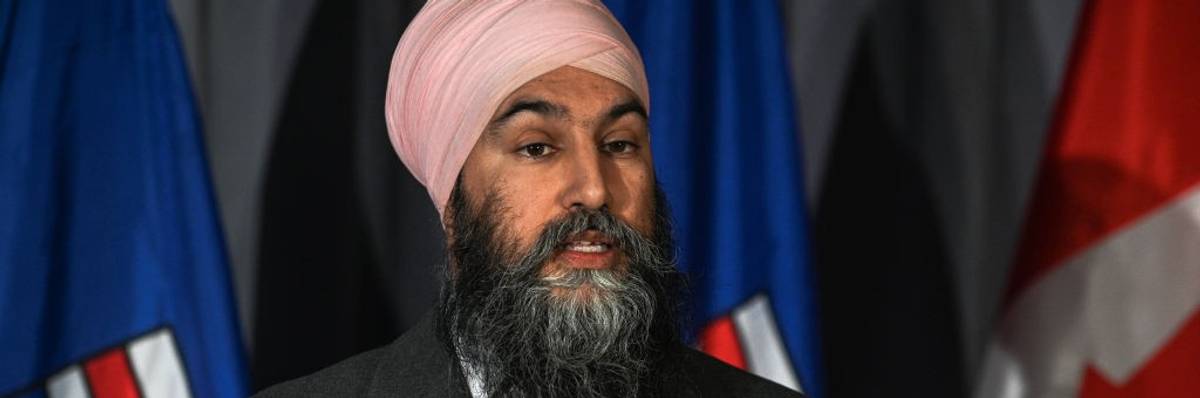
Canada's NDP Leader, Jagmeet Singh, addressing the media on January 25, 2024 in Edmonton, Alberta, Canada.
Now that we’re witnessing a revival of leftish populism from Harris and particularly Walz, we can plainly see what has long been obvious but unsaid: that a New Deal-inspired agenda offers more for working people.
It would be a great pity if the NDP squanders this promising moment to revive left-wing populism in Canada.
The current upheaval in U.S. politics, with the dramatic and unexpected rise of the Kamala Harris/Tim Walz Democratic ticket, may suddenly be opening possibilities here in Canada that have long appeared out of reach.
After decades of the business elite successfully imposing its agenda — tax cuts, smaller government, an empowered private sector — Harris and Walz are energizing a large swath of U.S. voters with a very different left-populist pitch for strong government programs, pro-labour policies, and tax hikes on the rich.
Such a pro-worker agenda, which grew out of FDR’s New Deal and prevailed in the early postwar decades, has largely disappeared in recent years as business priorities — supported by the media, academia, and conservative think tanks — have come to dominate politics to an extraordinary extent.
As a result, even left-leaning political parties have been afraid to get too far offside the business agenda, for fear of looking like they don’t understand economic realities and would be irresponsible in managing the economy.
Accordingly, Democrats in the U.S. and the NDP in Canada have reluctantly gone along with much of the business agenda — even though it’s produced a society top-heavy with billionaires, with little for working people.
But now that we’re witnessing a revival of leftish populism from Harris and particularly Walz, we can plainly see what has long been obvious but unsaid: that a New Deal-inspired agenda offers more for working people.
That explains the joyous looks on the faces of Harris and Walz as they push for policies — like a $6,000 tax credit for newborns — that would greatly improve the lives of millions of Americans.
President Joe Biden also championed pro-worker policies but had no ability to sell them. Harris and Walz are brat as salespeople.
All this stirring south of the border creates possibilities for Canada.
NDP Leader Jagmeet Singh signalled his intention to distinguish his party from the Liberals by breaking the Liberal-NDP supply-and-confidence deal earlier this month.
But he missed a big opportunity to do more — to move the party towards the kind of left-populist agenda pioneered by early Canadian progressives like the late Tommy Douglas, celebrated as the father of medicare in Canada.
Instead, Singh used the Liberal-NDP breakup to signal that he’s backing away from the Trudeau government’s unpopular carbon tax.
That was a foolish move, which will only bolster the credibility of Conservative Leader Pierre Poilievre’s aggressive (and misguided) campaign against the carbon tax.
Singh could have differentiated himself from the Liberals much more effectively by insisting he’d only continue to support them if they introduced a wealth tax — a truly game-changing, populist measure with the potential to raise $32 billion a year to rebuild social programs.
The NDP actually supports an annual net wealth tax, which has been part of its official platform since 2019. But you might not know that, since the party rarely mentions it (probably out of fear they might look like irresponsible economic managers).
However, the tax, which would impact only the very wealthy, is consistently popular with Canadians, with polls showing support above 80 per cent.
Business strongly opposes a wealth tax, so championing it would put the NDP in a fight against business, the Liberals and the Conservatives — as a truly populist, pro-worker party — instead of letting Poilievre, posing as a friend of the working class, steal much of that vote.
A wealth tax is also nicely in line with Kamala Harris’ support for a “billionaire minimum tax” that would impose a 25 per cent minimum tax on total income exceeding $100 million (including unrealized gains).
Instead of crushing one of Ottawa’s few measures to tackle climate change, the NDP would be far more inspiring if it pushed to extract wealth from some of the most overprivileged people on earth.
Dear Common Dreams reader, It’s been nearly 30 years since I co-founded Common Dreams with my late wife, Lina Newhouser. We had the radical notion that journalism should serve the public good, not corporate profits. It was clear to us from the outset what it would take to build such a project. No paid advertisements. No corporate sponsors. No millionaire publisher telling us what to think or do. Many people said we wouldn't last a year, but we proved those doubters wrong. Together with a tremendous team of journalists and dedicated staff, we built an independent media outlet free from the constraints of profits and corporate control. Our mission has always been simple: To inform. To inspire. To ignite change for the common good. Building Common Dreams was not easy. Our survival was never guaranteed. When you take on the most powerful forces—Wall Street greed, fossil fuel industry destruction, Big Tech lobbyists, and uber-rich oligarchs who have spent billions upon billions rigging the economy and democracy in their favor—the only bulwark you have is supporters who believe in your work. But here’s the urgent message from me today. It's never been this bad out there. And it's never been this hard to keep us going. At the very moment Common Dreams is most needed, the threats we face are intensifying. We need your support now more than ever. We don't accept corporate advertising and never will. We don't have a paywall because we don't think people should be blocked from critical news based on their ability to pay. Everything we do is funded by the donations of readers like you. When everyone does the little they can afford, we are strong. But if that support retreats or dries up, so do we. Will you donate now to make sure Common Dreams not only survives but thrives? —Craig Brown, Co-founder |
It would be a great pity if the NDP squanders this promising moment to revive left-wing populism in Canada.
The current upheaval in U.S. politics, with the dramatic and unexpected rise of the Kamala Harris/Tim Walz Democratic ticket, may suddenly be opening possibilities here in Canada that have long appeared out of reach.
After decades of the business elite successfully imposing its agenda — tax cuts, smaller government, an empowered private sector — Harris and Walz are energizing a large swath of U.S. voters with a very different left-populist pitch for strong government programs, pro-labour policies, and tax hikes on the rich.
Such a pro-worker agenda, which grew out of FDR’s New Deal and prevailed in the early postwar decades, has largely disappeared in recent years as business priorities — supported by the media, academia, and conservative think tanks — have come to dominate politics to an extraordinary extent.
As a result, even left-leaning political parties have been afraid to get too far offside the business agenda, for fear of looking like they don’t understand economic realities and would be irresponsible in managing the economy.
Accordingly, Democrats in the U.S. and the NDP in Canada have reluctantly gone along with much of the business agenda — even though it’s produced a society top-heavy with billionaires, with little for working people.
But now that we’re witnessing a revival of leftish populism from Harris and particularly Walz, we can plainly see what has long been obvious but unsaid: that a New Deal-inspired agenda offers more for working people.
That explains the joyous looks on the faces of Harris and Walz as they push for policies — like a $6,000 tax credit for newborns — that would greatly improve the lives of millions of Americans.
President Joe Biden also championed pro-worker policies but had no ability to sell them. Harris and Walz are brat as salespeople.
All this stirring south of the border creates possibilities for Canada.
NDP Leader Jagmeet Singh signalled his intention to distinguish his party from the Liberals by breaking the Liberal-NDP supply-and-confidence deal earlier this month.
But he missed a big opportunity to do more — to move the party towards the kind of left-populist agenda pioneered by early Canadian progressives like the late Tommy Douglas, celebrated as the father of medicare in Canada.
Instead, Singh used the Liberal-NDP breakup to signal that he’s backing away from the Trudeau government’s unpopular carbon tax.
That was a foolish move, which will only bolster the credibility of Conservative Leader Pierre Poilievre’s aggressive (and misguided) campaign against the carbon tax.
Singh could have differentiated himself from the Liberals much more effectively by insisting he’d only continue to support them if they introduced a wealth tax — a truly game-changing, populist measure with the potential to raise $32 billion a year to rebuild social programs.
The NDP actually supports an annual net wealth tax, which has been part of its official platform since 2019. But you might not know that, since the party rarely mentions it (probably out of fear they might look like irresponsible economic managers).
However, the tax, which would impact only the very wealthy, is consistently popular with Canadians, with polls showing support above 80 per cent.
Business strongly opposes a wealth tax, so championing it would put the NDP in a fight against business, the Liberals and the Conservatives — as a truly populist, pro-worker party — instead of letting Poilievre, posing as a friend of the working class, steal much of that vote.
A wealth tax is also nicely in line with Kamala Harris’ support for a “billionaire minimum tax” that would impose a 25 per cent minimum tax on total income exceeding $100 million (including unrealized gains).
Instead of crushing one of Ottawa’s few measures to tackle climate change, the NDP would be far more inspiring if it pushed to extract wealth from some of the most overprivileged people on earth.
It would be a great pity if the NDP squanders this promising moment to revive left-wing populism in Canada.
The current upheaval in U.S. politics, with the dramatic and unexpected rise of the Kamala Harris/Tim Walz Democratic ticket, may suddenly be opening possibilities here in Canada that have long appeared out of reach.
After decades of the business elite successfully imposing its agenda — tax cuts, smaller government, an empowered private sector — Harris and Walz are energizing a large swath of U.S. voters with a very different left-populist pitch for strong government programs, pro-labour policies, and tax hikes on the rich.
Such a pro-worker agenda, which grew out of FDR’s New Deal and prevailed in the early postwar decades, has largely disappeared in recent years as business priorities — supported by the media, academia, and conservative think tanks — have come to dominate politics to an extraordinary extent.
As a result, even left-leaning political parties have been afraid to get too far offside the business agenda, for fear of looking like they don’t understand economic realities and would be irresponsible in managing the economy.
Accordingly, Democrats in the U.S. and the NDP in Canada have reluctantly gone along with much of the business agenda — even though it’s produced a society top-heavy with billionaires, with little for working people.
But now that we’re witnessing a revival of leftish populism from Harris and particularly Walz, we can plainly see what has long been obvious but unsaid: that a New Deal-inspired agenda offers more for working people.
That explains the joyous looks on the faces of Harris and Walz as they push for policies — like a $6,000 tax credit for newborns — that would greatly improve the lives of millions of Americans.
President Joe Biden also championed pro-worker policies but had no ability to sell them. Harris and Walz are brat as salespeople.
All this stirring south of the border creates possibilities for Canada.
NDP Leader Jagmeet Singh signalled his intention to distinguish his party from the Liberals by breaking the Liberal-NDP supply-and-confidence deal earlier this month.
But he missed a big opportunity to do more — to move the party towards the kind of left-populist agenda pioneered by early Canadian progressives like the late Tommy Douglas, celebrated as the father of medicare in Canada.
Instead, Singh used the Liberal-NDP breakup to signal that he’s backing away from the Trudeau government’s unpopular carbon tax.
That was a foolish move, which will only bolster the credibility of Conservative Leader Pierre Poilievre’s aggressive (and misguided) campaign against the carbon tax.
Singh could have differentiated himself from the Liberals much more effectively by insisting he’d only continue to support them if they introduced a wealth tax — a truly game-changing, populist measure with the potential to raise $32 billion a year to rebuild social programs.
The NDP actually supports an annual net wealth tax, which has been part of its official platform since 2019. But you might not know that, since the party rarely mentions it (probably out of fear they might look like irresponsible economic managers).
However, the tax, which would impact only the very wealthy, is consistently popular with Canadians, with polls showing support above 80 per cent.
Business strongly opposes a wealth tax, so championing it would put the NDP in a fight against business, the Liberals and the Conservatives — as a truly populist, pro-worker party — instead of letting Poilievre, posing as a friend of the working class, steal much of that vote.
A wealth tax is also nicely in line with Kamala Harris’ support for a “billionaire minimum tax” that would impose a 25 per cent minimum tax on total income exceeding $100 million (including unrealized gains).
Instead of crushing one of Ottawa’s few measures to tackle climate change, the NDP would be far more inspiring if it pushed to extract wealth from some of the most overprivileged people on earth.