5
#000000
#FFFFFF
To donate by check, phone, or other method, see our More Ways to Give page.
Daily news & progressive opinion—funded by the people, not the corporations—delivered straight to your inbox.
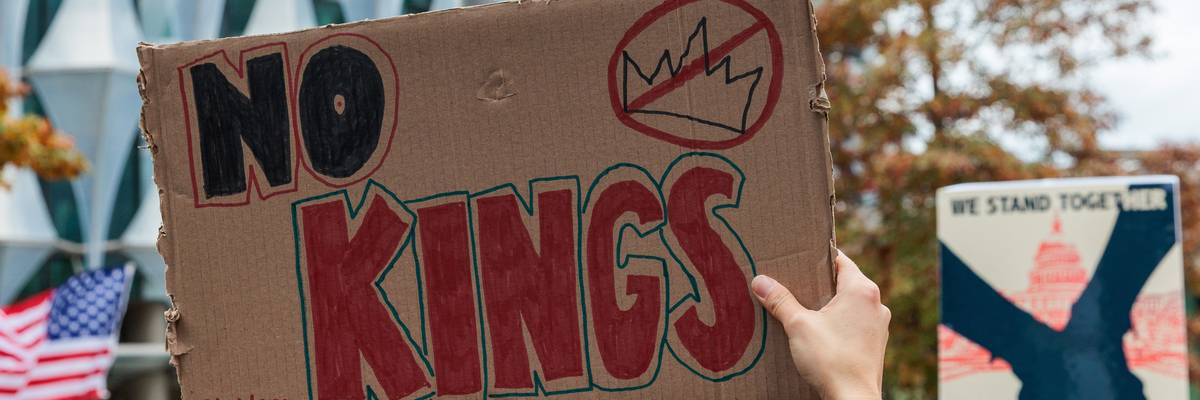
Hundreds of protesters, including supporters of Democrats Abroad, take part in a "No Tyrants" event outside the US embassy on October 18, 2025 in London, United Kingdom.
Once we manage to drive this guy from power there’s something left to look forward to, but only if we all show up.
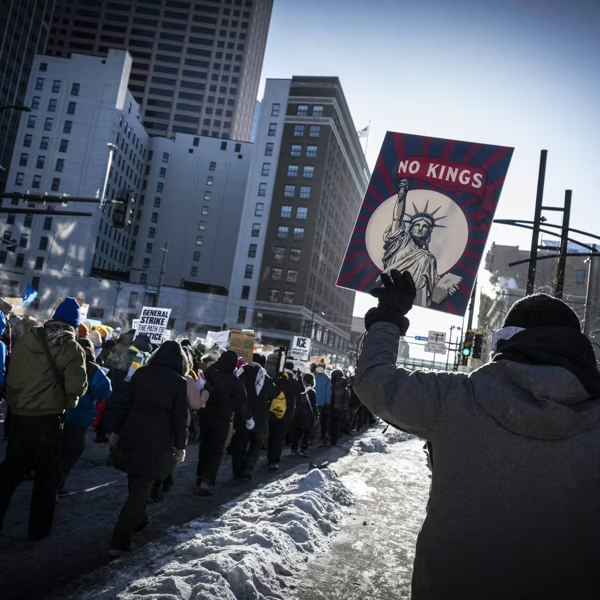
There are lots of moments for analysis, and this isn’t one of them. My only goal this week is to make sure you bring everyone you can to Saturday’s No Kings Day protests. It’s going to be chilly in the East and hot in the West, so no one is going to be out on the street by accident; people need to want to come. So I’m going to try and provide some motivation to get you out the door, and I’m going to use every trick of emotional manipulation I can muster.
There’s anger. Since the last No Kings protest in October, the administration has invaded Venezuela and attacked Iran, it has killed Renee Good and Alex Pretti, and it has blown up the global economy. Here’s this week’s particular barb, at least for people who care about energy and climate: They’ve taken a billion taxpayer dollars (that’s about six bucks per taxpayer) and used it to buy back offshore wind leases from Total Energies, a French firm, in an effort to make sure that this wind is never captured for clean energy.
“Considering that the development of offshore wind projects is not in the country’s interest, we have decided to renounce offshore wind development in the United States,” said Patrick Pouyanné, the CEO of the company, which should—if Democrats ever regain power—never be allowed to work on anything in America ever again.
All this while the price of energy is going through the roof thanks to our folly in the Persian Gulf—but it’s more important to bury wind energy than to provide affordable power to Americans. And according to Monday’s Houston Chronicle, Total has been instructed to redirect the money they’re receiving to a Texas liquefied natural gas (LNG) plant, one more subsidy for an industry already awash in them. And by the way, exporting more gas raises prices for the same Americans who won’t be able to heat their homes or power their cars with the cheap electricity the wind farms would have provided.
The weaker President Donald Trump is, the better our chances of survival.
Want just a touch more anger, just at the pettiness of these guys? The Trump administration, because it can, is about to remove a bike lane in DC:
The National Park Service will soon start removing a protected bike lane that runs along 15th Street NW from Constitution Avenue down to the Tidal Basin and Jefferson Memorial, eliminating a popular cycling route just as crowds are expected to increase for the annual blooming of the cherry blossoms.
The work is expected to start on Monday, according to NPS. Once it’s done, it will sever one of DC’s longest protected bike lanes, stretching virtually uninterrupted from the Tidal Basin all the way up to Columbia Heights, and additionally serving as a vital cycling connection to the 14th Street Bridge into Virginia.
There are three Capital Bikeshare stations located along the stretch of the bike lane that will be removed. On Friday morning, the first day of spring in DC, there were also dozens of Veo bikes and Lime scooters available in the area. According to DDOT [District Department of Transportation], those Bikeshare stations are among the most used in the entire system.
An evaluation by DDOT of incidents along 15th Street after the bike lane was installed found that roadway crashes along the corridor had decreased by 46%—and bicycle injury crashes dropped even more, by 91%.
How does that compare with other world capitals? On Sunday, Parisians returned to power for a third term the socialists who—under the remarkable Mayor Anne Hidalgo—have built a true bike city. Hidalgo is handing the job to Emmanuel Gregoire, who rode a bike-share cycle to his victory party.
Under his predecessor’s Plan Vélo, Paris, according to the Bicycle Network:
has gained over 1,000 new kilometres of dedicated cycling infrastructure including the now-famous ‘Corona pistes’—pop-up bike lanes created during the Covid-19 pandemic that later became permanent due to overwhelming public support.
Oh, and as Paris has become a bike city, air pollution has dropped 55%.
So, if you’re not angry enough to march now, then perhaps I can motivate you with just a soupçon of fear.
The World Meteorological Organization released its latest State of the Global Climate report on Monday, which for the first time attempts to track the planet’s energy imbalance. As Jonathan Watts puts it:
The Earth’s energy imbalance increased by about 11 zettajoules a year between 2005 and 2025, which is equivalent to about 18 times total human energy use. Last year it was more than double that average.
At present, humans and other life forms on the surface directly suffer only a small fraction of that energy backup because 91% is absorbed by oceans, 5% by the land, 1% warms the atmosphere, and 3% melts ice at the poles and on high mountains.
As Eric Niller explains in the Times:
One worrying result is that scientists are detecting more heat deeper in the ocean, rather than just at the surface, according to Dr. Von Schuckmann.
Below 2,000 meters, oceans store and hold heat longer than at the surface layer, which releases it to the atmosphere. That means that the effects of climate change will continue for a long time, she said.
“The more we have heat kept away from communication with the atmosphere,” Dr. Karina Von Schuckmann, an author of the report, said, “the more we are moving to time scales of committed climate change of 400 to 1,000 years.”
But we’re already seeing the heat at the surface. This week offered reports of Arctic sea ice at all time lows for the date, and of the highest March temperatures ever recorded in the US—measurements so loony they’re almost beyond credulity. New record highs for March—112°F in California and Arizona—beat the old records by two degrees, and were just a degree shy of the all-time April record. As the indomitable Bob Henson and Jeff Masters write:
At least 14 states set their all-time statewide records for March heat from Thursday through Saturday, as compiled by weather records expert Maximiliano Herrera (@extremetemps on Bluesky). These include every state from the Rocky Mountains west to the Pacific coast except for Oregon and Washington, plus several others between the Rockies and the Mississippi River.
Beyond the crazy fire danger now building across the West (Nebraska last week had the biggest fire in its history, and one of the 20 biggest in American history; a new study today explicitly links shrinking snowpacks to growing fire danger), there’s another peril now fully in play: The winter saw precious little snowpack across the Rockies, and much of that melted in last week’s heatdome, which means the Colorado River is headed toward previously unknown states. As Mark Gongloff chronicles:
Lake Powell, the main reservoir near the border between the upper and lower basins, will get just 52% of its usual inflow from snowmelt this year, the Bureau of Reclamation forecast last month.
Lake Powell can’t afford an off year. It recently stood at just 24% of its capacity, 170 feet below “full pool” and just 160 feet from going “dead pool,” when water can no longer escape from the Glen Canyon Dam. That would be a catastrophe for the lower-basin states of Arizona, California, and Nevada.
More immediately, the reservoir is just 40 feet away from “minimum power pool,” below which it will be unable to move the turbines on Glen Canyon Dam’s hydropower plant, which serves seven Western states. It generates 5 billion kilowatt-hours of electricity each year, enough to power 500,000 homes. A West filling up with data centers desperately needs this power supply.
Do you trust the Trump administration to wisely navigate the endless complications of the West running out of water? I don’t—he flushed billions of gallons of water pointlessly out to sea after the Los Angeles fires to try and make some kind of political point about his ability to control a “giant faucet.” We’re in for trouble, and the weaker President Donald Trump is, the better our chances of survival.
But maybe anger and fear aren’t what sink your boat? What about a bit of hope that once we manage to drive this guy from power there’s something left to look forward to?
I’ll offer it in limited form. We’re at such a moment of inflection, with cheap clean energy widely available, that we could make astonishingly rapid change. At least as much as Paris, China (which is slightly larger) is an entirely different place today than it was even five years ago. And that should tickle some memories for Americans—remember, once it was our cities that were filthy, and then we passed some laws, and they got remarkably cleaner remarkably fast. Indeed, Ann Carlson has a new book out detailing just how fast it happened.
Which means that if we manage to force change, it could come quickly. The news about wind power this week is very bad, as noted above. But this is also the week when—over the sabotaging efforts of the Trump administration—construction work finished on Vineyard Wind off Massachusetts, and Revolution Wind off Rhode Island began connecting to the grid. Together they will supply the electricity for 750,000 homes—a not insignificant percentage of the 160 million homes in America. They proved during this winter’s cold stretch in the Northeast that they’re at least as reliable as gas-fired power plants. And now there’s infrastructure in place for the ongoing buildout. As Massachusetts State Sen. Michael Barrett (D-3) told WGBH this week:
Time’s passing. Trump’s gone in under three years and the winds around here have staying power. The industry will come back if we’re smart about it and set the stage.
I don’t need to tell anyone reading this that three years is a long time—too long. One of our jobs this weekend is to help shorten that stretch—with an overwhelming win in the midterms, Trump can be effectively weakened before this year is out. But we have to do the work.
And if we do—but only if we do—then I think we’re allowed our small bits of hope. A new survey this week found that there were 400,000 acres of old growth forest in my part of the world—the Adirondack Mountains of New York—that had been “hiding in plain sight.” It’s good news in many ways:
In these undisturbed systems, carbon is pumped into the Earth through root networks and the slow decomposition of leaf litter and “coarse woody debris” (fallen logs). Unlike in managed timberlands where the soil is frequently disturbed, the soil in old growth forests remains a stable, permanent reservoir.
But mostly it’s good news because these woods are majestic and noble and good companions. I’ve hiked many of the areas the research described, and marveled at the big trees, but it’s good to know just how old they are. They’re a reminder that the planet has surprises yet, and some of them are beautiful.
We earn our hope. See you Saturday.
Dear Common Dreams reader, The U.S. is on a fast track to authoritarianism like nothing I've ever seen. Meanwhile, corporate news outlets are utterly capitulating to Trump, twisting their coverage to avoid drawing his ire while lining up to stuff cash in his pockets. That's why I believe that Common Dreams is doing the best and most consequential reporting that we've ever done. Our small but mighty team is a progressive reporting powerhouse, covering the news every day that the corporate media never will. Our mission has always been simple: To inform. To inspire. And to ignite change for the common good. Now here's the key piece that I want all our readers to understand: None of this would be possible without your financial support. That's not just some fundraising cliche. It's the absolute and literal truth. We don't accept corporate advertising and never will. We don't have a paywall because we don't think people should be blocked from critical news based on their ability to pay. Everything we do is funded by the donations of readers like you. Will you donate now to help power the nonprofit, independent reporting of Common Dreams? Thank you for being a vital member of our community. Together, we can keep independent journalism alive when it’s needed most. - Craig Brown, Co-founder |
There are lots of moments for analysis, and this isn’t one of them. My only goal this week is to make sure you bring everyone you can to Saturday’s No Kings Day protests. It’s going to be chilly in the East and hot in the West, so no one is going to be out on the street by accident; people need to want to come. So I’m going to try and provide some motivation to get you out the door, and I’m going to use every trick of emotional manipulation I can muster.
There’s anger. Since the last No Kings protest in October, the administration has invaded Venezuela and attacked Iran, it has killed Renee Good and Alex Pretti, and it has blown up the global economy. Here’s this week’s particular barb, at least for people who care about energy and climate: They’ve taken a billion taxpayer dollars (that’s about six bucks per taxpayer) and used it to buy back offshore wind leases from Total Energies, a French firm, in an effort to make sure that this wind is never captured for clean energy.
“Considering that the development of offshore wind projects is not in the country’s interest, we have decided to renounce offshore wind development in the United States,” said Patrick Pouyanné, the CEO of the company, which should—if Democrats ever regain power—never be allowed to work on anything in America ever again.
All this while the price of energy is going through the roof thanks to our folly in the Persian Gulf—but it’s more important to bury wind energy than to provide affordable power to Americans. And according to Monday’s Houston Chronicle, Total has been instructed to redirect the money they’re receiving to a Texas liquefied natural gas (LNG) plant, one more subsidy for an industry already awash in them. And by the way, exporting more gas raises prices for the same Americans who won’t be able to heat their homes or power their cars with the cheap electricity the wind farms would have provided.
The weaker President Donald Trump is, the better our chances of survival.
Want just a touch more anger, just at the pettiness of these guys? The Trump administration, because it can, is about to remove a bike lane in DC:
The National Park Service will soon start removing a protected bike lane that runs along 15th Street NW from Constitution Avenue down to the Tidal Basin and Jefferson Memorial, eliminating a popular cycling route just as crowds are expected to increase for the annual blooming of the cherry blossoms.
The work is expected to start on Monday, according to NPS. Once it’s done, it will sever one of DC’s longest protected bike lanes, stretching virtually uninterrupted from the Tidal Basin all the way up to Columbia Heights, and additionally serving as a vital cycling connection to the 14th Street Bridge into Virginia.
There are three Capital Bikeshare stations located along the stretch of the bike lane that will be removed. On Friday morning, the first day of spring in DC, there were also dozens of Veo bikes and Lime scooters available in the area. According to DDOT [District Department of Transportation], those Bikeshare stations are among the most used in the entire system.
An evaluation by DDOT of incidents along 15th Street after the bike lane was installed found that roadway crashes along the corridor had decreased by 46%—and bicycle injury crashes dropped even more, by 91%.
How does that compare with other world capitals? On Sunday, Parisians returned to power for a third term the socialists who—under the remarkable Mayor Anne Hidalgo—have built a true bike city. Hidalgo is handing the job to Emmanuel Gregoire, who rode a bike-share cycle to his victory party.
Under his predecessor’s Plan Vélo, Paris, according to the Bicycle Network:
has gained over 1,000 new kilometres of dedicated cycling infrastructure including the now-famous ‘Corona pistes’—pop-up bike lanes created during the Covid-19 pandemic that later became permanent due to overwhelming public support.
Oh, and as Paris has become a bike city, air pollution has dropped 55%.
So, if you’re not angry enough to march now, then perhaps I can motivate you with just a soupçon of fear.
The World Meteorological Organization released its latest State of the Global Climate report on Monday, which for the first time attempts to track the planet’s energy imbalance. As Jonathan Watts puts it:
The Earth’s energy imbalance increased by about 11 zettajoules a year between 2005 and 2025, which is equivalent to about 18 times total human energy use. Last year it was more than double that average.
At present, humans and other life forms on the surface directly suffer only a small fraction of that energy backup because 91% is absorbed by oceans, 5% by the land, 1% warms the atmosphere, and 3% melts ice at the poles and on high mountains.
As Eric Niller explains in the Times:
One worrying result is that scientists are detecting more heat deeper in the ocean, rather than just at the surface, according to Dr. Von Schuckmann.
Below 2,000 meters, oceans store and hold heat longer than at the surface layer, which releases it to the atmosphere. That means that the effects of climate change will continue for a long time, she said.
“The more we have heat kept away from communication with the atmosphere,” Dr. Karina Von Schuckmann, an author of the report, said, “the more we are moving to time scales of committed climate change of 400 to 1,000 years.”
But we’re already seeing the heat at the surface. This week offered reports of Arctic sea ice at all time lows for the date, and of the highest March temperatures ever recorded in the US—measurements so loony they’re almost beyond credulity. New record highs for March—112°F in California and Arizona—beat the old records by two degrees, and were just a degree shy of the all-time April record. As the indomitable Bob Henson and Jeff Masters write:
At least 14 states set their all-time statewide records for March heat from Thursday through Saturday, as compiled by weather records expert Maximiliano Herrera (@extremetemps on Bluesky). These include every state from the Rocky Mountains west to the Pacific coast except for Oregon and Washington, plus several others between the Rockies and the Mississippi River.
Beyond the crazy fire danger now building across the West (Nebraska last week had the biggest fire in its history, and one of the 20 biggest in American history; a new study today explicitly links shrinking snowpacks to growing fire danger), there’s another peril now fully in play: The winter saw precious little snowpack across the Rockies, and much of that melted in last week’s heatdome, which means the Colorado River is headed toward previously unknown states. As Mark Gongloff chronicles:
Lake Powell, the main reservoir near the border between the upper and lower basins, will get just 52% of its usual inflow from snowmelt this year, the Bureau of Reclamation forecast last month.
Lake Powell can’t afford an off year. It recently stood at just 24% of its capacity, 170 feet below “full pool” and just 160 feet from going “dead pool,” when water can no longer escape from the Glen Canyon Dam. That would be a catastrophe for the lower-basin states of Arizona, California, and Nevada.
More immediately, the reservoir is just 40 feet away from “minimum power pool,” below which it will be unable to move the turbines on Glen Canyon Dam’s hydropower plant, which serves seven Western states. It generates 5 billion kilowatt-hours of electricity each year, enough to power 500,000 homes. A West filling up with data centers desperately needs this power supply.
Do you trust the Trump administration to wisely navigate the endless complications of the West running out of water? I don’t—he flushed billions of gallons of water pointlessly out to sea after the Los Angeles fires to try and make some kind of political point about his ability to control a “giant faucet.” We’re in for trouble, and the weaker President Donald Trump is, the better our chances of survival.
But maybe anger and fear aren’t what sink your boat? What about a bit of hope that once we manage to drive this guy from power there’s something left to look forward to?
I’ll offer it in limited form. We’re at such a moment of inflection, with cheap clean energy widely available, that we could make astonishingly rapid change. At least as much as Paris, China (which is slightly larger) is an entirely different place today than it was even five years ago. And that should tickle some memories for Americans—remember, once it was our cities that were filthy, and then we passed some laws, and they got remarkably cleaner remarkably fast. Indeed, Ann Carlson has a new book out detailing just how fast it happened.
Which means that if we manage to force change, it could come quickly. The news about wind power this week is very bad, as noted above. But this is also the week when—over the sabotaging efforts of the Trump administration—construction work finished on Vineyard Wind off Massachusetts, and Revolution Wind off Rhode Island began connecting to the grid. Together they will supply the electricity for 750,000 homes—a not insignificant percentage of the 160 million homes in America. They proved during this winter’s cold stretch in the Northeast that they’re at least as reliable as gas-fired power plants. And now there’s infrastructure in place for the ongoing buildout. As Massachusetts State Sen. Michael Barrett (D-3) told WGBH this week:
Time’s passing. Trump’s gone in under three years and the winds around here have staying power. The industry will come back if we’re smart about it and set the stage.
I don’t need to tell anyone reading this that three years is a long time—too long. One of our jobs this weekend is to help shorten that stretch—with an overwhelming win in the midterms, Trump can be effectively weakened before this year is out. But we have to do the work.
And if we do—but only if we do—then I think we’re allowed our small bits of hope. A new survey this week found that there were 400,000 acres of old growth forest in my part of the world—the Adirondack Mountains of New York—that had been “hiding in plain sight.” It’s good news in many ways:
In these undisturbed systems, carbon is pumped into the Earth through root networks and the slow decomposition of leaf litter and “coarse woody debris” (fallen logs). Unlike in managed timberlands where the soil is frequently disturbed, the soil in old growth forests remains a stable, permanent reservoir.
But mostly it’s good news because these woods are majestic and noble and good companions. I’ve hiked many of the areas the research described, and marveled at the big trees, but it’s good to know just how old they are. They’re a reminder that the planet has surprises yet, and some of them are beautiful.
We earn our hope. See you Saturday.
There are lots of moments for analysis, and this isn’t one of them. My only goal this week is to make sure you bring everyone you can to Saturday’s No Kings Day protests. It’s going to be chilly in the East and hot in the West, so no one is going to be out on the street by accident; people need to want to come. So I’m going to try and provide some motivation to get you out the door, and I’m going to use every trick of emotional manipulation I can muster.
There’s anger. Since the last No Kings protest in October, the administration has invaded Venezuela and attacked Iran, it has killed Renee Good and Alex Pretti, and it has blown up the global economy. Here’s this week’s particular barb, at least for people who care about energy and climate: They’ve taken a billion taxpayer dollars (that’s about six bucks per taxpayer) and used it to buy back offshore wind leases from Total Energies, a French firm, in an effort to make sure that this wind is never captured for clean energy.
“Considering that the development of offshore wind projects is not in the country’s interest, we have decided to renounce offshore wind development in the United States,” said Patrick Pouyanné, the CEO of the company, which should—if Democrats ever regain power—never be allowed to work on anything in America ever again.
All this while the price of energy is going through the roof thanks to our folly in the Persian Gulf—but it’s more important to bury wind energy than to provide affordable power to Americans. And according to Monday’s Houston Chronicle, Total has been instructed to redirect the money they’re receiving to a Texas liquefied natural gas (LNG) plant, one more subsidy for an industry already awash in them. And by the way, exporting more gas raises prices for the same Americans who won’t be able to heat their homes or power their cars with the cheap electricity the wind farms would have provided.
The weaker President Donald Trump is, the better our chances of survival.
Want just a touch more anger, just at the pettiness of these guys? The Trump administration, because it can, is about to remove a bike lane in DC:
The National Park Service will soon start removing a protected bike lane that runs along 15th Street NW from Constitution Avenue down to the Tidal Basin and Jefferson Memorial, eliminating a popular cycling route just as crowds are expected to increase for the annual blooming of the cherry blossoms.
The work is expected to start on Monday, according to NPS. Once it’s done, it will sever one of DC’s longest protected bike lanes, stretching virtually uninterrupted from the Tidal Basin all the way up to Columbia Heights, and additionally serving as a vital cycling connection to the 14th Street Bridge into Virginia.
There are three Capital Bikeshare stations located along the stretch of the bike lane that will be removed. On Friday morning, the first day of spring in DC, there were also dozens of Veo bikes and Lime scooters available in the area. According to DDOT [District Department of Transportation], those Bikeshare stations are among the most used in the entire system.
An evaluation by DDOT of incidents along 15th Street after the bike lane was installed found that roadway crashes along the corridor had decreased by 46%—and bicycle injury crashes dropped even more, by 91%.
How does that compare with other world capitals? On Sunday, Parisians returned to power for a third term the socialists who—under the remarkable Mayor Anne Hidalgo—have built a true bike city. Hidalgo is handing the job to Emmanuel Gregoire, who rode a bike-share cycle to his victory party.
Under his predecessor’s Plan Vélo, Paris, according to the Bicycle Network:
has gained over 1,000 new kilometres of dedicated cycling infrastructure including the now-famous ‘Corona pistes’—pop-up bike lanes created during the Covid-19 pandemic that later became permanent due to overwhelming public support.
Oh, and as Paris has become a bike city, air pollution has dropped 55%.
So, if you’re not angry enough to march now, then perhaps I can motivate you with just a soupçon of fear.
The World Meteorological Organization released its latest State of the Global Climate report on Monday, which for the first time attempts to track the planet’s energy imbalance. As Jonathan Watts puts it:
The Earth’s energy imbalance increased by about 11 zettajoules a year between 2005 and 2025, which is equivalent to about 18 times total human energy use. Last year it was more than double that average.
At present, humans and other life forms on the surface directly suffer only a small fraction of that energy backup because 91% is absorbed by oceans, 5% by the land, 1% warms the atmosphere, and 3% melts ice at the poles and on high mountains.
As Eric Niller explains in the Times:
One worrying result is that scientists are detecting more heat deeper in the ocean, rather than just at the surface, according to Dr. Von Schuckmann.
Below 2,000 meters, oceans store and hold heat longer than at the surface layer, which releases it to the atmosphere. That means that the effects of climate change will continue for a long time, she said.
“The more we have heat kept away from communication with the atmosphere,” Dr. Karina Von Schuckmann, an author of the report, said, “the more we are moving to time scales of committed climate change of 400 to 1,000 years.”
But we’re already seeing the heat at the surface. This week offered reports of Arctic sea ice at all time lows for the date, and of the highest March temperatures ever recorded in the US—measurements so loony they’re almost beyond credulity. New record highs for March—112°F in California and Arizona—beat the old records by two degrees, and were just a degree shy of the all-time April record. As the indomitable Bob Henson and Jeff Masters write:
At least 14 states set their all-time statewide records for March heat from Thursday through Saturday, as compiled by weather records expert Maximiliano Herrera (@extremetemps on Bluesky). These include every state from the Rocky Mountains west to the Pacific coast except for Oregon and Washington, plus several others between the Rockies and the Mississippi River.
Beyond the crazy fire danger now building across the West (Nebraska last week had the biggest fire in its history, and one of the 20 biggest in American history; a new study today explicitly links shrinking snowpacks to growing fire danger), there’s another peril now fully in play: The winter saw precious little snowpack across the Rockies, and much of that melted in last week’s heatdome, which means the Colorado River is headed toward previously unknown states. As Mark Gongloff chronicles:
Lake Powell, the main reservoir near the border between the upper and lower basins, will get just 52% of its usual inflow from snowmelt this year, the Bureau of Reclamation forecast last month.
Lake Powell can’t afford an off year. It recently stood at just 24% of its capacity, 170 feet below “full pool” and just 160 feet from going “dead pool,” when water can no longer escape from the Glen Canyon Dam. That would be a catastrophe for the lower-basin states of Arizona, California, and Nevada.
More immediately, the reservoir is just 40 feet away from “minimum power pool,” below which it will be unable to move the turbines on Glen Canyon Dam’s hydropower plant, which serves seven Western states. It generates 5 billion kilowatt-hours of electricity each year, enough to power 500,000 homes. A West filling up with data centers desperately needs this power supply.
Do you trust the Trump administration to wisely navigate the endless complications of the West running out of water? I don’t—he flushed billions of gallons of water pointlessly out to sea after the Los Angeles fires to try and make some kind of political point about his ability to control a “giant faucet.” We’re in for trouble, and the weaker President Donald Trump is, the better our chances of survival.
But maybe anger and fear aren’t what sink your boat? What about a bit of hope that once we manage to drive this guy from power there’s something left to look forward to?
I’ll offer it in limited form. We’re at such a moment of inflection, with cheap clean energy widely available, that we could make astonishingly rapid change. At least as much as Paris, China (which is slightly larger) is an entirely different place today than it was even five years ago. And that should tickle some memories for Americans—remember, once it was our cities that were filthy, and then we passed some laws, and they got remarkably cleaner remarkably fast. Indeed, Ann Carlson has a new book out detailing just how fast it happened.
Which means that if we manage to force change, it could come quickly. The news about wind power this week is very bad, as noted above. But this is also the week when—over the sabotaging efforts of the Trump administration—construction work finished on Vineyard Wind off Massachusetts, and Revolution Wind off Rhode Island began connecting to the grid. Together they will supply the electricity for 750,000 homes—a not insignificant percentage of the 160 million homes in America. They proved during this winter’s cold stretch in the Northeast that they’re at least as reliable as gas-fired power plants. And now there’s infrastructure in place for the ongoing buildout. As Massachusetts State Sen. Michael Barrett (D-3) told WGBH this week:
Time’s passing. Trump’s gone in under three years and the winds around here have staying power. The industry will come back if we’re smart about it and set the stage.
I don’t need to tell anyone reading this that three years is a long time—too long. One of our jobs this weekend is to help shorten that stretch—with an overwhelming win in the midterms, Trump can be effectively weakened before this year is out. But we have to do the work.
And if we do—but only if we do—then I think we’re allowed our small bits of hope. A new survey this week found that there were 400,000 acres of old growth forest in my part of the world—the Adirondack Mountains of New York—that had been “hiding in plain sight.” It’s good news in many ways:
In these undisturbed systems, carbon is pumped into the Earth through root networks and the slow decomposition of leaf litter and “coarse woody debris” (fallen logs). Unlike in managed timberlands where the soil is frequently disturbed, the soil in old growth forests remains a stable, permanent reservoir.
But mostly it’s good news because these woods are majestic and noble and good companions. I’ve hiked many of the areas the research described, and marveled at the big trees, but it’s good to know just how old they are. They’re a reminder that the planet has surprises yet, and some of them are beautiful.
We earn our hope. See you Saturday.