SUBSCRIBE TO OUR FREE NEWSLETTER
Daily news & progressive opinion—funded by the people, not the corporations—delivered straight to your inbox.
5
#000000
#FFFFFF
To donate by check, phone, or other method, see our More Ways to Give page.
“The American patriots who pledged their lives to independence in 1776 were the heirs to this majestic inheritance. Their veins ran with Anglo-Saxon courage. Their hearts beat with an English faith in standing firm for what is right, good, and true. In recent years, we’ve often heard it said that America is merely an idea, but the cause of freedom did not simply appear as an intellectual invention of 1776. The American founding was the culmination of hundreds of years of thought, struggle, sweat, blood, and sacrifice on both sides of the Atlantic." —President Donald Trump, greeting British King Charles on April 28, 2026.
“The Declaration of Independence, the Constitution, and the Gettysburg Address are descendants of the Magna Charta— supreme symbols of Anglo-Saxon souls striving for freedom, justice, and humanity. Anglo-Saxons established this Nation, wrote its code, and sent their sons into the wilderness to gather fresh stars for the flag. . . . The making of America is fundamentally an Anglo-Saxon achievement. Anglo-Saxons brains have guided the course of the Republic. Our ideals are Anglo-Saxon, our social traditions, our standards of honor, our quality of imagination, and our indomitability.” —from “Americans Take Heed! Scum O’ The Melting Pot,” a 1921 KKK pamphlet.
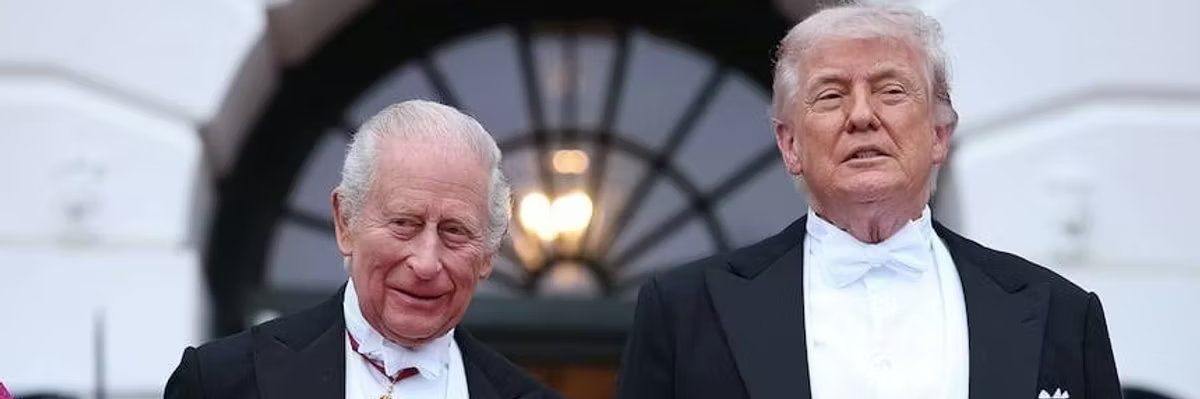
Donald Trump’s most recent contribution to his year-long “America 250” celebration was truly bizarre, with British King Charles somehow serving as a symbol of the heritage for which the American Revolution was fought. That Trump simultaneously posted a photo of the two leaders, under the heading “Two Kings,” only added to the weirdness. But, as Jonathan Chait has noted, along with many others, accompanying the weirdness was something dark and dangerous—the idea that the US is an “Anglo Saxon” nation, and that the idea of “freedom” announced in the Declaration of Independence is a White, Anglo-Saxon, and Protestant idea that is “alien” to “alien” peoples and cultures.
It was thus interesting that on the same day that he feted King Charles with encomiums to their common Anglo-Saxon heritage, Trump also announced his new “America 250” commemorative passport, featuring on one side an enormous drawing of his head against the background of the Declaration, and on the other the famous John Turnbull painting of the Continental Congress. Trump’s Kim Jong Un impression notwithstanding, it is entirely fitting that he would commemorate his “America 250” vision with a passport, for the policing of borders, long with the massive campaign of immigrant kidnapping, AKA/detention, and deportation, are the hallmarks of his administration.
Trump made this commitment clear while speaking at the Republican National Convention and accepting the party’s presidential nomination on July 19, 2024, reiterating what he has been saying for well over a decade:
The greatest invasion in history is taking place right here in our country. They are coming in from every corner of the earth, not just from South America, but from Africa, Asia, Middle East. They’re coming from everywhere. They’re coming at levels that we’ve never seen before. It is an invasion indeed, and this administration does absolutely nothing to stop them. They’re coming from prisons. They’re coming from jails. They’re coming from mental institutions and insane asylums. I, you know the press is always on because I say this. Has anyone seen “The Silence of the Lambs”? The late, great Hannibal Lecter. He’d love to have you for dinner. That’s insane asylums. They’re emptying out their insane asylums. And terrorists at numbers that we’ve never seen before. Bad things are going to happen.
The Trump administration’s violent and sometimes murderous assaults on Los Angeles, Chicago, Memphis, Washington, D.C., and especially Minneapolis, began only months ago and continue still, even if in less obtrusive ways. Mass deportation is simply one element of a much broader attack on refugees and immigrants. Last November, Trump’s Department of Homeland Security announced a total ban on reviewing asylum applications. Common Dreams reports that “Not a single refugee who isn’t a white South African has been legally resettled in the United States since October, according to the State Department’s most recent arrivals report.” Meanwhile, Trump continues to disparage Somalia, its people, and Rep. Ilhan Omar (D-Minn.) in viciously racist ways, recently doubling down on his vile 2018 comment:
Why is it we only take people from shithole countries, right? Why can’t we have some people from Norway, Sweden – just a few – let us have a few. From Denmark – do you mind sending us a few people? Send us some nice people, do you mind? But we always take people from Somalia. Places that are a disaster, right? Filthy, dirty, disgusting, ridden with crime.
For Trump, there is absolutely no contradiction between white supremacy and the unabashed celebration of American patriotism. It sometimes seems as if he is single-handedly trying to validate the most radical versions of the “critical race theories” that he hates, personifying a past, and present, of exultant White supremacy.
Trump is hardly the first White supremacist to occupy the White House. And yet, in a sense, his every move confirms what Ta-Nehisi Coates observed back in 2017, in labeling him “The First White President.” “To Trump, whiteness is neither notional nor symbolic but is the very core of his power," Coates argued. "In this, Trump is not singular. But whereas his forebears carried whiteness like an ancestral talisman, Trump cracked the glowing amulet open, releasing its eldritch energies.”
While Trump has many ideological predecessors—George Wallace springs immediately to mind—one has to go back an entire century, and to a perhaps unexpected place, to locate a public figure who so powerfully conjoins racism and xenophobia.
Back in May of 1926, the North American Review--founded by Boston Brahmin intellectuals in 1815, and widely considered the first significant literary magazine published in the US—featured just such a figure: Hiram Wesley Evans, the Vanderbilt University-educated author of a substantial, 30-page essay entitled “The Klan’s Fight for Americanism.” Evans was an up and coming public figure seeking to promote the restoration of American Greatness. He was also the Imperial Wizard and Emperor of the Knights of the Ku Klux Klan (KKK). And his essay, described by the editors as an “authoritative paper on the Ku Klux Klan by the foremost representative of that Order,” inaugurated a symposium featuring essays by four “writers of national authority”: Martin J. Scott, S.J.; Rev. Dr. Joseph Silverman, Rabbi Emeritus, Temple Emmanu-el, New York; W. E. Burghart Du Bois, National Association for the Advancement of Colored People; and William Starr Myers, Professor of Politics, Princeton University.
It may seem surprising that such an eminent journal would feature a serious symposium on the KKK centered on a substantial essay by its “Imperial Wizard and Emperor.” But indeed, the KKK—boosted by the 1915 release of D.W. Griffith’s “The Birth of a Nation," whose legendary ending featured the glorious rescue of vulnerable Whites by heroic Klansmen on horseback—had just experienced a rebirth under the leadership of William J. Simmons. Simmons was a vicious racist. He was also a patriot, and he dedicated his organization to the “sublime principles of a pure Americanism,” and declaring that “[T]he Klan is a purely American organization assembled around the Constitution of the United States, to safeguard its provisions, advance its purposes, and perpetuate its democracy.”
As Linda Gordon notes in her 2017 classic, The Second Coming of the KKK, by the 1920’s the Klan was a nationally important organization whose reach extended far beyond the South and claimed between 4 to 6 million members. More important: “the 1920’s Klan’s program was embraced by millions who were not members, possibly even a majority of Americans. Far from appearing disreputable or extreme in its ideology, the 1920’s Klan seemed ordinary and respectable to its contemporaries.” Over the course of the decade, it elected governors in Indiana, Oklahoma, Oregon, Colorado, and Texas., and exerted influence in a range of other states from Ohio and Michigan to New York.
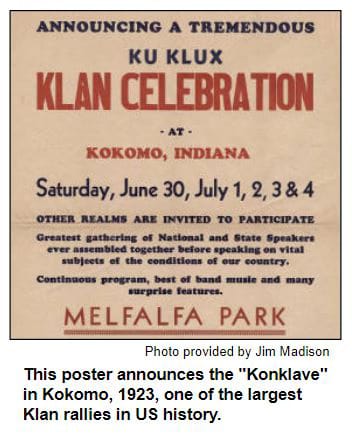
The organization was particularly strong in Indiana, where in the mid-1920’s it claimed both the state’s governor and a majority of both houses of the General Assembly. Gordon indeed opens her book by describing a 1923 Fourth of July Klan celebration that attracted thousands of supporters in Kokomo, Indiana, and which featured a speech by Indiana Grand Dragon D.C. Stephenson. The speech—entitled not “Why We Hate Blacks, Catholics, and Jews” but rather “Back to the Constitution"—declared: “We always had governed ourselves, and we always meant to. . . The American Revolution was fought for principles of self-government…then embodied in a federal constitution the like of which man never seen, are sacred now as they were then.”)
By 1923, Hiram Wesley Evans had been named Imperial Wizard of the Klan, supplanting Simmons and initiating a campaign to raise the profile and advance the political influence of the Klan. “The Klan’s Fight for Americanism” was, in effect, his vision statement. And its parallels with the rhetoric of Trump’s MAGA movement are chilling.
Evans begins by noting that while in 1915 the nation was “in the confusion of sudden awakening from the lovely dream of the melting pot, disorganized and helpless before the invasion of aliens and alien ideas. After ten years of the Klan, it is in arms for defense . . . “ The Klan, he insists, is dedicated above all to “the idea of preserving and developing America first and chiefly for the benefit of the children of the pioneers who made America, and only and definitely along the lines of the purpose and spirit of those pioneers.”
According to Evans, the Klan hates no one, and simply seeks to protect the American homeland from invaders who threaten true Americans: “We are a protest movement—protesting against being robbed . . . our great cities . . . taken over by strangers . . . the Nordic American is today a stranger in large parts of the land his fathers gave him.”
And while Evans denounces the alien hordes, he also blames “liberals” (also referred to as “Mongrelized liberals”) for the civilizational crisis at hand, insisting that liberalism “provided no defense against the alien invasion, but instead has excused it—even defended it against Americanism. Liberalism is today charged in the mind of most Americans with nothing less than national, racial, and spiritual treason.”
As America is being besieged by enemies without and within, he insists that “the Klan alone faces the invader . . . the Klan is the champion, but it is not merely an organization. It is an idea, a faith, a purpose, an organized crusade,” one that indeed has “won the leadership in the movement for Americanism.” Standing firmly “against radicalism, cosmopolitanism, and alienism of all kinds,” Evans insists that the Klan alone stands for American Greatness without apologies: “We believe, in short, that we have the right to make America American and for Americans.”
The anticipations of Trump here are striking.
Trump does not explicitly denounce Catholics, Jews, Asians, and Blacks in the manner of Evans and his turn of the 20th century Klansmen, nor does he invoke the language of “Nordic” racial superiority in the manner of Evans, who praises “the instincts of loyalty to the white race, to the traditions of America, and to the spirit of Protestantism, which has been an essential part of Americanism ever since the days of Roanoke and Plymouth Rock. They are condensed into the Klan slogan: ‘Native, white, Protestant supremacy.’”
And yet, minus the reference to “instincts of loyalty to the white race,” it is easy to imagine Trump speaking in much the same way. The distinction between real, Anglo-Saxon Americans and aliens; the contempt for people of color; the obsession with stemming a literal alien invasion; the representation of liberals and radicals as traitors to the nation—these are the core themes of Trumpism.
Trump does not wear a white robe and pointy white hat, or claim to be a Grand Wizard, or burn crosses, or talk of Nordic racial superiority. He does display a remarkable solicitude for tiki torch-bearing neo-Nazis, Confederate battle flag carriers, violent Three Percenters, and Proud Boy insurrectionists.
But Trump is no Klansman. He is the twice-elected President of the United States. And yet his defensive, xenophobic, and frankly reactionary vision of “Americanism” bears a striking resemblance to the vision put forward a century ago by the Klan—a group whose ideology was, and is, closer to the center of American politics than we might like to believe.
Contributor's note: I would like to thank Robert Orsi and Bob Ivie for their comments on this piece.
“The American patriots who pledged their lives to independence in 1776 were the heirs to this majestic inheritance. Their veins ran with Anglo-Saxon courage. Their hearts beat with an English faith in standing firm for what is right, good, and true. In recent years, we’ve often heard it said that America is merely an idea, but the cause of freedom did not simply appear as an intellectual invention of 1776. The American founding was the culmination of hundreds of years of thought, struggle, sweat, blood, and sacrifice on both sides of the Atlantic." —President Donald Trump, greeting British King Charles on April 28, 2026.
“The Declaration of Independence, the Constitution, and the Gettysburg Address are descendants of the Magna Charta— supreme symbols of Anglo-Saxon souls striving for freedom, justice, and humanity. Anglo-Saxons established this Nation, wrote its code, and sent their sons into the wilderness to gather fresh stars for the flag. . . . The making of America is fundamentally an Anglo-Saxon achievement. Anglo-Saxons brains have guided the course of the Republic. Our ideals are Anglo-Saxon, our social traditions, our standards of honor, our quality of imagination, and our indomitability.” —from “Americans Take Heed! Scum O’ The Melting Pot,” a 1921 KKK pamphlet.
Donald Trump’s most recent contribution to his year-long “America 250” celebration was truly bizarre, with British King Charles somehow serving as a symbol of the heritage for which the American Revolution was fought. That Trump simultaneously posted a photo of the two leaders, under the heading “Two Kings,” only added to the weirdness. But, as Jonathan Chait has noted, along with many others, accompanying the weirdness was something dark and dangerous—the idea that the US is an “Anglo Saxon” nation, and that the idea of “freedom” announced in the Declaration of Independence is a White, Anglo-Saxon, and Protestant idea that is “alien” to “alien” peoples and cultures.
It was thus interesting that on the same day that he feted King Charles with encomiums to their common Anglo-Saxon heritage, Trump also announced his new “America 250” commemorative passport, featuring on one side an enormous drawing of his head against the background of the Declaration, and on the other the famous John Turnbull painting of the Continental Congress. Trump’s Kim Jong Un impression notwithstanding, it is entirely fitting that he would commemorate his “America 250” vision with a passport, for the policing of borders, long with the massive campaign of immigrant kidnapping, AKA/detention, and deportation, are the hallmarks of his administration.
Trump made this commitment clear while speaking at the Republican National Convention and accepting the party’s presidential nomination on July 19, 2024, reiterating what he has been saying for well over a decade:
The greatest invasion in history is taking place right here in our country. They are coming in from every corner of the earth, not just from South America, but from Africa, Asia, Middle East. They’re coming from everywhere. They’re coming at levels that we’ve never seen before. It is an invasion indeed, and this administration does absolutely nothing to stop them. They’re coming from prisons. They’re coming from jails. They’re coming from mental institutions and insane asylums. I, you know the press is always on because I say this. Has anyone seen “The Silence of the Lambs”? The late, great Hannibal Lecter. He’d love to have you for dinner. That’s insane asylums. They’re emptying out their insane asylums. And terrorists at numbers that we’ve never seen before. Bad things are going to happen.
The Trump administration’s violent and sometimes murderous assaults on Los Angeles, Chicago, Memphis, Washington, D.C., and especially Minneapolis, began only months ago and continue still, even if in less obtrusive ways. Mass deportation is simply one element of a much broader attack on refugees and immigrants. Last November, Trump’s Department of Homeland Security announced a total ban on reviewing asylum applications. Common Dreams reports that “Not a single refugee who isn’t a white South African has been legally resettled in the United States since October, according to the State Department’s most recent arrivals report.” Meanwhile, Trump continues to disparage Somalia, its people, and Rep. Ilhan Omar (D-Minn.) in viciously racist ways, recently doubling down on his vile 2018 comment:
Why is it we only take people from shithole countries, right? Why can’t we have some people from Norway, Sweden – just a few – let us have a few. From Denmark – do you mind sending us a few people? Send us some nice people, do you mind? But we always take people from Somalia. Places that are a disaster, right? Filthy, dirty, disgusting, ridden with crime.
For Trump, there is absolutely no contradiction between white supremacy and the unabashed celebration of American patriotism. It sometimes seems as if he is single-handedly trying to validate the most radical versions of the “critical race theories” that he hates, personifying a past, and present, of exultant White supremacy.
Trump is hardly the first White supremacist to occupy the White House. And yet, in a sense, his every move confirms what Ta-Nehisi Coates observed back in 2017, in labeling him “The First White President.” “To Trump, whiteness is neither notional nor symbolic but is the very core of his power," Coates argued. "In this, Trump is not singular. But whereas his forebears carried whiteness like an ancestral talisman, Trump cracked the glowing amulet open, releasing its eldritch energies.”
While Trump has many ideological predecessors—George Wallace springs immediately to mind—one has to go back an entire century, and to a perhaps unexpected place, to locate a public figure who so powerfully conjoins racism and xenophobia.
Back in May of 1926, the North American Review--founded by Boston Brahmin intellectuals in 1815, and widely considered the first significant literary magazine published in the US—featured just such a figure: Hiram Wesley Evans, the Vanderbilt University-educated author of a substantial, 30-page essay entitled “The Klan’s Fight for Americanism.” Evans was an up and coming public figure seeking to promote the restoration of American Greatness. He was also the Imperial Wizard and Emperor of the Knights of the Ku Klux Klan (KKK). And his essay, described by the editors as an “authoritative paper on the Ku Klux Klan by the foremost representative of that Order,” inaugurated a symposium featuring essays by four “writers of national authority”: Martin J. Scott, S.J.; Rev. Dr. Joseph Silverman, Rabbi Emeritus, Temple Emmanu-el, New York; W. E. Burghart Du Bois, National Association for the Advancement of Colored People; and William Starr Myers, Professor of Politics, Princeton University.
It may seem surprising that such an eminent journal would feature a serious symposium on the KKK centered on a substantial essay by its “Imperial Wizard and Emperor.” But indeed, the KKK—boosted by the 1915 release of D.W. Griffith’s “The Birth of a Nation," whose legendary ending featured the glorious rescue of vulnerable Whites by heroic Klansmen on horseback—had just experienced a rebirth under the leadership of William J. Simmons. Simmons was a vicious racist. He was also a patriot, and he dedicated his organization to the “sublime principles of a pure Americanism,” and declaring that “[T]he Klan is a purely American organization assembled around the Constitution of the United States, to safeguard its provisions, advance its purposes, and perpetuate its democracy.”
As Linda Gordon notes in her 2017 classic, The Second Coming of the KKK, by the 1920’s the Klan was a nationally important organization whose reach extended far beyond the South and claimed between 4 to 6 million members. More important: “the 1920’s Klan’s program was embraced by millions who were not members, possibly even a majority of Americans. Far from appearing disreputable or extreme in its ideology, the 1920’s Klan seemed ordinary and respectable to its contemporaries.” Over the course of the decade, it elected governors in Indiana, Oklahoma, Oregon, Colorado, and Texas., and exerted influence in a range of other states from Ohio and Michigan to New York.
The organization was particularly strong in Indiana, where in the mid-1920’s it claimed both the state’s governor and a majority of both houses of the General Assembly. Gordon indeed opens her book by describing a 1923 Fourth of July Klan celebration that attracted thousands of supporters in Kokomo, Indiana, and which featured a speech by Indiana Grand Dragon D.C. Stephenson. The speech—entitled not “Why We Hate Blacks, Catholics, and Jews” but rather “Back to the Constitution"—declared: “We always had governed ourselves, and we always meant to. . . The American Revolution was fought for principles of self-government…then embodied in a federal constitution the like of which man never seen, are sacred now as they were then.”)
By 1923, Hiram Wesley Evans had been named Imperial Wizard of the Klan, supplanting Simmons and initiating a campaign to raise the profile and advance the political influence of the Klan. “The Klan’s Fight for Americanism” was, in effect, his vision statement. And its parallels with the rhetoric of Trump’s MAGA movement are chilling.
Evans begins by noting that while in 1915 the nation was “in the confusion of sudden awakening from the lovely dream of the melting pot, disorganized and helpless before the invasion of aliens and alien ideas. After ten years of the Klan, it is in arms for defense . . . “ The Klan, he insists, is dedicated above all to “the idea of preserving and developing America first and chiefly for the benefit of the children of the pioneers who made America, and only and definitely along the lines of the purpose and spirit of those pioneers.”
According to Evans, the Klan hates no one, and simply seeks to protect the American homeland from invaders who threaten true Americans: “We are a protest movement—protesting against being robbed . . . our great cities . . . taken over by strangers . . . the Nordic American is today a stranger in large parts of the land his fathers gave him.”
And while Evans denounces the alien hordes, he also blames “liberals” (also referred to as “Mongrelized liberals”) for the civilizational crisis at hand, insisting that liberalism “provided no defense against the alien invasion, but instead has excused it—even defended it against Americanism. Liberalism is today charged in the mind of most Americans with nothing less than national, racial, and spiritual treason.”
As America is being besieged by enemies without and within, he insists that “the Klan alone faces the invader . . . the Klan is the champion, but it is not merely an organization. It is an idea, a faith, a purpose, an organized crusade,” one that indeed has “won the leadership in the movement for Americanism.” Standing firmly “against radicalism, cosmopolitanism, and alienism of all kinds,” Evans insists that the Klan alone stands for American Greatness without apologies: “We believe, in short, that we have the right to make America American and for Americans.”
The anticipations of Trump here are striking.
Trump does not explicitly denounce Catholics, Jews, Asians, and Blacks in the manner of Evans and his turn of the 20th century Klansmen, nor does he invoke the language of “Nordic” racial superiority in the manner of Evans, who praises “the instincts of loyalty to the white race, to the traditions of America, and to the spirit of Protestantism, which has been an essential part of Americanism ever since the days of Roanoke and Plymouth Rock. They are condensed into the Klan slogan: ‘Native, white, Protestant supremacy.’”
And yet, minus the reference to “instincts of loyalty to the white race,” it is easy to imagine Trump speaking in much the same way. The distinction between real, Anglo-Saxon Americans and aliens; the contempt for people of color; the obsession with stemming a literal alien invasion; the representation of liberals and radicals as traitors to the nation—these are the core themes of Trumpism.
Trump does not wear a white robe and pointy white hat, or claim to be a Grand Wizard, or burn crosses, or talk of Nordic racial superiority. He does display a remarkable solicitude for tiki torch-bearing neo-Nazis, Confederate battle flag carriers, violent Three Percenters, and Proud Boy insurrectionists.
But Trump is no Klansman. He is the twice-elected President of the United States. And yet his defensive, xenophobic, and frankly reactionary vision of “Americanism” bears a striking resemblance to the vision put forward a century ago by the Klan—a group whose ideology was, and is, closer to the center of American politics than we might like to believe.
Contributor's note: I would like to thank Robert Orsi and Bob Ivie for their comments on this piece.
“The American patriots who pledged their lives to independence in 1776 were the heirs to this majestic inheritance. Their veins ran with Anglo-Saxon courage. Their hearts beat with an English faith in standing firm for what is right, good, and true. In recent years, we’ve often heard it said that America is merely an idea, but the cause of freedom did not simply appear as an intellectual invention of 1776. The American founding was the culmination of hundreds of years of thought, struggle, sweat, blood, and sacrifice on both sides of the Atlantic." —President Donald Trump, greeting British King Charles on April 28, 2026.
“The Declaration of Independence, the Constitution, and the Gettysburg Address are descendants of the Magna Charta— supreme symbols of Anglo-Saxon souls striving for freedom, justice, and humanity. Anglo-Saxons established this Nation, wrote its code, and sent their sons into the wilderness to gather fresh stars for the flag. . . . The making of America is fundamentally an Anglo-Saxon achievement. Anglo-Saxons brains have guided the course of the Republic. Our ideals are Anglo-Saxon, our social traditions, our standards of honor, our quality of imagination, and our indomitability.” —from “Americans Take Heed! Scum O’ The Melting Pot,” a 1921 KKK pamphlet.
Donald Trump’s most recent contribution to his year-long “America 250” celebration was truly bizarre, with British King Charles somehow serving as a symbol of the heritage for which the American Revolution was fought. That Trump simultaneously posted a photo of the two leaders, under the heading “Two Kings,” only added to the weirdness. But, as Jonathan Chait has noted, along with many others, accompanying the weirdness was something dark and dangerous—the idea that the US is an “Anglo Saxon” nation, and that the idea of “freedom” announced in the Declaration of Independence is a White, Anglo-Saxon, and Protestant idea that is “alien” to “alien” peoples and cultures.
It was thus interesting that on the same day that he feted King Charles with encomiums to their common Anglo-Saxon heritage, Trump also announced his new “America 250” commemorative passport, featuring on one side an enormous drawing of his head against the background of the Declaration, and on the other the famous John Turnbull painting of the Continental Congress. Trump’s Kim Jong Un impression notwithstanding, it is entirely fitting that he would commemorate his “America 250” vision with a passport, for the policing of borders, long with the massive campaign of immigrant kidnapping, AKA/detention, and deportation, are the hallmarks of his administration.
Trump made this commitment clear while speaking at the Republican National Convention and accepting the party’s presidential nomination on July 19, 2024, reiterating what he has been saying for well over a decade:
The greatest invasion in history is taking place right here in our country. They are coming in from every corner of the earth, not just from South America, but from Africa, Asia, Middle East. They’re coming from everywhere. They’re coming at levels that we’ve never seen before. It is an invasion indeed, and this administration does absolutely nothing to stop them. They’re coming from prisons. They’re coming from jails. They’re coming from mental institutions and insane asylums. I, you know the press is always on because I say this. Has anyone seen “The Silence of the Lambs”? The late, great Hannibal Lecter. He’d love to have you for dinner. That’s insane asylums. They’re emptying out their insane asylums. And terrorists at numbers that we’ve never seen before. Bad things are going to happen.
The Trump administration’s violent and sometimes murderous assaults on Los Angeles, Chicago, Memphis, Washington, D.C., and especially Minneapolis, began only months ago and continue still, even if in less obtrusive ways. Mass deportation is simply one element of a much broader attack on refugees and immigrants. Last November, Trump’s Department of Homeland Security announced a total ban on reviewing asylum applications. Common Dreams reports that “Not a single refugee who isn’t a white South African has been legally resettled in the United States since October, according to the State Department’s most recent arrivals report.” Meanwhile, Trump continues to disparage Somalia, its people, and Rep. Ilhan Omar (D-Minn.) in viciously racist ways, recently doubling down on his vile 2018 comment:
Why is it we only take people from shithole countries, right? Why can’t we have some people from Norway, Sweden – just a few – let us have a few. From Denmark – do you mind sending us a few people? Send us some nice people, do you mind? But we always take people from Somalia. Places that are a disaster, right? Filthy, dirty, disgusting, ridden with crime.
For Trump, there is absolutely no contradiction between white supremacy and the unabashed celebration of American patriotism. It sometimes seems as if he is single-handedly trying to validate the most radical versions of the “critical race theories” that he hates, personifying a past, and present, of exultant White supremacy.
Trump is hardly the first White supremacist to occupy the White House. And yet, in a sense, his every move confirms what Ta-Nehisi Coates observed back in 2017, in labeling him “The First White President.” “To Trump, whiteness is neither notional nor symbolic but is the very core of his power," Coates argued. "In this, Trump is not singular. But whereas his forebears carried whiteness like an ancestral talisman, Trump cracked the glowing amulet open, releasing its eldritch energies.”
While Trump has many ideological predecessors—George Wallace springs immediately to mind—one has to go back an entire century, and to a perhaps unexpected place, to locate a public figure who so powerfully conjoins racism and xenophobia.
Back in May of 1926, the North American Review--founded by Boston Brahmin intellectuals in 1815, and widely considered the first significant literary magazine published in the US—featured just such a figure: Hiram Wesley Evans, the Vanderbilt University-educated author of a substantial, 30-page essay entitled “The Klan’s Fight for Americanism.” Evans was an up and coming public figure seeking to promote the restoration of American Greatness. He was also the Imperial Wizard and Emperor of the Knights of the Ku Klux Klan (KKK). And his essay, described by the editors as an “authoritative paper on the Ku Klux Klan by the foremost representative of that Order,” inaugurated a symposium featuring essays by four “writers of national authority”: Martin J. Scott, S.J.; Rev. Dr. Joseph Silverman, Rabbi Emeritus, Temple Emmanu-el, New York; W. E. Burghart Du Bois, National Association for the Advancement of Colored People; and William Starr Myers, Professor of Politics, Princeton University.
It may seem surprising that such an eminent journal would feature a serious symposium on the KKK centered on a substantial essay by its “Imperial Wizard and Emperor.” But indeed, the KKK—boosted by the 1915 release of D.W. Griffith’s “The Birth of a Nation," whose legendary ending featured the glorious rescue of vulnerable Whites by heroic Klansmen on horseback—had just experienced a rebirth under the leadership of William J. Simmons. Simmons was a vicious racist. He was also a patriot, and he dedicated his organization to the “sublime principles of a pure Americanism,” and declaring that “[T]he Klan is a purely American organization assembled around the Constitution of the United States, to safeguard its provisions, advance its purposes, and perpetuate its democracy.”
As Linda Gordon notes in her 2017 classic, The Second Coming of the KKK, by the 1920’s the Klan was a nationally important organization whose reach extended far beyond the South and claimed between 4 to 6 million members. More important: “the 1920’s Klan’s program was embraced by millions who were not members, possibly even a majority of Americans. Far from appearing disreputable or extreme in its ideology, the 1920’s Klan seemed ordinary and respectable to its contemporaries.” Over the course of the decade, it elected governors in Indiana, Oklahoma, Oregon, Colorado, and Texas., and exerted influence in a range of other states from Ohio and Michigan to New York.
The organization was particularly strong in Indiana, where in the mid-1920’s it claimed both the state’s governor and a majority of both houses of the General Assembly. Gordon indeed opens her book by describing a 1923 Fourth of July Klan celebration that attracted thousands of supporters in Kokomo, Indiana, and which featured a speech by Indiana Grand Dragon D.C. Stephenson. The speech—entitled not “Why We Hate Blacks, Catholics, and Jews” but rather “Back to the Constitution"—declared: “We always had governed ourselves, and we always meant to. . . The American Revolution was fought for principles of self-government…then embodied in a federal constitution the like of which man never seen, are sacred now as they were then.”)
By 1923, Hiram Wesley Evans had been named Imperial Wizard of the Klan, supplanting Simmons and initiating a campaign to raise the profile and advance the political influence of the Klan. “The Klan’s Fight for Americanism” was, in effect, his vision statement. And its parallels with the rhetoric of Trump’s MAGA movement are chilling.
Evans begins by noting that while in 1915 the nation was “in the confusion of sudden awakening from the lovely dream of the melting pot, disorganized and helpless before the invasion of aliens and alien ideas. After ten years of the Klan, it is in arms for defense . . . “ The Klan, he insists, is dedicated above all to “the idea of preserving and developing America first and chiefly for the benefit of the children of the pioneers who made America, and only and definitely along the lines of the purpose and spirit of those pioneers.”
According to Evans, the Klan hates no one, and simply seeks to protect the American homeland from invaders who threaten true Americans: “We are a protest movement—protesting against being robbed . . . our great cities . . . taken over by strangers . . . the Nordic American is today a stranger in large parts of the land his fathers gave him.”
And while Evans denounces the alien hordes, he also blames “liberals” (also referred to as “Mongrelized liberals”) for the civilizational crisis at hand, insisting that liberalism “provided no defense against the alien invasion, but instead has excused it—even defended it against Americanism. Liberalism is today charged in the mind of most Americans with nothing less than national, racial, and spiritual treason.”
As America is being besieged by enemies without and within, he insists that “the Klan alone faces the invader . . . the Klan is the champion, but it is not merely an organization. It is an idea, a faith, a purpose, an organized crusade,” one that indeed has “won the leadership in the movement for Americanism.” Standing firmly “against radicalism, cosmopolitanism, and alienism of all kinds,” Evans insists that the Klan alone stands for American Greatness without apologies: “We believe, in short, that we have the right to make America American and for Americans.”
The anticipations of Trump here are striking.
Trump does not explicitly denounce Catholics, Jews, Asians, and Blacks in the manner of Evans and his turn of the 20th century Klansmen, nor does he invoke the language of “Nordic” racial superiority in the manner of Evans, who praises “the instincts of loyalty to the white race, to the traditions of America, and to the spirit of Protestantism, which has been an essential part of Americanism ever since the days of Roanoke and Plymouth Rock. They are condensed into the Klan slogan: ‘Native, white, Protestant supremacy.’”
And yet, minus the reference to “instincts of loyalty to the white race,” it is easy to imagine Trump speaking in much the same way. The distinction between real, Anglo-Saxon Americans and aliens; the contempt for people of color; the obsession with stemming a literal alien invasion; the representation of liberals and radicals as traitors to the nation—these are the core themes of Trumpism.
Trump does not wear a white robe and pointy white hat, or claim to be a Grand Wizard, or burn crosses, or talk of Nordic racial superiority. He does display a remarkable solicitude for tiki torch-bearing neo-Nazis, Confederate battle flag carriers, violent Three Percenters, and Proud Boy insurrectionists.
But Trump is no Klansman. He is the twice-elected President of the United States. And yet his defensive, xenophobic, and frankly reactionary vision of “Americanism” bears a striking resemblance to the vision put forward a century ago by the Klan—a group whose ideology was, and is, closer to the center of American politics than we might like to believe.
Contributor's note: I would like to thank Robert Orsi and Bob Ivie for their comments on this piece.