5
#000000
#FFFFFF
To donate by check, phone, or other method, see our More Ways to Give page.
Daily news & progressive opinion—funded by the people, not the corporations—delivered straight to your inbox.
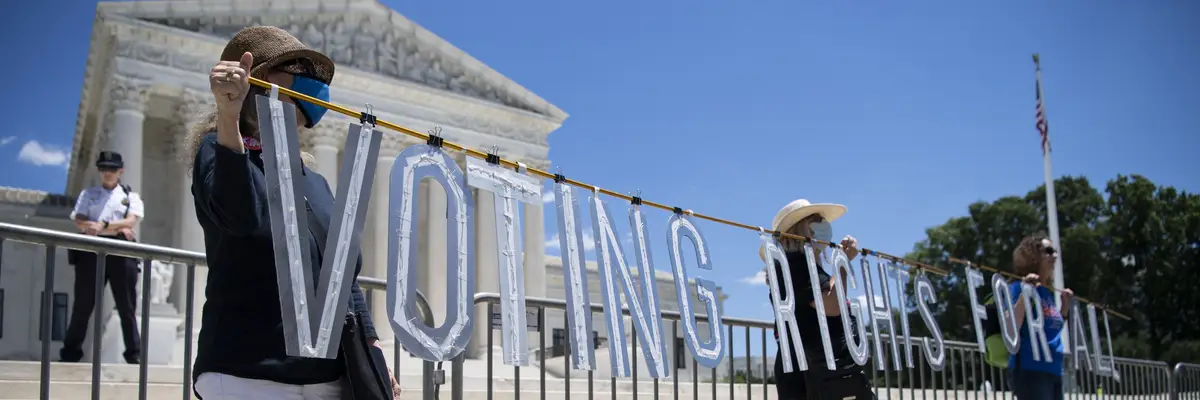
Demonstrators hold up a sign as they participate in the Moral March on Manchin and McConnell, a rally held by the Poor Peoples Campaign, calling on them to eliminate the legislative filibuster and pass the "For The People" voting rights bill, outside the Supreme Court in Washington on Wednesday, June 23, 2021.
The legislative branch must stop dragging its heels and pass laws to ban partisan gerrymandering, bolster voting rights, and reform the Supreme Court.
The Supreme Court’s decision to destroy what remained of the Voting Rights Act in Louisiana v. Callais will take every element of our already broken political system and make it worse. It was not a surprise. But it shocked nonetheless.
What should we do? Boil with fury at the ruling. Scoff at the justices who claim only to call “balls and strikes,” in a game they’ve fixed. But don’t stop there. Yell, loudly, for action by the one part of our government that can do something: Congress.
The Supreme Court’s ruling leaves the Voting Rights Act “all but a dead letter,” as Justice Elena Kagan put it. Callais is a grave blow to racial equality, especially in the South. Scholar Rick Hasen warned, “This decision will bleach the halls of Congress, state legislatures, and local bodies like city councils.” We may see the fastest rollback in representation since the end of Reconstruction after the Civil War. Even if it’s not as bad as that, it will be bad enough.
Arid legal abstractions can have harsh real-world consequences. After the 2013 Shelby County v. Holder ruling, which gutted the most important part of the Voting Rights Act, the gap between white and nonwhite voters’ turnout grew twice as fast in states that were once covered by the strong protections of the law, according to the Brennan Center’s research. Callais will only worsen this disparity, especially since the justices have agreed to rush the implementation of their decision so its effects will be felt as soon as possible.
In recent years, a paralyzed and polarized Congress has failed to do its job. This torpor created the opening for an imperial judiciary and an abusive executive.
To perfume its actions, the ruling glorifies, of all things, partisan gerrymandering. And this in the middle of a nationwide redistricting frenzy. Justice Samuel Alito explained that states can deflect even proof of a racially discriminatory map by simply claiming that the manipulative district lines aim to entrench a political party. We aren’t discriminating against Black people, you see. Just against Democrats. Case closed.
After this overt assault on our democracy, Congress has a duty to act.
First, it should ban partisan gerrymandering—immediately. Such a rule would apply to red states and blue states alike. A bill to do this has been introduced by Sens. Alex Padilla (D-Calif.), Raphael Warnock (D-Ga.), Angus King (I-Maine), and Adam Schiff (D-Calif.), building off language from the Freedom to Vote Act. Rep. Zoe Lofgren (D-Calif.) put forward the measure in the House.
Such a move is constitutional. None other than Chief Justice John Roberts wrote in 2019’s Rucho v. Common Cause ruling, “[The] Framers gave Congress the power to do something about partisan gerrymandering in the Elections Clause.” He even approvingly pointed to what became the Freedom to Vote Act, which would come very close to becoming law in 2022.
Second, Congress should enact new laws to give citizens a meaningful and robust right to vote, as well as a right to sue if their voting rights have been abridged, diluted, or denied. Judges should be charged with viewing any burden or dilution with extreme skepticism. It should be easier to prove discriminatory intent. And nationwide standards for elections would make them harder to manipulate.
Finally, Callais shows the urgent need for Supreme Court reform, starting with an 18-year term limit for justices. Judicial term limits would restore accountability. They would reflect the core value that nobody should hold too much power for too long. Term limits are broadly popular. The most recent Fox News poll on the issue showed that 78% of the public supports them. That’s an awful lot of Republicans, on top of Democrats and independents.
Momentum is growing. A Congressional Black Caucus (CBC) statement put it well. “Our nation’s highest court has been compromised,” it declared. “The CBC will make it our mission to aggressively advance Supreme Court reform. We will work to establish term limits for justices to help restore independence, neutrality, and legitimacy to the court.”
This kind of congressional pushback used to be common. But in recent years, a paralyzed and polarized Congress has failed to do its job. This torpor created the opening for an imperial judiciary and an abusive executive. As my colleagues Miriam Rosenbaum and Emily Whitehead noted, “In recent years, the court has repeatedly gutted landmark pieces of democratically enacted legislation that had earlier survived the court’s scrutiny.” Citizens United destroyed a century of campaign finance laws, just as Callais finished the job of demolishing the voting rights legislation overwhelmingly passed by Congress and signed into law by a Republican president. Yet Congress failed to restore the Voting Rights Act or repair campaign finance rules, even when Democrats controlled the White House and the legislature.
This year, Americans have been energized around voting issues in response to the egregious SAVE Act, now blocked in the Senate. But rhetoric is not enough, and playing defense surely is not enough. Lawmakers must put at the center of their agenda bold, tough, unflinching steps to restore the health of American democracy.
Dear Common Dreams reader, It’s been nearly 30 years since I co-founded Common Dreams with my late wife, Lina Newhouser. We had the radical notion that journalism should serve the public good, not corporate profits. It was clear to us from the outset what it would take to build such a project. No paid advertisements. No corporate sponsors. No millionaire publisher telling us what to think or do. Many people said we wouldn't last a year, but we proved those doubters wrong. Together with a tremendous team of journalists and dedicated staff, we built an independent media outlet free from the constraints of profits and corporate control. Our mission has always been simple: To inform. To inspire. To ignite change for the common good. Building Common Dreams was not easy. Our survival was never guaranteed. When you take on the most powerful forces—Wall Street greed, fossil fuel industry destruction, Big Tech lobbyists, and uber-rich oligarchs who have spent billions upon billions rigging the economy and democracy in their favor—the only bulwark you have is supporters who believe in your work. But here’s the urgent message from me today. It's never been this bad out there. And it's never been this hard to keep us going. At the very moment Common Dreams is most needed, the threats we face are intensifying. We need your support now more than ever. We don't accept corporate advertising and never will. We don't have a paywall because we don't think people should be blocked from critical news based on their ability to pay. Everything we do is funded by the donations of readers like you. When everyone does the little they can afford, we are strong. But if that support retreats or dries up, so do we. Will you donate now to make sure Common Dreams not only survives but thrives? —Craig Brown, Co-founder |
The Supreme Court’s decision to destroy what remained of the Voting Rights Act in Louisiana v. Callais will take every element of our already broken political system and make it worse. It was not a surprise. But it shocked nonetheless.
What should we do? Boil with fury at the ruling. Scoff at the justices who claim only to call “balls and strikes,” in a game they’ve fixed. But don’t stop there. Yell, loudly, for action by the one part of our government that can do something: Congress.
The Supreme Court’s ruling leaves the Voting Rights Act “all but a dead letter,” as Justice Elena Kagan put it. Callais is a grave blow to racial equality, especially in the South. Scholar Rick Hasen warned, “This decision will bleach the halls of Congress, state legislatures, and local bodies like city councils.” We may see the fastest rollback in representation since the end of Reconstruction after the Civil War. Even if it’s not as bad as that, it will be bad enough.
Arid legal abstractions can have harsh real-world consequences. After the 2013 Shelby County v. Holder ruling, which gutted the most important part of the Voting Rights Act, the gap between white and nonwhite voters’ turnout grew twice as fast in states that were once covered by the strong protections of the law, according to the Brennan Center’s research. Callais will only worsen this disparity, especially since the justices have agreed to rush the implementation of their decision so its effects will be felt as soon as possible.
In recent years, a paralyzed and polarized Congress has failed to do its job. This torpor created the opening for an imperial judiciary and an abusive executive.
To perfume its actions, the ruling glorifies, of all things, partisan gerrymandering. And this in the middle of a nationwide redistricting frenzy. Justice Samuel Alito explained that states can deflect even proof of a racially discriminatory map by simply claiming that the manipulative district lines aim to entrench a political party. We aren’t discriminating against Black people, you see. Just against Democrats. Case closed.
After this overt assault on our democracy, Congress has a duty to act.
First, it should ban partisan gerrymandering—immediately. Such a rule would apply to red states and blue states alike. A bill to do this has been introduced by Sens. Alex Padilla (D-Calif.), Raphael Warnock (D-Ga.), Angus King (I-Maine), and Adam Schiff (D-Calif.), building off language from the Freedom to Vote Act. Rep. Zoe Lofgren (D-Calif.) put forward the measure in the House.
Such a move is constitutional. None other than Chief Justice John Roberts wrote in 2019’s Rucho v. Common Cause ruling, “[The] Framers gave Congress the power to do something about partisan gerrymandering in the Elections Clause.” He even approvingly pointed to what became the Freedom to Vote Act, which would come very close to becoming law in 2022.
Second, Congress should enact new laws to give citizens a meaningful and robust right to vote, as well as a right to sue if their voting rights have been abridged, diluted, or denied. Judges should be charged with viewing any burden or dilution with extreme skepticism. It should be easier to prove discriminatory intent. And nationwide standards for elections would make them harder to manipulate.
Finally, Callais shows the urgent need for Supreme Court reform, starting with an 18-year term limit for justices. Judicial term limits would restore accountability. They would reflect the core value that nobody should hold too much power for too long. Term limits are broadly popular. The most recent Fox News poll on the issue showed that 78% of the public supports them. That’s an awful lot of Republicans, on top of Democrats and independents.
Momentum is growing. A Congressional Black Caucus (CBC) statement put it well. “Our nation’s highest court has been compromised,” it declared. “The CBC will make it our mission to aggressively advance Supreme Court reform. We will work to establish term limits for justices to help restore independence, neutrality, and legitimacy to the court.”
This kind of congressional pushback used to be common. But in recent years, a paralyzed and polarized Congress has failed to do its job. This torpor created the opening for an imperial judiciary and an abusive executive. As my colleagues Miriam Rosenbaum and Emily Whitehead noted, “In recent years, the court has repeatedly gutted landmark pieces of democratically enacted legislation that had earlier survived the court’s scrutiny.” Citizens United destroyed a century of campaign finance laws, just as Callais finished the job of demolishing the voting rights legislation overwhelmingly passed by Congress and signed into law by a Republican president. Yet Congress failed to restore the Voting Rights Act or repair campaign finance rules, even when Democrats controlled the White House and the legislature.
This year, Americans have been energized around voting issues in response to the egregious SAVE Act, now blocked in the Senate. But rhetoric is not enough, and playing defense surely is not enough. Lawmakers must put at the center of their agenda bold, tough, unflinching steps to restore the health of American democracy.
The Supreme Court’s decision to destroy what remained of the Voting Rights Act in Louisiana v. Callais will take every element of our already broken political system and make it worse. It was not a surprise. But it shocked nonetheless.
What should we do? Boil with fury at the ruling. Scoff at the justices who claim only to call “balls and strikes,” in a game they’ve fixed. But don’t stop there. Yell, loudly, for action by the one part of our government that can do something: Congress.
The Supreme Court’s ruling leaves the Voting Rights Act “all but a dead letter,” as Justice Elena Kagan put it. Callais is a grave blow to racial equality, especially in the South. Scholar Rick Hasen warned, “This decision will bleach the halls of Congress, state legislatures, and local bodies like city councils.” We may see the fastest rollback in representation since the end of Reconstruction after the Civil War. Even if it’s not as bad as that, it will be bad enough.
Arid legal abstractions can have harsh real-world consequences. After the 2013 Shelby County v. Holder ruling, which gutted the most important part of the Voting Rights Act, the gap between white and nonwhite voters’ turnout grew twice as fast in states that were once covered by the strong protections of the law, according to the Brennan Center’s research. Callais will only worsen this disparity, especially since the justices have agreed to rush the implementation of their decision so its effects will be felt as soon as possible.
In recent years, a paralyzed and polarized Congress has failed to do its job. This torpor created the opening for an imperial judiciary and an abusive executive.
To perfume its actions, the ruling glorifies, of all things, partisan gerrymandering. And this in the middle of a nationwide redistricting frenzy. Justice Samuel Alito explained that states can deflect even proof of a racially discriminatory map by simply claiming that the manipulative district lines aim to entrench a political party. We aren’t discriminating against Black people, you see. Just against Democrats. Case closed.
After this overt assault on our democracy, Congress has a duty to act.
First, it should ban partisan gerrymandering—immediately. Such a rule would apply to red states and blue states alike. A bill to do this has been introduced by Sens. Alex Padilla (D-Calif.), Raphael Warnock (D-Ga.), Angus King (I-Maine), and Adam Schiff (D-Calif.), building off language from the Freedom to Vote Act. Rep. Zoe Lofgren (D-Calif.) put forward the measure in the House.
Such a move is constitutional. None other than Chief Justice John Roberts wrote in 2019’s Rucho v. Common Cause ruling, “[The] Framers gave Congress the power to do something about partisan gerrymandering in the Elections Clause.” He even approvingly pointed to what became the Freedom to Vote Act, which would come very close to becoming law in 2022.
Second, Congress should enact new laws to give citizens a meaningful and robust right to vote, as well as a right to sue if their voting rights have been abridged, diluted, or denied. Judges should be charged with viewing any burden or dilution with extreme skepticism. It should be easier to prove discriminatory intent. And nationwide standards for elections would make them harder to manipulate.
Finally, Callais shows the urgent need for Supreme Court reform, starting with an 18-year term limit for justices. Judicial term limits would restore accountability. They would reflect the core value that nobody should hold too much power for too long. Term limits are broadly popular. The most recent Fox News poll on the issue showed that 78% of the public supports them. That’s an awful lot of Republicans, on top of Democrats and independents.
Momentum is growing. A Congressional Black Caucus (CBC) statement put it well. “Our nation’s highest court has been compromised,” it declared. “The CBC will make it our mission to aggressively advance Supreme Court reform. We will work to establish term limits for justices to help restore independence, neutrality, and legitimacy to the court.”
This kind of congressional pushback used to be common. But in recent years, a paralyzed and polarized Congress has failed to do its job. This torpor created the opening for an imperial judiciary and an abusive executive. As my colleagues Miriam Rosenbaum and Emily Whitehead noted, “In recent years, the court has repeatedly gutted landmark pieces of democratically enacted legislation that had earlier survived the court’s scrutiny.” Citizens United destroyed a century of campaign finance laws, just as Callais finished the job of demolishing the voting rights legislation overwhelmingly passed by Congress and signed into law by a Republican president. Yet Congress failed to restore the Voting Rights Act or repair campaign finance rules, even when Democrats controlled the White House and the legislature.
This year, Americans have been energized around voting issues in response to the egregious SAVE Act, now blocked in the Senate. But rhetoric is not enough, and playing defense surely is not enough. Lawmakers must put at the center of their agenda bold, tough, unflinching steps to restore the health of American democracy.