SUBSCRIBE TO OUR FREE NEWSLETTER
Daily news & progressive opinion—funded by the people, not the corporations—delivered straight to your inbox.
5
#000000
#FFFFFF
To donate by check, phone, or other method, see our More Ways to Give page.
Daily news & progressive opinion—funded by the people, not the corporations—delivered straight to your inbox.
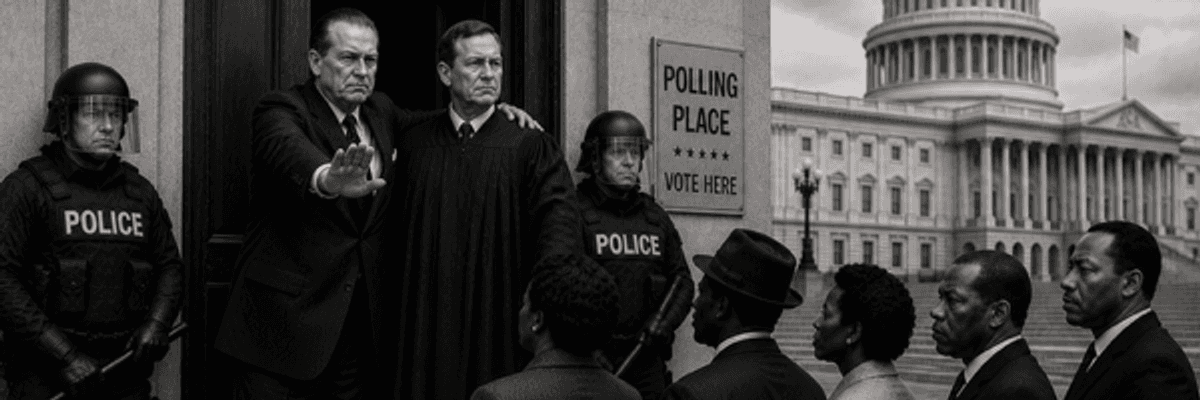
An AI-generated cartoon depicting infamous segregationist George Wallace alongside US Supreme Court Chief Justice John Roberts preventing black Americans from voting.
What the infamous segregationist from Alabama could not accomplish with violence, the US Supreme Court Justice has accomplished with a pen.
George Wallace was sworn in as Governor of Alabama in 1963 and famously declared in his inauguration speech (written by a Ku Klux Klan leader) "segregation now, segregation tomorrow, segregation forever." Two years later, Alabama state troopers violently broke up a nighttime voting rights march during which a police officer shot and killed young African American protester and Baptist deacon Jimmie Lee Jackson who was unarmed and protecting his mother.
In response, civil rights leaders, including Martin Luther King and John Lewis, organized a mass march from Selma to Montgomery over the Edmund Pettus Bridge in an attempt to deliver a civil rights and voting rights message to Gov. Wallace. It became known as "Bloody Sunday" as state troopers gassed and beat the protestors, including fracturing Lewis' skull and sending 57 others to the hospital. Televised images of the brutal attack shocked the nation, directly leading to President Johnson's push for the Voting Rights Act of 1965.
Numerous Americans, black and white, were injured and even died fighting for the Civil Rights Act. John Roberts and his five Republican Supreme Court colleagues effectively overturned the Civil Rights Act and essentially disenfranchised black voters.
George Wallace tried to disenfranchise black voters with violent state troopers. Roberts disenfranchised black voters with the stroke of a pen. It's not hyperbole to say that while Roberts wears the black robes of a judge, he may as well wear the white robes of the Klan.
It's not hyperbole to say that while Roberts wears the black robes of a judge, he may as well wear the white robes of the Klan.
In her dissent to Louisiana v. Callais in which the 6-member Republican majority of the Court effectively overturned Section 2 of the Civil Rights Act, Justice Elena Kagan wrote: “The Voting Rights Act is—or, now more accurately, was—one of the most consequential, efficacious, and amply justified exercises of federal legislative power in our Nation’s history. It was born of the literal blood of Union soldiers and civil rights marchers. It ushered in awe-inspiring change, bringing this Nation closer to fulfilling the ideals of democracy and racial equality." Kagan concluded, " I dissent because the Court betrays its duty to faithfully implement the great statute Congress wrote. I dissent because the Court’s decision will set back the foundational right Congress granted of racial equality in electoral opportunity. I dissent.”
But the Court didn't destroy the Civil Rights Act in a day. It was part of a lifelong mission by John Roberts to do so.
Starting as early as 1981, as a 26-year-old lawyer just three years out of Harvard Law School, Roberts began his campaign to undermine the Civil Rights Act. He got himself a job as Special Assistant to Ronald Reagan's Attorney General William French Smith. Congress was about to amend the Civil Rights Act to provide that state laws would be illegal if they had a racially discriminatory effect, without having to prove that they had a racially discriminatory intent—something almost impossible to prove.
Roberts zealously took on the assignment coming up with arguments against the Amendment. Roberts wrote over 25 memos opposing the Amendment. In one, he argued that the Civil Rights Act was "the most intrusive interference imaginable by federal courts into state and local processes."
Despite the efforts of Roberts and others in the Reagan administration, Congress passed the Amendment with overwhelming bipartisan support. Little did anyone imagine at the time that Roberts would become Chief Justice and the leader of right-wing Justices' ultimately successful efforts to undermine the Civil Rights Act as he had initially set out to do as a young Justice Department official.
At his confirmation hearing, Roberts told the Senate "The existing Voting Rights Act, the constitutionality has been upheld and I don't have any issue with that." He was lying.
In 2013, Roberts got his first shot at dismantling the Civil Rights Act. In his 5-4 ruling in Shelby v. Holder, he overturned Section 5 of the Act , which required that states with a history of racist voter suppression pre-clear changes in election laws with the Justice Department to be sure they were not reinstituting racial suppression. He argued that it was no longer necessary since racism in America had diminished since the Act had been passed. In response, many states previously subject to preclearance rushed to enact new voter suppression laws.
In coming years, the Roberts Court further chipped away at the Voting Rights Act. But Roberts finally got his opportunity to make the rest of the Voting Rights Act a nullity when Louisiana v. Calais came before the Court this year. In a 6-3 opinion, which Roberts assigned to his anti-voting rights ally Justice Samuel Alito, the Court overruled the other crown jewel of the Voting Rights Act which had previously held that racially gerrymandered districts were illegal if they had racially discriminatory effect. Instead, racially gerrymandered districts would only be illegal if it can be proven that they have a racially discriminatory intent, a bar that is almost impossible to clear.
This was the argument that Roberts first made as a young Justice Department attorney back in 1982. As Chief Justice, he finally succeeded in his long campaign to revoke the Civil Rights Act.
Meanwhile, if a state can claim that it's gerrymandering is motivated by ensuring that its political party wins, it's totally cool with the Roberts Court. With the Court overturning both Section 2 and Section 5 of the Voting Rights Act, it effectively repealed the entire Voting Rights Act that so many had fought and died for.
The very next day, Florida passed a redistricting law that would allow for new levels of gerrymandering designed to erase districts with large populations of black voters.
Roberts accomplished with a pen what George Wallace had tried to accomplish with violent state troopers.
Dear Common Dreams reader, It’s been nearly 30 years since I co-founded Common Dreams with my late wife, Lina Newhouser. We had the radical notion that journalism should serve the public good, not corporate profits. It was clear to us from the outset what it would take to build such a project. No paid advertisements. No corporate sponsors. No millionaire publisher telling us what to think or do. Many people said we wouldn't last a year, but we proved those doubters wrong. Together with a tremendous team of journalists and dedicated staff, we built an independent media outlet free from the constraints of profits and corporate control. Our mission has always been simple: To inform. To inspire. To ignite change for the common good. Building Common Dreams was not easy. Our survival was never guaranteed. When you take on the most powerful forces—Wall Street greed, fossil fuel industry destruction, Big Tech lobbyists, and uber-rich oligarchs who have spent billions upon billions rigging the economy and democracy in their favor—the only bulwark you have is supporters who believe in your work. But here’s the urgent message from me today. It's never been this bad out there. And it's never been this hard to keep us going. At the very moment Common Dreams is most needed, the threats we face are intensifying. We need your support now more than ever. We don't accept corporate advertising and never will. We don't have a paywall because we don't think people should be blocked from critical news based on their ability to pay. Everything we do is funded by the donations of readers like you. When everyone does the little they can afford, we are strong. But if that support retreats or dries up, so do we. Will you donate now to make sure Common Dreams not only survives but thrives? —Craig Brown, Co-founder |
George Wallace was sworn in as Governor of Alabama in 1963 and famously declared in his inauguration speech (written by a Ku Klux Klan leader) "segregation now, segregation tomorrow, segregation forever." Two years later, Alabama state troopers violently broke up a nighttime voting rights march during which a police officer shot and killed young African American protester and Baptist deacon Jimmie Lee Jackson who was unarmed and protecting his mother.
In response, civil rights leaders, including Martin Luther King and John Lewis, organized a mass march from Selma to Montgomery over the Edmund Pettus Bridge in an attempt to deliver a civil rights and voting rights message to Gov. Wallace. It became known as "Bloody Sunday" as state troopers gassed and beat the protestors, including fracturing Lewis' skull and sending 57 others to the hospital. Televised images of the brutal attack shocked the nation, directly leading to President Johnson's push for the Voting Rights Act of 1965.
Numerous Americans, black and white, were injured and even died fighting for the Civil Rights Act. John Roberts and his five Republican Supreme Court colleagues effectively overturned the Civil Rights Act and essentially disenfranchised black voters.
George Wallace tried to disenfranchise black voters with violent state troopers. Roberts disenfranchised black voters with the stroke of a pen. It's not hyperbole to say that while Roberts wears the black robes of a judge, he may as well wear the white robes of the Klan.
It's not hyperbole to say that while Roberts wears the black robes of a judge, he may as well wear the white robes of the Klan.
In her dissent to Louisiana v. Callais in which the 6-member Republican majority of the Court effectively overturned Section 2 of the Civil Rights Act, Justice Elena Kagan wrote: “The Voting Rights Act is—or, now more accurately, was—one of the most consequential, efficacious, and amply justified exercises of federal legislative power in our Nation’s history. It was born of the literal blood of Union soldiers and civil rights marchers. It ushered in awe-inspiring change, bringing this Nation closer to fulfilling the ideals of democracy and racial equality." Kagan concluded, " I dissent because the Court betrays its duty to faithfully implement the great statute Congress wrote. I dissent because the Court’s decision will set back the foundational right Congress granted of racial equality in electoral opportunity. I dissent.”
But the Court didn't destroy the Civil Rights Act in a day. It was part of a lifelong mission by John Roberts to do so.
Starting as early as 1981, as a 26-year-old lawyer just three years out of Harvard Law School, Roberts began his campaign to undermine the Civil Rights Act. He got himself a job as Special Assistant to Ronald Reagan's Attorney General William French Smith. Congress was about to amend the Civil Rights Act to provide that state laws would be illegal if they had a racially discriminatory effect, without having to prove that they had a racially discriminatory intent—something almost impossible to prove.
Roberts zealously took on the assignment coming up with arguments against the Amendment. Roberts wrote over 25 memos opposing the Amendment. In one, he argued that the Civil Rights Act was "the most intrusive interference imaginable by federal courts into state and local processes."
Despite the efforts of Roberts and others in the Reagan administration, Congress passed the Amendment with overwhelming bipartisan support. Little did anyone imagine at the time that Roberts would become Chief Justice and the leader of right-wing Justices' ultimately successful efforts to undermine the Civil Rights Act as he had initially set out to do as a young Justice Department official.
At his confirmation hearing, Roberts told the Senate "The existing Voting Rights Act, the constitutionality has been upheld and I don't have any issue with that." He was lying.
In 2013, Roberts got his first shot at dismantling the Civil Rights Act. In his 5-4 ruling in Shelby v. Holder, he overturned Section 5 of the Act , which required that states with a history of racist voter suppression pre-clear changes in election laws with the Justice Department to be sure they were not reinstituting racial suppression. He argued that it was no longer necessary since racism in America had diminished since the Act had been passed. In response, many states previously subject to preclearance rushed to enact new voter suppression laws.
In coming years, the Roberts Court further chipped away at the Voting Rights Act. But Roberts finally got his opportunity to make the rest of the Voting Rights Act a nullity when Louisiana v. Calais came before the Court this year. In a 6-3 opinion, which Roberts assigned to his anti-voting rights ally Justice Samuel Alito, the Court overruled the other crown jewel of the Voting Rights Act which had previously held that racially gerrymandered districts were illegal if they had racially discriminatory effect. Instead, racially gerrymandered districts would only be illegal if it can be proven that they have a racially discriminatory intent, a bar that is almost impossible to clear.
This was the argument that Roberts first made as a young Justice Department attorney back in 1982. As Chief Justice, he finally succeeded in his long campaign to revoke the Civil Rights Act.
Meanwhile, if a state can claim that it's gerrymandering is motivated by ensuring that its political party wins, it's totally cool with the Roberts Court. With the Court overturning both Section 2 and Section 5 of the Voting Rights Act, it effectively repealed the entire Voting Rights Act that so many had fought and died for.
The very next day, Florida passed a redistricting law that would allow for new levels of gerrymandering designed to erase districts with large populations of black voters.
Roberts accomplished with a pen what George Wallace had tried to accomplish with violent state troopers.
George Wallace was sworn in as Governor of Alabama in 1963 and famously declared in his inauguration speech (written by a Ku Klux Klan leader) "segregation now, segregation tomorrow, segregation forever." Two years later, Alabama state troopers violently broke up a nighttime voting rights march during which a police officer shot and killed young African American protester and Baptist deacon Jimmie Lee Jackson who was unarmed and protecting his mother.
In response, civil rights leaders, including Martin Luther King and John Lewis, organized a mass march from Selma to Montgomery over the Edmund Pettus Bridge in an attempt to deliver a civil rights and voting rights message to Gov. Wallace. It became known as "Bloody Sunday" as state troopers gassed and beat the protestors, including fracturing Lewis' skull and sending 57 others to the hospital. Televised images of the brutal attack shocked the nation, directly leading to President Johnson's push for the Voting Rights Act of 1965.
Numerous Americans, black and white, were injured and even died fighting for the Civil Rights Act. John Roberts and his five Republican Supreme Court colleagues effectively overturned the Civil Rights Act and essentially disenfranchised black voters.
George Wallace tried to disenfranchise black voters with violent state troopers. Roberts disenfranchised black voters with the stroke of a pen. It's not hyperbole to say that while Roberts wears the black robes of a judge, he may as well wear the white robes of the Klan.
It's not hyperbole to say that while Roberts wears the black robes of a judge, he may as well wear the white robes of the Klan.
In her dissent to Louisiana v. Callais in which the 6-member Republican majority of the Court effectively overturned Section 2 of the Civil Rights Act, Justice Elena Kagan wrote: “The Voting Rights Act is—or, now more accurately, was—one of the most consequential, efficacious, and amply justified exercises of federal legislative power in our Nation’s history. It was born of the literal blood of Union soldiers and civil rights marchers. It ushered in awe-inspiring change, bringing this Nation closer to fulfilling the ideals of democracy and racial equality." Kagan concluded, " I dissent because the Court betrays its duty to faithfully implement the great statute Congress wrote. I dissent because the Court’s decision will set back the foundational right Congress granted of racial equality in electoral opportunity. I dissent.”
But the Court didn't destroy the Civil Rights Act in a day. It was part of a lifelong mission by John Roberts to do so.
Starting as early as 1981, as a 26-year-old lawyer just three years out of Harvard Law School, Roberts began his campaign to undermine the Civil Rights Act. He got himself a job as Special Assistant to Ronald Reagan's Attorney General William French Smith. Congress was about to amend the Civil Rights Act to provide that state laws would be illegal if they had a racially discriminatory effect, without having to prove that they had a racially discriminatory intent—something almost impossible to prove.
Roberts zealously took on the assignment coming up with arguments against the Amendment. Roberts wrote over 25 memos opposing the Amendment. In one, he argued that the Civil Rights Act was "the most intrusive interference imaginable by federal courts into state and local processes."
Despite the efforts of Roberts and others in the Reagan administration, Congress passed the Amendment with overwhelming bipartisan support. Little did anyone imagine at the time that Roberts would become Chief Justice and the leader of right-wing Justices' ultimately successful efforts to undermine the Civil Rights Act as he had initially set out to do as a young Justice Department official.
At his confirmation hearing, Roberts told the Senate "The existing Voting Rights Act, the constitutionality has been upheld and I don't have any issue with that." He was lying.
In 2013, Roberts got his first shot at dismantling the Civil Rights Act. In his 5-4 ruling in Shelby v. Holder, he overturned Section 5 of the Act , which required that states with a history of racist voter suppression pre-clear changes in election laws with the Justice Department to be sure they were not reinstituting racial suppression. He argued that it was no longer necessary since racism in America had diminished since the Act had been passed. In response, many states previously subject to preclearance rushed to enact new voter suppression laws.
In coming years, the Roberts Court further chipped away at the Voting Rights Act. But Roberts finally got his opportunity to make the rest of the Voting Rights Act a nullity when Louisiana v. Calais came before the Court this year. In a 6-3 opinion, which Roberts assigned to his anti-voting rights ally Justice Samuel Alito, the Court overruled the other crown jewel of the Voting Rights Act which had previously held that racially gerrymandered districts were illegal if they had racially discriminatory effect. Instead, racially gerrymandered districts would only be illegal if it can be proven that they have a racially discriminatory intent, a bar that is almost impossible to clear.
This was the argument that Roberts first made as a young Justice Department attorney back in 1982. As Chief Justice, he finally succeeded in his long campaign to revoke the Civil Rights Act.
Meanwhile, if a state can claim that it's gerrymandering is motivated by ensuring that its political party wins, it's totally cool with the Roberts Court. With the Court overturning both Section 2 and Section 5 of the Voting Rights Act, it effectively repealed the entire Voting Rights Act that so many had fought and died for.
The very next day, Florida passed a redistricting law that would allow for new levels of gerrymandering designed to erase districts with large populations of black voters.
Roberts accomplished with a pen what George Wallace had tried to accomplish with violent state troopers.