SUBSCRIBE TO OUR FREE NEWSLETTER
Daily news & progressive opinion—funded by the people, not the corporations—delivered straight to your inbox.
5
#000000
#FFFFFF
To donate by check, phone, or other method, see our More Ways to Give page.
Daily news & progressive opinion—funded by the people, not the corporations—delivered straight to your inbox.
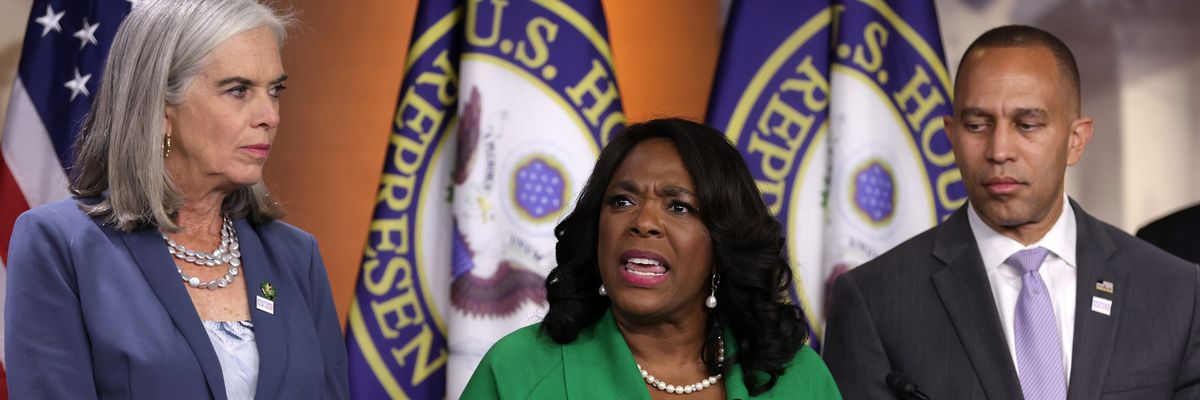
U.S. Rep. Terri Sewell (D-Ala.), flanked by House Minority Whip Katherine Clark (D-Mass.) and House Minority Leader Rep. Hakeem Jeffries (D-N.Y.), speaks at the U.S. Capitol in Washington, D.C. on September 19, 2023.
"It will take passage of the John R. Lewis Voting Rights Advancement Act to curb this new generation of assaults on the freedom to vote," said one campaigner.
Although it is nearly certain to go nowhere in a Republican-dominated U.S. House of Representatives, pro-democracy groups nationwide celebrated on Tuesday as Congresswoman Terri Sewell reintroduced the John R. Lewis Voting Rights Advancement Act.
"Generations of Americans—many in my hometown of Selma, Alabama—marched, fought, and even died for the equal right of all Americans to vote," Sewell (D-Ala.) said in a statement. "But today, their legacy and our very democracy are under attack as MAGA extremists target voters with new laws to restrict voting access."
"The fight for voting rights has never been more urgent," she argued, explaining that the legislation—named for the late Democratic Georgia congressman and civil rights leader—aims to restore and modernize the full protections of the Voting Rights Act of 1965 (VRA), which was gutted by the U.S. Supreme Court a decade ago in Shelby County v. Holder.
The bill is backed by every House Democrat but faces tough odds in both chambers. Early last year, Democratic right-wing Sen. Joe Manchin (W.Va.) and Sen. Kyrsten Sinema (Ariz.), who switched from Democrat to Independent in December, worked with Republicans to block a megabill that included the Freedom to Vote Act and the John Lewis legislation.
Still, U.S. advocacy groups on Tuesday applauded the lawmakers' renewed push for federal voting rights reforms—as they did in July, when Democratic leaders reintroduced the Freedom to Vote Act.
"The John Lewis Voting Rights Advancement Act is key in preserving democracy, full stop," declared Public Citizen executive vice president Lisa Gilbert. "A decade after the Supreme Court gutted 'preclearance' protection in the Voting Rights Act, more than half of U.S. states have passed over 90 laws that make it harder to vote for communities of color, in particular."
"Without this legislation, we risk further entrenching anti-democratic, partisan forces that want to choose their own voters," Gilbert warned.
According to the Declaration for American Democracy coalition:
In the last decade since the Shelby County v. Holder Supreme Court decision gutted key enforcement mechanisms in the Voting Rights Act, at least 29 states have passed 94 laws making it harder to vote, with at least 11 states enacting 13 restrictive voting laws in 2023 alone.
Attacks on our freedom to vote disproportionately impact Black, Latino, Asian, Native, and other voters of color. Since Shelby v. Holder, the racial turnout gap has grown significantly in 5 of the 6 states previously covered by the preclearance sections of the Voting Rights Act.
Sylvia Albert, Common Cause's director of voting and elections, stressed that "this ongoing effort to suppress the vote harkens back to the shameful Jim Crow era. At that time, it took the passage of the Voting Rights Act of 1965 and rigorous enforcement by the U.S. Department of Justice to curb the wholesale abuses and attacks on the freedom to vote."
"Today it will take passage of the John R. Lewis Voting Rights Advancement Act to curb this new generation of assaults on the freedom to vote and to strengthen the ability of the Department of Justice to protect that sacred freedom with the tools it used for decades," she asserted, specifically calling out Republican-controlled state legislatures that have tried "to silence Black and Brown voters after they showed up to vote in record numbers during the 2020 election."
Noting that the VRA "has a long history of bipartisan support," Leslie Proll of the Leadership Conference on Civil and Human Rights said: "We applaud our elected officials who have responded to the call of the majority of people in this country who support new legislation to protect the vote. We need federal action now."
Michael Waldman, president and CEO of the Brennan Center for Justice at New York University School of Law, also highlighted previous bipartisan support for the VRA, pointing out that "the last time the Voting Rights Act was reauthorized, in 2006, it gained 98 votes in the Senate." He called on Congress to swiftly pass the "urgently needed" John Lewis bill and the Freedom to Vote Act.
Organizations focused on key issues like abortion rights and the climate emergency also demanded action on the proposal.
"This legislation is long overdue," said a 15-member coalition that included Clean Water Action, Climate Hawks Vote, the Climate Reality Project, Earthjustice, EDF Action, Environmental Law & Policy Center, Greenpeace USA, Interfaith Power & Light, League of Conservation Voters, the National Wildlife Federation, NextGen America, Sierra Club, Union of Concerned Scientists, WE ACT for Environmental Justice, and Zero Hour.
"We cannot effectively tackle the critical issues our nation faces—like combating the climate crisis, advancing environmental justice, and protecting our air, lands, waters, biodiversity, wildlife, and oceans—without fixing the broken system that caters to corporate polluters and disenfranchises too many voters," the coalition argued.
Meanwhile, NARAL Pro-Choice America said on social media that "voting rights and reproductive freedom are deeply intertwined."
"Anti-abortion extremists attack voting rights knowing that it is critical to electing repro champions," the organization added. "Congress MUST pass the John Lewis Voting Rights Act."
Dear Common Dreams reader, It’s been nearly 30 years since I co-founded Common Dreams with my late wife, Lina Newhouser. We had the radical notion that journalism should serve the public good, not corporate profits. It was clear to us from the outset what it would take to build such a project. No paid advertisements. No corporate sponsors. No millionaire publisher telling us what to think or do. Many people said we wouldn't last a year, but we proved those doubters wrong. Together with a tremendous team of journalists and dedicated staff, we built an independent media outlet free from the constraints of profits and corporate control. Our mission has always been simple: To inform. To inspire. To ignite change for the common good. Building Common Dreams was not easy. Our survival was never guaranteed. When you take on the most powerful forces—Wall Street greed, fossil fuel industry destruction, Big Tech lobbyists, and uber-rich oligarchs who have spent billions upon billions rigging the economy and democracy in their favor—the only bulwark you have is supporters who believe in your work. But here’s the urgent message from me today. It's never been this bad out there. And it's never been this hard to keep us going. At the very moment Common Dreams is most needed, the threats we face are intensifying. We need your support now more than ever. We don't accept corporate advertising and never will. We don't have a paywall because we don't think people should be blocked from critical news based on their ability to pay. Everything we do is funded by the donations of readers like you. When everyone does the little they can afford, we are strong. But if that support retreats or dries up, so do we. Will you donate now to make sure Common Dreams not only survives but thrives? —Craig Brown, Co-founder |
Although it is nearly certain to go nowhere in a Republican-dominated U.S. House of Representatives, pro-democracy groups nationwide celebrated on Tuesday as Congresswoman Terri Sewell reintroduced the John R. Lewis Voting Rights Advancement Act.
"Generations of Americans—many in my hometown of Selma, Alabama—marched, fought, and even died for the equal right of all Americans to vote," Sewell (D-Ala.) said in a statement. "But today, their legacy and our very democracy are under attack as MAGA extremists target voters with new laws to restrict voting access."
"The fight for voting rights has never been more urgent," she argued, explaining that the legislation—named for the late Democratic Georgia congressman and civil rights leader—aims to restore and modernize the full protections of the Voting Rights Act of 1965 (VRA), which was gutted by the U.S. Supreme Court a decade ago in Shelby County v. Holder.
The bill is backed by every House Democrat but faces tough odds in both chambers. Early last year, Democratic right-wing Sen. Joe Manchin (W.Va.) and Sen. Kyrsten Sinema (Ariz.), who switched from Democrat to Independent in December, worked with Republicans to block a megabill that included the Freedom to Vote Act and the John Lewis legislation.
Still, U.S. advocacy groups on Tuesday applauded the lawmakers' renewed push for federal voting rights reforms—as they did in July, when Democratic leaders reintroduced the Freedom to Vote Act.
"The John Lewis Voting Rights Advancement Act is key in preserving democracy, full stop," declared Public Citizen executive vice president Lisa Gilbert. "A decade after the Supreme Court gutted 'preclearance' protection in the Voting Rights Act, more than half of U.S. states have passed over 90 laws that make it harder to vote for communities of color, in particular."
"Without this legislation, we risk further entrenching anti-democratic, partisan forces that want to choose their own voters," Gilbert warned.
According to the Declaration for American Democracy coalition:
In the last decade since the Shelby County v. Holder Supreme Court decision gutted key enforcement mechanisms in the Voting Rights Act, at least 29 states have passed 94 laws making it harder to vote, with at least 11 states enacting 13 restrictive voting laws in 2023 alone.
Attacks on our freedom to vote disproportionately impact Black, Latino, Asian, Native, and other voters of color. Since Shelby v. Holder, the racial turnout gap has grown significantly in 5 of the 6 states previously covered by the preclearance sections of the Voting Rights Act.
Sylvia Albert, Common Cause's director of voting and elections, stressed that "this ongoing effort to suppress the vote harkens back to the shameful Jim Crow era. At that time, it took the passage of the Voting Rights Act of 1965 and rigorous enforcement by the U.S. Department of Justice to curb the wholesale abuses and attacks on the freedom to vote."
"Today it will take passage of the John R. Lewis Voting Rights Advancement Act to curb this new generation of assaults on the freedom to vote and to strengthen the ability of the Department of Justice to protect that sacred freedom with the tools it used for decades," she asserted, specifically calling out Republican-controlled state legislatures that have tried "to silence Black and Brown voters after they showed up to vote in record numbers during the 2020 election."
Noting that the VRA "has a long history of bipartisan support," Leslie Proll of the Leadership Conference on Civil and Human Rights said: "We applaud our elected officials who have responded to the call of the majority of people in this country who support new legislation to protect the vote. We need federal action now."
Michael Waldman, president and CEO of the Brennan Center for Justice at New York University School of Law, also highlighted previous bipartisan support for the VRA, pointing out that "the last time the Voting Rights Act was reauthorized, in 2006, it gained 98 votes in the Senate." He called on Congress to swiftly pass the "urgently needed" John Lewis bill and the Freedom to Vote Act.
Organizations focused on key issues like abortion rights and the climate emergency also demanded action on the proposal.
"This legislation is long overdue," said a 15-member coalition that included Clean Water Action, Climate Hawks Vote, the Climate Reality Project, Earthjustice, EDF Action, Environmental Law & Policy Center, Greenpeace USA, Interfaith Power & Light, League of Conservation Voters, the National Wildlife Federation, NextGen America, Sierra Club, Union of Concerned Scientists, WE ACT for Environmental Justice, and Zero Hour.
"We cannot effectively tackle the critical issues our nation faces—like combating the climate crisis, advancing environmental justice, and protecting our air, lands, waters, biodiversity, wildlife, and oceans—without fixing the broken system that caters to corporate polluters and disenfranchises too many voters," the coalition argued.
Meanwhile, NARAL Pro-Choice America said on social media that "voting rights and reproductive freedom are deeply intertwined."
"Anti-abortion extremists attack voting rights knowing that it is critical to electing repro champions," the organization added. "Congress MUST pass the John Lewis Voting Rights Act."
Although it is nearly certain to go nowhere in a Republican-dominated U.S. House of Representatives, pro-democracy groups nationwide celebrated on Tuesday as Congresswoman Terri Sewell reintroduced the John R. Lewis Voting Rights Advancement Act.
"Generations of Americans—many in my hometown of Selma, Alabama—marched, fought, and even died for the equal right of all Americans to vote," Sewell (D-Ala.) said in a statement. "But today, their legacy and our very democracy are under attack as MAGA extremists target voters with new laws to restrict voting access."
"The fight for voting rights has never been more urgent," she argued, explaining that the legislation—named for the late Democratic Georgia congressman and civil rights leader—aims to restore and modernize the full protections of the Voting Rights Act of 1965 (VRA), which was gutted by the U.S. Supreme Court a decade ago in Shelby County v. Holder.
The bill is backed by every House Democrat but faces tough odds in both chambers. Early last year, Democratic right-wing Sen. Joe Manchin (W.Va.) and Sen. Kyrsten Sinema (Ariz.), who switched from Democrat to Independent in December, worked with Republicans to block a megabill that included the Freedom to Vote Act and the John Lewis legislation.
Still, U.S. advocacy groups on Tuesday applauded the lawmakers' renewed push for federal voting rights reforms—as they did in July, when Democratic leaders reintroduced the Freedom to Vote Act.
"The John Lewis Voting Rights Advancement Act is key in preserving democracy, full stop," declared Public Citizen executive vice president Lisa Gilbert. "A decade after the Supreme Court gutted 'preclearance' protection in the Voting Rights Act, more than half of U.S. states have passed over 90 laws that make it harder to vote for communities of color, in particular."
"Without this legislation, we risk further entrenching anti-democratic, partisan forces that want to choose their own voters," Gilbert warned.
According to the Declaration for American Democracy coalition:
In the last decade since the Shelby County v. Holder Supreme Court decision gutted key enforcement mechanisms in the Voting Rights Act, at least 29 states have passed 94 laws making it harder to vote, with at least 11 states enacting 13 restrictive voting laws in 2023 alone.
Attacks on our freedom to vote disproportionately impact Black, Latino, Asian, Native, and other voters of color. Since Shelby v. Holder, the racial turnout gap has grown significantly in 5 of the 6 states previously covered by the preclearance sections of the Voting Rights Act.
Sylvia Albert, Common Cause's director of voting and elections, stressed that "this ongoing effort to suppress the vote harkens back to the shameful Jim Crow era. At that time, it took the passage of the Voting Rights Act of 1965 and rigorous enforcement by the U.S. Department of Justice to curb the wholesale abuses and attacks on the freedom to vote."
"Today it will take passage of the John R. Lewis Voting Rights Advancement Act to curb this new generation of assaults on the freedom to vote and to strengthen the ability of the Department of Justice to protect that sacred freedom with the tools it used for decades," she asserted, specifically calling out Republican-controlled state legislatures that have tried "to silence Black and Brown voters after they showed up to vote in record numbers during the 2020 election."
Noting that the VRA "has a long history of bipartisan support," Leslie Proll of the Leadership Conference on Civil and Human Rights said: "We applaud our elected officials who have responded to the call of the majority of people in this country who support new legislation to protect the vote. We need federal action now."
Michael Waldman, president and CEO of the Brennan Center for Justice at New York University School of Law, also highlighted previous bipartisan support for the VRA, pointing out that "the last time the Voting Rights Act was reauthorized, in 2006, it gained 98 votes in the Senate." He called on Congress to swiftly pass the "urgently needed" John Lewis bill and the Freedom to Vote Act.
Organizations focused on key issues like abortion rights and the climate emergency also demanded action on the proposal.
"This legislation is long overdue," said a 15-member coalition that included Clean Water Action, Climate Hawks Vote, the Climate Reality Project, Earthjustice, EDF Action, Environmental Law & Policy Center, Greenpeace USA, Interfaith Power & Light, League of Conservation Voters, the National Wildlife Federation, NextGen America, Sierra Club, Union of Concerned Scientists, WE ACT for Environmental Justice, and Zero Hour.
"We cannot effectively tackle the critical issues our nation faces—like combating the climate crisis, advancing environmental justice, and protecting our air, lands, waters, biodiversity, wildlife, and oceans—without fixing the broken system that caters to corporate polluters and disenfranchises too many voters," the coalition argued.
Meanwhile, NARAL Pro-Choice America said on social media that "voting rights and reproductive freedom are deeply intertwined."
"Anti-abortion extremists attack voting rights knowing that it is critical to electing repro champions," the organization added. "Congress MUST pass the John Lewis Voting Rights Act."