SUBSCRIBE TO OUR FREE NEWSLETTER
Daily news & progressive opinion—funded by the people, not the corporations—delivered straight to your inbox.
5
#000000
#FFFFFF
To donate by check, phone, or other method, see our More Ways to Give page.
Daily news & progressive opinion—funded by the people, not the corporations—delivered straight to your inbox.
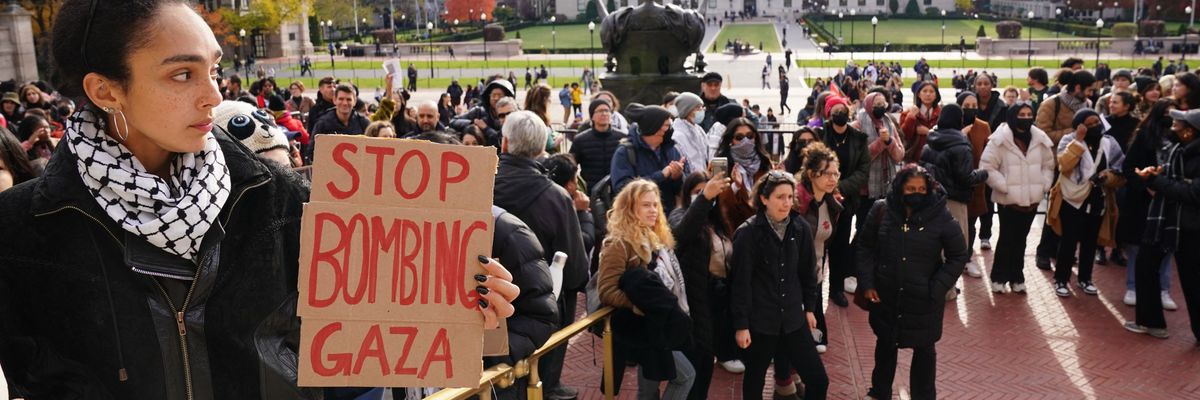
Peaceful, intensely determined protesters, demanding their institutions divest from the Israeli war machine, face violent resistance from police.
Peaceful protest, violent response—that says it all.
Human politics—from global to local—remain mixed with hatred, dominance and... well, dehumanization. We've organized ourselves across the planet around one primary principle: the existence of an enemy. The division between "us" and "them" can be based on anything: a difference in race, language, culture—or simply a difference of opinion, which is beginning to happen on campuses across the country, as peaceful, intensely determined protesters, demanding their institutions divest from the Israeli war machine, face violent resistance from police and/or counter-protesters.
Yes, the peaceful protesters are interrupting the status quo—setting up encampments, even occupying university buildings. For instance, at Columbia University, students actually renamed the occupied Hamilton Hall, declaring its new name to be Hind's Hall, after Hind Rajab, a 6-year-old Palestinian girl killed by Israeli armed forces, along with the rest of her family (and several aid workers), as they were fleeing their home in Gaza. The point of the protests is, indeed, to change the world: to stop U.S., including university, support of the devastating "war" (i.e., carnage). They’re not trying to eliminate an enemy but, rather, illuminate the situation—putting themselves on the line to do so.
Some of the responses to the protests are definitely illuminating. A statement from UCLA's Palestine Solidarity Encampment, for instance, noted:
The life-threatening assault we face tonight is nothing less than a horrifying, despicable act of terror. For over seven hours, Zionist aggressors hurled gas canisters, sprayed pepper spray, and threw fireworks and bricks into our encampment. They broke our barriers repeatedly, clearly in an attempt to kill us.
Furthermore, the account continued: "Campus safety left within minutes, external security the university hired for 'backup' watched, filmed, and laughed on the side as the immediate danger inflicted upon us escalated. Law enforcement simply stood at the edge of the lawn and refused to budge as we screamed for their help. . . .
"The university would rather see us dead than divest."
In other words, those damn students are the enemy. Even when the response to the protests isn't outright violence, it's often rhetorically violent, such as GOP Sen. Marsha Blackburn of Tennessee calling the protesters terrorists and declaring that "any student who has promoted terrorism or engaged in terrorist acts on behalf of Hamas should be immediately added to the terrorist watch list and placed on the [Transportation Security Administration] no-fly list."
This is utterly linear, minimalist thinking. Critics aren't engaging in a debate on the nature (and necessity) of war, plunging, with the protesters, into a complex discussion of global politics, military industrialism, and the morality of killing. That's too much trouble! They're simply calling the outraged protesters "the enemy"—just a bunch of terrorists, same as Hamas. And yeah, no doubt part of that good old Axis of Evil.
This is the thinking the protesters are trying to disrupt! Alas, it's also solidly part of the infrastructure of the status quo. Militarism is baked into the American core. When we're not waging our own wars, we're enabling various allies to do so.
As Heidi Peltier, writing at Brown University's Costs of War Project, points out, regarding this country's annual budget of nearly $2 trillion: "Almost half of the U.S. federal discretionary budget is allocated to the Department of Defense and more than half of the discretionary budget goes to 'defense' overall, which includes not only the Pentagon but also nuclear weapons programs within the Department of Energy and additional defense spending in other departments."
"As a result, other elements and capacities of the U.S. government and civilian economy have been weakened, and military industries have gained political power," Peltier continued. "Decades of high levels of military spending have changed U.S. government and society— strengthening its ability to fight wars, while weakening its capacities to perform other core functions. Investments in infrastructure, healthcare, education, and emergency preparedness, for instance, have all suffered as military spending and industry have crowded them out."
The campus protests around the country, at which, so far, more than 1,000 students have been arrested, primarily address the twisted irony of money. Universities have multi-billion-dollar endowments—donation money—which they then invest in the stock market, in various companies, including... well, yeah, weapons manufacturers, like Lockheed Martin, Boeing, Raytheon, General Dynamics, Northrop Grumman, and many more. Oh, the mysterious, ironic flow of money!
At New York University, a spokesman there informed protesting students that the university is not divesting from such companies because it needs to maximize its investment returns in order to "help the university fulfill its research and educational mission." You know, to bring truth and knowledge into the world—for the sake, among others, of the protesters themselves.
American college students are facing this irony head-on—at a personal cost. But the cost, as they say, is minimal, compared to the one being paid by Palestinians, and by victims of war all around the world.
Dear Common Dreams reader, It’s been nearly 30 years since I co-founded Common Dreams with my late wife, Lina Newhouser. We had the radical notion that journalism should serve the public good, not corporate profits. It was clear to us from the outset what it would take to build such a project. No paid advertisements. No corporate sponsors. No millionaire publisher telling us what to think or do. Many people said we wouldn't last a year, but we proved those doubters wrong. Together with a tremendous team of journalists and dedicated staff, we built an independent media outlet free from the constraints of profits and corporate control. Our mission has always been simple: To inform. To inspire. To ignite change for the common good. Building Common Dreams was not easy. Our survival was never guaranteed. When you take on the most powerful forces—Wall Street greed, fossil fuel industry destruction, Big Tech lobbyists, and uber-rich oligarchs who have spent billions upon billions rigging the economy and democracy in their favor—the only bulwark you have is supporters who believe in your work. But here’s the urgent message from me today. It's never been this bad out there. And it's never been this hard to keep us going. At the very moment Common Dreams is most needed, the threats we face are intensifying. We need your support now more than ever. We don't accept corporate advertising and never will. We don't have a paywall because we don't think people should be blocked from critical news based on their ability to pay. Everything we do is funded by the donations of readers like you. When everyone does the little they can afford, we are strong. But if that support retreats or dries up, so do we. Will you donate now to make sure Common Dreams not only survives but thrives? —Craig Brown, Co-founder |
Peaceful protest, violent response—that says it all.
Human politics—from global to local—remain mixed with hatred, dominance and... well, dehumanization. We've organized ourselves across the planet around one primary principle: the existence of an enemy. The division between "us" and "them" can be based on anything: a difference in race, language, culture—or simply a difference of opinion, which is beginning to happen on campuses across the country, as peaceful, intensely determined protesters, demanding their institutions divest from the Israeli war machine, face violent resistance from police and/or counter-protesters.
Yes, the peaceful protesters are interrupting the status quo—setting up encampments, even occupying university buildings. For instance, at Columbia University, students actually renamed the occupied Hamilton Hall, declaring its new name to be Hind's Hall, after Hind Rajab, a 6-year-old Palestinian girl killed by Israeli armed forces, along with the rest of her family (and several aid workers), as they were fleeing their home in Gaza. The point of the protests is, indeed, to change the world: to stop U.S., including university, support of the devastating "war" (i.e., carnage). They’re not trying to eliminate an enemy but, rather, illuminate the situation—putting themselves on the line to do so.
Some of the responses to the protests are definitely illuminating. A statement from UCLA's Palestine Solidarity Encampment, for instance, noted:
The life-threatening assault we face tonight is nothing less than a horrifying, despicable act of terror. For over seven hours, Zionist aggressors hurled gas canisters, sprayed pepper spray, and threw fireworks and bricks into our encampment. They broke our barriers repeatedly, clearly in an attempt to kill us.
Furthermore, the account continued: "Campus safety left within minutes, external security the university hired for 'backup' watched, filmed, and laughed on the side as the immediate danger inflicted upon us escalated. Law enforcement simply stood at the edge of the lawn and refused to budge as we screamed for their help. . . .
"The university would rather see us dead than divest."
In other words, those damn students are the enemy. Even when the response to the protests isn't outright violence, it's often rhetorically violent, such as GOP Sen. Marsha Blackburn of Tennessee calling the protesters terrorists and declaring that "any student who has promoted terrorism or engaged in terrorist acts on behalf of Hamas should be immediately added to the terrorist watch list and placed on the [Transportation Security Administration] no-fly list."
This is utterly linear, minimalist thinking. Critics aren't engaging in a debate on the nature (and necessity) of war, plunging, with the protesters, into a complex discussion of global politics, military industrialism, and the morality of killing. That's too much trouble! They're simply calling the outraged protesters "the enemy"—just a bunch of terrorists, same as Hamas. And yeah, no doubt part of that good old Axis of Evil.
This is the thinking the protesters are trying to disrupt! Alas, it's also solidly part of the infrastructure of the status quo. Militarism is baked into the American core. When we're not waging our own wars, we're enabling various allies to do so.
As Heidi Peltier, writing at Brown University's Costs of War Project, points out, regarding this country's annual budget of nearly $2 trillion: "Almost half of the U.S. federal discretionary budget is allocated to the Department of Defense and more than half of the discretionary budget goes to 'defense' overall, which includes not only the Pentagon but also nuclear weapons programs within the Department of Energy and additional defense spending in other departments."
"As a result, other elements and capacities of the U.S. government and civilian economy have been weakened, and military industries have gained political power," Peltier continued. "Decades of high levels of military spending have changed U.S. government and society— strengthening its ability to fight wars, while weakening its capacities to perform other core functions. Investments in infrastructure, healthcare, education, and emergency preparedness, for instance, have all suffered as military spending and industry have crowded them out."
The campus protests around the country, at which, so far, more than 1,000 students have been arrested, primarily address the twisted irony of money. Universities have multi-billion-dollar endowments—donation money—which they then invest in the stock market, in various companies, including... well, yeah, weapons manufacturers, like Lockheed Martin, Boeing, Raytheon, General Dynamics, Northrop Grumman, and many more. Oh, the mysterious, ironic flow of money!
At New York University, a spokesman there informed protesting students that the university is not divesting from such companies because it needs to maximize its investment returns in order to "help the university fulfill its research and educational mission." You know, to bring truth and knowledge into the world—for the sake, among others, of the protesters themselves.
American college students are facing this irony head-on—at a personal cost. But the cost, as they say, is minimal, compared to the one being paid by Palestinians, and by victims of war all around the world.
Peaceful protest, violent response—that says it all.
Human politics—from global to local—remain mixed with hatred, dominance and... well, dehumanization. We've organized ourselves across the planet around one primary principle: the existence of an enemy. The division between "us" and "them" can be based on anything: a difference in race, language, culture—or simply a difference of opinion, which is beginning to happen on campuses across the country, as peaceful, intensely determined protesters, demanding their institutions divest from the Israeli war machine, face violent resistance from police and/or counter-protesters.
Yes, the peaceful protesters are interrupting the status quo—setting up encampments, even occupying university buildings. For instance, at Columbia University, students actually renamed the occupied Hamilton Hall, declaring its new name to be Hind's Hall, after Hind Rajab, a 6-year-old Palestinian girl killed by Israeli armed forces, along with the rest of her family (and several aid workers), as they were fleeing their home in Gaza. The point of the protests is, indeed, to change the world: to stop U.S., including university, support of the devastating "war" (i.e., carnage). They’re not trying to eliminate an enemy but, rather, illuminate the situation—putting themselves on the line to do so.
Some of the responses to the protests are definitely illuminating. A statement from UCLA's Palestine Solidarity Encampment, for instance, noted:
The life-threatening assault we face tonight is nothing less than a horrifying, despicable act of terror. For over seven hours, Zionist aggressors hurled gas canisters, sprayed pepper spray, and threw fireworks and bricks into our encampment. They broke our barriers repeatedly, clearly in an attempt to kill us.
Furthermore, the account continued: "Campus safety left within minutes, external security the university hired for 'backup' watched, filmed, and laughed on the side as the immediate danger inflicted upon us escalated. Law enforcement simply stood at the edge of the lawn and refused to budge as we screamed for their help. . . .
"The university would rather see us dead than divest."
In other words, those damn students are the enemy. Even when the response to the protests isn't outright violence, it's often rhetorically violent, such as GOP Sen. Marsha Blackburn of Tennessee calling the protesters terrorists and declaring that "any student who has promoted terrorism or engaged in terrorist acts on behalf of Hamas should be immediately added to the terrorist watch list and placed on the [Transportation Security Administration] no-fly list."
This is utterly linear, minimalist thinking. Critics aren't engaging in a debate on the nature (and necessity) of war, plunging, with the protesters, into a complex discussion of global politics, military industrialism, and the morality of killing. That's too much trouble! They're simply calling the outraged protesters "the enemy"—just a bunch of terrorists, same as Hamas. And yeah, no doubt part of that good old Axis of Evil.
This is the thinking the protesters are trying to disrupt! Alas, it's also solidly part of the infrastructure of the status quo. Militarism is baked into the American core. When we're not waging our own wars, we're enabling various allies to do so.
As Heidi Peltier, writing at Brown University's Costs of War Project, points out, regarding this country's annual budget of nearly $2 trillion: "Almost half of the U.S. federal discretionary budget is allocated to the Department of Defense and more than half of the discretionary budget goes to 'defense' overall, which includes not only the Pentagon but also nuclear weapons programs within the Department of Energy and additional defense spending in other departments."
"As a result, other elements and capacities of the U.S. government and civilian economy have been weakened, and military industries have gained political power," Peltier continued. "Decades of high levels of military spending have changed U.S. government and society— strengthening its ability to fight wars, while weakening its capacities to perform other core functions. Investments in infrastructure, healthcare, education, and emergency preparedness, for instance, have all suffered as military spending and industry have crowded them out."
The campus protests around the country, at which, so far, more than 1,000 students have been arrested, primarily address the twisted irony of money. Universities have multi-billion-dollar endowments—donation money—which they then invest in the stock market, in various companies, including... well, yeah, weapons manufacturers, like Lockheed Martin, Boeing, Raytheon, General Dynamics, Northrop Grumman, and many more. Oh, the mysterious, ironic flow of money!
At New York University, a spokesman there informed protesting students that the university is not divesting from such companies because it needs to maximize its investment returns in order to "help the university fulfill its research and educational mission." You know, to bring truth and knowledge into the world—for the sake, among others, of the protesters themselves.
American college students are facing this irony head-on—at a personal cost. But the cost, as they say, is minimal, compared to the one being paid by Palestinians, and by victims of war all around the world.