5
#000000
#FFFFFF
To donate by check, phone, or other method, see our More Ways to Give page.
Daily news & progressive opinion—funded by the people, not the corporations—delivered straight to your inbox.
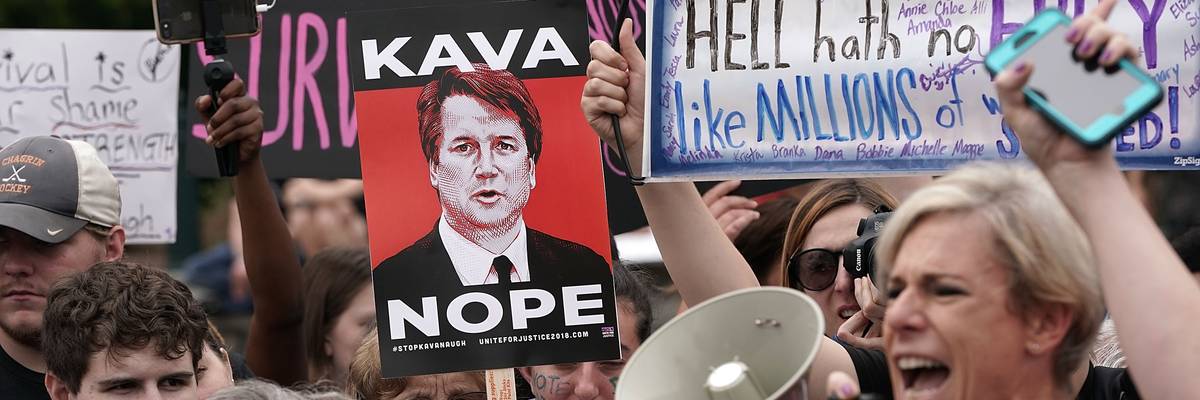
Protesters rally against the confirmation of Supreme Court nominee Judge Brett Kavanaugh, outside of the Supreme Court, on October 6, 2018 in Washington, DC.
It’s frightening but indisputable: The future of American law may rest in his ideological, incompetent hands.
If I asked you to name the most unpopular Supreme Court justice, you might choose the venal Clarence Thomas or the perpetually enraged Samuel Alito. In either event, you’d be wrong. Americans’ least popular member of the high tribunal is Brett “I like beer” Kavanaugh. Poll after poll has shown Kavanaugh taking the honor since his nomination in 2018.
Kavanaugh also holds the honor of being President Donald Trump’s favorite justice, an accolade he earned with his dissenting opinion from the court’s February invalidation of Trump’s worldwide “reciprocal tariffs.” Kavanaugh is now poised to deliberate on pending voting rights cases and a ruling on birthright citizenship under the 14th Amendment. It’s frightening but indisputable: The future of American law may rest in his ideological, incompetent hands.
Kavanaugh’s initial low public standing stemmed from his snarling televised response to the testimony of psychologist Cristine Blasey Ford, who credibly accused him during his confirmation hearing of sexually assaulting her at a boozy high school party. Declaring his innocence and choking back tears, Kavanaugh described the allegations as “a calculated and orchestrated political hit, fueled with apparent pent-up anger about President Trump [and] millions of dollars in money from outside left-wing opposition groups.” Trump quickly came to his embattled nominee’s rescue in a tweet posted hours after the hearing, calling his testimony “powerful, honest, and riveting.”
Long before Senate Republicans approved his nomination by a vote of 50-48, Kavanaugh had built a well-earned reputation as a credentialed and loyal Republican hitman, highlighted by his decision to join Ken Starr’s Office of Independent Counsel in 1997 to assist in the investigations that eventually led to the impeachment of President Bill Clinton.
Since taking his place on the Supreme Court, Kavanaugh has proven a reliable Trump flunky. But unlike Thomas and Alito, he’s also proven to be an intellectual lightweight.
While in Starr’s service, Kavanaugh penned a lurid memorandum that suggested 10 questions for prosecutors to ask Clinton about his relationship with Monica Lewinsky when he testified before a federal grand jury. Among them:
After a brief stint in private practice, Kavanaugh joined the GOP’s legal team in the run-up to the Supreme Court’s infamous Bush v. Gore decision, which handed the presidency to George W. Bush. In 2001, he was rewarded with an associate’s position in the White House counsel’s office, and two years later he was nominated to the US Court of Appeals for the District of Columbia Circuit.
Senate Democrats were alarmed at the thought of an enrobed Kavanaugh, and they managed to put the nominee through two confirmation hearings. “As I look through all of the different issues that you have been involved in as an attorney in public service and the private sector, it seems that you are the Zelig or Forrest Gump of Republican politics,” the normally mild-mannered Sen. Dick Durbin (D-Ill.) remarked in 2004. “You show up at every scene of the crime. You are somehow or another deeply involved, whether it is Elian Gonzalez or the Starr Report, you are there.” In the end, the Democrats failed to stop Kavanaugh’s confirmation in 2006.
During his 12 years on the circuit court, Kavanaugh won praise from right-wing advocacy organizations for a record of overtly pro-business rulings that routinely undercut federal regulations on air quality, consumer protections, and other issues.
Since taking his place on the Supreme Court, Kavanaugh has proven a reliable Trump flunky. But unlike Thomas and Alito, he’s also proven to be an intellectual lightweight, penning few consequential majority opinions of his own and generally following the lead of Chief Justice John Roberts, with whom he voted more than 95% of the time in his first few years on the court.
Recently, however, Kavanaugh has begun to break with Roberts to more closely align with Trump—sometimes to comical effects.
Consider the interim “shadow docket” ruling issued last September, Noem v. Perdomo. The court’s decision lifted a lower-court injunction that had barred Immigration and Customs Enforcement (ICE) agents in Los Angeles from detaining suspected undocumented immigrants based solely on their ethnicity, language, geographic location, and occupations. Like most shadow docket decisions, the Perdomo order was bare-bones, comprising a single paragraph that failed to explain the court’s rationale, but permitted litigation to continue in the lower courts. Kavanaugh, however, took it upon himself to write a 10-page concurrence filled with misstatements of fact and law, in which he argued without evidence that because 10% of people in the Los Angeles region are illegally present, the “totality of circumstances”—including race, location, and language—indicated a high probability that such stops would enable ICE to fulfill its important core mission.
He also added, again without evidence, that any such detentions would be basically benign, reasoning:
The Government sometimes makes brief investigative stops to check the immigration status of those who gather in locations where people are hired for day jobs; who work or appear to work in jobs such as construction, landscaping, agriculture, or car washes that often do not require paperwork and are therefore attractive to illegal immigrants; and who do not speak much if any English. If the officers learn that the individual they stopped is a US citizen or otherwise lawfully in the United States, they promptly let the individual go.
The concurrence was widely panned as authorizing violations of the Fourth Amendment’s requirements of individualized suspicion and probable cause—which soon became known as “Kavanaugh stops.” The criticism became so intense that Kavanaugh was compelled to add a footnote to his concurring opinion in the court’s December shadow docket ruling that struck down the deployment of the National Guard in Chicago (Trump v. Illinois). “The Fourth Amendment requires,” he wrote,
that immigration stops must be based on reasonable suspicion of illegal presence, stops must be brief, arrests must be based on probable cause, and officers must not employ excessive force. Moreover, the officers must not make interior immigration stops or arrests based on race or ethnicity.
The mea culpa did little to restore Kavanaugh’s jurisprudential standing or dignity. In February, his career hit a humiliating low when Chief Justice Roberts publicly rebuked him for essentially cutting and pasting the Trump administration’s arguments for tariffs into his dissenting opinion.
It’s not easy to imagine Kavanaugh sinking much lower than he already has, but one thing remains constant: Trump’s favorite Supreme Court justice has no business casting votes on the most powerful judicial body in the world.
Dear Common Dreams reader, It’s been nearly 30 years since I co-founded Common Dreams with my late wife, Lina Newhouser. We had the radical notion that journalism should serve the public good, not corporate profits. It was clear to us from the outset what it would take to build such a project. No paid advertisements. No corporate sponsors. No millionaire publisher telling us what to think or do. Many people said we wouldn't last a year, but we proved those doubters wrong. Together with a tremendous team of journalists and dedicated staff, we built an independent media outlet free from the constraints of profits and corporate control. Our mission has always been simple: To inform. To inspire. To ignite change for the common good. Building Common Dreams was not easy. Our survival was never guaranteed. When you take on the most powerful forces—Wall Street greed, fossil fuel industry destruction, Big Tech lobbyists, and uber-rich oligarchs who have spent billions upon billions rigging the economy and democracy in their favor—the only bulwark you have is supporters who believe in your work. But here’s the urgent message from me today. It's never been this bad out there. And it's never been this hard to keep us going. At the very moment Common Dreams is most needed, the threats we face are intensifying. We need your support now more than ever. We don't accept corporate advertising and never will. We don't have a paywall because we don't think people should be blocked from critical news based on their ability to pay. Everything we do is funded by the donations of readers like you. When everyone does the little they can afford, we are strong. But if that support retreats or dries up, so do we. Will you donate now to make sure Common Dreams not only survives but thrives? —Craig Brown, Co-founder |
If I asked you to name the most unpopular Supreme Court justice, you might choose the venal Clarence Thomas or the perpetually enraged Samuel Alito. In either event, you’d be wrong. Americans’ least popular member of the high tribunal is Brett “I like beer” Kavanaugh. Poll after poll has shown Kavanaugh taking the honor since his nomination in 2018.
Kavanaugh also holds the honor of being President Donald Trump’s favorite justice, an accolade he earned with his dissenting opinion from the court’s February invalidation of Trump’s worldwide “reciprocal tariffs.” Kavanaugh is now poised to deliberate on pending voting rights cases and a ruling on birthright citizenship under the 14th Amendment. It’s frightening but indisputable: The future of American law may rest in his ideological, incompetent hands.
Kavanaugh’s initial low public standing stemmed from his snarling televised response to the testimony of psychologist Cristine Blasey Ford, who credibly accused him during his confirmation hearing of sexually assaulting her at a boozy high school party. Declaring his innocence and choking back tears, Kavanaugh described the allegations as “a calculated and orchestrated political hit, fueled with apparent pent-up anger about President Trump [and] millions of dollars in money from outside left-wing opposition groups.” Trump quickly came to his embattled nominee’s rescue in a tweet posted hours after the hearing, calling his testimony “powerful, honest, and riveting.”
Long before Senate Republicans approved his nomination by a vote of 50-48, Kavanaugh had built a well-earned reputation as a credentialed and loyal Republican hitman, highlighted by his decision to join Ken Starr’s Office of Independent Counsel in 1997 to assist in the investigations that eventually led to the impeachment of President Bill Clinton.
Since taking his place on the Supreme Court, Kavanaugh has proven a reliable Trump flunky. But unlike Thomas and Alito, he’s also proven to be an intellectual lightweight.
While in Starr’s service, Kavanaugh penned a lurid memorandum that suggested 10 questions for prosecutors to ask Clinton about his relationship with Monica Lewinsky when he testified before a federal grand jury. Among them:
After a brief stint in private practice, Kavanaugh joined the GOP’s legal team in the run-up to the Supreme Court’s infamous Bush v. Gore decision, which handed the presidency to George W. Bush. In 2001, he was rewarded with an associate’s position in the White House counsel’s office, and two years later he was nominated to the US Court of Appeals for the District of Columbia Circuit.
Senate Democrats were alarmed at the thought of an enrobed Kavanaugh, and they managed to put the nominee through two confirmation hearings. “As I look through all of the different issues that you have been involved in as an attorney in public service and the private sector, it seems that you are the Zelig or Forrest Gump of Republican politics,” the normally mild-mannered Sen. Dick Durbin (D-Ill.) remarked in 2004. “You show up at every scene of the crime. You are somehow or another deeply involved, whether it is Elian Gonzalez or the Starr Report, you are there.” In the end, the Democrats failed to stop Kavanaugh’s confirmation in 2006.
During his 12 years on the circuit court, Kavanaugh won praise from right-wing advocacy organizations for a record of overtly pro-business rulings that routinely undercut federal regulations on air quality, consumer protections, and other issues.
Since taking his place on the Supreme Court, Kavanaugh has proven a reliable Trump flunky. But unlike Thomas and Alito, he’s also proven to be an intellectual lightweight, penning few consequential majority opinions of his own and generally following the lead of Chief Justice John Roberts, with whom he voted more than 95% of the time in his first few years on the court.
Recently, however, Kavanaugh has begun to break with Roberts to more closely align with Trump—sometimes to comical effects.
Consider the interim “shadow docket” ruling issued last September, Noem v. Perdomo. The court’s decision lifted a lower-court injunction that had barred Immigration and Customs Enforcement (ICE) agents in Los Angeles from detaining suspected undocumented immigrants based solely on their ethnicity, language, geographic location, and occupations. Like most shadow docket decisions, the Perdomo order was bare-bones, comprising a single paragraph that failed to explain the court’s rationale, but permitted litigation to continue in the lower courts. Kavanaugh, however, took it upon himself to write a 10-page concurrence filled with misstatements of fact and law, in which he argued without evidence that because 10% of people in the Los Angeles region are illegally present, the “totality of circumstances”—including race, location, and language—indicated a high probability that such stops would enable ICE to fulfill its important core mission.
He also added, again without evidence, that any such detentions would be basically benign, reasoning:
The Government sometimes makes brief investigative stops to check the immigration status of those who gather in locations where people are hired for day jobs; who work or appear to work in jobs such as construction, landscaping, agriculture, or car washes that often do not require paperwork and are therefore attractive to illegal immigrants; and who do not speak much if any English. If the officers learn that the individual they stopped is a US citizen or otherwise lawfully in the United States, they promptly let the individual go.
The concurrence was widely panned as authorizing violations of the Fourth Amendment’s requirements of individualized suspicion and probable cause—which soon became known as “Kavanaugh stops.” The criticism became so intense that Kavanaugh was compelled to add a footnote to his concurring opinion in the court’s December shadow docket ruling that struck down the deployment of the National Guard in Chicago (Trump v. Illinois). “The Fourth Amendment requires,” he wrote,
that immigration stops must be based on reasonable suspicion of illegal presence, stops must be brief, arrests must be based on probable cause, and officers must not employ excessive force. Moreover, the officers must not make interior immigration stops or arrests based on race or ethnicity.
The mea culpa did little to restore Kavanaugh’s jurisprudential standing or dignity. In February, his career hit a humiliating low when Chief Justice Roberts publicly rebuked him for essentially cutting and pasting the Trump administration’s arguments for tariffs into his dissenting opinion.
It’s not easy to imagine Kavanaugh sinking much lower than he already has, but one thing remains constant: Trump’s favorite Supreme Court justice has no business casting votes on the most powerful judicial body in the world.
If I asked you to name the most unpopular Supreme Court justice, you might choose the venal Clarence Thomas or the perpetually enraged Samuel Alito. In either event, you’d be wrong. Americans’ least popular member of the high tribunal is Brett “I like beer” Kavanaugh. Poll after poll has shown Kavanaugh taking the honor since his nomination in 2018.
Kavanaugh also holds the honor of being President Donald Trump’s favorite justice, an accolade he earned with his dissenting opinion from the court’s February invalidation of Trump’s worldwide “reciprocal tariffs.” Kavanaugh is now poised to deliberate on pending voting rights cases and a ruling on birthright citizenship under the 14th Amendment. It’s frightening but indisputable: The future of American law may rest in his ideological, incompetent hands.
Kavanaugh’s initial low public standing stemmed from his snarling televised response to the testimony of psychologist Cristine Blasey Ford, who credibly accused him during his confirmation hearing of sexually assaulting her at a boozy high school party. Declaring his innocence and choking back tears, Kavanaugh described the allegations as “a calculated and orchestrated political hit, fueled with apparent pent-up anger about President Trump [and] millions of dollars in money from outside left-wing opposition groups.” Trump quickly came to his embattled nominee’s rescue in a tweet posted hours after the hearing, calling his testimony “powerful, honest, and riveting.”
Long before Senate Republicans approved his nomination by a vote of 50-48, Kavanaugh had built a well-earned reputation as a credentialed and loyal Republican hitman, highlighted by his decision to join Ken Starr’s Office of Independent Counsel in 1997 to assist in the investigations that eventually led to the impeachment of President Bill Clinton.
Since taking his place on the Supreme Court, Kavanaugh has proven a reliable Trump flunky. But unlike Thomas and Alito, he’s also proven to be an intellectual lightweight.
While in Starr’s service, Kavanaugh penned a lurid memorandum that suggested 10 questions for prosecutors to ask Clinton about his relationship with Monica Lewinsky when he testified before a federal grand jury. Among them:
After a brief stint in private practice, Kavanaugh joined the GOP’s legal team in the run-up to the Supreme Court’s infamous Bush v. Gore decision, which handed the presidency to George W. Bush. In 2001, he was rewarded with an associate’s position in the White House counsel’s office, and two years later he was nominated to the US Court of Appeals for the District of Columbia Circuit.
Senate Democrats were alarmed at the thought of an enrobed Kavanaugh, and they managed to put the nominee through two confirmation hearings. “As I look through all of the different issues that you have been involved in as an attorney in public service and the private sector, it seems that you are the Zelig or Forrest Gump of Republican politics,” the normally mild-mannered Sen. Dick Durbin (D-Ill.) remarked in 2004. “You show up at every scene of the crime. You are somehow or another deeply involved, whether it is Elian Gonzalez or the Starr Report, you are there.” In the end, the Democrats failed to stop Kavanaugh’s confirmation in 2006.
During his 12 years on the circuit court, Kavanaugh won praise from right-wing advocacy organizations for a record of overtly pro-business rulings that routinely undercut federal regulations on air quality, consumer protections, and other issues.
Since taking his place on the Supreme Court, Kavanaugh has proven a reliable Trump flunky. But unlike Thomas and Alito, he’s also proven to be an intellectual lightweight, penning few consequential majority opinions of his own and generally following the lead of Chief Justice John Roberts, with whom he voted more than 95% of the time in his first few years on the court.
Recently, however, Kavanaugh has begun to break with Roberts to more closely align with Trump—sometimes to comical effects.
Consider the interim “shadow docket” ruling issued last September, Noem v. Perdomo. The court’s decision lifted a lower-court injunction that had barred Immigration and Customs Enforcement (ICE) agents in Los Angeles from detaining suspected undocumented immigrants based solely on their ethnicity, language, geographic location, and occupations. Like most shadow docket decisions, the Perdomo order was bare-bones, comprising a single paragraph that failed to explain the court’s rationale, but permitted litigation to continue in the lower courts. Kavanaugh, however, took it upon himself to write a 10-page concurrence filled with misstatements of fact and law, in which he argued without evidence that because 10% of people in the Los Angeles region are illegally present, the “totality of circumstances”—including race, location, and language—indicated a high probability that such stops would enable ICE to fulfill its important core mission.
He also added, again without evidence, that any such detentions would be basically benign, reasoning:
The Government sometimes makes brief investigative stops to check the immigration status of those who gather in locations where people are hired for day jobs; who work or appear to work in jobs such as construction, landscaping, agriculture, or car washes that often do not require paperwork and are therefore attractive to illegal immigrants; and who do not speak much if any English. If the officers learn that the individual they stopped is a US citizen or otherwise lawfully in the United States, they promptly let the individual go.
The concurrence was widely panned as authorizing violations of the Fourth Amendment’s requirements of individualized suspicion and probable cause—which soon became known as “Kavanaugh stops.” The criticism became so intense that Kavanaugh was compelled to add a footnote to his concurring opinion in the court’s December shadow docket ruling that struck down the deployment of the National Guard in Chicago (Trump v. Illinois). “The Fourth Amendment requires,” he wrote,
that immigration stops must be based on reasonable suspicion of illegal presence, stops must be brief, arrests must be based on probable cause, and officers must not employ excessive force. Moreover, the officers must not make interior immigration stops or arrests based on race or ethnicity.
The mea culpa did little to restore Kavanaugh’s jurisprudential standing or dignity. In February, his career hit a humiliating low when Chief Justice Roberts publicly rebuked him for essentially cutting and pasting the Trump administration’s arguments for tariffs into his dissenting opinion.
It’s not easy to imagine Kavanaugh sinking much lower than he already has, but one thing remains constant: Trump’s favorite Supreme Court justice has no business casting votes on the most powerful judicial body in the world.