SUBSCRIBE TO OUR FREE NEWSLETTER
Daily news & progressive opinion—funded by the people, not the corporations—delivered straight to your inbox.
5
#000000
#FFFFFF
To donate by check, phone, or other method, see our More Ways to Give page.
Daily news & progressive opinion—funded by the people, not the corporations—delivered straight to your inbox.
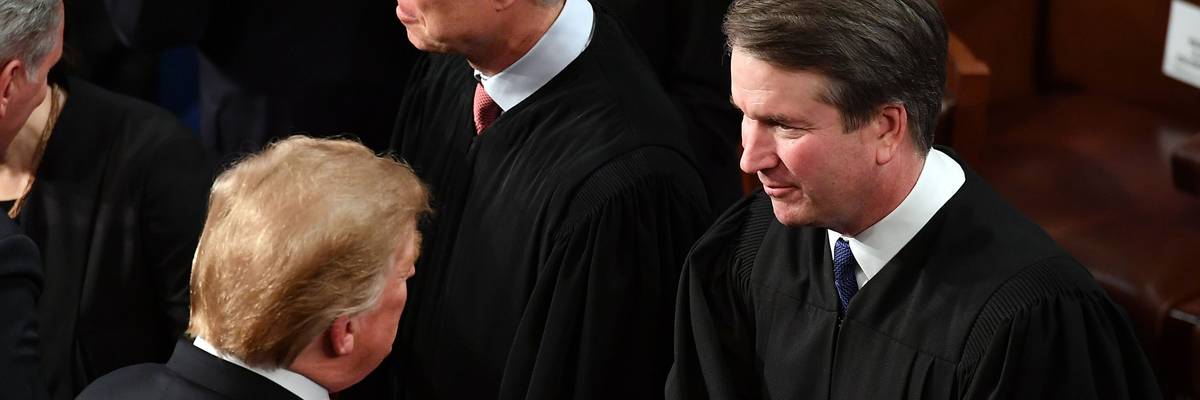
U.S. President Donald Trump shakes hands with Supreme Court Justice Brett Kavanaugh before delivering the State of the Union address in Washington, D.C., on February 5, 2019.
"The Trump White House exercised total control over the scope of the investigation, preventing the FBI from interviewing relevant witnesses and following up on tips," reads a new report.
"Our suspicions are confirmed," said one veteran women's rights advocate on Tuesday after a U.S. Senate report was released on former Republican President Donald Trump's suppression of a federal probe into Supreme Court Justice Brett Kavanaugh.
Sen. Sheldon Whitehouse (D-R.I.) released a report after an investigation that he said took six years to complete due to a lack of access to Federal Bureau of Investigation correspondence and officials, but that ultimately revealed the Trump White House "exercised total control over the scope" of the FBI's investigation into allegations that Kavanaugh had committed sexual assault.
The report was released as U.S. voters in some states have already begun heading to the polls to vote in the 2024 election, in which Trump is running for a second term.
Whitehouse launched his investigation in 2018 after Kavanaugh was confirmed to the Supreme Court—a major victory for the far right as it sought to gut federal abortion rights, which the justices did in 2022. Kavanaugh's confirmation followed allegations of sexual assault made by Christine Blasey Ford, who testified at an explosive hearing, and Deborah Ramirez, a Yale classmate of the judge.
A supplemental background investigation into Blasey Ford's allegations was begun by the FBI in response to the allegations, but the probe failed to uncover corroborating evidence for Blasey Ford's claims—a fact that several senators cited when explaining why they voted to confirm Kavanaugh despite the accusations against him.
Whitehouse's report found that the supplemental background investigation was "flawed and incomplete"—criticisms that were shared by Democratic senators and rights advocates at the time—and furthermore, that Trump's claim that the FBI would have "free rein" over the probe was a "sham."
"The Trump White House exercised total control over the scope of the investigation, preventing the FBI from interviewing relevant witnesses and following up on tips. The White House refused to authorize basic investigatory steps that might have uncovered information corroborating the allegations," reads the report, titled Unworthy of Reliance.
The report confirms that the FBI received more than 4,500 calls and electronic messages about Kavanaugh, but on instructions from the White House, officials forwarded the tips to the Trump administration "without investigation."
"If anything, the White House may have used the tip line to steer FBI investigators away from derogatory or damaging information," said Whitehouse.
The report found that the FBI interviewed only 10 people before concluding the supplemental background investigation on October 4, 2018, two days before Kavanaugh was confirmed by an historically narrow margin.
The people interviewed by the FBI had "firsthand knowledge of the allegations," but agents did not speak to "the witnesses potentially with the most firsthand knowledge"—Blasey Ford and Kavanaugh.
"Sometimes having what you know confirmed doesn't make it better," said Ilyse Hogue, former president of NARAL Pro-Choice America, now called Reproductive Freedom for All. Hogue and other reproductive justice advocates sounded the alarm in 2018 that the FBI's probe was "a total joke" that "disregarded women."
With the Trump administration circumscribing the FBI investigation and prohibiting officials from following up on leads, said Whitehouse, "senators cast their vote on the confirmation of a Supreme Court nominee credibly accused of sexual assault by multiple women on the basis of a truncated and incomplete investigation about whose scope the senators had been misled."
Debra Katz, a lawyer for Blasey Ford, applauded Whitehouse's probe and called for the Office of the Inspector General at the FBI to investigate the "sham" that took place in 2018.
"The congressional report published today confirms what we long suspected: The FBI supplemental investigation of then-nominee Brett M. Kavanaugh was, in fact, a sham effort directed by the Trump White House to silence brave victims and other witnesses who came forward and to hide the truth," said Katz and Lisa Banks, another attorney who represented Blasey Ford.
Whitehouse said his investigation showed how the FBI's supplemental background investigation process "can be easily manipulated," and "would benefit from greater transparency."
"The FBI and White House should implement clear, written procedures that apply uniformly to the conduct of supplemental
background investigations—or at least to situations like the Kavanaugh nomination, where major allegations of misconduct surface after a nominee's initial background investigation is complete," reads the report. "Only then can the Senate be assured that a supplemental background investigation is used to gather rather than suppress information."
Dear Common Dreams reader, It’s been nearly 30 years since I co-founded Common Dreams with my late wife, Lina Newhouser. We had the radical notion that journalism should serve the public good, not corporate profits. It was clear to us from the outset what it would take to build such a project. No paid advertisements. No corporate sponsors. No millionaire publisher telling us what to think or do. Many people said we wouldn't last a year, but we proved those doubters wrong. Together with a tremendous team of journalists and dedicated staff, we built an independent media outlet free from the constraints of profits and corporate control. Our mission has always been simple: To inform. To inspire. To ignite change for the common good. Building Common Dreams was not easy. Our survival was never guaranteed. When you take on the most powerful forces—Wall Street greed, fossil fuel industry destruction, Big Tech lobbyists, and uber-rich oligarchs who have spent billions upon billions rigging the economy and democracy in their favor—the only bulwark you have is supporters who believe in your work. But here’s the urgent message from me today. It's never been this bad out there. And it's never been this hard to keep us going. At the very moment Common Dreams is most needed, the threats we face are intensifying. We need your support now more than ever. We don't accept corporate advertising and never will. We don't have a paywall because we don't think people should be blocked from critical news based on their ability to pay. Everything we do is funded by the donations of readers like you. When everyone does the little they can afford, we are strong. But if that support retreats or dries up, so do we. Will you donate now to make sure Common Dreams not only survives but thrives? —Craig Brown, Co-founder |
"Our suspicions are confirmed," said one veteran women's rights advocate on Tuesday after a U.S. Senate report was released on former Republican President Donald Trump's suppression of a federal probe into Supreme Court Justice Brett Kavanaugh.
Sen. Sheldon Whitehouse (D-R.I.) released a report after an investigation that he said took six years to complete due to a lack of access to Federal Bureau of Investigation correspondence and officials, but that ultimately revealed the Trump White House "exercised total control over the scope" of the FBI's investigation into allegations that Kavanaugh had committed sexual assault.
The report was released as U.S. voters in some states have already begun heading to the polls to vote in the 2024 election, in which Trump is running for a second term.
Whitehouse launched his investigation in 2018 after Kavanaugh was confirmed to the Supreme Court—a major victory for the far right as it sought to gut federal abortion rights, which the justices did in 2022. Kavanaugh's confirmation followed allegations of sexual assault made by Christine Blasey Ford, who testified at an explosive hearing, and Deborah Ramirez, a Yale classmate of the judge.
A supplemental background investigation into Blasey Ford's allegations was begun by the FBI in response to the allegations, but the probe failed to uncover corroborating evidence for Blasey Ford's claims—a fact that several senators cited when explaining why they voted to confirm Kavanaugh despite the accusations against him.
Whitehouse's report found that the supplemental background investigation was "flawed and incomplete"—criticisms that were shared by Democratic senators and rights advocates at the time—and furthermore, that Trump's claim that the FBI would have "free rein" over the probe was a "sham."
"The Trump White House exercised total control over the scope of the investigation, preventing the FBI from interviewing relevant witnesses and following up on tips. The White House refused to authorize basic investigatory steps that might have uncovered information corroborating the allegations," reads the report, titled Unworthy of Reliance.
The report confirms that the FBI received more than 4,500 calls and electronic messages about Kavanaugh, but on instructions from the White House, officials forwarded the tips to the Trump administration "without investigation."
"If anything, the White House may have used the tip line to steer FBI investigators away from derogatory or damaging information," said Whitehouse.
The report found that the FBI interviewed only 10 people before concluding the supplemental background investigation on October 4, 2018, two days before Kavanaugh was confirmed by an historically narrow margin.
The people interviewed by the FBI had "firsthand knowledge of the allegations," but agents did not speak to "the witnesses potentially with the most firsthand knowledge"—Blasey Ford and Kavanaugh.
"Sometimes having what you know confirmed doesn't make it better," said Ilyse Hogue, former president of NARAL Pro-Choice America, now called Reproductive Freedom for All. Hogue and other reproductive justice advocates sounded the alarm in 2018 that the FBI's probe was "a total joke" that "disregarded women."
With the Trump administration circumscribing the FBI investigation and prohibiting officials from following up on leads, said Whitehouse, "senators cast their vote on the confirmation of a Supreme Court nominee credibly accused of sexual assault by multiple women on the basis of a truncated and incomplete investigation about whose scope the senators had been misled."
Debra Katz, a lawyer for Blasey Ford, applauded Whitehouse's probe and called for the Office of the Inspector General at the FBI to investigate the "sham" that took place in 2018.
"The congressional report published today confirms what we long suspected: The FBI supplemental investigation of then-nominee Brett M. Kavanaugh was, in fact, a sham effort directed by the Trump White House to silence brave victims and other witnesses who came forward and to hide the truth," said Katz and Lisa Banks, another attorney who represented Blasey Ford.
Whitehouse said his investigation showed how the FBI's supplemental background investigation process "can be easily manipulated," and "would benefit from greater transparency."
"The FBI and White House should implement clear, written procedures that apply uniformly to the conduct of supplemental
background investigations—or at least to situations like the Kavanaugh nomination, where major allegations of misconduct surface after a nominee's initial background investigation is complete," reads the report. "Only then can the Senate be assured that a supplemental background investigation is used to gather rather than suppress information."
"Our suspicions are confirmed," said one veteran women's rights advocate on Tuesday after a U.S. Senate report was released on former Republican President Donald Trump's suppression of a federal probe into Supreme Court Justice Brett Kavanaugh.
Sen. Sheldon Whitehouse (D-R.I.) released a report after an investigation that he said took six years to complete due to a lack of access to Federal Bureau of Investigation correspondence and officials, but that ultimately revealed the Trump White House "exercised total control over the scope" of the FBI's investigation into allegations that Kavanaugh had committed sexual assault.
The report was released as U.S. voters in some states have already begun heading to the polls to vote in the 2024 election, in which Trump is running for a second term.
Whitehouse launched his investigation in 2018 after Kavanaugh was confirmed to the Supreme Court—a major victory for the far right as it sought to gut federal abortion rights, which the justices did in 2022. Kavanaugh's confirmation followed allegations of sexual assault made by Christine Blasey Ford, who testified at an explosive hearing, and Deborah Ramirez, a Yale classmate of the judge.
A supplemental background investigation into Blasey Ford's allegations was begun by the FBI in response to the allegations, but the probe failed to uncover corroborating evidence for Blasey Ford's claims—a fact that several senators cited when explaining why they voted to confirm Kavanaugh despite the accusations against him.
Whitehouse's report found that the supplemental background investigation was "flawed and incomplete"—criticisms that were shared by Democratic senators and rights advocates at the time—and furthermore, that Trump's claim that the FBI would have "free rein" over the probe was a "sham."
"The Trump White House exercised total control over the scope of the investigation, preventing the FBI from interviewing relevant witnesses and following up on tips. The White House refused to authorize basic investigatory steps that might have uncovered information corroborating the allegations," reads the report, titled Unworthy of Reliance.
The report confirms that the FBI received more than 4,500 calls and electronic messages about Kavanaugh, but on instructions from the White House, officials forwarded the tips to the Trump administration "without investigation."
"If anything, the White House may have used the tip line to steer FBI investigators away from derogatory or damaging information," said Whitehouse.
The report found that the FBI interviewed only 10 people before concluding the supplemental background investigation on October 4, 2018, two days before Kavanaugh was confirmed by an historically narrow margin.
The people interviewed by the FBI had "firsthand knowledge of the allegations," but agents did not speak to "the witnesses potentially with the most firsthand knowledge"—Blasey Ford and Kavanaugh.
"Sometimes having what you know confirmed doesn't make it better," said Ilyse Hogue, former president of NARAL Pro-Choice America, now called Reproductive Freedom for All. Hogue and other reproductive justice advocates sounded the alarm in 2018 that the FBI's probe was "a total joke" that "disregarded women."
With the Trump administration circumscribing the FBI investigation and prohibiting officials from following up on leads, said Whitehouse, "senators cast their vote on the confirmation of a Supreme Court nominee credibly accused of sexual assault by multiple women on the basis of a truncated and incomplete investigation about whose scope the senators had been misled."
Debra Katz, a lawyer for Blasey Ford, applauded Whitehouse's probe and called for the Office of the Inspector General at the FBI to investigate the "sham" that took place in 2018.
"The congressional report published today confirms what we long suspected: The FBI supplemental investigation of then-nominee Brett M. Kavanaugh was, in fact, a sham effort directed by the Trump White House to silence brave victims and other witnesses who came forward and to hide the truth," said Katz and Lisa Banks, another attorney who represented Blasey Ford.
Whitehouse said his investigation showed how the FBI's supplemental background investigation process "can be easily manipulated," and "would benefit from greater transparency."
"The FBI and White House should implement clear, written procedures that apply uniformly to the conduct of supplemental
background investigations—or at least to situations like the Kavanaugh nomination, where major allegations of misconduct surface after a nominee's initial background investigation is complete," reads the report. "Only then can the Senate be assured that a supplemental background investigation is used to gather rather than suppress information."