SUBSCRIBE TO OUR FREE NEWSLETTER
Daily news & progressive opinion—funded by the people, not the corporations—delivered straight to your inbox.
5
#000000
#FFFFFF
To donate by check, phone, or other method, see our More Ways to Give page.
Daily news & progressive opinion—funded by the people, not the corporations—delivered straight to your inbox.
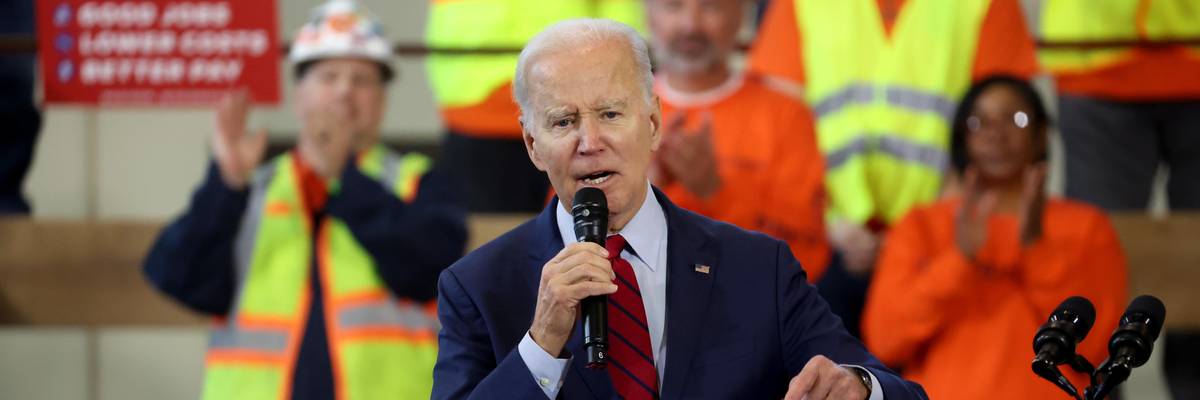
President Joe Biden speaks to guests at the Laborers’ International Union of North America (LIUNA) training center on February 08, 2023 in De Forest, Wisconsin. The visit came a day after his State of the Union address in Washington.
Under the billionaire minimum income tax, billionaires would pay a tax rate of at least 20 percent on their full income, including unrealized appreciation, just like workers pay taxes on their paychecks each year.
In his third State of the Union address, President Joe Biden renewed his call for a billionaire minimum income tax, demanding Congress take action on a broken tax system that rewards wealth over work.
“Pass my proposal for a billionaire minimum tax,” Biden proclaimed. “Because no billionaire should pay a lower tax rate than a school teacher or a firefighter.”
Since the pandemic began in March 2020, U.S. billionaire wealth has increased by a staggering $1.5 trillion to a collective $4.48 trillion. Many of those huge billionaires’ gains will go untaxed under current rules — and will disappear entirely for tax purposes when they’re passed onto the next generation.
Under the billionaire minimum income tax, billionaires would pay a tax rate of at least 20 percent on their full income, including unrealized appreciation, just like workers pay taxes on their paychecks each year.
If Congress won’t take action, state governments should make good on President Biden’s proposals and take meaningful steps towards rebalancing the tax code.
According to the White House, the tax will apply only to the top 0.01 percent of American households, which currently includes those worth over $100 million. Over half of the revenue generated from the tax will come from households worth more than $1 billion.
And while Republicans are eyeing cuts to Medicare and Social Security as a means to address the federal deficit, a billionaire minimum income tax would not only make America’s tax code fairer. White House officials estimate it would reduce the deficit by about $360 billion over the next decade.
The U.S. has no shortage of wealthy tax cheats in need of fair taxing. The 20 percent minimum income tax proposed by Biden is a 12 percentage point increase from the average 8 percent tax rate those high earners currently pay, assuming they pay anything at all.
In 2021, a ProPublica investigation revealed how little in taxes the wealthiest Americans actually pay. In 2018, for example, Elon Musk — until very recently the richest man in the world — paid no federal income tax. A school teacher, like those in West Virginia who went on strike for higher pay that year, paid an estimated federal income tax rate of 22 percent.
While public support for a billionaire minimum income tax is very strong, the probability of it passing a Republican-controlled House of Representatives is highly unlikely given the GOP’s aversion to targeting the pockets of their most generous donors.
But federal gridlock provides state governments an opportunity to take income inequality into their own hands.
Voters in Massachusetts, for example, recently elected to amend their state’s constitution to levy a 4 percent surtax on all individuals with annual income of one million dollars or more. The Fair Share Amendment — or “millionaire’s tax,” as it is known colloquially — is expected to generate an additional $1.2 billion to $2 billion per year, which the commonwealth plans to invest in public education and transportation.
Similar wealth tax proposals are on the table in other states across the country, including California, Connecticut, Hawaii, Illinois, Maryland, New York, and Washington.
The astonishing, unequal wealth gains amid a global pandemic renewed public appetite for increasing taxes on billionaires — a significant majority of Americans believe billionaires are taxed too little.
If Congress won’t take action, state governments should make good on President Biden’s proposals and take meaningful steps towards rebalancing the tax code. Let’s ensure that everyone, including the ultra-wealthy, pay their fair share.
Dear Common Dreams reader, It’s been nearly 30 years since I co-founded Common Dreams with my late wife, Lina Newhouser. We had the radical notion that journalism should serve the public good, not corporate profits. It was clear to us from the outset what it would take to build such a project. No paid advertisements. No corporate sponsors. No millionaire publisher telling us what to think or do. Many people said we wouldn't last a year, but we proved those doubters wrong. Together with a tremendous team of journalists and dedicated staff, we built an independent media outlet free from the constraints of profits and corporate control. Our mission has always been simple: To inform. To inspire. To ignite change for the common good. Building Common Dreams was not easy. Our survival was never guaranteed. When you take on the most powerful forces—Wall Street greed, fossil fuel industry destruction, Big Tech lobbyists, and uber-rich oligarchs who have spent billions upon billions rigging the economy and democracy in their favor—the only bulwark you have is supporters who believe in your work. But here’s the urgent message from me today. It's never been this bad out there. And it's never been this hard to keep us going. At the very moment Common Dreams is most needed, the threats we face are intensifying. We need your support now more than ever. We don't accept corporate advertising and never will. We don't have a paywall because we don't think people should be blocked from critical news based on their ability to pay. Everything we do is funded by the donations of readers like you. When everyone does the little they can afford, we are strong. But if that support retreats or dries up, so do we. Will you donate now to make sure Common Dreams not only survives but thrives? —Craig Brown, Co-founder |
In his third State of the Union address, President Joe Biden renewed his call for a billionaire minimum income tax, demanding Congress take action on a broken tax system that rewards wealth over work.
“Pass my proposal for a billionaire minimum tax,” Biden proclaimed. “Because no billionaire should pay a lower tax rate than a school teacher or a firefighter.”
Since the pandemic began in March 2020, U.S. billionaire wealth has increased by a staggering $1.5 trillion to a collective $4.48 trillion. Many of those huge billionaires’ gains will go untaxed under current rules — and will disappear entirely for tax purposes when they’re passed onto the next generation.
Under the billionaire minimum income tax, billionaires would pay a tax rate of at least 20 percent on their full income, including unrealized appreciation, just like workers pay taxes on their paychecks each year.
If Congress won’t take action, state governments should make good on President Biden’s proposals and take meaningful steps towards rebalancing the tax code.
According to the White House, the tax will apply only to the top 0.01 percent of American households, which currently includes those worth over $100 million. Over half of the revenue generated from the tax will come from households worth more than $1 billion.
And while Republicans are eyeing cuts to Medicare and Social Security as a means to address the federal deficit, a billionaire minimum income tax would not only make America’s tax code fairer. White House officials estimate it would reduce the deficit by about $360 billion over the next decade.
The U.S. has no shortage of wealthy tax cheats in need of fair taxing. The 20 percent minimum income tax proposed by Biden is a 12 percentage point increase from the average 8 percent tax rate those high earners currently pay, assuming they pay anything at all.
In 2021, a ProPublica investigation revealed how little in taxes the wealthiest Americans actually pay. In 2018, for example, Elon Musk — until very recently the richest man in the world — paid no federal income tax. A school teacher, like those in West Virginia who went on strike for higher pay that year, paid an estimated federal income tax rate of 22 percent.
While public support for a billionaire minimum income tax is very strong, the probability of it passing a Republican-controlled House of Representatives is highly unlikely given the GOP’s aversion to targeting the pockets of their most generous donors.
But federal gridlock provides state governments an opportunity to take income inequality into their own hands.
Voters in Massachusetts, for example, recently elected to amend their state’s constitution to levy a 4 percent surtax on all individuals with annual income of one million dollars or more. The Fair Share Amendment — or “millionaire’s tax,” as it is known colloquially — is expected to generate an additional $1.2 billion to $2 billion per year, which the commonwealth plans to invest in public education and transportation.
Similar wealth tax proposals are on the table in other states across the country, including California, Connecticut, Hawaii, Illinois, Maryland, New York, and Washington.
The astonishing, unequal wealth gains amid a global pandemic renewed public appetite for increasing taxes on billionaires — a significant majority of Americans believe billionaires are taxed too little.
If Congress won’t take action, state governments should make good on President Biden’s proposals and take meaningful steps towards rebalancing the tax code. Let’s ensure that everyone, including the ultra-wealthy, pay their fair share.
In his third State of the Union address, President Joe Biden renewed his call for a billionaire minimum income tax, demanding Congress take action on a broken tax system that rewards wealth over work.
“Pass my proposal for a billionaire minimum tax,” Biden proclaimed. “Because no billionaire should pay a lower tax rate than a school teacher or a firefighter.”
Since the pandemic began in March 2020, U.S. billionaire wealth has increased by a staggering $1.5 trillion to a collective $4.48 trillion. Many of those huge billionaires’ gains will go untaxed under current rules — and will disappear entirely for tax purposes when they’re passed onto the next generation.
Under the billionaire minimum income tax, billionaires would pay a tax rate of at least 20 percent on their full income, including unrealized appreciation, just like workers pay taxes on their paychecks each year.
If Congress won’t take action, state governments should make good on President Biden’s proposals and take meaningful steps towards rebalancing the tax code.
According to the White House, the tax will apply only to the top 0.01 percent of American households, which currently includes those worth over $100 million. Over half of the revenue generated from the tax will come from households worth more than $1 billion.
And while Republicans are eyeing cuts to Medicare and Social Security as a means to address the federal deficit, a billionaire minimum income tax would not only make America’s tax code fairer. White House officials estimate it would reduce the deficit by about $360 billion over the next decade.
The U.S. has no shortage of wealthy tax cheats in need of fair taxing. The 20 percent minimum income tax proposed by Biden is a 12 percentage point increase from the average 8 percent tax rate those high earners currently pay, assuming they pay anything at all.
In 2021, a ProPublica investigation revealed how little in taxes the wealthiest Americans actually pay. In 2018, for example, Elon Musk — until very recently the richest man in the world — paid no federal income tax. A school teacher, like those in West Virginia who went on strike for higher pay that year, paid an estimated federal income tax rate of 22 percent.
While public support for a billionaire minimum income tax is very strong, the probability of it passing a Republican-controlled House of Representatives is highly unlikely given the GOP’s aversion to targeting the pockets of their most generous donors.
But federal gridlock provides state governments an opportunity to take income inequality into their own hands.
Voters in Massachusetts, for example, recently elected to amend their state’s constitution to levy a 4 percent surtax on all individuals with annual income of one million dollars or more. The Fair Share Amendment — or “millionaire’s tax,” as it is known colloquially — is expected to generate an additional $1.2 billion to $2 billion per year, which the commonwealth plans to invest in public education and transportation.
Similar wealth tax proposals are on the table in other states across the country, including California, Connecticut, Hawaii, Illinois, Maryland, New York, and Washington.
The astonishing, unequal wealth gains amid a global pandemic renewed public appetite for increasing taxes on billionaires — a significant majority of Americans believe billionaires are taxed too little.
If Congress won’t take action, state governments should make good on President Biden’s proposals and take meaningful steps towards rebalancing the tax code. Let’s ensure that everyone, including the ultra-wealthy, pay their fair share.