SUBSCRIBE TO OUR FREE NEWSLETTER
Daily news & progressive opinion—funded by the people, not the corporations—delivered straight to your inbox.
5
#000000
#FFFFFF
To donate by check, phone, or other method, see our More Ways to Give page.
Daily news & progressive opinion—funded by the people, not the corporations—delivered straight to your inbox.
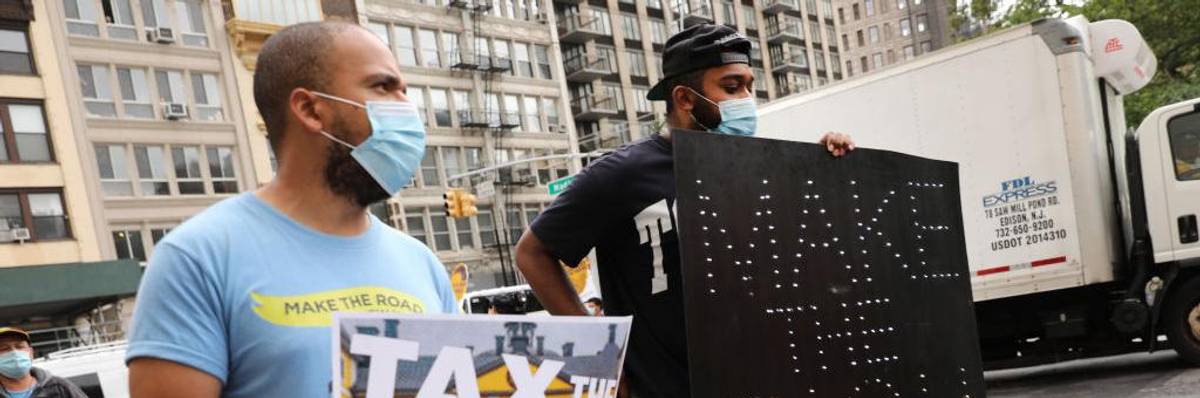
People participate in a "March on Billionaires" event on July 17, 2020 in New York City. (Photo: Spencer Platt/Getty Images)
Nothing symbolizes the inequality of sacrifice during the Covid-19 pandemic more than watching a few hundred billionaires gain while everyone else struggles through job losses, debilitating illness, or death.
Hundreds of thousands of Americans have died from Covid-19 and over 32 million have lost their jobs. U.S. households lost an estimated $6.5 trillion in wealth during the first quarter of 2020 alone.
"It is time to levy an emergency wealth tax on billionaire profiteers and direct the funds to offset the cost of the nation's health-care costs." But billionaire wealth is surging. Since March 18, the beginning of the pandemic lockdown, the 467 U.S. billionaires have seen their wealth increase by over $730 billion, or 30%, according to an analysis of Forbes data by Americans for Tax Fairness and the Institute for Policy Studies.
The Fed has used emergency measures to prop up the economy that reversed the stock-market crash caused by the pandemic, even as the rest of the economy falters. The biggest beneficiaries have been the billionaire class, which keeps on growing wealthier.
It is time to levy an emergency wealth tax on billionaire profiteers and direct the funds to offset the cost of the nation's health-care costs.
Independent Vermont Sen. Bernie Sanders--backed by Democratic Sens. Kirsten Gillibrand of New York and Ed Markey of Massachusetts--has introduced the Make Billionaires Pay Act to recapture over half the extreme wealth gains made by billionaires during the pandemic. The bill proposes a one-time, 60% tax exclusively on billionaires' gains between March 18 and the end of this year. It would raise about $420 billion, based on the increased wealth of the country's billionaires as of Aug. 5.
Sanders proposes directing funds to Medicare to pay all out-of-pocket health-care expenses for uninsured and underinsured households over the next year, including prescription-drug costs. That would "guarantee health care as a right to all for an entire year," said Sanders in a press statement.
Of course, other members of Congress might have their own ideas for how to spend $420 billion--including putting it toward helping state governments provide public services, maintaining those weekly $600 expanded unemployment payments, or paying out another round of $1,200 stimulus checks, all of which the House-passed Heroes Act would do.
Even with the new tax, billionaires would still have an estimated $310 billion in gains during the worst economic downturn since the Great Depression.
Amazon founder Jeff Bezos, whose wealth has increased a stunning 63% during the pandemic, is now worth an estimated $184 billion. Under the emergency pandemic wealth tax, Bezos would pay an estimated one-time tax of $42.8 billion. After the tax, Bezos would remain the richest person on the planet, with over $140 billion.
"Even with the new tax, billionaires would still have an estimated $310 billion in gains during the worst economic downturn since the Great Depression.". Elon Musk, the CEO of Tesla, has seen his wealth nearly triple during the pandemic to $70 billion. He would pay an estimated one-time wealth tax of $27.3 billion and would be 75% richer than he was five months ago. Facebook co-founder Mark Zuckerberg, who is worth over $88 billion, would pay an estimated one-time wealth tax of $22.1 billion. His wealth would be 28% higher than on March 18.
COVID-19 has caused an unprecedented health and economic crisis that no one should be excessively profiting from. Yet many billionaires are making huge hauls during a time of suffering and sacrifice.
In the past, our leaders took action to curb such profiteering in times of crisis.During World War II, Sen. Harry Truman held congressional hearings on war profiteering, exposing the ways some corporations grabbed profits during wartime sacrifice. Under President Dwight Eisenhower, the U.S. levied an excess profits tax on companies profiteering during the Korean War.
Today, the choice is stark: Do we enable 500 or so billionaires to further concentrate wealth and power during a pandemic, or do we tax the gains of these billionaires to improve the health and welfare of our country?
How we face this extraordinary inequality is the ultimate test of what kind of country we are and what we will become.
Dear Common Dreams reader, It’s been nearly 30 years since I co-founded Common Dreams with my late wife, Lina Newhouser. We had the radical notion that journalism should serve the public good, not corporate profits. It was clear to us from the outset what it would take to build such a project. No paid advertisements. No corporate sponsors. No millionaire publisher telling us what to think or do. Many people said we wouldn't last a year, but we proved those doubters wrong. Together with a tremendous team of journalists and dedicated staff, we built an independent media outlet free from the constraints of profits and corporate control. Our mission has always been simple: To inform. To inspire. To ignite change for the common good. Building Common Dreams was not easy. Our survival was never guaranteed. When you take on the most powerful forces—Wall Street greed, fossil fuel industry destruction, Big Tech lobbyists, and uber-rich oligarchs who have spent billions upon billions rigging the economy and democracy in their favor—the only bulwark you have is supporters who believe in your work. But here’s the urgent message from me today. It's never been this bad out there. And it's never been this hard to keep us going. At the very moment Common Dreams is most needed, the threats we face are intensifying. We need your support now more than ever. We don't accept corporate advertising and never will. We don't have a paywall because we don't think people should be blocked from critical news based on their ability to pay. Everything we do is funded by the donations of readers like you. When everyone does the little they can afford, we are strong. But if that support retreats or dries up, so do we. Will you donate now to make sure Common Dreams not only survives but thrives? —Craig Brown, Co-founder |
Nothing symbolizes the inequality of sacrifice during the Covid-19 pandemic more than watching a few hundred billionaires gain while everyone else struggles through job losses, debilitating illness, or death.
Hundreds of thousands of Americans have died from Covid-19 and over 32 million have lost their jobs. U.S. households lost an estimated $6.5 trillion in wealth during the first quarter of 2020 alone.
"It is time to levy an emergency wealth tax on billionaire profiteers and direct the funds to offset the cost of the nation's health-care costs." But billionaire wealth is surging. Since March 18, the beginning of the pandemic lockdown, the 467 U.S. billionaires have seen their wealth increase by over $730 billion, or 30%, according to an analysis of Forbes data by Americans for Tax Fairness and the Institute for Policy Studies.
The Fed has used emergency measures to prop up the economy that reversed the stock-market crash caused by the pandemic, even as the rest of the economy falters. The biggest beneficiaries have been the billionaire class, which keeps on growing wealthier.
It is time to levy an emergency wealth tax on billionaire profiteers and direct the funds to offset the cost of the nation's health-care costs.
Independent Vermont Sen. Bernie Sanders--backed by Democratic Sens. Kirsten Gillibrand of New York and Ed Markey of Massachusetts--has introduced the Make Billionaires Pay Act to recapture over half the extreme wealth gains made by billionaires during the pandemic. The bill proposes a one-time, 60% tax exclusively on billionaires' gains between March 18 and the end of this year. It would raise about $420 billion, based on the increased wealth of the country's billionaires as of Aug. 5.
Sanders proposes directing funds to Medicare to pay all out-of-pocket health-care expenses for uninsured and underinsured households over the next year, including prescription-drug costs. That would "guarantee health care as a right to all for an entire year," said Sanders in a press statement.
Of course, other members of Congress might have their own ideas for how to spend $420 billion--including putting it toward helping state governments provide public services, maintaining those weekly $600 expanded unemployment payments, or paying out another round of $1,200 stimulus checks, all of which the House-passed Heroes Act would do.
Even with the new tax, billionaires would still have an estimated $310 billion in gains during the worst economic downturn since the Great Depression.
Amazon founder Jeff Bezos, whose wealth has increased a stunning 63% during the pandemic, is now worth an estimated $184 billion. Under the emergency pandemic wealth tax, Bezos would pay an estimated one-time tax of $42.8 billion. After the tax, Bezos would remain the richest person on the planet, with over $140 billion.
"Even with the new tax, billionaires would still have an estimated $310 billion in gains during the worst economic downturn since the Great Depression.". Elon Musk, the CEO of Tesla, has seen his wealth nearly triple during the pandemic to $70 billion. He would pay an estimated one-time wealth tax of $27.3 billion and would be 75% richer than he was five months ago. Facebook co-founder Mark Zuckerberg, who is worth over $88 billion, would pay an estimated one-time wealth tax of $22.1 billion. His wealth would be 28% higher than on March 18.
COVID-19 has caused an unprecedented health and economic crisis that no one should be excessively profiting from. Yet many billionaires are making huge hauls during a time of suffering and sacrifice.
In the past, our leaders took action to curb such profiteering in times of crisis.During World War II, Sen. Harry Truman held congressional hearings on war profiteering, exposing the ways some corporations grabbed profits during wartime sacrifice. Under President Dwight Eisenhower, the U.S. levied an excess profits tax on companies profiteering during the Korean War.
Today, the choice is stark: Do we enable 500 or so billionaires to further concentrate wealth and power during a pandemic, or do we tax the gains of these billionaires to improve the health and welfare of our country?
How we face this extraordinary inequality is the ultimate test of what kind of country we are and what we will become.
Nothing symbolizes the inequality of sacrifice during the Covid-19 pandemic more than watching a few hundred billionaires gain while everyone else struggles through job losses, debilitating illness, or death.
Hundreds of thousands of Americans have died from Covid-19 and over 32 million have lost their jobs. U.S. households lost an estimated $6.5 trillion in wealth during the first quarter of 2020 alone.
"It is time to levy an emergency wealth tax on billionaire profiteers and direct the funds to offset the cost of the nation's health-care costs." But billionaire wealth is surging. Since March 18, the beginning of the pandemic lockdown, the 467 U.S. billionaires have seen their wealth increase by over $730 billion, or 30%, according to an analysis of Forbes data by Americans for Tax Fairness and the Institute for Policy Studies.
The Fed has used emergency measures to prop up the economy that reversed the stock-market crash caused by the pandemic, even as the rest of the economy falters. The biggest beneficiaries have been the billionaire class, which keeps on growing wealthier.
It is time to levy an emergency wealth tax on billionaire profiteers and direct the funds to offset the cost of the nation's health-care costs.
Independent Vermont Sen. Bernie Sanders--backed by Democratic Sens. Kirsten Gillibrand of New York and Ed Markey of Massachusetts--has introduced the Make Billionaires Pay Act to recapture over half the extreme wealth gains made by billionaires during the pandemic. The bill proposes a one-time, 60% tax exclusively on billionaires' gains between March 18 and the end of this year. It would raise about $420 billion, based on the increased wealth of the country's billionaires as of Aug. 5.
Sanders proposes directing funds to Medicare to pay all out-of-pocket health-care expenses for uninsured and underinsured households over the next year, including prescription-drug costs. That would "guarantee health care as a right to all for an entire year," said Sanders in a press statement.
Of course, other members of Congress might have their own ideas for how to spend $420 billion--including putting it toward helping state governments provide public services, maintaining those weekly $600 expanded unemployment payments, or paying out another round of $1,200 stimulus checks, all of which the House-passed Heroes Act would do.
Even with the new tax, billionaires would still have an estimated $310 billion in gains during the worst economic downturn since the Great Depression.
Amazon founder Jeff Bezos, whose wealth has increased a stunning 63% during the pandemic, is now worth an estimated $184 billion. Under the emergency pandemic wealth tax, Bezos would pay an estimated one-time tax of $42.8 billion. After the tax, Bezos would remain the richest person on the planet, with over $140 billion.
"Even with the new tax, billionaires would still have an estimated $310 billion in gains during the worst economic downturn since the Great Depression.". Elon Musk, the CEO of Tesla, has seen his wealth nearly triple during the pandemic to $70 billion. He would pay an estimated one-time wealth tax of $27.3 billion and would be 75% richer than he was five months ago. Facebook co-founder Mark Zuckerberg, who is worth over $88 billion, would pay an estimated one-time wealth tax of $22.1 billion. His wealth would be 28% higher than on March 18.
COVID-19 has caused an unprecedented health and economic crisis that no one should be excessively profiting from. Yet many billionaires are making huge hauls during a time of suffering and sacrifice.
In the past, our leaders took action to curb such profiteering in times of crisis.During World War II, Sen. Harry Truman held congressional hearings on war profiteering, exposing the ways some corporations grabbed profits during wartime sacrifice. Under President Dwight Eisenhower, the U.S. levied an excess profits tax on companies profiteering during the Korean War.
Today, the choice is stark: Do we enable 500 or so billionaires to further concentrate wealth and power during a pandemic, or do we tax the gains of these billionaires to improve the health and welfare of our country?
How we face this extraordinary inequality is the ultimate test of what kind of country we are and what we will become.