

SUBSCRIBE TO OUR FREE NEWSLETTER
Daily news & progressive opinion—funded by the people, not the corporations—delivered straight to your inbox.
5
#000000
#FFFFFF
To donate by check, phone, or other method, see our More Ways to Give page.
Daily news & progressive opinion—funded by the people, not the corporations—delivered straight to your inbox.
Dylan Blaylock, GAP Communications Director
Phone: 202.457.0034, ext. 137
Email: dylanb@whistleblower.org
On Tuesday, April 8, three prominent figures in the ongoing debate over constitutional privacy rights in the face of growing government surveillance will speak at the University of Southern California (USC) Annenberg School for Communication and Journalism. The event is co-sponsored by the Government Accountability Project (GAP), a nonprofit, nonpartisan whistleblower advocacy organization, as part of its American Whistleblower Tour, a series of events that brings whistleblowers to universities nationwide. The USC program, Patriot or Traitor? Whistleblowing and Journalism in the Age of Government Surveillance, will explore the critical balance between civil liberties and national security.
After journalists began publishing articles based on the disclosures of National Security Agency (NSA) whistleblower Edward Snowden last June, an intense debate over the balance between civil liberties and national security has enveloped governments and civil society around the world. This Tour stop will feature a moderated panel of three whistleblowers, which will explore the challenges facing national security workers when they seek to expose wrongdoing and violations of law. The details of the panel are:
Moderated by Annenberg Clinical Professor Robert Scheer
Tuesday, April 8
6:30 p.m. - 8:15 p.m.
USC Annenberg Auditorium
Other events complementing the main Tour stop include:
"Since Edward Snowden began disclosing the extent of the NSA's secret surveillance practices, discussions about whistleblowing and privacy rights have been more important than ever before," said GAP Senior Fellow and American Whistleblower Tour Director Dana Gold. "This Tour stop provides an opportunity for the public to hear firsthand from employees who disclosed abuses of government power - first through internal channels and then, when those channels failed to correct the wrongdoing, through the media. History shows that whistleblowers and their allies in investigative journalism are the best defense against corruption, illegality and abuses of power."
Speakers
For more event details and to RSVP, contact USC Annenberg Media Representative Anne Bergman at 818.378.5417 or anne.bergman@usc.edu. For more information about GAP's American Whistleblower Tour, or to arrange an interview with a panelist, contact GAP Communications Director Dylan Blaylock at 202.457.0034, ext. 137 or dylanb@whistleblower.org.
About the Tour
GAP's American Whistleblower Tour aims to educate the public - particularly university students - about the phenomenon and practice of whistleblowing. The events are free to all, though RSVPs are required. A full description of the Tour can be found at www.WhistleblowerTour.org.
This Tour stop at USC is the eighth of several to be held this academic year. Previous 2013-14 stops have included Florida International University, American University, West Virginia, Auburn, Princeton, Syracuse and Temple. Future slated stops include Stanford and West Chester. GAP secures some of the most prominent whistleblowers in American history for its Tour. Previous whistleblower presenters have included Frank Serpico (NYPD) and Sherron Watkins (Enron).
The Government Accountability Project (GAP) is a 30-year-old nonprofit public interest group that promotes government and corporate accountability by advancing occupational free speech, defending whistleblowers, and empowering citizen activists. We pursue this mission through our Nuclear Safety, International Reform, Corporate Accountability, Food & Drug Safety, and Federal Employee/National Security programs. GAP is the nation's leading whistleblower protection organization.

"I get a chuckle out of the fact that a lot of folks in this political system who come from incredible amounts of privilege and wealth are the first ones to be like, 'Are you really working class?"
In an extensive New York Times profile and interview published Friday and Saturday, the newspaper dug into what it called US Senate candidate Graham Platner's "complex class story" and asked how he can consider himself part of the "working class" considering his relatively privileged background.
The presumptive Democratic Maine candidate scoffed at the line of questioning as he pointed to the wide gap between his financial situation and that of people who have questioned his authenticity—as well as that of his opponent, Sen. Susan Collins (R-Maine).
"I get a chuckle out of the fact that a lot of folks in this political system who come from incredible amounts of privilege and wealth are the first ones to be like, 'Are you really working class? You’re just out there not making a lot of money and working on the ocean, but your dad was a small-town attorney,'" Platner told Lulu Garcia-Navarro, host of the Times' podcast The Interview. "Does that mean that you can’t actually represent working people?"
As the Times reported Friday, Platner is "the son of a Dartmouth College-educated lawyer, the grandson of a famed Connecticut architect, and a graduate of a private high school," with a mother who owns an "upscale restaurant." His family and his in-laws contributed financial help when Platner and his wife purchased their home and when they pursued in-vitro fertilization in Norway, having found the treatment unaffordable under the United States' for-profit healthcare system.
Platner, who is a first-time political candidate and a Marine combat veteran, owns an oyster farm, and according to his financial disclosure forms, the Times reported, "The bulk of his income appears to come from the nearly $60,000 in tax-free disability benefits he qualifies for each year after serving four combat tours."
The Times noted that both Republicans and Democrats who had supported Platner's primary opponent, Gov. Janet Mills, have attacked him over his background and suggested he is wealthier than he lets on.
One Mills supporter, former Maine Democratic Party chair and corporate lobbyist Tony Buxton, was quoted as saying, “This is not a salt-of-the-earth guy coming up from a hardscrabble existence." Buxton is with the firm Preti Flaherty, which represents a company that aims to build a data center in Maine; Platner supports a nationwide moratorium on artificial intelligence data centers.
Contrary to Buxton's remarks, according to financial disclosures, Platner would be the fifth-least wealthy US senator should he be elected in November. His and his wife's combined net worth is below $100,000.
Ryan Grim, co-founder of Drop Site News, wondered whether the Times would ever send "three reporters to report on the kind of life Susan Collins has lived versus Graham Platner the last 20 years."
"Tally the private planes, very nice restaurants, millions in wealth accumulation, and stack them next to each other and compare," he suggested. "That would be balanced."
According to Collins' financial disclosures, the five-term Republican senator's current net worth is $9.6 million, with up to $1.8 million directly in the bank last year. More than $342,000 of her wealth comes from interest and dividends from one of the best-performing stock portfolios in the Senate—a portfolio that is in her husband's name, a spokesperson told the Times.
Collins has opposed a ban on stock trading for members of Congress and their spouses.
The senator's financial disclosures also show that the $4.8 million she holds in corporate stocks include Amazon, United Health, and Visa—a company that would directly benefit from Collins' vote this past week against protecting consumers from overdraft fees.
“You could make $25 million a year in this country, you’re way closer to any of the billionaires."
While the National Republican Senatorial Committee's (NRSC) recently asserted that Platner is an "out-of-touch rich kid," the Democrat's campaign told the Times that his Republican opponent is "ultra wealthy."
"I don't think you could come up with a better avatar for the long-serving, self-enriching establishment politician than Susan Collins, who raises an immense amount of money outside of the state of Maine," he told Garcia-Navarro. "She takes an immense amount of money from [the American Israel Public Affairs Committee]. She takes an immense amount of money from special interest groups and fossil fuel companies, and she has a very high-performing stock portfolio. I think a lot of people look at that in Maine and say, 'I don't think that that is actually the politics I want representing me."
Despite the NRSC's attack on Platner as a "rich kid," polls and data suggest that many of the 41-year-old candidate's peers can relate to his personal financial background, with millennials reporting in numerous surveys that their lives are more financially precarious than their parents' were at their age, due to rising costs and debt.
“It’s a lot harder for young people today to save up for markers of the American Dream than it was for previous generations,” Joanne Hsu, director of the University of Michigan’s Surveys of Consumers, told CNBC last year.
According to the Times and his detractors in the political establishment, wrote Maine-based writer Andy O'Brien, "Graham is this privileged rich kid, but he needs help paying for healthcare and housing. How is that not relatable?"
"I’ve been to a number of Platner’s town halls and one of the most common themes are older Mainers talking about the lack of economic opportunities for their adult children and grandchildren," O'Brien wrote. "Many of these young people are still living at home, even though they have jobs, because they can’t afford to rent or buy a home in Maine. Many of them struggle without affordable healthcare and childcare to allow them to work. At a recent town hall in Appleton, a local teacher told Platner that she had been teaching for 30 years in the area and still had $100,000 in student loan debt that kept compounding interest."
The Times reporters appeared taken aback by Platner's definition of "working class," one that the newspaper called "an expansive interpretation."
“My definition of working class these days is essentially anybody who makes money from wages,” he told the Times. “If you work for a living and you go out and put in hours and you pay taxes just like everyone else, I think that’s quite fair.”
He alluded to his exchange with the reporters in a conversation with The Lever's David Sirota before the articles came out.
While his grandfather was a successful architect, he suggested, the family's financial prosperity hasn't been carried down through subsequent generations.
"My mom is still working because she has no money," he said. "And we're trying to figure out, quite frankly, if she can't sell her restaurant, she's got no retirement. My wife and I, we're not broke, but there's no money at the end of the month."
"You could make $25 million a year in this country, you are way closer to somebody living in poverty than any of the billionaires," he told Sirota. "And these New York Times reporters were like, 'Well, that's a really expansive vision of 'working class.' I'm like, 'You know what else is expansive? Wealth inequality.' Because all of us don't own anything, and a couple people own damn near everything."
Asked whether he’s “really working class,” @grahamformaine had a blunt response:
“Well they’re fucking not.”
In a new Lever Time interview, Platner argues America’s class divide isn’t about who has the perfect résumé — it’s about who works for a living, and who lives off… pic.twitter.com/L2hgrIW6Qy
— The Lever (@LeverNews) May 13, 2026
To Garcia-Navarro, he said: "You are working class if you make your money from work and wages. The world of wealth disparity has become so intense that there are just so many people now who are sitting on so much money who do not work. They make money off their investments. They make money off their wealth."
"I know it’s an expansive definition of 'working class,'" he added, "but I think you need to have an expansive definition when we have the most expansive margin of wealth inequality in the history of the country."

Labor rights and voting rights groups were among those who gathered in Selma and Montgomery, Alabama for the All Roads Lead to the South Day of Action.
This is a developing story... Please check back for possible updates...
In a show of resistance to the US Supreme Court's dismantling of the Voting Rights Act and Republicans' efforts to redraw congressional districts across southern states in a bid to retain power despite their party's unpopular agenda, labor and voting rights groups were among those that arrived in Montgomery, Alabama Saturday for "Day One" of a mass mobilization against GOP lawmakers who they said are intent on "resurrecting Jim Crow."
While groups including the Movement for Black Lives and National Jobs With Justice boarded buses in Atlanta Saturday morning to join more than 250 organizations at a rally at the Alabama State Capitol, other organizers began the "All Roads Lead to the South" National Day of Action with a march across the Edmund Pettus Bridge in Selma, Alabama—the same site of the historic 1965 voting rights march that became known as Bloody Sunday.
"We started here because we wanted to stand on sacred ground and consecrate ourselves," said organizer LaTosha Brown, co-founder of the group Black Voters Matter. "You cannot fight hate with hate, you have to stand in the spirit of love, and so look around—this is what love looks like."We’re joining the All Roads Lead to the South coalition in Alabama today to show that We the People will not allow a Jim Crow 2.0.
Today’s march is a powerful reminder: courage and community are how we will get through this.
WATCH: https://t.co/9Z5DOblam1
— Democracy Forward (@DemocracyFwd) May 16, 2026
The march and rally were organized in response to a ramp-up of efforts by the Republican Party and right-wing courts, including the far-right majority on the US Supreme Court, to redraw electoral maps in states including Louisiana, Alabama, and Tennessee.
The mass mobilization was organized after the Supreme Court handed down its ruling in Louisiana v. Callais last month, effectively eviscerating Section 2 of the Voting Rights Act, which has held that voters of color have the right to legally challenge racially discriminatory congressional maps.
The Supreme Court this week allowed Alabama to revert back to an electoral map with just one majority-Black district out of seven, despite that fact that 26% of Alabama residents are Black.
Tennessee Republicans also adopted a new electoral map that splits up the state's only majority-Black district, and the Missouri Supreme Court approved a congressional map that targets the state's 5th District, represented by Rep. Emanuel Cleaver.
Arriving in Montgomery, Tennessee state Rep. Justin Jones (D-52) said voters across the South need "a united front... to take on this new Confederacy... We know what the intent of these governors and state lawmakers are, to dismantle every gain made during the civil rights movement and dismantle the crown jewel of the civil rights movement, which was the Voting Rights Act."
Rep. @brotherjones_ in Montgomery: “We’re here united to take on this new confederacy, 60 years after the Selma March… because we know their intent is to dismantle everything gained during the civil rights movement.” pic.twitter.com/op87I4g8hT
— The Tennessee Holler (@TheTNHoller) May 16, 2026
"Our parents and grandparents marched, organized, bled, and won," said organizers ahead of the rally. "The Voting Rights Act was theirs. The fight to keep it is ours. Right now, state by state, that law is being dismantled. We know that we cannot fight the same battles the same way. New times demand new tactics—economic pressure, political organizing, community action, culture, and faith. But we know what we know: Organizing works. And we have unfinished business."
At the rally, US Rep. Alexandria Ocasio-Cortez (D-NY) emphasized the need for solidarity from across the US, with supporters of voting rights mobilizing in states near and far from the South—the current center of the GOP's attacks.
"They think they can draw us out of power. They do not know the sleeping giant they just awakened," said Ocasio-Cortez. "When Black Americans have the right to vote and that vote is protected, our schools get funded. When voting rights are protected, healthcare gets expanded. When voting rights are protected, our country moves forward. And Montgomery, that's what they're actually afraid of."
AOC: “It is time for the North to pull up to the South and let them know exactly what they have uncorked with this injustice. They think they can draw us out of power. They do not know the sleeping giant they just awakened. What they thought was the final blow is actually just… pic.twitter.com/kQvixR2Olv
— Marco Foster (@MarcoFoster_) May 16, 2026
Erica Smiley, executive director of Jobs With Justice, said labor groups joined the mass mobilization because "the bridges we have to cross are not only in Selma."
"Jim Crow didn't just come for the ballot. It came for anyone who tried to organize and have a voice," said Smiley. "Efforts to rollback equality and democracy are happening in the occupied cities, shop floors, and now the halls of the Capitol across the country."
Rep. Terri Sewell (D-Ala.) called for the rally to mark the beginning of a "Freedom Summer," with rallies at "every State House" in the country to pressure state legislators to end the GOP gerrymandering efforts, which President Donald Trump has explicitly called for.
"Let's declare a Freedom Summer and go to every courthouse this summer, to tell those legislators, 'We will not go back,'" said Sewell.
Dozens of satellite events were also taking place across the US on Saturday.
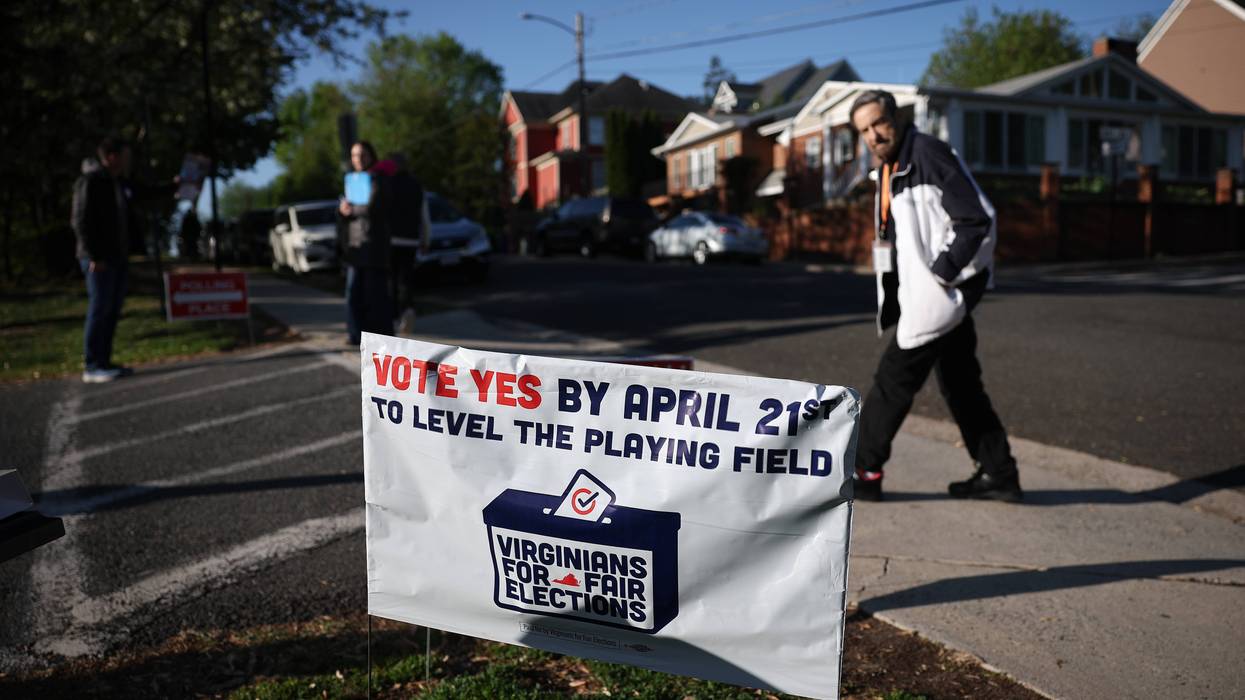
"Donald Trump, Republican state legislatures, and conservative courts are systematically and unabashedly tilting power away from the people for Trump’s political gain," said state Attorney General Jay Jones.
Virginia's Democratic attorney general, Jay Jones, said Friday night that he would redouble efforts to campaign on behalf of Democrats in the upcoming midterm elections following the US Supreme Court's rejection of a request to restore a voter-approved congressional map.
Following the high court's one-sentence denial of Democratic state officials' petition for emergency relief, which they had filed to block the state Supreme Court's ruling against a congressional map that passed via ballot measure last month, Jones said he would be "working tirelessly to support our Democratic candidates so we can win control of the House in spite of Republicans putting their thumbs on the scale."
With no dissents noted, the Supreme Court said Friday evening that it was denying the request to block the Virginia high court's ruling that had tossed out last month's redistricting referendum.
BREAKING: SCOTUS denies Virginia Democrats' request to block the Virginia Supreme Court ruling tossing out the redistricting referendum. There are no noted dissents and no opinion.
[image or embed]
— Chris Geidner (@chrisgeidner.bsky.social) May 15, 2026 at 6:35 PM
The decision "leaves in place the deeply flawed ruling from the Supreme Court of Virginia, which overturned the results of a lawful election and erased the will of millions of Virginia voters," said Jones.
It also served as "yet another profoundly troubling example of the continued national attack on voting rights and the rule of law by [President] Donald Trump, Republican state legislatures, and conservative courts," said the attorney general.
The map that was narrowly approved by voters last month included four new Democratic-leaning US House districts in Virginia, putting the party on equal footing with Republicans nationally or potentially giving it an edge in a mid-decade redistricting battle that was kicked off last year. Trump has urged Republican state legislatures to redraw congressional districts to give the GOP more winnable seats in the US House—as the president's economic policies and his deeply unpopular war on Iran as well as other military actions have pushed his approval rating to a low point for his second term ahead of the November midterms.
The redistricting fight was intensified late last month with the Supreme Court's ruling in Louisiana v. Callais, which held that Louisiana must redraw its 2024 congressional map. The map had created a second majority-minority district in the state, whose population is one-third Black. The ruling effectively gutted Section 2 of the Voting Rights Act, which allowed voters of color to challenge racially discriminatory electoral maps in court.
After the ruling, Louisiana's Republican governor, Jeff Landry, suspended the state's primary elections to allow the Republican-controlled legislature to redraw the congressional map, throwing out roughly 45,000 votes that had already been cast.
In the Virginia case, the US Supreme Court sided with the state's high court, which had found earlier this month that Virginia's Democratic legislature improperly began the process of placing an amendment to the state constitution after early voting in last fall's election was underway. The amendment cleared the way for Democrats to redraw the map, and the General Assembly approved the amendment days before the election.
Virginia voters then approved the redrawn map in April, only to have the state Supreme Court strike it down.
In filing their emergency petition with the US Supreme Court, Virginia Democrats argued the ruling had undermined the will of the residents who had voted for the referendum in April.
On Friday evening, Democratic Gov. Abigail Spanberger said the court had chosen "to nullify an election and the votes of more than three million Virginians."
Jones added in his statement that "Donald Trump, Republican state legislatures, and conservative courts are systematically and unabashedly tilting power away from the people for Trump’s political gain. Just this past month in Louisiana, Tennessee, and South Carolina, they have redrawn their maps and diluted Black political representation because it threatens their hold on power."
"This attack is not subtle," said the attorney general. "It is a coordinated effort to stack the deck in the Republicans' favor before the midterms, lock in political advantage, and make it harder for voters, especially Black voters and communities of color, to hold Trump and his allies accountable. There can be no doubt: Trump and his allies want only their most politically extreme supporters to have their voices heard in Washington. The Supreme Court of Virginia’s previous decision and today’s refusal by the United States Supreme Court to act are only bolstering these extreme MAGA voices."
Addressing Virginia voters, Jones added, "This fight is far from over, and I am committed to fighting alongside you."