
SUBSCRIBE TO OUR FREE NEWSLETTER
Daily news & progressive opinion—funded by the people, not the corporations—delivered straight to your inbox.
5
#000000
#FFFFFF
To donate by check, phone, or other method, see our More Ways to Give page.


Daily news & progressive opinion—funded by the people, not the corporations—delivered straight to your inbox.
"Jake Sullivan's been a critical decision-maker in every Democratic catastrophe of the last decade," said one observer. "Why is he still in the inner circle?"
Amid the latest battle over the direction the Democratic Party should move in, a number of strategists and political advisers from across the center-left's ideological spectrum are assembling a committee to determine the policy agenda they hope will be taken up by a Democratic successor to President Donald Trump.
Some of the names on the list of people crafting the agenda—named Project 2029, an echo of the far-right Project 2025 blueprint Trump is currently enacting—left progressives with deepened concerns that party insiders have "learnt nothing" and "forgotten nothing" from the president's electoral victories against centrist Democratic candidates over the past decade, as one economist said.
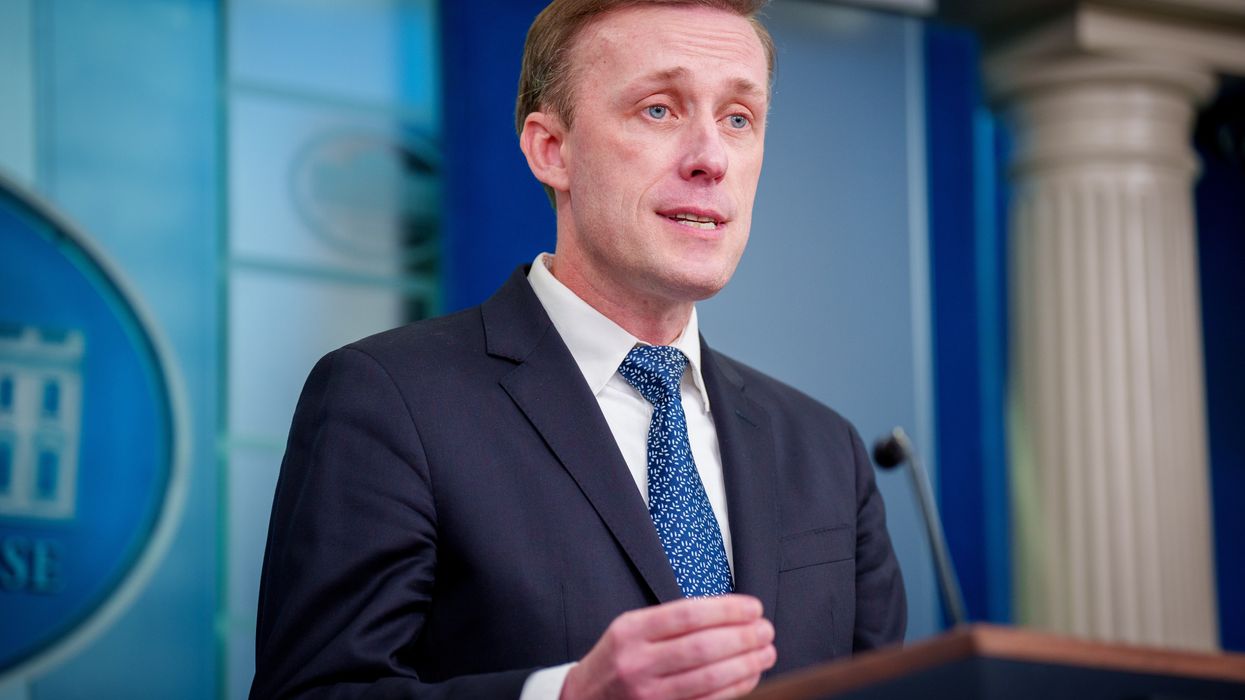
The project is being assembled by former Democratic speechwriter Andrei Cherny, now co-founder of the policy journal Democracy: A Journal of Ideas, and includes Jake Sullivan, a former national security adviser under the Biden administration; Jim Kessler, founder of the centrist think tank Third Way; and Neera Tanden, president of the Center for American Progress and longtime adviser to former Secretary of State Hillary Clinton.
Progressives on the advisory board for the project include economist Justin Wolfers and former Roosevelt Institute president Felicia Wong, but antitrust expert Hal Singer said any policy agenda aimed at securing a Democratic victory in the 2028 election "needs way more progressives."
As The New York Times noted in its reporting on Project 2029, the panel is being convened amid extensive infighting regarding how the Democratic Party can win back control of the White House and Congress.
After democratic socialist and state Assemblymember Zohran Mamdani's (D-36) surprise win against former New York Gov. Andrew Cuomo last week in New York City's mayoral primary election—following a campaign with a clear-eyed focus on making childcare, rent, public transit, and groceries more affordable—New York City has emerged as a battleground in the fight. Influential Democrats including House Minority Leader Hakeem Jeffries (D-N.Y.) and Sen. Kirsten Gillibrand (D-N.Y.) have so far refused to endorse him and attacked him for his unequivocal support for Palestinian rights.
Progressives have called on party leaders to back Mamdani, pointing to his popularity with young voters, and accept that his clear message about making life more affordable for working families resonated with Democratic constituents.
But speaking to the Times, Democratic pollster Celinda Lake exemplified how many of the party's strategists have insisted that candidates only need to package their messages to voters differently—not change the messages to match the political priorities of Mamdani and other popular progressives like Sen. Bernie Sanders (I-Vt.) and Rep. Alexandria Ocasio-Cortez (D-N.Y.).
"We didn't lack policies," Lake told the Times of recent national elections. "But we lacked a functioning narrative to communicate those policies."
Sanders and Ocasio-Cortez have drawn crowds of thousands in red districts this year at Sanders' Fighting Oligarchy rallies—another sign, progressives say, that voters are responding to politicians who focus on billionaires' outsized control over the U.S. political system and on economic justice.
Project 2029's inclusion of strategists like Kessler, who declared economic populism "a dead end for Democrats" in 2013, demonstrates "the whole problem [with Democratic leadership] in a nutshell," said Jonathan Cohn of Progressive Mass—as does Sullivan's seat on the advisory board.
As national security adviser to President Joe Biden, Sullivan played a key role in the administration's defense and funding of Israel's assault on Gaza, which international experts and human rights groups have said is a genocide.
"Jake Sullivan's been a critical decision-maker in every Democratic catastrophe of the last decade: Hillary Clinton's 2016 campaign, the withdrawal from Afghanistan, the Israel/Gaza War, and the 2024 Joe Biden campaign," said Nick Field of the Pennsylvania Capital-Star. "Why is he still in the inner circle?"
"Jake Sullivan is shaping domestic policy for the next Democratic administration," he added. "Who is happy with the Biden foreign policy legacy?"

"The administration is cracking down on all the ways that companies—through paperwork, hold times and general aggravation—waste people's money, waste people's time," a White House official said.
The Biden administration on Monday launched a wide-ranging consumer protection campaign called "Time Is Money" aimed at cracking down on hard-to-cancel services, deliberately poor customer service, and other "corporate tricks" that involve overly complicated or burdensome processes, such as in the filling out of insurance claims.
The effort involves a number of agencies and initiatives, some already underway, like a proposed Federal Trade Commission (FTC) rule, first announced in March 2023 and currently under public review, that would require companies to make it as easy to cancel a subscription or service as it is to sign up. At least one regulation the administration included as part of "Time Is Money" is already final: a Department of Transportation rule on automatic refunds for airline tickets that are canceled or significantly changed.
Other changes are forthcoming, the White House says. The Consumer Financial Protection Bureau (CFPB) will introduce a rule that would require companies under its jurisdiction to allow callers to escape customer service "doom loops" and speak to a human being by pressing a single button; the Federal Communications Commission (FCC) is considering a similar initiative for cable and other communications companies, as well as a proposal like the FTC's proposed easy-to-cancel rule.
"The administration is cracking down on all the ways that companies—through paperwork, hold times, and general aggravation—waste people's money, waste people's time," said Neera Tanden, a domestic policy adviser to President Joe Biden, a Democrat, according to HuffPost.
"For example, you want to cancel your gym membership or subscription service to a newspaper," Tanden said. "It took one or two clicks to sign up, but now to end your subscription or cancel the membership, you have to go in person or wait on hold for 20 minutes."
"These seemingly small inconveniences don't really happen by accident," she added. "They have huge financial consequences."
BREAKING: Banks, credit card companies, and more will be required to let customers talk to a human by pressing a single button under a new Biden administration proposed rule.
The @CFPB rule is part of a campaign to crack down on customer service “doom loops.”
— More Perfect Union (@MorePerfectUS) August 12, 2024
Tanden, a former Hillary Clinton aid who has often been at odds with progressives, was careful to clarify that regulations were not aimed at "shaming corporations writ large."
The White House said the new campaign fits with its long-standing effort to improve customer experience with government services. In 2021, Biden signed an executive order calling for federal agencies to streamline and simplify the services they offer. The U.S. State Department has since launched a trial effort to renew passports online, and the Internal Revenue Service has launched a "Direct File" program that's free to use, following a successful pilot.
The "Time Is Money" campaign is also in keeping with the administration's consumer protection agenda. Both the FTC—led by Chair Lina Khan, a favorite of progressives—and the U.S. Department of Justice have stepped up antitrust enforcement. And in October the FTC announced a crackdown on junk and hidden fees.
All of these initiatives have come from the executive branch, making them vulnerable to reversal if Republicans take control of the White House or U.S. Congress next year. Democrats may be hoping the presumed popularity of efforts such as "Time Is Money" help prevent that from happening.
"Federal agencies have shown themselves reluctant to act against unreasonable prices, and this new proposal may give them permission to continue to do nothing," said one expert.
While welcoming the White House's willingness to tackle pharmaceutical companies' patent abuse and high prescription drug prices, progressive critics argued Thursday that U.S. President Joe Biden must do more to challenge Big Pharma's monopoly power.
The White House on Thursday announced "new actions to promote competition in healthcare and support lowering prescription drug costs for American families, including the release of a proposed framework for agencies on the exercise of march-in rights on taxpayer-funded drugs and other inventions."
Under the Bayh-Dole Act of 1980—legislation meant to promote the commercialization and public availability of government-funded inventions—federal agencies reserve the right to "march in" and authorize price-lowering generic alternatives to patented medications developed with public funding.
The federal government has never invoked march-in rights, which are staunchly opposed by the pharmaceutical and other industries and interests.
"American taxpayers pay more for research than any country in the world: Hundreds of billions of dollars on research relevant to developing new drugs through the [National Institutes of Health] and other agencies," White House domestic policy adviser Neera Tanden said at a Thursday press briefing, according to The Hill.
"But at the same time, pharmaceutical companies charge Americans two to three times—and sometimes even more than that—for the same drugs than what they can charge in other countries," she added.
The White House said Thursday that the Department of Commerce and Department of Health and Human Services "released a proposed framework for agencies on the exercise of march-in rights that specifies for the first time that price can be a factor in determining that a drug or other taxpayer-funded invention is not accessible to the public."
The issue of greedy pharmaceutical companies charging exorbitant prices for publicly funded drugs took center stage during the Covid-19 pandemic, when corporations reaped record profits selling vaccines and other treatments developed fully or partly with taxpayer money.
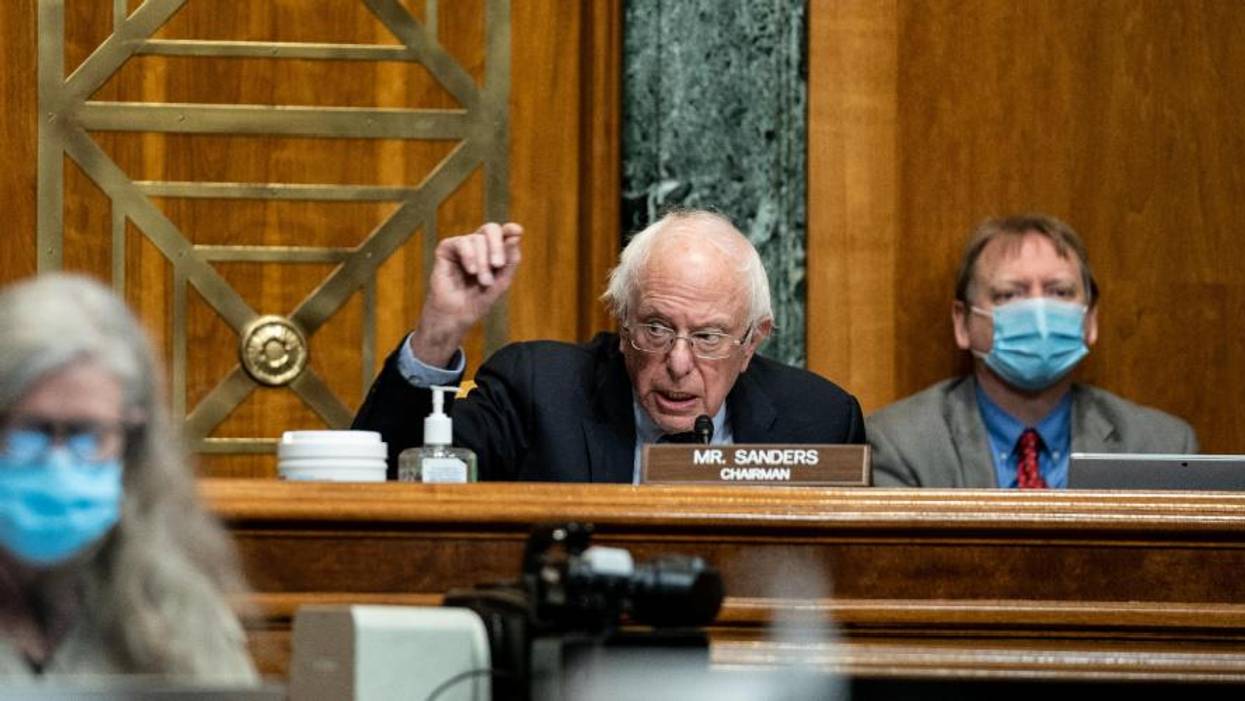
U.S. SenateHealth, Education, Labor, and Pensions (HELP) Committee Chair Bernie Sanders (I-Vt.)—a leading congressional critic of Big Pharma greed—called Thursday's announcement "a step forward in the right direction."
Sanders continued:
But, in my view, much more must be done. The American people are sick and tired of seeing hundreds of billions of their tax dollars going to the research and development of new treatments and cures only to end up paying, by far, the highest prices in the world for prescription drugs. In my view, the administration should reinstate and expand the reasonable pricing clause to require the pharmaceutical industry to charge affordable prices for new prescription drugs developed with taxpayer support. It should also move to substantially lower the price of the prostate cancer drug Xtandi by allowing companies to manufacture generic versions of this treatment. This is a drug that was invented with taxpayer dollars by scientists at UCLA and can be purchased in Canada for one-fifth [of] the U.S. price.
In March, patient advocates blasted the Biden administration's refusal to compel Pfizer to lower Xtandi's price, even though the lifesaving prostate cancer drug—which has a nearly $190,000 annual price tag—was developed completely with public funds.
Peter Maybarduk, director of the Access to Medicines program at the consumer advocacy group Public Citizen, said: "March-in can be, should be, a powerful tool to support fair pricing and access to publicly funded medicines, as President Biden importantly suggests. Unfortunately, the administration's march-in policy is far more limited than the statute allows."
"It should be quickly revised to recommend use of march-in wherever publicly funded medicines are unreasonably priced," he continued. "Where most drug prices already are egregious and force rationing, few drugs will seem 'extremely' priced by comparison. Federal agencies have shown themselves reluctant to act against unreasonable prices, and this new proposal may give them permission to continue to do nothing."
"Unfortunately, the administration's march-in policy is far more limited than the statute allows."
"The examples the announcement offers evade the main and important use case: Where drug corporations abuse their monopoly power to charge exorbitant prices, ignore the government contribution to [research and development], and charge Americans more than people in other countries," Maybarduk asserted.
"The final guidelines must be adjusted so they explicitly cover these scenarios and establish commonsense criteria for what constitutes an unreasonable price," he added. "Falling short risks doing nothing to lower the prices of taxpayer-funded medicines for patients, and instead perpetuating an unacceptable status quo. Americans have a right to expect not to be price gouged for medicines they paid for in the first place."
Progressives on Tuesday applauded the White House's decision to withdraw the highly controversial nomination of Neera Tanden to lead the Office of Management and Budget, with one leading activist noting that "nasty tweets and nasty politics have consequences."
In a statement, President Joe Biden said that he had "accepted Neera Tanden's request to withdraw her name from nomination" for OMB director.
"I have the utmost respect for her record of accomplishment, her experience, and her counsel, and I look forward to having her serve in a role in my administration," the president said of Tanden. "She will bring valuable perspective and insight to our work."
Tanden's left-wing critics pointed to her history of pushing cuts to Social Security, disparaging Medicare for All and other popular ideas, and proudly raising money from massive corporations--as well as what Sen. Bernie Sanders (I-Vt.) called her "vicious attacks" on progressives--as they welcomed news of her torpedoed nomination.
The progressive advocacy group RootsAction issued the following statement:
RootsAction is proud to have led the progressive opposition to Neera Tanden's nomination and heartened that she will not be OMB director. The opposition of Republican senators over nasty tweets was of course hypocritical and absurd, given their muted response to years of Trump's tweeting. But it was inexcusable for Democratic senators to be silent about the legitimate reasons to oppose her nomination--the potential conflicts of interest raised by her years of coziness with powerful corporate elites.
That silence may be explained by the fact that Democrats in the Senate are beholden to some of the same corporate donors that lavishly bankroll Tanden's think tank. Tanden was the wrong choice to head a federal agency that is vital in the regulatory process. It strains credulity to contend that she would have been a true advocate for the public interest after many years of dutifully serving corporate interests.
Medea Benjamin, co-founder of the peace group CodePink, tweeted: "Goes to show: nasty tweets and nasty politics have consequences."
Although clearly relishing their victory, some progressives kept their eyes on the proverbial ball, pointing to the exclusion of a $15 hourly federal minimum wage in Biden's $1.9 trillion coronavirus relief proposal as an example of a critical issue for which Democrats should fight as robustly as they fought for Tanden's nomination.
"The reason to celebrate the end of Neera Tanden's nomination has nothing to do with her late-night out-of-control rage-tweeting and everything to do with her record," tweeted Guardian columnist David Sirota.
Calling on the Senate Democratic majority to disregard the advice of the unelected parliamentarian, Sen. Bernie Sanders late Monday announced he will force a vote this week on an amendment to include a $15 minimum wage provision in the pending $1.9 trillion coronavirus relief package.
"At a time when millions of workers are earning starvation wages, when the minimum wage has not been raised by Congress since 2007 and stands at a pathetic $7.25 an hour, it is time to raise the minimum wage to a living wage," Sanders, the chairman of the Senate Budget Committee, said in a statement.
"The Senate should ignore the parliamentarian's advice, which is wrong in a number of respects."
--Sen. Bernie Sanders
The Vermont senator's announcement came as the White House and Senate Democrats signaled a retreat from the effort to include a minimum wage increase in the coronavirus relief package after the parliamentarian advised last week that the measure would run afoul of the Byrd Rule, which requires provisions of reconciliation bills to have a direct--not "merely incidental"--impact on the federal budget.
Citing two anonymous Democratic aides, the Washington Post reported Monday that "Senate Democrats will move forward with a version of the relief bill that does not attempt to raise the minimum wage." Senate Majority Leader Chuck Schumer (D-N.Y.) said in a floor speech Monday that the chamber will begin voting on the sprawling relief package this week, with an initial procedural vote expected as early as Wednesday.
In his statement Monday night, Sanders said he was "extremely disappointed by the decision of the parliamentarian, who ruled that the minimum wage provision was inconsistent with the Byrd Rule and the reconciliation process."
Echoing the calls of progressive House Democrats and dozens of grassroots advocacy groups representing millions of people across the U.S., Sanders said his "own personal view is that the Senate should ignore the parliamentarian's advice, which is wrong in a number of respects."
"I am not sure, however, that my view at this point is the majority view in the Democratic caucus," the Vermont senator added, alluding to opposition from Sens. Joe Manchin (D-W.Va.) and Kyrsten Sinema (D-Ariz.). "Obviously, as soon as we can, we must end the filibuster that currently exists in the U.S. Senate. Given the enormous crises facing working families today, we cannot allow a minority of the Senate to obstruct what the vast majority of the American people want and need."
Progressives in recent days have pushed Vice President Kamala Harris to overrule the parliamentarian's advice, which she has the constitutional authority to do. Should the vice president opt to use that authority, it would take 60 votes in the Senate to overrule her.
But White House Press Secretary Jen Psaki was adamant during a Monday briefing that Harris will not attempt to overrule the parliamentarian, the official tasked with interpreting Senate rules.
Asked by NBC News reporter Geoff Bennett why the White House appears to be fighting harder to salvage the collapsing nomination of budget office pick Neera Tanden than to keep the minimum wage increase in the coronavirus relief package, Psaki accused Bennett of "mixing a few things kind of irresponsibly."
Sanders made clear Monday that he will continue pushing to raise the federal minimum wage to $15 an hour if his coronavirus relief amendment fails to pass this week.
Following the parliamentarian's advisory ruling against the proposed pay raise last week, Sanders and Sen. Ron Wyden (D-Ore.) began crafting a backup plan that would impose tax penalties on large corporations that don't pay their employees $15 an hour. But Sanders and Wyden reportedly dropped the plan after it became clear that the measure would be too difficult to implement and that there wouldn't be sufficient support to include it in the emerging Covid-19 relief package.
Speaking to the press about his new $15 minimum wage amendment, Sanders said Monday that "there will be a roll call vote, and we'll see who votes for it and doesn't."
"I would suggest that those who vote against it from a political point of view, that's a mistake. The American people want to see that minimum wage raised," Sanders continued. "Let me be very clear--if we fail in this legislation, I will be back."
The youth-led Sunrise Movement on Friday issued a scathing statement warning of severe political, economic, and environmental consequences if the Biden administration and Democratic majority allow the Senate parliamentarian--an unelected official with no constitutional authority--to block key portions of their policy agenda by pointing to an obscure rule that "most Americans do not give a shit about."
"What will happen next if the parliamentarian rules a 100% Clean Energy Standard--another key Biden promise--is in violation of the arbitrary Byrd Rule? Will the president, vice president, and Senate leadership buckle then?" asked Sunrise political director Evan Weber. "The laws of the atmosphere and physics--that are telling us we are in a full-blown climate emergency--are certainly not going to give a shit about the made-up laws of the Senate."
"We need the Biden administration and Senate Democrats to do everything in their power--overrule the parliamentarian, fire them, abolish the filibuster--to ensure that no less than a $15 minimum wage becomes the law of the land."
--Evan Weber, Sunrise Movement
Named after late Democratic Sen. Robert Byrd, the rule in question empowers individual senators to object to any provision of a reconciliation bill that they believe would have "merely incidental" effects--rather than a direct impact--on the federal budget.
After hearing arguments for and against the provision, the Senate parliamentarian offers advice to the chamber's presiding officer--in this case Vice President Kamala Harris--on whether the measure qualifies under budget reconciliation, a highly subjective judgement that hinges almost entirely on the official's interpretation of the word "incidental."
Late Thursday, Senate parliamentarian Elizabeth MacDonough sided with Republican senators who argued that a proposal to increase the federal minimum wage to $15 by 2025 runs afoul of the Byrd Rule and should be removed from the pending $1.9 trillion coronavirus relief package--despite recent government analyses showing that the pay raise would have a substantial impact on federal spending and revenue.
But Harris, in her capacity as presiding officer of the Senate, has the constitutional authority to overrule the parliamentarian's advice. Should Harris decide to disregard the parliamentarian in an effort to keep the $15 minimum wage provision in the relief package, 60 votes in the Senate would be required to override the vice president.
Senators who oppose the $15 minimum wage proposal--such as Sens. Joe Manchin (D-W.Va.) and Kyrsten Sinema (D-Ariz.), two key swing votes--would then be forced to decide whether to accept the popular pay raise or risk tanking the entire $1.9 trillion relief package.
To the dismay of Sunrise and other progressive advocacy groups, the White House has thus far indicated that Harris is not willing to exercise her authority to preserve the wage increase, which Biden campaigned on during the 2020 election. White House National Economic Council Director Brian Deese said Friday that "the vice president is not going to weigh in," echoing earlier comments by the press secretary and chief of staff.
"The statements by the Biden administration that they will not overturn the parliamentarian's cruel decision--which Vice President Harris and Senate leadership have the power to do--is deeply troubling," said Weber. "Working people in this country, labor unions, and activists have been putting their jobs and lives on the line, striking, organizing, and fighting tirelessly for a $15 minimum wage and union."
"We are glad to see House leadership commit to keeping the $15 minimum wage in their bill," Weber continued. "Now, we need the Biden administration and Senate Democrats to join them in this fight, which is not over, and do everything in their power--overrule the parliamentarian, fire them, abolish the filibuster--to ensure that no less than a $15 minimum wage becomes the law of the land."
On Twitter, Weber lamented that the White House appears to be fighting harder to save the collapsing nomination of budget office pick Neera Tanden than to raise the wages of tens of millions of Americans. Unlike Tanden's nomination, Weber argued, there's still a "pathway for $15" through reconciliation, the filibuster-proof process Democrats are using to pass coronavirus relief without the support of obstructionist Republicans.
Also pressuring Harris is a women of color-led coalition of dozens of advocacy organizations, which sent a letter (pdf) to the vice president late Thursday urging her to "use the full power of [her] office to bring essential financial relief to all working people in America by ensuring that a $15 federal minimum wage is included in the budget reconciliation process, regardless of the opinion of the parliamentarian."
"As you know, women and people of color were the deciding force in electing both the president and the Senate in the 2020 elections; a $15 minimum wage was one of the top reasons they voted and will determine whether they vote again," the letter reads. "This single, powerful move will begin to reset the economic system so that millions of low-wage workers--disproportionately of women of color and communities of color--will no longer be treated as second-class citizens."
Saru Jayaraman, president and co-founder of One Fair Wage--a signatory of the new letter--said in a statement Friday that "the passage of a $15 federal minimum wage and elimination of the subminimum wages for tipped workers, workers with disabilities, and youth workers would guarantee a livable wage for all workers for the first time in our country's nearly 250 year history."
"Decency," Jayaraman added, "is Democrats using the political power they've been handed to finally deliver for the hardworking people of this country who have been repeatedly stepped on and disregarded over the last four years and especially during the pandemic."
Most corporate media outlets have depicted President Biden's effort to win Senate confirmation of Neera Tanden as a battle to overcome Republican hypocrisy about her "mean tweets," name-calling and nasty partisanship. But there are very important reasons to prevent Tanden from becoming the Office of Management and Budget director. They have nothing to do with her nasty tweets and everything to do with her political orientation.
Tanden has a record as one of the most anti-progressive operators among Democratic Party movers and shakers. Long enmeshed with corporate elites, she has been vehemently hostile to the Bernie Sanders wing of the party. Progressive activists have ample cause to be alarmed at the prospect of her becoming OMB director--one of the most powerful and consequential positions in the entire Executive Branch.
"We've opposed Tanden not because of her 'mean tweets' but because of her close funding relationships with corporate titans and foreign governments. What's stunning is the silence from Senate Democrats about the potential conflicts of interest raised by her decade of aggressive fundraising from powerful interests."
--Jeff Cohen, RootsAction
Yet some leaders of left-leaning groups have bought into spin that carefully ignores Tanden's fervent embrace of corporate power and touts her as eminently suitable for the OMB job. Media coverage has been a key factor. The newspaper owned by the richest person on the planet, Jeff Bezos, is a good example.
With the Tanden battle intensifying last weekend, the Washington Post launched an opinion spree to defend her while repeatedly expressing alarm and indignation that she might not be confirmed. The day after news broke that Tanden's nomination was in serious trouble, the newspaper's barrage started with a piece by right-wing pundit Hugh Hewitt, who urged Senate Republicans "to forgive the small stuff and encourage the recruitment of talent." That was on Saturday.
On Monday, the Post's editorial board weighed in, proclaiming the newspaper's official position: "Yes, Ms. Tanden has been undiplomatic," but hypocritical GOP senators had approved Donald Trump's nominees who were even nastier, and the Senate should confirm her.
By then, the national media mold was set, and countless words quickly poured into it--including six more pro-Tanden pieces that the Post published in the next two days. On Tuesday, the Tanden defenders were staff columnists Greg Sargent and Karen Tumulty as well as the paper's chief political correspondent Dan Balz. On Wednesday, staff columnists Dana Milbank and Jennifer Rubin shared the polemical duties with feminist author Jill Filipovic.
The Post's writers denounced conservative objections to confirming Tanden as director of OMB, which the newspaper has aptly described as "the nerve center of the federal government." Meanwhile, there was no space for substantive criticism of Tanden; the paper's opinion section didn't offer a pixel with a contrary outlook, let alone a progressive critique.
Much of the left has a strong aversion to Tanden. Days ago, Common Dreams reported on "her history of pushing cuts to Social Security, disparaging Medicare for All and other popular ideas, and raising money from massive corporations." As president of the Center for American Progress, she sought and received between $1.5 million and $3 million in donations from the United Arab Emirates monarchy; later, CAP remained silent about a bipartisan congressional resolution to end the U.S. government's assistance to the continual Saudi-UAE warfare killing huge numbers of Yemeni civilians.
But some progressive organizations have voiced support for Tanden's nomination, turning a blind eye to such matters as her close fundraising ties with corporate elites, Big Tech, Wall Street, Walmart, health insurers and military contractor Northrop Grumman. Yet ties like that would create foreseeable conflicts of interest in the top OMB job, which oversees regulatory processes across the federal government.
It was not a good sign when a usually-laudable progressive organizer told CNN viewers that Tanden should be confirmed. And--given Tanden's record of opposing Medicare for All, opposing a $15 federal minimum wage and advocating for collaboration with Republican leaders in potential cuts to Social Security, Medicare and Medicaid--something is seriously amiss when a leading advocate for women's health rights urges confirmation.
In a tweet last week, NARAL's president Ilyse Hogue called Tanden "a committed progressive" and added: "How about assessing her work, competence and vision instead the tone her tweets? Stop sinking good women because they are outspoken."
Oddly, the director of the excellent Revolving Door Project, Jeff Hauser, publicly defended Tanden days ago, telling the New York Times: "The last decade has seen mediocre or worse cabinet appointments rubber-stamped by the Senate with regularity. It is unconscionable that the rare exception to that norm might be based on feelings hurt by imprudent tweets and suggests that senators vote more on egos than substance."
I contacted Hauser for clarification, since it seemed that he was using the hypocrisy of Senate Republicans to justify support for Tanden's nomination. In effect, he appeared to be adding some drops of WD-40 to hinges on the particular revolving door that Tanden is trying to move through.
When I asked Hauser if he supported confirmation of Tanden and whether he considered her to be part of the revolving-door phenomenon, he replied: "We oppose the arguments actually endangering her confirmation, which are from [Sen. Joe] Manchin and [Sen. Susan] Collins and the like and hold that it makes sense to confirm the likes of Richard Grenell and Brett Kavanaugh but not Neera Tanden. But we do not lobby, so we do not formally urge votes one way or another once a person is actually nominated for a job."
Hauser added: "I don't think Tanden is 'revolving door,' but I stand by the concerns I raised about CAP fundraising in the Washington Post." Ironically, the Post news article that Hauser was citing, published in December 2020, scrutinized Tanden's longtime corporate entanglements via her Center for American Progress and reported: "Founded in 2003 by allies of Bill and Hillary Clinton, CAP is widely viewed as a Democratic administration-in-waiting, with a revolving door between the think tank and the White House."
At RootsAction, which has been working to defeat Tanden's nomination, my colleague Jeff Cohen has a very different perspective than what can be heard from Tanden's enablers: "We've opposed Tanden not because of her 'mean tweets' but because of her close funding relationships with corporate titans and foreign governments. What's stunning is the silence from Senate Democrats about the potential conflicts of interest raised by her decade of aggressive fundraising from powerful interests."
That kind of silence, whether from the U.S. Senate or from big-budget progressive groups, could dangerously help the Biden administration to do its worst instead of its potential best.
Given her history of pushing cuts to Social Security, disparaging Medicare for All and other popular ideas, and raising money from massive corporations, progressives were not exactly saddened to learn that Neera Tanden's nomination to lead the White House budget office is on the verge of collapse after Democratic Sen. Joe Manchin and two swing Republicans announced they will oppose her confirmation.
Tanden's chances of becoming director of the Office of Management and Budget (OMB) were thrown into serious doubt late last week when Manchin--an opponent of progressive causes who supported several of former President Donald Trump's Cabinet nominees, including former Attorney General Bill Barr--said he would vote against Tanden, citing "overtly partisan statements" she has made in the past.
On Monday, after President Joe Biden expressed confidence that he could find the votes to get Tanden through the Senate and said he had no intention of pulling her nomination, Sens. Susan Collins (R-Maine) and Mitt Romney (R-Utah.) both announced that they too would vote no, further imperiling Tanden's already slim chances of reaching the simple-majority threshold required for confirmation.
"Without Romney or Collins supporting her nomination, it's increasingly unlikely that Tanden will be confirmed," Politico reported Monday. "Tanden would be the first Biden cabinet nominee to fail."
White House press secretary Jen Psaki signaled Monday morning that despite the rapidly dwindling odds of Senate approval, the Biden team is not yet ready to withdraw Tanden's nomination. On Twitter, Psaki said Tanden is an "accomplished policy expert, would be the first Asian American woman to lead OMB, [and] has lived experience having benefited from a number of federal programs as a kid."
Progressives--who oppose Tanden's nomination for different reasons than Manchin, Collins, and Romney--were not impressed with Psaki's case:
Jeff Cohen, co-founder of progressive advocacy group RootsAction--which has been urging the Senate to reject Tanden's nomination since it was officially announced in December--said in a statement Monday that "consummate fundraiser Neera Tanden is a prime symbol of corporatism within a party that once fought for working-class interests."
"For decades, Democratic Party leaders and top advisers have wallowed in donations from the super-rich while moving the party toward policies that have shifted wealth and income from working-class people to elites," said Cohen. "We call on the Biden administration to nominate someone who will put the public interest ahead of corporate interests when it comes to overseeing federal budgetary and regulatory policies."
Currently president and CEO of the Center for American Progress (CAP)--an influential Democratic-aligned think tank--Tanden previously worked in the Bill Clinton White House under then-chief domestic policy adviser Bruce Reed, a key architect of the disastrous 1996 welfare reform law that fueled an explosion of deep poverty. In 2016, Reed told The Intercept that Tanden was "obviously involved in the implementation" of welfare reform--an account Tanden denied.
After Biden decided in late November to nominate Tanden to head OMB amid a pandemic-driven economic collapse, progressives pointed to the CAP president's comments in support of cuts to Social Security and Medicare during a C-SPAN interview in 2012.
"We should have savings on entitlements, and the Center for American Progress has put forward ideas on proposals to reform the beneficiary structure of Social Security--some of our progressive allies aren't as excited about that as we are," Tanden said at the time. "But we've put those ideas on the table."
During the second of her two confirmation hearings earlier this month, Sen. Bernie Sanders (I-Vt.)--chairman of the Senate Budget Committee and a frequent target of Tanden's past rhetoric--raised concerns about the OMB nominee's "vicious attacks" on progressives as well as her record of raising money from such corporate giants as Walmart, JPMorgan Chase, and Bank of America.
Sanders has not said he how he intends to vote on Tanden.
"I happen to believe that big money interests have an undue influence over the economic and political life of our country," Sanders said during the February 10 hearing. "That, too often, campaign contributions are what determine policy rather than needs of ordinary Americans."
It is unclear who's next in line for the OMB role should Tanden fail to get past the Senate. The American Prospect's Robert Kuttner reported last week that one possible alternative is Gene Sperling, who most recently served as director of the National Economic Council under former President Barack Obama.
"Sperling has become more of a progressive since leaving office," Kuttner argued. "His 2020 book, Economic Dignity, helps offset some youthful indiscretions of the Clinton years such as his work on the 1997 Balanced Budget Act. Most progressives would applaud, but he is just orthodox enough to win easy confirmation. He'd round out a progressive senior economic team."
Dean Baker, co-founder of the Center for Economic and Policy Research (CEPR), told Kuttner that "Gene's views have genuinely evolved from when he was in the Clinton administration."
"While I would not have wanted the Gene Sperling of 25 years ago to hold a top position in the Biden administration," Baker said, "I think the Gene Sperling of today would be an outstanding pick as head of OMB."
While Republicans have worked to focus a sizeable portion of budget office nominee Neera Tanden's confirmation process on her past tweets condemning GOP lawmakers, Senate Budget Committee chairman Sen. Bernie Sanders on Wednesday was sure to make note of the Center for American Progress president's long history of attacking progressives--including himself and his supporters.
"There were vicious attacks made against progressives, people who I have worked with, me personally," Sanders (I-Vt.) said during Tanden's appearance before the Senate budget panel on Wednesday for the second hearing on her nomination to lead the Office of Management and Budget, a crucial agency particularly during a time of economic calamity.
Sanders did not cite specific examples, but Tanden--a longtime loyalist to former Secretary of State Hillary Clinton--became notorious during the 2016 presidential race for disparaging the Vermont senator, his staff, and the progressive ideas he champions, including raising the federal minimum wage to $15 an hour, a proposal that is now well within the mainstream of the Democratic Party.
Tanden's left-punching became an issue once more during the 2020 Democratic presidential primary after ThinkProgress, CAP's now-defunct news site, published an article and video criticizing then-candidate Sanders' appearance and book income and accusing him of being hypocritical in his denunciations of income inequality.
"Center for American Progress leader Neera Tanden repeatedly calls for unity while simultaneously maligning my staff and supporters and belittling progressive ideas," Sanders wrote in a letter to CAP's board in April of 2019. "This counterproductive negative campaigning needs to stop. The Democratic primary must be a campaign of ideas, not of bad faith smears."
In response to Sanders' questioning Wednesday, Tanden expressed regret for her past rhetoric and "expressions on social media" and vowed that, if confirmed to lead OMB, her approach to personal interactions will be "radically different."
Watch the exchange:
Sanders also used the budget committee hearing to press Tanden on CAP's prolific corporate fundraising during her more than nine years as the Democratic establishment-aligned think tank's president and CEO.
"I happen to believe that big money interests have an undue influence over the economic and political life of our country," Sanders said. "That, too often, campaign contributions are what determine policy rather than needs of ordinary Americans."
The Vermont senator pointed to Washington Post reporting detailing how since 2014, CAP has received millions of dollars in donations from Walmart--which Sanders noted pays its workers starvation-level wages--and other major corporations such as Google, Facebook, JPMorgan Chase, and Wells Fargo.
In an interview with the Post in 2015, Tanden said that "we're proud of our donors" and pointed to the list of contributors on CAP's website, which today features such corporate behemoths as Amazon.com, Bank of America, and Microsoft.
On Wednesday, Tanden--a past proponent of Social Security and Medicare cuts--said CAP's corporate donors "will have zero impact" on her decision-making at OMB and added, "It will be my role to ensure that I am only serving the interests of the American people."
Watch:
Sometimes a couple of nominations convey an incoming president's basic mindset and worldview. That's how it seems with Joe Biden's choices to run the Office of Management and Budget and the State Department.
For OMB director, Biden selected corporate centrist Neera Tanden, whose Center for American Progress thrives on the largesse of wealthy donors representing powerful corporate interests. Tanden has been a notably scornful foe of the Democratic Party's progressive wing; former Sanders speechwriter David Sirota calls her "the single biggest, most aggressive Bernie Sanders critic in the United States." Who better to oversee the budget of the U.S. government?
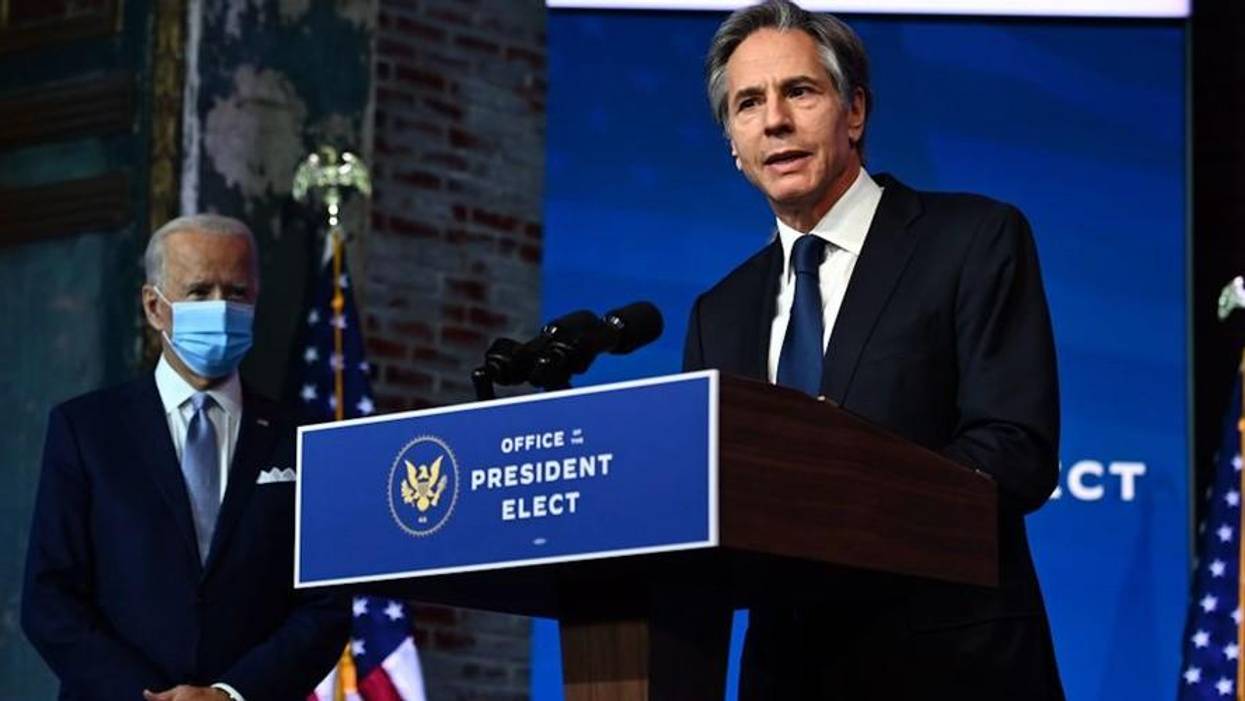
For Secretary of State, Biden chose his longtime top foreign-policy adviser, whose frequent support for U.S. warfare included pushing for the disastrous 2011 military intervention in Libya. Antony Blinken is a revolving-door pro who has combined his record of war boosterism with entrepreneurial zeal to personally profit from influence-peddling for weapons sales to the Pentagon. Who better to oversee diplomacy for the U.S. government?
"With few exceptions, Biden's current policy positions are destructively corporate, deferential to obscene concentrations of wealth, woefully inadequate for meeting human needs, and zealously militaristic." Standard news coverage tells us that Tanden and Blinken are "moderates." But what's so moderate about being on the take from rich beneficiaries of corporate America while opposing proposals that would curb their profits in order to reduce income inequality and advance social justice? What's so moderate about serving the military-industrial complex while advocating for massive "defense" spending and what amounts to endless war?
Unless they fail to get Senate confirmation, Tanden and Blinken will shape future history in major ways.
As OMB director, Tanden would head what the Washington Post describes as "the nerve center of the federal government, executing the annual spending plan, setting fiscal and personnel policy for agencies, and overseeing the regulatory process across the executive branch."
Blinken is ready to be the administration's most influential figure on foreign policy, bolstered by his longstanding close ties with Biden. As staff director for the Senate Foreign Relations Committee when Biden chaired the panel's mid-2002 crucial sham hearings on scenarios for invading Iraq, Blinken helped grease the skids for the catastrophic invasion.
Overall, purported "moderates" Tanden and Blinken have benefited from favorable mass-media coverage since their nominations were announced several weeks ago. Most of the well-documented critical accounts have appeared in progressive outlets such as Common Dreams, Democracy Now, The Daily Poster, In These Times and The American Prospect. But some unappealing aspects of their records have been reported by the mainstream press.
"In her nine years helming Washington's leading liberal think tank, Neera Tanden mingled with deep-pocketed donors who made their fortunes on Wall Street, in Silicon Valley and in other powerful sectors of corporate America," the Washington Post reported in early December. "At formal pitches and swanky fundraisers, Tanden personally cultivated the bevy of benefactors fueling the $45 million to $50 million annual budget of the Center for American Progress."
The Post added: "As OMB director, Tanden would have a hand in policies that touch every part of the economy after years spent courting corporate and foreign donors. These regulatory decisions will have profound implications for a range of U.S. companies, dictating how much they pay in taxes, the barriers they face and whether they benefit from new stimulus programs."
Blinken's eagerness to cash in on the warfare state -- when not a formal part of the government's war-making apparatus -- is well-documented and chilling. In a healthier political culture, Blinken's shameless insistence on profiteering from military weapons sales, as spelled out in a Nov. 28 New York Times news story, would have sunk his nomination for Secretary of State.
As for Tanden, in recent years her Center for American Progress received between $1.5 million and $3 million from the United Arab Emirates, which is allied with Saudi Arabia in waging a long and murderous war on Yemen. CAP refused to back a Senate resolution calling for the U.S. government to end its military support for that war. On a range of foreign-policy issues, Tanden has shown dedication to militarism again and again and again.
By many accounts, progressive organizing was a key factor in preventing the widely expected nomination of hawkish Michele Flournoy to be Secretary of Defense. (RootsAction.org, where I'm national director, was part of that organizing effort.) Last week, the withdrawal of torture defender Mike Morell from consideration for CIA director was a victory for activism led by CodePink, Progressive Democrats of America, Witness Against Torture and other groups.
During the first weeks of 2021, such organizing could be effective in helping to derail other nominations. High on the deserving list are Agriculture Secretary nominee Tom "Mr. Monsanto" Vilsack, a loyal ally of corporate Big Ag, and Director of National Intelligence nominee Avril Haines -- whose record as former deputy director of the CIA included working to prevent accountability for agency personnel who engaged in torture, as well as crafting legal rationales for drone strikes that often killed civilians.
Such deplorable nominees don't tell the whole story of Biden's incoming team, which includes some decent economic and environmental appointees. "There's no question that progressive focus on personnel has led to far better outcomes than when Obama put a corporate- and bank-friendly Cabinet together with little resistance," The American Prospect's executive editor, David Dayen, correctly pointed out last week. At the same time, none of Biden's high-level nominees were supporters of the Bernie Sanders 2020 campaign or are fully in sync with the progressive wing of the party.
The brighter spots among Joe Biden's nominations reflect the political wattage that progressives have generated in recent years on a wide array of intertwined matters, from climate to healthcare to economic justice to structural racism. Yet, with few exceptions, Biden's current policy positions are destructively corporate, deferential to obscene concentrations of wealth, woefully inadequate for meeting human needs, and zealously militaristic. It's hardly incidental that the list of key White House staff is overwhelmingly dominated by corporate-aligned operatives and PR specialists.
Wishful thinking aside, on vital issue after vital issue, it's foreseeable that Biden -- and the people in line for the most powerful roles in his administration -- will not do the right thing unless movements can organize effectively enough to make them do it.