SUBSCRIBE TO OUR FREE NEWSLETTER
Daily news & progressive opinion—funded by the people, not the corporations—delivered straight to your inbox.
5
#000000
#FFFFFF
To donate by check, phone, or other method, see our More Ways to Give page.
Daily news & progressive opinion—funded by the people, not the corporations—delivered straight to your inbox.
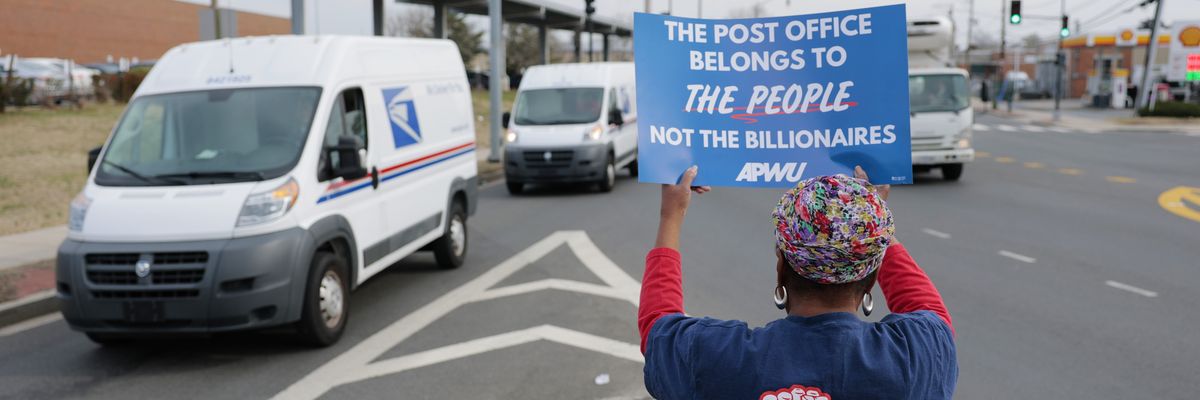
Activists protest during a "U.S. Mail Not For Sale" rally near the Brentwood Post Office on March 20, 2025 in Washington, D.C.
"Postal customers should trust their gut when it comes to schemes to sell off or transfer the USPS," said the head of the American Postal Workers Union.
As the Trump administration signaled a potential step toward privatizing the U.S. Postal Service with the reported selection of a FedEx board member to serve as postmaster general, new polling on Thursday showed just how strongly the American public would oppose such a move.
The survey by Hart Research Associates and North Star Opinion Research, which was commissioned by the American Postal Workers Union, found that 60% of respondents were opposed to privatizing the postal service, while just 26% were in favor.
The opposition cut across ideological, geographic, and demographic divides, with people in all regions of the country saying they wanted to maintain the USPS as a public service by a margin of at least 29 points—and as many as 40 points in western states.
While rural voters supported President Donald Trump by a 23-point margin in the 2024 election, the research firms posited that the heavy reliance people in far-flung areas have on the USPS helped push rural respondents to say they oppose privatization, with 58% saying they were against it.
As Common Dreams reported last month, an analysis by the Institute for Policy Studies found that private mail carriers like FedEx and UPS already charge "remote surcharges" to 8% of all U.S. ZIP Codes—home to nearly 4 million people—because they are in mountain communities and other remote areas. While USPS has a universal service obligation, people in rural areas pay up to $15.50 for deliveries from private companies.
Fifty-six percent of Americans said privatization would result in higher prices for mailing packages and letters, while 17% said prices were likely to improve.
Without competition from USPS, private companies could impose additional charges for weekend deliveries, fuel, residential deliveries, and more.
"Postal customers should trust their gut when it comes to schemes to sell off or transfer the USPS," said APWU president Mark Dimondstein. "Plans to privatize the Post Office are about enriching Wall Street and not serving Main Street. Evidence shows that selling off the USPS would lead to higher prices for postal services as well as higher prices for shipping packages at FedEx and UPS."
On the House floor recently, U.S. Rep. Sarah McBride (D-Del.) warned that "corporations won't serve what isn't profitable."
"This isn't about efficiency," she said. "This is about dismantling public services so they can prove government doesn't work."
The poll was released two months after Wells Fargo presented a five-step plan for privatizing USPS to Wall Street investors, including raising USPS prices by as much as 140%, selling postal real estate to commercial bidders, and imposing mass layoffs on the service's 600,000 employees.
The bank said privatization would lead to the "harvesting," or closing, of neighborhood post offices across the country—something 72% of respondents opposed in Thursday's poll.
Trump ally Elon Musk also said in March that Amtrak and USPS were top targets for the so-called Department of Government Efficiency, which the president selected him to lead and which has pushed to dismantle numerous government agencies and laid off nearly 300,000 federal employees.
"I think logically we should privatize anything that can reasonably be privatized," Musk said. Trump has also expressed support for privatization.
Respondents to Thursday's poll expressed support for a number of steps that could strengthen the U.S. Postal Service's finances, including 77% who backed making office supplies available for purchase in post offices, 72% who supported the selling of hunting and fishing licenses, and 60% who supported making magazines and newspapers available for purchase.
"The survey results indicate that the outlook is good in our ongoing fight against privatizers trying to sell off our public Postal Service for profit," said the APWU. "We should remain steady in our message—the U.S. Mail Is Not for Sale!"
Dear Common Dreams reader, It’s been nearly 30 years since I co-founded Common Dreams with my late wife, Lina Newhouser. We had the radical notion that journalism should serve the public good, not corporate profits. It was clear to us from the outset what it would take to build such a project. No paid advertisements. No corporate sponsors. No millionaire publisher telling us what to think or do. Many people said we wouldn't last a year, but we proved those doubters wrong. Together with a tremendous team of journalists and dedicated staff, we built an independent media outlet free from the constraints of profits and corporate control. Our mission has always been simple: To inform. To inspire. To ignite change for the common good. Building Common Dreams was not easy. Our survival was never guaranteed. When you take on the most powerful forces—Wall Street greed, fossil fuel industry destruction, Big Tech lobbyists, and uber-rich oligarchs who have spent billions upon billions rigging the economy and democracy in their favor—the only bulwark you have is supporters who believe in your work. But here’s the urgent message from me today. It's never been this bad out there. And it's never been this hard to keep us going. At the very moment Common Dreams is most needed, the threats we face are intensifying. We need your support now more than ever. We don't accept corporate advertising and never will. We don't have a paywall because we don't think people should be blocked from critical news based on their ability to pay. Everything we do is funded by the donations of readers like you. When everyone does the little they can afford, we are strong. But if that support retreats or dries up, so do we. Will you donate now to make sure Common Dreams not only survives but thrives? —Craig Brown, Co-founder |
As the Trump administration signaled a potential step toward privatizing the U.S. Postal Service with the reported selection of a FedEx board member to serve as postmaster general, new polling on Thursday showed just how strongly the American public would oppose such a move.
The survey by Hart Research Associates and North Star Opinion Research, which was commissioned by the American Postal Workers Union, found that 60% of respondents were opposed to privatizing the postal service, while just 26% were in favor.
The opposition cut across ideological, geographic, and demographic divides, with people in all regions of the country saying they wanted to maintain the USPS as a public service by a margin of at least 29 points—and as many as 40 points in western states.
While rural voters supported President Donald Trump by a 23-point margin in the 2024 election, the research firms posited that the heavy reliance people in far-flung areas have on the USPS helped push rural respondents to say they oppose privatization, with 58% saying they were against it.
As Common Dreams reported last month, an analysis by the Institute for Policy Studies found that private mail carriers like FedEx and UPS already charge "remote surcharges" to 8% of all U.S. ZIP Codes—home to nearly 4 million people—because they are in mountain communities and other remote areas. While USPS has a universal service obligation, people in rural areas pay up to $15.50 for deliveries from private companies.
Fifty-six percent of Americans said privatization would result in higher prices for mailing packages and letters, while 17% said prices were likely to improve.
Without competition from USPS, private companies could impose additional charges for weekend deliveries, fuel, residential deliveries, and more.
"Postal customers should trust their gut when it comes to schemes to sell off or transfer the USPS," said APWU president Mark Dimondstein. "Plans to privatize the Post Office are about enriching Wall Street and not serving Main Street. Evidence shows that selling off the USPS would lead to higher prices for postal services as well as higher prices for shipping packages at FedEx and UPS."
On the House floor recently, U.S. Rep. Sarah McBride (D-Del.) warned that "corporations won't serve what isn't profitable."
"This isn't about efficiency," she said. "This is about dismantling public services so they can prove government doesn't work."
The poll was released two months after Wells Fargo presented a five-step plan for privatizing USPS to Wall Street investors, including raising USPS prices by as much as 140%, selling postal real estate to commercial bidders, and imposing mass layoffs on the service's 600,000 employees.
The bank said privatization would lead to the "harvesting," or closing, of neighborhood post offices across the country—something 72% of respondents opposed in Thursday's poll.
Trump ally Elon Musk also said in March that Amtrak and USPS were top targets for the so-called Department of Government Efficiency, which the president selected him to lead and which has pushed to dismantle numerous government agencies and laid off nearly 300,000 federal employees.
"I think logically we should privatize anything that can reasonably be privatized," Musk said. Trump has also expressed support for privatization.
Respondents to Thursday's poll expressed support for a number of steps that could strengthen the U.S. Postal Service's finances, including 77% who backed making office supplies available for purchase in post offices, 72% who supported the selling of hunting and fishing licenses, and 60% who supported making magazines and newspapers available for purchase.
"The survey results indicate that the outlook is good in our ongoing fight against privatizers trying to sell off our public Postal Service for profit," said the APWU. "We should remain steady in our message—the U.S. Mail Is Not for Sale!"
As the Trump administration signaled a potential step toward privatizing the U.S. Postal Service with the reported selection of a FedEx board member to serve as postmaster general, new polling on Thursday showed just how strongly the American public would oppose such a move.
The survey by Hart Research Associates and North Star Opinion Research, which was commissioned by the American Postal Workers Union, found that 60% of respondents were opposed to privatizing the postal service, while just 26% were in favor.
The opposition cut across ideological, geographic, and demographic divides, with people in all regions of the country saying they wanted to maintain the USPS as a public service by a margin of at least 29 points—and as many as 40 points in western states.
While rural voters supported President Donald Trump by a 23-point margin in the 2024 election, the research firms posited that the heavy reliance people in far-flung areas have on the USPS helped push rural respondents to say they oppose privatization, with 58% saying they were against it.
As Common Dreams reported last month, an analysis by the Institute for Policy Studies found that private mail carriers like FedEx and UPS already charge "remote surcharges" to 8% of all U.S. ZIP Codes—home to nearly 4 million people—because they are in mountain communities and other remote areas. While USPS has a universal service obligation, people in rural areas pay up to $15.50 for deliveries from private companies.
Fifty-six percent of Americans said privatization would result in higher prices for mailing packages and letters, while 17% said prices were likely to improve.
Without competition from USPS, private companies could impose additional charges for weekend deliveries, fuel, residential deliveries, and more.
"Postal customers should trust their gut when it comes to schemes to sell off or transfer the USPS," said APWU president Mark Dimondstein. "Plans to privatize the Post Office are about enriching Wall Street and not serving Main Street. Evidence shows that selling off the USPS would lead to higher prices for postal services as well as higher prices for shipping packages at FedEx and UPS."
On the House floor recently, U.S. Rep. Sarah McBride (D-Del.) warned that "corporations won't serve what isn't profitable."
"This isn't about efficiency," she said. "This is about dismantling public services so they can prove government doesn't work."
The poll was released two months after Wells Fargo presented a five-step plan for privatizing USPS to Wall Street investors, including raising USPS prices by as much as 140%, selling postal real estate to commercial bidders, and imposing mass layoffs on the service's 600,000 employees.
The bank said privatization would lead to the "harvesting," or closing, of neighborhood post offices across the country—something 72% of respondents opposed in Thursday's poll.
Trump ally Elon Musk also said in March that Amtrak and USPS were top targets for the so-called Department of Government Efficiency, which the president selected him to lead and which has pushed to dismantle numerous government agencies and laid off nearly 300,000 federal employees.
"I think logically we should privatize anything that can reasonably be privatized," Musk said. Trump has also expressed support for privatization.
Respondents to Thursday's poll expressed support for a number of steps that could strengthen the U.S. Postal Service's finances, including 77% who backed making office supplies available for purchase in post offices, 72% who supported the selling of hunting and fishing licenses, and 60% who supported making magazines and newspapers available for purchase.
"The survey results indicate that the outlook is good in our ongoing fight against privatizers trying to sell off our public Postal Service for profit," said the APWU. "We should remain steady in our message—the U.S. Mail Is Not for Sale!"