SUBSCRIBE TO OUR FREE NEWSLETTER
Daily news & progressive opinion—funded by the people, not the corporations—delivered straight to your inbox.
5
#000000
#FFFFFF
To donate by check, phone, or other method, see our More Ways to Give page.
Daily news & progressive opinion—funded by the people, not the corporations—delivered straight to your inbox.
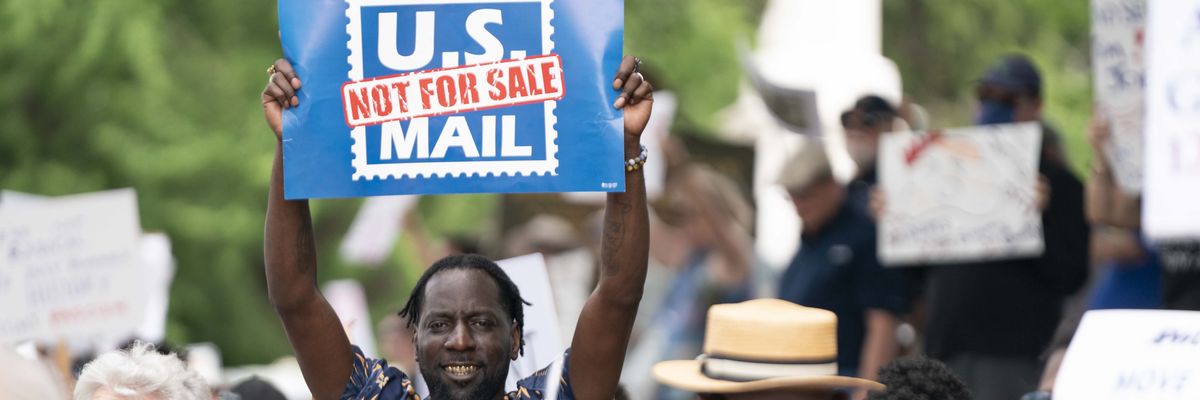
A demonstrator holds a sign supporting the United States Postal Service during in a Hands Off protest on April 5, 2025 in Columbia, South Carolina.
"Without competition from our public Postal Service, for-profit firms would jack up delivery fees on as many customers as possible."
As U.S. President Donald Trump and his centi-billionaire ally Elon Musk revive the right-wing dream to privatize the public mail system, an analysis released Tuesday details how the pain already inflicted on over 100 million Americans by the for-profit delivery industry will only get worse if Trump's plan succeeds.
Americans already have the option of using private companies like FedEx and UPS to mail packages, and in about 25,000 ZIP codes where 102 million people live—about a third of the U.S. population—the corporations already pile on extra charges for deliveries, according to the report by the Institute for Policy Studies (IPS).
Some of the ZIP codes lie in Alaska and Hawaii, where sending mail from the contiguous U.S. is predictably more expensive.
But private carriers also charge "remote surcharges" to about 8% of all U.S. ZIP codes because they are in mountain communities, ranchlands, and other remote areas that are home to nearly 4 million people. According to IPS, people pay up to $15.50 for deliveries in these regions when they use FedEx or UPS, but with the USPS universal service obligation, they pay nothing if they use the public mail carrier.
Thirty-five percent of U.S. ZIP codes are in rural areas where 35 million people pay up to $8.30 in "extended area surcharges" when they use a private delivery company. The companies also charge up to $6.20 for deliveries to certain suburban areas and smaller towns that are home to 19 million.
"Today's higher FedEx and UPS delivery rates are just a taste of what would come if the Trump administration succeeds in privatizing the U.S. Postal Service," said report author Sarah Anderson, director of the Global Economy Project at IPS. "Without competition from our public Postal Service, for-profit firms would jack up delivery fees on as many customers as possible."
Without USPS, the companies could also add to the various extra charges they already impose on customers for Saturday deliveries, fuel, and residential deliveries.
The rural communities that are currently served by USPS at no cost to residents would face a wide range of impacts if Trump moves forward with a reported plan to disband the Postal Board of Governors and place the service under the control of the Department of Commerce—a likely first step toward privatizing the agency.
"Today's higher FedEx and UPS delivery rates are just a taste of what would come if the Trump administration succeeds in privatizing the U.S. Postal Service."
On top of higher costs, these communities would lose postal jobs that pay decent wages with benefits as rural post offices would close. Military veterans, who use USPS to get 84% of their prescriptions and more than 25% of whom live in rural areas, would face potential disruption of essential services, and rural residents would could lose the ability to vote by mail.
Small businesses could face higher shipping costs, leading to lower profits or higher prices for their customers.
Privatizing USPS "could jeopardize our entire system of universal postal service," said Anderson.
The report was published weeks after Musk told a group of Wall Street bankers that USPS is a top target as he seeks to privatize the federal government "as much as possible," and after a Wells Fargo report laid out a five-step plan for privatizing the service.
The bank included in its framework raising USPS parcel service prices by as much as 30%-140%, to "generate economic parcel profits on a standalone basis," selling the service's parcel business to private investors, selling postal real estate to commercial bidders, imposing mass layoffs on USPS' 600,000 workforce, and repealing the Postal Reorganization Act of 1970, which converted the USPS into an independent agency.
IPS warned that postal privatization would "destroy a vital and truly democratic public service."
"This extensive, centuries-old network helped build up America's democracy and economy by spreading information and goods to every corner of the country," said IPS. "Over its 250-year history, USPS has continually reinvented itself in response to changes in technology and the evolving needs of our society. Rather than selling this public treasure off to the highest bidder, we should explore opportunities for strengthening the Postal Service to deliver even better services to the American public in the 21st century."
Dear Common Dreams reader, It’s been nearly 30 years since I co-founded Common Dreams with my late wife, Lina Newhouser. We had the radical notion that journalism should serve the public good, not corporate profits. It was clear to us from the outset what it would take to build such a project. No paid advertisements. No corporate sponsors. No millionaire publisher telling us what to think or do. Many people said we wouldn't last a year, but we proved those doubters wrong. Together with a tremendous team of journalists and dedicated staff, we built an independent media outlet free from the constraints of profits and corporate control. Our mission has always been simple: To inform. To inspire. To ignite change for the common good. Building Common Dreams was not easy. Our survival was never guaranteed. When you take on the most powerful forces—Wall Street greed, fossil fuel industry destruction, Big Tech lobbyists, and uber-rich oligarchs who have spent billions upon billions rigging the economy and democracy in their favor—the only bulwark you have is supporters who believe in your work. But here’s the urgent message from me today. It's never been this bad out there. And it's never been this hard to keep us going. At the very moment Common Dreams is most needed, the threats we face are intensifying. We need your support now more than ever. We don't accept corporate advertising and never will. We don't have a paywall because we don't think people should be blocked from critical news based on their ability to pay. Everything we do is funded by the donations of readers like you. When everyone does the little they can afford, we are strong. But if that support retreats or dries up, so do we. Will you donate now to make sure Common Dreams not only survives but thrives? —Craig Brown, Co-founder |
As U.S. President Donald Trump and his centi-billionaire ally Elon Musk revive the right-wing dream to privatize the public mail system, an analysis released Tuesday details how the pain already inflicted on over 100 million Americans by the for-profit delivery industry will only get worse if Trump's plan succeeds.
Americans already have the option of using private companies like FedEx and UPS to mail packages, and in about 25,000 ZIP codes where 102 million people live—about a third of the U.S. population—the corporations already pile on extra charges for deliveries, according to the report by the Institute for Policy Studies (IPS).
Some of the ZIP codes lie in Alaska and Hawaii, where sending mail from the contiguous U.S. is predictably more expensive.
But private carriers also charge "remote surcharges" to about 8% of all U.S. ZIP codes because they are in mountain communities, ranchlands, and other remote areas that are home to nearly 4 million people. According to IPS, people pay up to $15.50 for deliveries in these regions when they use FedEx or UPS, but with the USPS universal service obligation, they pay nothing if they use the public mail carrier.
Thirty-five percent of U.S. ZIP codes are in rural areas where 35 million people pay up to $8.30 in "extended area surcharges" when they use a private delivery company. The companies also charge up to $6.20 for deliveries to certain suburban areas and smaller towns that are home to 19 million.
"Today's higher FedEx and UPS delivery rates are just a taste of what would come if the Trump administration succeeds in privatizing the U.S. Postal Service," said report author Sarah Anderson, director of the Global Economy Project at IPS. "Without competition from our public Postal Service, for-profit firms would jack up delivery fees on as many customers as possible."
Without USPS, the companies could also add to the various extra charges they already impose on customers for Saturday deliveries, fuel, and residential deliveries.
The rural communities that are currently served by USPS at no cost to residents would face a wide range of impacts if Trump moves forward with a reported plan to disband the Postal Board of Governors and place the service under the control of the Department of Commerce—a likely first step toward privatizing the agency.
"Today's higher FedEx and UPS delivery rates are just a taste of what would come if the Trump administration succeeds in privatizing the U.S. Postal Service."
On top of higher costs, these communities would lose postal jobs that pay decent wages with benefits as rural post offices would close. Military veterans, who use USPS to get 84% of their prescriptions and more than 25% of whom live in rural areas, would face potential disruption of essential services, and rural residents would could lose the ability to vote by mail.
Small businesses could face higher shipping costs, leading to lower profits or higher prices for their customers.
Privatizing USPS "could jeopardize our entire system of universal postal service," said Anderson.
The report was published weeks after Musk told a group of Wall Street bankers that USPS is a top target as he seeks to privatize the federal government "as much as possible," and after a Wells Fargo report laid out a five-step plan for privatizing the service.
The bank included in its framework raising USPS parcel service prices by as much as 30%-140%, to "generate economic parcel profits on a standalone basis," selling the service's parcel business to private investors, selling postal real estate to commercial bidders, imposing mass layoffs on USPS' 600,000 workforce, and repealing the Postal Reorganization Act of 1970, which converted the USPS into an independent agency.
IPS warned that postal privatization would "destroy a vital and truly democratic public service."
"This extensive, centuries-old network helped build up America's democracy and economy by spreading information and goods to every corner of the country," said IPS. "Over its 250-year history, USPS has continually reinvented itself in response to changes in technology and the evolving needs of our society. Rather than selling this public treasure off to the highest bidder, we should explore opportunities for strengthening the Postal Service to deliver even better services to the American public in the 21st century."
As U.S. President Donald Trump and his centi-billionaire ally Elon Musk revive the right-wing dream to privatize the public mail system, an analysis released Tuesday details how the pain already inflicted on over 100 million Americans by the for-profit delivery industry will only get worse if Trump's plan succeeds.
Americans already have the option of using private companies like FedEx and UPS to mail packages, and in about 25,000 ZIP codes where 102 million people live—about a third of the U.S. population—the corporations already pile on extra charges for deliveries, according to the report by the Institute for Policy Studies (IPS).
Some of the ZIP codes lie in Alaska and Hawaii, where sending mail from the contiguous U.S. is predictably more expensive.
But private carriers also charge "remote surcharges" to about 8% of all U.S. ZIP codes because they are in mountain communities, ranchlands, and other remote areas that are home to nearly 4 million people. According to IPS, people pay up to $15.50 for deliveries in these regions when they use FedEx or UPS, but with the USPS universal service obligation, they pay nothing if they use the public mail carrier.
Thirty-five percent of U.S. ZIP codes are in rural areas where 35 million people pay up to $8.30 in "extended area surcharges" when they use a private delivery company. The companies also charge up to $6.20 for deliveries to certain suburban areas and smaller towns that are home to 19 million.
"Today's higher FedEx and UPS delivery rates are just a taste of what would come if the Trump administration succeeds in privatizing the U.S. Postal Service," said report author Sarah Anderson, director of the Global Economy Project at IPS. "Without competition from our public Postal Service, for-profit firms would jack up delivery fees on as many customers as possible."
Without USPS, the companies could also add to the various extra charges they already impose on customers for Saturday deliveries, fuel, and residential deliveries.
The rural communities that are currently served by USPS at no cost to residents would face a wide range of impacts if Trump moves forward with a reported plan to disband the Postal Board of Governors and place the service under the control of the Department of Commerce—a likely first step toward privatizing the agency.
"Today's higher FedEx and UPS delivery rates are just a taste of what would come if the Trump administration succeeds in privatizing the U.S. Postal Service."
On top of higher costs, these communities would lose postal jobs that pay decent wages with benefits as rural post offices would close. Military veterans, who use USPS to get 84% of their prescriptions and more than 25% of whom live in rural areas, would face potential disruption of essential services, and rural residents would could lose the ability to vote by mail.
Small businesses could face higher shipping costs, leading to lower profits or higher prices for their customers.
Privatizing USPS "could jeopardize our entire system of universal postal service," said Anderson.
The report was published weeks after Musk told a group of Wall Street bankers that USPS is a top target as he seeks to privatize the federal government "as much as possible," and after a Wells Fargo report laid out a five-step plan for privatizing the service.
The bank included in its framework raising USPS parcel service prices by as much as 30%-140%, to "generate economic parcel profits on a standalone basis," selling the service's parcel business to private investors, selling postal real estate to commercial bidders, imposing mass layoffs on USPS' 600,000 workforce, and repealing the Postal Reorganization Act of 1970, which converted the USPS into an independent agency.
IPS warned that postal privatization would "destroy a vital and truly democratic public service."
"This extensive, centuries-old network helped build up America's democracy and economy by spreading information and goods to every corner of the country," said IPS. "Over its 250-year history, USPS has continually reinvented itself in response to changes in technology and the evolving needs of our society. Rather than selling this public treasure off to the highest bidder, we should explore opportunities for strengthening the Postal Service to deliver even better services to the American public in the 21st century."