

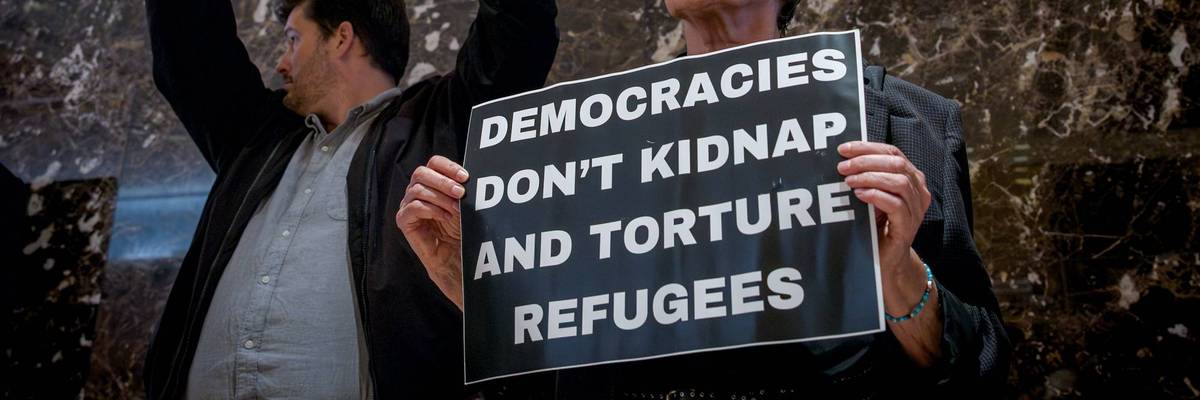
Members of the activist group Rise and Resist were arrested in an act of civil disobedience at Trump Tower in Manhattan on June 9, 2025. Protesters held signs opposing the administration's immigration policies.
'Stunning Betrayal': Refugees at Risk of Arrest Under New DHS Memo
"You cannot invite people under one set of rules and move the goalposts after they arrive," said one group, calling for "lawful, humane, consistent treatment of refugees and allies."
Rights advocates are sounding the alarm over a new US Department of Homeland Security memorandum that puts legal refugees across the United States at risk of arrest as part of President Donald Trump's sweeping anti-immigrant agenda.
The US Department of Justice submitted the memo to a federal judge in the lead-up to a Thursday preliminary injunction hearing about DHS arrests of refugees in Minnesota, where Trump recently sent thousands of immigration agents who were subsequently accused of various acts of violence, including fatally shooting citizens Renee Good and Alex Pretti.
The document was first reported on Wednesday by Law Dork's Chris Geidner, who has unsuccessfully fought to make such filings available remotely. Right now, for this case, they are only available at the federal courthouse in Minnesota.
While the Trump administration claims it is ending "Operation Metro Surge" and removing most Customs and Border Protection (CBP) and Immigration and Customs Enforcement (ICE) agents who have terrorized the Twin Cities, the arrest policy detailed in the memo overhauls a long-standing interpretation of federal law for the entire country.
As American Immigration Council senior fellow Aaron Reichlin-Melnick laid out on social media Thursday: "Refugees are people vetted overseas by US Refugee Officers through an often yearslong process. They enter the country legally and on a path to citizenship. Refugees are required to apply for a green card one year after they arrive, but they CANNOT apply earlier than that."
The Wednesday memo from US Citizenship and Immigration Services Director Joseph Edlow and ICE acting Director Todd Lyons states that after being in the country for a year, refugees "must return, or be returned," to DHS custody "for inspection and examination for admission" as a green-card holder, officially called a lawful permanent resident.
"If the refugee does not voluntarily return, DHS will return the individual to custody (i.e., arrest and detain) for this purpose... DHS may maintain custody for the duration of the inspection and examination process," the memo continues, adding that the detention period "is not indefinite, but also is not limited to merely 48 hours."
Krish O'Mara Vignarajah, president and CEO of Global Refuge, declared in a Thursday statement that "this unprecedented policy weaponizes a routine administrative milestone as a pretext for detention."
"These are families the United States government already screened more rigorously than any other category of immigrant," she stressed. "Only after years of background checks, biometric screenings, and in-person interviews were they invited to rebuild their lives here. To now subject them to arrest and open-ended detention is a stunning betrayal of both our legal commitments and our moral compass."
DHS is claiming—in the memo and on social media, in response to new reporting—that the Refugee Act of 1980 requires the policy. Reichlin-Melnick emphasized that "reaching this conclusion required overturning decades-old interpretations."
"In a section of the memo that is truly Orwellian, the Trump [administration] says it's REFUGEES who have a 'misguided belief' about the law—even though its policy is a brand new interpretation of a 45-year-old law—and so it's THEIR fault they're traumatized when ICE comes to jail them," he noted.
"Making matters worse, the Trump [administration] is REFUSING to adjudicate green-card applications for refugees who come from one of the 39 countries Trump banned," Reichlin-Melnick added. "So under this policy, a refugee who applies for a green card exactly on time, doing nothing wrong, can be jailed by ICE."
The International Refugee Assistance Project is representing refugees in the Minnesota case. IRAP's vice president of US legal programs, Laurie Ball Cooper, told CNN that "this memo is part of a broad and concerted effort to strip refugees of their legal status and render them deportable... This government will clearly stop at nothing to terrorize refugee communities, and really all immigrants, while trampling over our constitutional rights."
Beth Oppenheim, CEO of HIAS, the world's oldest refugee agency, agreed that "this policy is a transparent effort to detain and potentially deport thousands of people who are legally present in this country, people the US government itself welcomed after years of extreme vetting."
"I have never seen anything like this in my 25 years of refugee protection work," Oppenheim said. "This memo was done in secret, with zero coordination with the organizations that serve refugees. It is a betrayal of our values and our legal commitments, and it will cause extraordinary harm."
Vignarajah also described the memo as "a broad attempt to redefine refugee status as conditional and revocable at will," and argued that "you do not welcome families fleeing war and persecution under one set of rules and then move the goalposts after they arrive."
Calling for "lawful, humane, consistent treatment of refugees and allies," AfghanEvac similarly said on social media that "you cannot invite people under one set of rules and move the goalposts after they arrive."
We are at a crossroads
This country and this world are at a monumental crossroads. In a few short weeks, US voters will have an opportunity to beat back the forces of fascism and confront the billionaires who are rigging the economy, our media system, and our democracy, making it increasingly impossible for ordinary people to get by. We’re not just talking about the election. We’re talking about what must be done once these fascist elements are vanquished from power. We need a bolder set of solutions than what either major party has so far been willing to offer and a working-class movement ready to fight like hell for it. Trump didn't emerge from nowhere. The conditions that fueled MAGA authoritarianism were created by decades of radical neoliberal economic policies and a corrupt political system dominated by corporate interests. They slashed taxes on the super-rich, promising that the benefits would trickle down. They said giveaways to the corporate titans would make life more affordable for the rest of us. It was all bullshit. And when a bitter, betrayed populace searches for someone to blame, right-wing demagogues have little trouble finding scapegoats. People know when they're being lied to, but you won't hear any of this from the corporate media. Only independent journalism—powered and funded by people who believe in building a better world—can deliver truly trustworthy daily news. Our Fall Campaign is underway, and we need your help. To power our newsroom through the rest of the year, we need to raise $125,000 by midnight on October 31. So if you share our vision, please contribute whatever you can to sustain our work. |
Rights advocates are sounding the alarm over a new US Department of Homeland Security memorandum that puts legal refugees across the United States at risk of arrest as part of President Donald Trump's sweeping anti-immigrant agenda.
The US Department of Justice submitted the memo to a federal judge in the lead-up to a Thursday preliminary injunction hearing about DHS arrests of refugees in Minnesota, where Trump recently sent thousands of immigration agents who were subsequently accused of various acts of violence, including fatally shooting citizens Renee Good and Alex Pretti.
The document was first reported on Wednesday by Law Dork's Chris Geidner, who has unsuccessfully fought to make such filings available remotely. Right now, for this case, they are only available at the federal courthouse in Minnesota.
While the Trump administration claims it is ending "Operation Metro Surge" and removing most Customs and Border Protection (CBP) and Immigration and Customs Enforcement (ICE) agents who have terrorized the Twin Cities, the arrest policy detailed in the memo overhauls a long-standing interpretation of federal law for the entire country.
As American Immigration Council senior fellow Aaron Reichlin-Melnick laid out on social media Thursday: "Refugees are people vetted overseas by US Refugee Officers through an often yearslong process. They enter the country legally and on a path to citizenship. Refugees are required to apply for a green card one year after they arrive, but they CANNOT apply earlier than that."
The Wednesday memo from US Citizenship and Immigration Services Director Joseph Edlow and ICE acting Director Todd Lyons states that after being in the country for a year, refugees "must return, or be returned," to DHS custody "for inspection and examination for admission" as a green-card holder, officially called a lawful permanent resident.
"If the refugee does not voluntarily return, DHS will return the individual to custody (i.e., arrest and detain) for this purpose... DHS may maintain custody for the duration of the inspection and examination process," the memo continues, adding that the detention period "is not indefinite, but also is not limited to merely 48 hours."
Krish O'Mara Vignarajah, president and CEO of Global Refuge, declared in a Thursday statement that "this unprecedented policy weaponizes a routine administrative milestone as a pretext for detention."
"These are families the United States government already screened more rigorously than any other category of immigrant," she stressed. "Only after years of background checks, biometric screenings, and in-person interviews were they invited to rebuild their lives here. To now subject them to arrest and open-ended detention is a stunning betrayal of both our legal commitments and our moral compass."
DHS is claiming—in the memo and on social media, in response to new reporting—that the Refugee Act of 1980 requires the policy. Reichlin-Melnick emphasized that "reaching this conclusion required overturning decades-old interpretations."
"In a section of the memo that is truly Orwellian, the Trump [administration] says it's REFUGEES who have a 'misguided belief' about the law—even though its policy is a brand new interpretation of a 45-year-old law—and so it's THEIR fault they're traumatized when ICE comes to jail them," he noted.
"Making matters worse, the Trump [administration] is REFUSING to adjudicate green-card applications for refugees who come from one of the 39 countries Trump banned," Reichlin-Melnick added. "So under this policy, a refugee who applies for a green card exactly on time, doing nothing wrong, can be jailed by ICE."
The International Refugee Assistance Project is representing refugees in the Minnesota case. IRAP's vice president of US legal programs, Laurie Ball Cooper, told CNN that "this memo is part of a broad and concerted effort to strip refugees of their legal status and render them deportable... This government will clearly stop at nothing to terrorize refugee communities, and really all immigrants, while trampling over our constitutional rights."
Beth Oppenheim, CEO of HIAS, the world's oldest refugee agency, agreed that "this policy is a transparent effort to detain and potentially deport thousands of people who are legally present in this country, people the US government itself welcomed after years of extreme vetting."
"I have never seen anything like this in my 25 years of refugee protection work," Oppenheim said. "This memo was done in secret, with zero coordination with the organizations that serve refugees. It is a betrayal of our values and our legal commitments, and it will cause extraordinary harm."
Vignarajah also described the memo as "a broad attempt to redefine refugee status as conditional and revocable at will," and argued that "you do not welcome families fleeing war and persecution under one set of rules and then move the goalposts after they arrive."
Calling for "lawful, humane, consistent treatment of refugees and allies," AfghanEvac similarly said on social media that "you cannot invite people under one set of rules and move the goalposts after they arrive."
- 'Not an Anomaly... A Blueprint': Homan Says Minnesota ICE Surge Ending—But Mass Deportations Aren't ›
- ACLU Calls On UN to Initiate 'Urgent Action' Protocols Over Trump's Authoritarian Abuses in Minnesota ›
- 'Unspeakably Cruel': Trump Freezes Green Cards to 235,000 Refugees Admitted Under Biden ›
- Trump Ripped for 'Absurdly Low' and 'Racist' Refugee Cap Prioritizing White South Africans ›
- Trump to Slash Refugee Numbers to Record Low, With White South Africans Taking Most Spots ›
Rights advocates are sounding the alarm over a new US Department of Homeland Security memorandum that puts legal refugees across the United States at risk of arrest as part of President Donald Trump's sweeping anti-immigrant agenda.
The US Department of Justice submitted the memo to a federal judge in the lead-up to a Thursday preliminary injunction hearing about DHS arrests of refugees in Minnesota, where Trump recently sent thousands of immigration agents who were subsequently accused of various acts of violence, including fatally shooting citizens Renee Good and Alex Pretti.
The document was first reported on Wednesday by Law Dork's Chris Geidner, who has unsuccessfully fought to make such filings available remotely. Right now, for this case, they are only available at the federal courthouse in Minnesota.
While the Trump administration claims it is ending "Operation Metro Surge" and removing most Customs and Border Protection (CBP) and Immigration and Customs Enforcement (ICE) agents who have terrorized the Twin Cities, the arrest policy detailed in the memo overhauls a long-standing interpretation of federal law for the entire country.
As American Immigration Council senior fellow Aaron Reichlin-Melnick laid out on social media Thursday: "Refugees are people vetted overseas by US Refugee Officers through an often yearslong process. They enter the country legally and on a path to citizenship. Refugees are required to apply for a green card one year after they arrive, but they CANNOT apply earlier than that."
The Wednesday memo from US Citizenship and Immigration Services Director Joseph Edlow and ICE acting Director Todd Lyons states that after being in the country for a year, refugees "must return, or be returned," to DHS custody "for inspection and examination for admission" as a green-card holder, officially called a lawful permanent resident.
"If the refugee does not voluntarily return, DHS will return the individual to custody (i.e., arrest and detain) for this purpose... DHS may maintain custody for the duration of the inspection and examination process," the memo continues, adding that the detention period "is not indefinite, but also is not limited to merely 48 hours."
Krish O'Mara Vignarajah, president and CEO of Global Refuge, declared in a Thursday statement that "this unprecedented policy weaponizes a routine administrative milestone as a pretext for detention."
"These are families the United States government already screened more rigorously than any other category of immigrant," she stressed. "Only after years of background checks, biometric screenings, and in-person interviews were they invited to rebuild their lives here. To now subject them to arrest and open-ended detention is a stunning betrayal of both our legal commitments and our moral compass."
DHS is claiming—in the memo and on social media, in response to new reporting—that the Refugee Act of 1980 requires the policy. Reichlin-Melnick emphasized that "reaching this conclusion required overturning decades-old interpretations."
"In a section of the memo that is truly Orwellian, the Trump [administration] says it's REFUGEES who have a 'misguided belief' about the law—even though its policy is a brand new interpretation of a 45-year-old law—and so it's THEIR fault they're traumatized when ICE comes to jail them," he noted.
"Making matters worse, the Trump [administration] is REFUSING to adjudicate green-card applications for refugees who come from one of the 39 countries Trump banned," Reichlin-Melnick added. "So under this policy, a refugee who applies for a green card exactly on time, doing nothing wrong, can be jailed by ICE."
The International Refugee Assistance Project is representing refugees in the Minnesota case. IRAP's vice president of US legal programs, Laurie Ball Cooper, told CNN that "this memo is part of a broad and concerted effort to strip refugees of their legal status and render them deportable... This government will clearly stop at nothing to terrorize refugee communities, and really all immigrants, while trampling over our constitutional rights."
Beth Oppenheim, CEO of HIAS, the world's oldest refugee agency, agreed that "this policy is a transparent effort to detain and potentially deport thousands of people who are legally present in this country, people the US government itself welcomed after years of extreme vetting."
"I have never seen anything like this in my 25 years of refugee protection work," Oppenheim said. "This memo was done in secret, with zero coordination with the organizations that serve refugees. It is a betrayal of our values and our legal commitments, and it will cause extraordinary harm."
Vignarajah also described the memo as "a broad attempt to redefine refugee status as conditional and revocable at will," and argued that "you do not welcome families fleeing war and persecution under one set of rules and then move the goalposts after they arrive."
Calling for "lawful, humane, consistent treatment of refugees and allies," AfghanEvac similarly said on social media that "you cannot invite people under one set of rules and move the goalposts after they arrive."
- 'Not an Anomaly... A Blueprint': Homan Says Minnesota ICE Surge Ending—But Mass Deportations Aren't ›
- ACLU Calls On UN to Initiate 'Urgent Action' Protocols Over Trump's Authoritarian Abuses in Minnesota ›
- 'Unspeakably Cruel': Trump Freezes Green Cards to 235,000 Refugees Admitted Under Biden ›
- Trump Ripped for 'Absurdly Low' and 'Racist' Refugee Cap Prioritizing White South Africans ›
- Trump to Slash Refugee Numbers to Record Low, With White South Africans Taking Most Spots ›