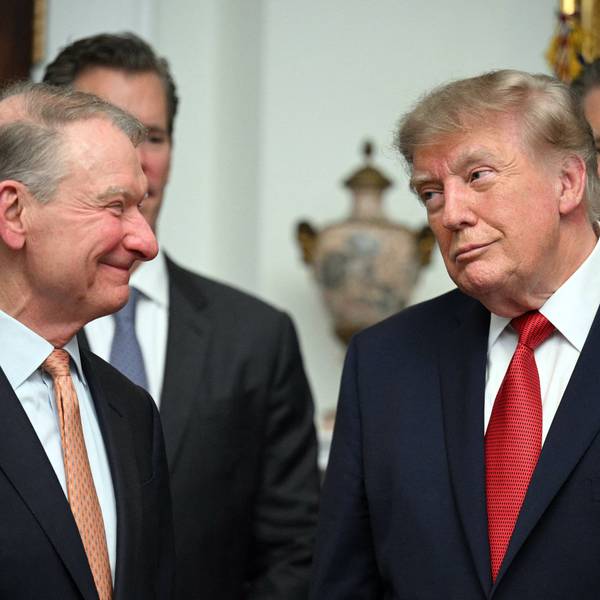
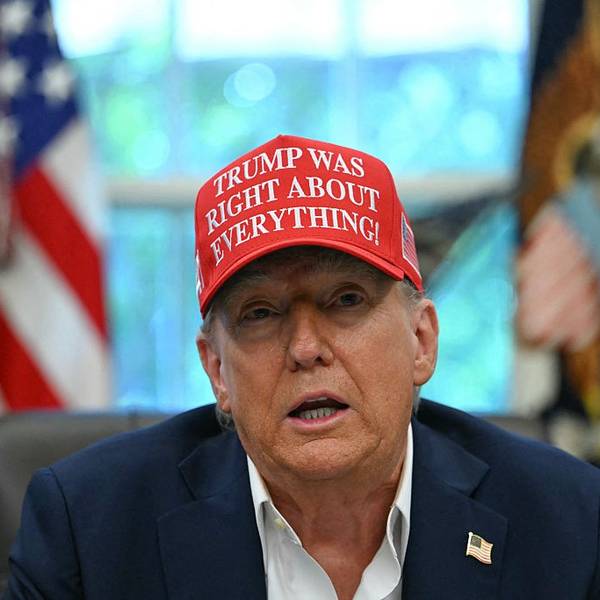
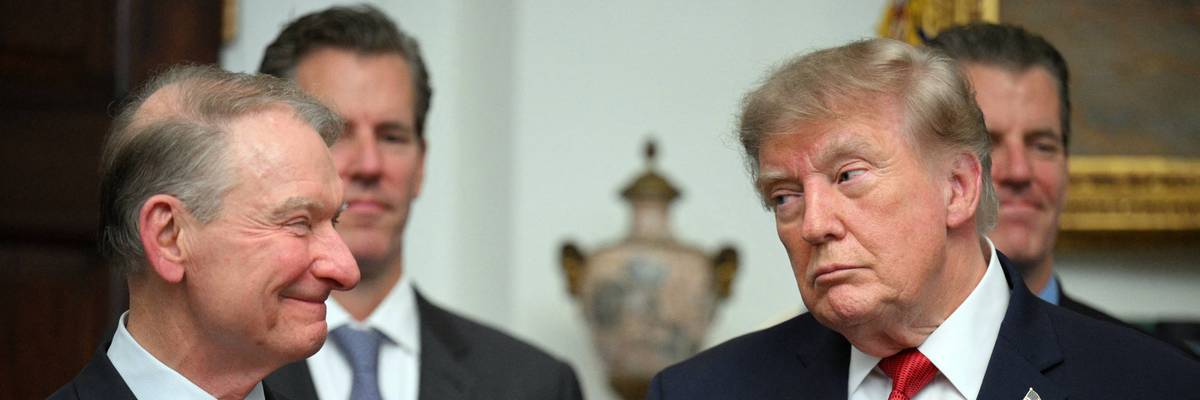
US President Donald Trump speaks with Securities and Exchange Commission Chairman Paul Atkins during a meeting on August 19, 2026.
New Proposal From Trump SEC 'Makes Buying Politicians Great Again,' Watchdog Warns
"Donald Trump and his administration are rigging our markets to work for the wealthy and well-connected while working people pay the price."
The US Securities and Exchange Commission on Thursday proposed axing anti-corruption rules designed to prevent investment advisers from using political donations to obtain business from public pension funds.
Finance industry watchdogs and Democratic lawmakers warned the SEC's proposal would potentially harm Americans' retirement accounts and further boost corruption in the federal government, where graft has become increasingly common and overt under the leadership of billionaire President Donald Trump. Better Markets said the SEC's plan to rescind the agency's longstanding "pay to-play" regulations "makes buying politicians great again."
“SEC Chair Paul Atkins has yet to meet a rule he does not want to rescind," said Benjamin Schiffrin, director of securities policy at Better Markets. "He has the SEC proposing to rescind a rule that prevents so-called ‘pay-to-play’ practices by investment advisers, where advisers make political contributions to government officials in the hopes that those officials will select them for the lucrative assignment of managing public pension funds and other government assets."
“Chair Atkins says the SEC is proposing to rescind the rule because it ‘has effectively resulted in the suppression of political speech.’ Not so," added Schiffrin. "It has resulted in the suppression of corruption. The rule was intended to, and does, ‘combat pay to play arrangements in which advisers are chosen based on their campaign contributions to political officials rather than on merit.’ Chair Atkins apparently believes that such arrangements should be promoted.”
The SEC's "pay-to-play" rules, enacted in 2010, barred investment advisers from providing paid services to government clients for at least two years after making a political contribution to an elected official or candidate.
The Trump SEC's proposal will face a 60-day public comment period once it is published in the Federal Register.
The Lever's Katya Schwenk and Freddy Brewster noted Friday that "after years of relatively weak enforcement, Biden’s SEC brought several charges against investment advisers for violating the pay-to-play rule in 2023 and 2024." For example, the Biden SEC charged Obra Capital Management for "continuing to provide investment advisory services for compensation from a government entity following a campaign contribution made by an associate to an elected official with influence over selecting investment advisers for the government entity."
"Since Trump came to office, the pay-to-play rule has been the subject of lobbying by financial powerhouses that are invested in public pension funds," Schwenk and Brewster reported. "BlackRock Funds Services Group, LLC, a subsidiary of the world’s largest asset manager BlackRock, Inc., spent more than $1.5 million in 2025 lobbying the SEC, Congress, the White House, and other regulators on the pay-to-play rule, among other matters, disclosures show."
Sen. Elizabeth Warren (D-Mass.), the top Democrat on the Senate Banking Committee, said in a statement Thursday that the rules targeted by Trump's SEC prevent "elected officials from rewarding wealthy campaign donors with lucrative contracts to advise government investments."
The proposed rollback, said Warren, represents "another example of how Donald Trump and his administration are rigging our markets to work for the wealthy and well-connected while working people pay the price.”
We are at a crossroads
This country and this world are at a monumental crossroads. In a few short weeks, US voters will have an opportunity to beat back the forces of fascism and confront the billionaires who are rigging the economy, our media system, and our democracy, making it increasingly impossible for ordinary people to get by. We’re not just talking about the election. We’re talking about what must be done once these fascist elements are vanquished from power. We need a bolder set of solutions than what either major party has so far been willing to offer and a working-class movement ready to fight like hell for it. Trump didn't emerge from nowhere. The conditions that fueled MAGA authoritarianism were created by decades of radical neoliberal economic policies and a corrupt political system dominated by corporate interests. They slashed taxes on the super-rich, promising that the benefits would trickle down. They said giveaways to the corporate titans would make life more affordable for the rest of us. It was all bullshit. And when a bitter, betrayed populace searches for someone to blame, right-wing demagogues have little trouble finding scapegoats. People know when they're being lied to, but you won't hear any of this from the corporate media. Only independent journalism—powered and funded by people who believe in building a better world—can deliver truly trustworthy daily news. Our Fall Campaign is underway, and we need your help. To power our newsroom through the rest of the year, we need to raise $125,000 by midnight on October 31. So if you share our vision, please contribute whatever you can to sustain our work. |
The US Securities and Exchange Commission on Thursday proposed axing anti-corruption rules designed to prevent investment advisers from using political donations to obtain business from public pension funds.
Finance industry watchdogs and Democratic lawmakers warned the SEC's proposal would potentially harm Americans' retirement accounts and further boost corruption in the federal government, where graft has become increasingly common and overt under the leadership of billionaire President Donald Trump. Better Markets said the SEC's plan to rescind the agency's longstanding "pay to-play" regulations "makes buying politicians great again."
“SEC Chair Paul Atkins has yet to meet a rule he does not want to rescind," said Benjamin Schiffrin, director of securities policy at Better Markets. "He has the SEC proposing to rescind a rule that prevents so-called ‘pay-to-play’ practices by investment advisers, where advisers make political contributions to government officials in the hopes that those officials will select them for the lucrative assignment of managing public pension funds and other government assets."
“Chair Atkins says the SEC is proposing to rescind the rule because it ‘has effectively resulted in the suppression of political speech.’ Not so," added Schiffrin. "It has resulted in the suppression of corruption. The rule was intended to, and does, ‘combat pay to play arrangements in which advisers are chosen based on their campaign contributions to political officials rather than on merit.’ Chair Atkins apparently believes that such arrangements should be promoted.”
The SEC's "pay-to-play" rules, enacted in 2010, barred investment advisers from providing paid services to government clients for at least two years after making a political contribution to an elected official or candidate.
The Trump SEC's proposal will face a 60-day public comment period once it is published in the Federal Register.
The Lever's Katya Schwenk and Freddy Brewster noted Friday that "after years of relatively weak enforcement, Biden’s SEC brought several charges against investment advisers for violating the pay-to-play rule in 2023 and 2024." For example, the Biden SEC charged Obra Capital Management for "continuing to provide investment advisory services for compensation from a government entity following a campaign contribution made by an associate to an elected official with influence over selecting investment advisers for the government entity."
"Since Trump came to office, the pay-to-play rule has been the subject of lobbying by financial powerhouses that are invested in public pension funds," Schwenk and Brewster reported. "BlackRock Funds Services Group, LLC, a subsidiary of the world’s largest asset manager BlackRock, Inc., spent more than $1.5 million in 2025 lobbying the SEC, Congress, the White House, and other regulators on the pay-to-play rule, among other matters, disclosures show."
Sen. Elizabeth Warren (D-Mass.), the top Democrat on the Senate Banking Committee, said in a statement Thursday that the rules targeted by Trump's SEC prevent "elected officials from rewarding wealthy campaign donors with lucrative contracts to advise government investments."
The proposed rollback, said Warren, represents "another example of how Donald Trump and his administration are rigging our markets to work for the wealthy and well-connected while working people pay the price.”
The US Securities and Exchange Commission on Thursday proposed axing anti-corruption rules designed to prevent investment advisers from using political donations to obtain business from public pension funds.
Finance industry watchdogs and Democratic lawmakers warned the SEC's proposal would potentially harm Americans' retirement accounts and further boost corruption in the federal government, where graft has become increasingly common and overt under the leadership of billionaire President Donald Trump. Better Markets said the SEC's plan to rescind the agency's longstanding "pay to-play" regulations "makes buying politicians great again."
“SEC Chair Paul Atkins has yet to meet a rule he does not want to rescind," said Benjamin Schiffrin, director of securities policy at Better Markets. "He has the SEC proposing to rescind a rule that prevents so-called ‘pay-to-play’ practices by investment advisers, where advisers make political contributions to government officials in the hopes that those officials will select them for the lucrative assignment of managing public pension funds and other government assets."
“Chair Atkins says the SEC is proposing to rescind the rule because it ‘has effectively resulted in the suppression of political speech.’ Not so," added Schiffrin. "It has resulted in the suppression of corruption. The rule was intended to, and does, ‘combat pay to play arrangements in which advisers are chosen based on their campaign contributions to political officials rather than on merit.’ Chair Atkins apparently believes that such arrangements should be promoted.”
The SEC's "pay-to-play" rules, enacted in 2010, barred investment advisers from providing paid services to government clients for at least two years after making a political contribution to an elected official or candidate.
The Trump SEC's proposal will face a 60-day public comment period once it is published in the Federal Register.
The Lever's Katya Schwenk and Freddy Brewster noted Friday that "after years of relatively weak enforcement, Biden’s SEC brought several charges against investment advisers for violating the pay-to-play rule in 2023 and 2024." For example, the Biden SEC charged Obra Capital Management for "continuing to provide investment advisory services for compensation from a government entity following a campaign contribution made by an associate to an elected official with influence over selecting investment advisers for the government entity."
"Since Trump came to office, the pay-to-play rule has been the subject of lobbying by financial powerhouses that are invested in public pension funds," Schwenk and Brewster reported. "BlackRock Funds Services Group, LLC, a subsidiary of the world’s largest asset manager BlackRock, Inc., spent more than $1.5 million in 2025 lobbying the SEC, Congress, the White House, and other regulators on the pay-to-play rule, among other matters, disclosures show."
Sen. Elizabeth Warren (D-Mass.), the top Democrat on the Senate Banking Committee, said in a statement Thursday that the rules targeted by Trump's SEC prevent "elected officials from rewarding wealthy campaign donors with lucrative contracts to advise government investments."
The proposed rollback, said Warren, represents "another example of how Donald Trump and his administration are rigging our markets to work for the wealthy and well-connected while working people pay the price.”