SUBSCRIBE TO OUR FREE NEWSLETTER
Daily news & progressive opinion—funded by the people, not the corporations—delivered straight to your inbox.
5
#000000
#FFFFFF
To donate by check, phone, or other method, see our More Ways to Give page.
Embedded in the House GOP's advancing reconciliation package is a major, long-sought victory for school privatization advocates that would let rich funders of vouchers avoid taxation, a change that opponents warned would supercharge the right-wing assault on public education.
The measure, which resembles the GOP-authored Educational Choice for Children Act (ECCA), was tucked into the House Republican tax legislation that passed out of the chamber's Ways and Means Committee earlier this week.
In effect, according to an analysis published Thursday by the Institute on Taxation and Economic Policy (ITEP), the legislation "allows wealthy individuals to avoid paying capital gains tax as a reward for funneling public funds into private schools."
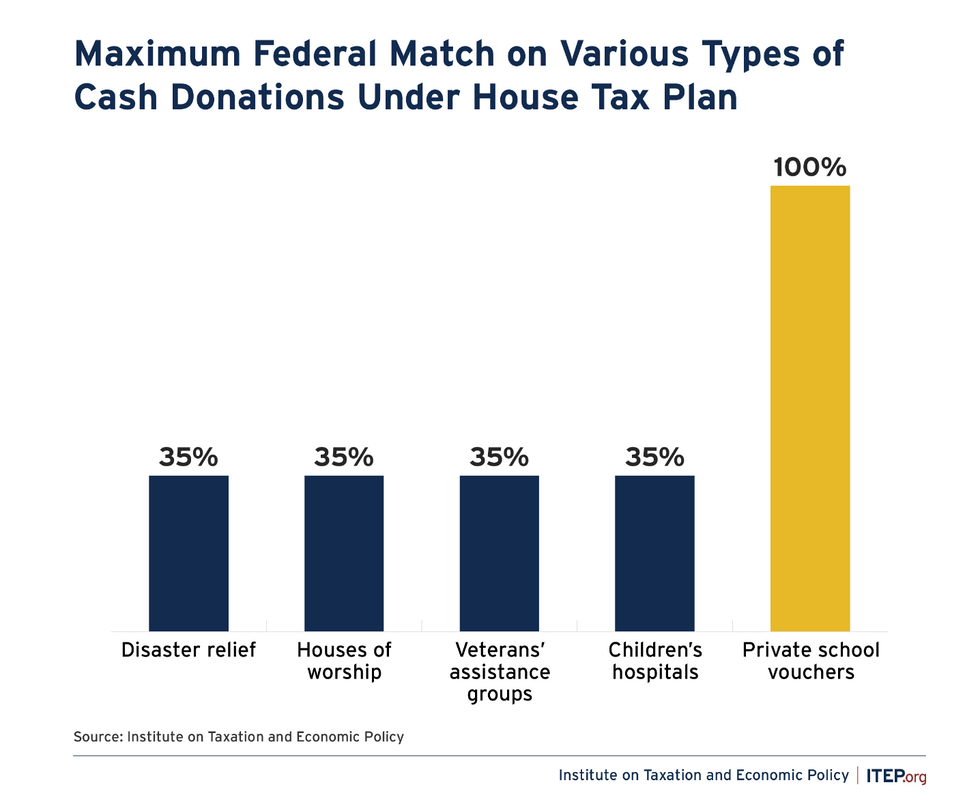
"While the bill significantly cuts charitable giving incentives overall, nonprofits that commit to focusing solely on supporting private K-12 schools would be spared from those cuts and see their donors' tax incentive almost triple relative to what they receive today," ITEP explained. "On top of that, the bill goes out of its way to provide school voucher donors who contribute corporate stock with an extra layer of tax subsidy that works as a lucrative tax shelter."
"The House tax plan would create a system that treats people supporting private K-12 vouchers far more generously than donors to children's hospitals, veterans' groups, and every other cause imaginable," the group added.
ITEP estimated that if the policy had been in effect in 2021, billionaire Elon Musk could have saved $690 million in federal capital gains taxes.
"By putting this arrangement on the books," ITEP said, "the bill's proponents have ensured that there will be an eager pool of wealthy donors lined up to help move public funds into private schools, and to collect their capital gains tax cuts as a reward."
Josh Cowen, a professor of education policy at Michigan State University, said Republicans' effort to ram the tax scheme through as part of their filibuster-proof reconciliation package is a testament to the unpopularity of school privatization at the state and local levels.
"People don't like this stuff," Cowen told Roll Call. "Voters, whether they're Republican or Democrat, look at this stuff, and they're like, what does this really do for me?"
Supporters of school privatization were quick to celebrate the inclusion of tax breaks for voucher donors, with the American Federation for Children applauding Republican leaders for their "relentless commitment to ensuring school choice becomes the law of the land."
The American Federation for Children is funded by the family of billionaire Betsy DeVos, who served as education secretary during President Donald Trump's first term.
The DeVos family is part of a network of deep-pocketed school privatization proponents that has been working for years to siphon taxpayer funding away from public schools and toward private—often religious—institutions.
Randi Weingarten, president of the American Federation of Teachers, told The New York Times on Tuesday that voucher supporters "don't believe in public schooling."
"We are against giving people tax breaks to defund public schools," the union leader said. "What you're seeing here is the fragmentation of American education."
The National Education Association, the largest teachers' union in the U.S., has also voiced opposition to the voucher tax break scheme, writing in a letter to members of the House Ways and Means Committee earlier this week that "taxpayer dollars should go to public schools open to all students, not private schools that can pick and choose their students."
"Every time voucher schemes are on state ballots—17 times in total, including three states last November—voters have rejected them," reads the letter. "America cannot afford to fund two education systems, one private and one public."
Embedded in the House GOP's advancing reconciliation package is a major, long-sought victory for school privatization advocates that would let rich funders of vouchers avoid taxation, a change that opponents warned would supercharge the right-wing assault on public education.
The measure, which resembles the GOP-authored Educational Choice for Children Act (ECCA), was tucked into the House Republican tax legislation that passed out of the chamber's Ways and Means Committee earlier this week.
In effect, according to an analysis published Thursday by the Institute on Taxation and Economic Policy (ITEP), the legislation "allows wealthy individuals to avoid paying capital gains tax as a reward for funneling public funds into private schools."
"While the bill significantly cuts charitable giving incentives overall, nonprofits that commit to focusing solely on supporting private K-12 schools would be spared from those cuts and see their donors' tax incentive almost triple relative to what they receive today," ITEP explained. "On top of that, the bill goes out of its way to provide school voucher donors who contribute corporate stock with an extra layer of tax subsidy that works as a lucrative tax shelter."
"The House tax plan would create a system that treats people supporting private K-12 vouchers far more generously than donors to children's hospitals, veterans' groups, and every other cause imaginable," the group added.
ITEP estimated that if the policy had been in effect in 2021, billionaire Elon Musk could have saved $690 million in federal capital gains taxes.
"By putting this arrangement on the books," ITEP said, "the bill's proponents have ensured that there will be an eager pool of wealthy donors lined up to help move public funds into private schools, and to collect their capital gains tax cuts as a reward."
Josh Cowen, a professor of education policy at Michigan State University, said Republicans' effort to ram the tax scheme through as part of their filibuster-proof reconciliation package is a testament to the unpopularity of school privatization at the state and local levels.
"People don't like this stuff," Cowen told Roll Call. "Voters, whether they're Republican or Democrat, look at this stuff, and they're like, what does this really do for me?"
Supporters of school privatization were quick to celebrate the inclusion of tax breaks for voucher donors, with the American Federation for Children applauding Republican leaders for their "relentless commitment to ensuring school choice becomes the law of the land."
The American Federation for Children is funded by the family of billionaire Betsy DeVos, who served as education secretary during President Donald Trump's first term.
The DeVos family is part of a network of deep-pocketed school privatization proponents that has been working for years to siphon taxpayer funding away from public schools and toward private—often religious—institutions.
Randi Weingarten, president of the American Federation of Teachers, told The New York Times on Tuesday that voucher supporters "don't believe in public schooling."
"We are against giving people tax breaks to defund public schools," the union leader said. "What you're seeing here is the fragmentation of American education."
The National Education Association, the largest teachers' union in the U.S., has also voiced opposition to the voucher tax break scheme, writing in a letter to members of the House Ways and Means Committee earlier this week that "taxpayer dollars should go to public schools open to all students, not private schools that can pick and choose their students."
"Every time voucher schemes are on state ballots—17 times in total, including three states last November—voters have rejected them," reads the letter. "America cannot afford to fund two education systems, one private and one public."
Embedded in the House GOP's advancing reconciliation package is a major, long-sought victory for school privatization advocates that would let rich funders of vouchers avoid taxation, a change that opponents warned would supercharge the right-wing assault on public education.
The measure, which resembles the GOP-authored Educational Choice for Children Act (ECCA), was tucked into the House Republican tax legislation that passed out of the chamber's Ways and Means Committee earlier this week.
In effect, according to an analysis published Thursday by the Institute on Taxation and Economic Policy (ITEP), the legislation "allows wealthy individuals to avoid paying capital gains tax as a reward for funneling public funds into private schools."
"While the bill significantly cuts charitable giving incentives overall, nonprofits that commit to focusing solely on supporting private K-12 schools would be spared from those cuts and see their donors' tax incentive almost triple relative to what they receive today," ITEP explained. "On top of that, the bill goes out of its way to provide school voucher donors who contribute corporate stock with an extra layer of tax subsidy that works as a lucrative tax shelter."
"The House tax plan would create a system that treats people supporting private K-12 vouchers far more generously than donors to children's hospitals, veterans' groups, and every other cause imaginable," the group added.
ITEP estimated that if the policy had been in effect in 2021, billionaire Elon Musk could have saved $690 million in federal capital gains taxes.
"By putting this arrangement on the books," ITEP said, "the bill's proponents have ensured that there will be an eager pool of wealthy donors lined up to help move public funds into private schools, and to collect their capital gains tax cuts as a reward."
Josh Cowen, a professor of education policy at Michigan State University, said Republicans' effort to ram the tax scheme through as part of their filibuster-proof reconciliation package is a testament to the unpopularity of school privatization at the state and local levels.
"People don't like this stuff," Cowen told Roll Call. "Voters, whether they're Republican or Democrat, look at this stuff, and they're like, what does this really do for me?"
Supporters of school privatization were quick to celebrate the inclusion of tax breaks for voucher donors, with the American Federation for Children applauding Republican leaders for their "relentless commitment to ensuring school choice becomes the law of the land."
The American Federation for Children is funded by the family of billionaire Betsy DeVos, who served as education secretary during President Donald Trump's first term.
The DeVos family is part of a network of deep-pocketed school privatization proponents that has been working for years to siphon taxpayer funding away from public schools and toward private—often religious—institutions.
Randi Weingarten, president of the American Federation of Teachers, told The New York Times on Tuesday that voucher supporters "don't believe in public schooling."
"We are against giving people tax breaks to defund public schools," the union leader said. "What you're seeing here is the fragmentation of American education."
The National Education Association, the largest teachers' union in the U.S., has also voiced opposition to the voucher tax break scheme, writing in a letter to members of the House Ways and Means Committee earlier this week that "taxpayer dollars should go to public schools open to all students, not private schools that can pick and choose their students."
"Every time voucher schemes are on state ballots—17 times in total, including three states last November—voters have rejected them," reads the letter. "America cannot afford to fund two education systems, one private and one public."