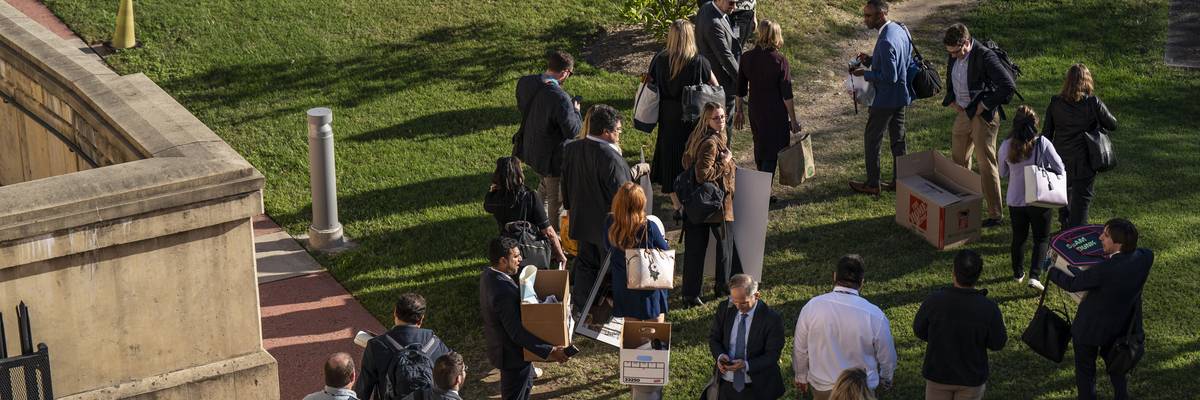
Reporters walk out together after turning in their credentials for refusing to sign new reporting limits dictated by Secretary of Defense Pete Hegseth at the Pentagon on October 15, 2025 in Arlington, Virginia.
After NYT Sues Over Pentagon Policy, Press Advocates 'Urge Other News Outlets to Follow'
"The only way to put an end to the Trump administration's multipronged assault on press freedom is for every news outlet to fight back at every opportunity," said the head of the Freedom of the Press Foundation.
Press freedom advocates on Thursday welcomed the New York Times' lawsuit over the US Department of Defense's "flatly unconstitutional" press policy, filed on the heels of the first briefing for what critics call the "Pentagon Propaganda Corps."
The newspaper and Times reporter Julian E. Barnes, one of several journalists who refused to sign the policy earlier this year, are suing the DOD—which President Donald Trump has dubbed the Department of War—as well as Defense Secretary Pete Hegseth and the Pentagon's chief spokesperson, Sean Parnell, in the US District Court in Washington, D.C.
The plaintiffs are asking Judge Paul L. Friedman, an appointee of former President Bill Clinton, to strike down provisions of the Pentagon policy that violate their First and Fifth Amendment rights, and warn that "if allowed to stand, that policy will upend the longstanding and 'healthy adversarial tension between the government, which may seek to keep its secrets' and 'the press, which may endeavor to' report them... and will deprive the public of vital information about the United States military and its leadership."
The filing notably comes not only as the DOD celebrates that dozens of "independent journalists, bloggers, and social media influencers" who "are not associated with legacy media outlets, including print media such as newspapers and magazines, and broadcast media, such as cable television news," have joined the new Pentagon Press Corps in exchange for signing the controversial agreement, but also as Trump and Hegseth face mounting outrage over boat bombings that experts argue are "war crimes, murder, or both."
Charlie Stadtlander, a spokesperson for the newspaper, said in a statement that "the Times stands with fellow news organizations across digital, print, and broadcast media, including many conservative outlets, in strongly opposing this unprecedented policy."
The paper has hired a prominent First Amendment lawyer, Theodore J. Boutrous Jr. of Gibson Dunn. The Washington Post reported that "lawyers representing the Times said they discussed litigation with other news organizations but ultimately decided to proceed on their own. They said they would welcome other outlets filing their own lawsuits or amicus briefs in the Times' case."
While Parnell said in a statement that "we are aware of the New York Times lawsuit and look forward to addressing these arguments in court," journalists and media advocacy groups are already signaling support for the newspaper—which is also battling a $15 billion defamation suit refiled by the president in October.
Reporters Committee for Freedom of the Press vice president of policy Gabe Rottman said Thursday that "the Pentagon's press access policy is unlawful because it gives government officials unchecked power over who gets a credential and who doesn't, something the First Amendment prohibits."
"The public needs independent journalism and the reporters who deliver it back in the Pentagon at a time of heightened scrutiny of the department's actions," he asserted. "We look forward to lending our voice in support of this suit."
The Pentagon Press Association said it was "encouraged by the New York Times' effort to step up and defend press freedom," while White House Correspondents' Association president Weijia Jiang declared that the WHCA "stands firmly" with the newspaper and described the suit as "a necessary and vital step to ensure journalists can do their jobs."
Clayton Weimers, executive director for Reporters Without Borders USA, said that "it's great to see the New York Times continue to proactively defend press freedom in the courts as well as on their pages. We all know by now that capitulation to Donald Trump's authoritarian impulses never works out, but fighting back will."
"This is the logical next step after the mass refusal of journalists to sign Secretary of Defense Hegseth's loyalty pledge," Weimers added. "Journalists must be able to cover the government critically and freely."
Pointing to television companies' recent settlements with the president, Freedom of the Press Foundation executive director Trevor Timm said that "in an era where news networks seem to be caving to Trump's censorious tactics left and right, it's refreshing to see the New York Times leading by example and sticking up for the First Amendment in court."
"An attack on any journalist’s rights is an attack on all. And the only way to put an end to the Trump administration's multipronged assault on press freedom is for every news outlet to fight back at every opportunity," Timm continued. "We urge other news outlets to follow the Times' lead."
"These days, the government has countless platforms of its own to tell the public what it wants it to know. A free and independent press isn't needed for that," he noted. "The Constitution guarantees one anyway precisely because the public needs the information the government does not want it to know. The Pentagon's absurd access pledge has been an affront to the First Amendment since the first day they proposed it. And we look forward to a federal judge throwing it out with the trash, where it belongs."
We are at a crossroads
This country and this world are at a monumental crossroads. In a few short weeks, US voters will have an opportunity to beat back the forces of fascism and confront the billionaires who are rigging the economy, our media system, and our democracy, making it increasingly impossible for ordinary people to get by. We’re not just talking about the election. We’re talking about what must be done once these fascist elements are vanquished from power. We need a bolder set of solutions than what either major party has so far been willing to offer and a working-class movement ready to fight like hell for it. Trump didn't emerge from nowhere. The conditions that fueled MAGA authoritarianism were created by decades of radical neoliberal economic policies and a corrupt political system dominated by corporate interests. They slashed taxes on the super-rich, promising that the benefits would trickle down. They said giveaways to the corporate titans would make life more affordable for the rest of us. It was all bullshit. And when a bitter, betrayed populace searches for someone to blame, right-wing demagogues have little trouble finding scapegoats. People know when they're being lied to, but you won't hear any of this from the corporate media. Only independent journalism—powered and funded by people who believe in building a better world—can deliver truly trustworthy daily news. Our Fall Campaign is underway, and we need your help. To power our newsroom through the rest of the year, we need to raise $125,000 by midnight on October 31. So if you share our vision, please contribute whatever you can to sustain our work. |
Press freedom advocates on Thursday welcomed the New York Times' lawsuit over the US Department of Defense's "flatly unconstitutional" press policy, filed on the heels of the first briefing for what critics call the "Pentagon Propaganda Corps."
The newspaper and Times reporter Julian E. Barnes, one of several journalists who refused to sign the policy earlier this year, are suing the DOD—which President Donald Trump has dubbed the Department of War—as well as Defense Secretary Pete Hegseth and the Pentagon's chief spokesperson, Sean Parnell, in the US District Court in Washington, D.C.
The plaintiffs are asking Judge Paul L. Friedman, an appointee of former President Bill Clinton, to strike down provisions of the Pentagon policy that violate their First and Fifth Amendment rights, and warn that "if allowed to stand, that policy will upend the longstanding and 'healthy adversarial tension between the government, which may seek to keep its secrets' and 'the press, which may endeavor to' report them... and will deprive the public of vital information about the United States military and its leadership."
The filing notably comes not only as the DOD celebrates that dozens of "independent journalists, bloggers, and social media influencers" who "are not associated with legacy media outlets, including print media such as newspapers and magazines, and broadcast media, such as cable television news," have joined the new Pentagon Press Corps in exchange for signing the controversial agreement, but also as Trump and Hegseth face mounting outrage over boat bombings that experts argue are "war crimes, murder, or both."
Charlie Stadtlander, a spokesperson for the newspaper, said in a statement that "the Times stands with fellow news organizations across digital, print, and broadcast media, including many conservative outlets, in strongly opposing this unprecedented policy."
The paper has hired a prominent First Amendment lawyer, Theodore J. Boutrous Jr. of Gibson Dunn. The Washington Post reported that "lawyers representing the Times said they discussed litigation with other news organizations but ultimately decided to proceed on their own. They said they would welcome other outlets filing their own lawsuits or amicus briefs in the Times' case."
While Parnell said in a statement that "we are aware of the New York Times lawsuit and look forward to addressing these arguments in court," journalists and media advocacy groups are already signaling support for the newspaper—which is also battling a $15 billion defamation suit refiled by the president in October.
Reporters Committee for Freedom of the Press vice president of policy Gabe Rottman said Thursday that "the Pentagon's press access policy is unlawful because it gives government officials unchecked power over who gets a credential and who doesn't, something the First Amendment prohibits."
"The public needs independent journalism and the reporters who deliver it back in the Pentagon at a time of heightened scrutiny of the department's actions," he asserted. "We look forward to lending our voice in support of this suit."
The Pentagon Press Association said it was "encouraged by the New York Times' effort to step up and defend press freedom," while White House Correspondents' Association president Weijia Jiang declared that the WHCA "stands firmly" with the newspaper and described the suit as "a necessary and vital step to ensure journalists can do their jobs."
Clayton Weimers, executive director for Reporters Without Borders USA, said that "it's great to see the New York Times continue to proactively defend press freedom in the courts as well as on their pages. We all know by now that capitulation to Donald Trump's authoritarian impulses never works out, but fighting back will."
"This is the logical next step after the mass refusal of journalists to sign Secretary of Defense Hegseth's loyalty pledge," Weimers added. "Journalists must be able to cover the government critically and freely."
Pointing to television companies' recent settlements with the president, Freedom of the Press Foundation executive director Trevor Timm said that "in an era where news networks seem to be caving to Trump's censorious tactics left and right, it's refreshing to see the New York Times leading by example and sticking up for the First Amendment in court."
"An attack on any journalist’s rights is an attack on all. And the only way to put an end to the Trump administration's multipronged assault on press freedom is for every news outlet to fight back at every opportunity," Timm continued. "We urge other news outlets to follow the Times' lead."
"These days, the government has countless platforms of its own to tell the public what it wants it to know. A free and independent press isn't needed for that," he noted. "The Constitution guarantees one anyway precisely because the public needs the information the government does not want it to know. The Pentagon's absurd access pledge has been an affront to the First Amendment since the first day they proposed it. And we look forward to a federal judge throwing it out with the trash, where it belongs."
- 'Pro-Trump Propagandists' Take Over Pentagon Press Corps After Signing Loyalty Pledge ›
- 'Direct Attack on Freedom of the Press': Hegseth Cracks Down on Journalists Covering Pentagon ›
- Trump's New Restrictions on Pentagon Reporters 'Should Alarm Every American' ›
- As Deadline Nears, News Outlets Have No Plans to Sign 'Flatly Unconstitutional' Pentagon Press Policy ›
- Siding With NYT, US Judge Blocks 'Outrageous' Pentagon Press Policy | Common Dreams ›
- In 'Troubling Escalation' Against Free Press, Pentagon Bans Reporters From Public Affairs Office | Common Dreams ›
Press freedom advocates on Thursday welcomed the New York Times' lawsuit over the US Department of Defense's "flatly unconstitutional" press policy, filed on the heels of the first briefing for what critics call the "Pentagon Propaganda Corps."
The newspaper and Times reporter Julian E. Barnes, one of several journalists who refused to sign the policy earlier this year, are suing the DOD—which President Donald Trump has dubbed the Department of War—as well as Defense Secretary Pete Hegseth and the Pentagon's chief spokesperson, Sean Parnell, in the US District Court in Washington, D.C.
The plaintiffs are asking Judge Paul L. Friedman, an appointee of former President Bill Clinton, to strike down provisions of the Pentagon policy that violate their First and Fifth Amendment rights, and warn that "if allowed to stand, that policy will upend the longstanding and 'healthy adversarial tension between the government, which may seek to keep its secrets' and 'the press, which may endeavor to' report them... and will deprive the public of vital information about the United States military and its leadership."
The filing notably comes not only as the DOD celebrates that dozens of "independent journalists, bloggers, and social media influencers" who "are not associated with legacy media outlets, including print media such as newspapers and magazines, and broadcast media, such as cable television news," have joined the new Pentagon Press Corps in exchange for signing the controversial agreement, but also as Trump and Hegseth face mounting outrage over boat bombings that experts argue are "war crimes, murder, or both."
Charlie Stadtlander, a spokesperson for the newspaper, said in a statement that "the Times stands with fellow news organizations across digital, print, and broadcast media, including many conservative outlets, in strongly opposing this unprecedented policy."
The paper has hired a prominent First Amendment lawyer, Theodore J. Boutrous Jr. of Gibson Dunn. The Washington Post reported that "lawyers representing the Times said they discussed litigation with other news organizations but ultimately decided to proceed on their own. They said they would welcome other outlets filing their own lawsuits or amicus briefs in the Times' case."
While Parnell said in a statement that "we are aware of the New York Times lawsuit and look forward to addressing these arguments in court," journalists and media advocacy groups are already signaling support for the newspaper—which is also battling a $15 billion defamation suit refiled by the president in October.
Reporters Committee for Freedom of the Press vice president of policy Gabe Rottman said Thursday that "the Pentagon's press access policy is unlawful because it gives government officials unchecked power over who gets a credential and who doesn't, something the First Amendment prohibits."
"The public needs independent journalism and the reporters who deliver it back in the Pentagon at a time of heightened scrutiny of the department's actions," he asserted. "We look forward to lending our voice in support of this suit."
The Pentagon Press Association said it was "encouraged by the New York Times' effort to step up and defend press freedom," while White House Correspondents' Association president Weijia Jiang declared that the WHCA "stands firmly" with the newspaper and described the suit as "a necessary and vital step to ensure journalists can do their jobs."
Clayton Weimers, executive director for Reporters Without Borders USA, said that "it's great to see the New York Times continue to proactively defend press freedom in the courts as well as on their pages. We all know by now that capitulation to Donald Trump's authoritarian impulses never works out, but fighting back will."
"This is the logical next step after the mass refusal of journalists to sign Secretary of Defense Hegseth's loyalty pledge," Weimers added. "Journalists must be able to cover the government critically and freely."
Pointing to television companies' recent settlements with the president, Freedom of the Press Foundation executive director Trevor Timm said that "in an era where news networks seem to be caving to Trump's censorious tactics left and right, it's refreshing to see the New York Times leading by example and sticking up for the First Amendment in court."
"An attack on any journalist’s rights is an attack on all. And the only way to put an end to the Trump administration's multipronged assault on press freedom is for every news outlet to fight back at every opportunity," Timm continued. "We urge other news outlets to follow the Times' lead."
"These days, the government has countless platforms of its own to tell the public what it wants it to know. A free and independent press isn't needed for that," he noted. "The Constitution guarantees one anyway precisely because the public needs the information the government does not want it to know. The Pentagon's absurd access pledge has been an affront to the First Amendment since the first day they proposed it. And we look forward to a federal judge throwing it out with the trash, where it belongs."
- 'Pro-Trump Propagandists' Take Over Pentagon Press Corps After Signing Loyalty Pledge ›
- 'Direct Attack on Freedom of the Press': Hegseth Cracks Down on Journalists Covering Pentagon ›
- Trump's New Restrictions on Pentagon Reporters 'Should Alarm Every American' ›
- As Deadline Nears, News Outlets Have No Plans to Sign 'Flatly Unconstitutional' Pentagon Press Policy ›
- Siding With NYT, US Judge Blocks 'Outrageous' Pentagon Press Policy | Common Dreams ›
- In 'Troubling Escalation' Against Free Press, Pentagon Bans Reporters From Public Affairs Office | Common Dreams ›