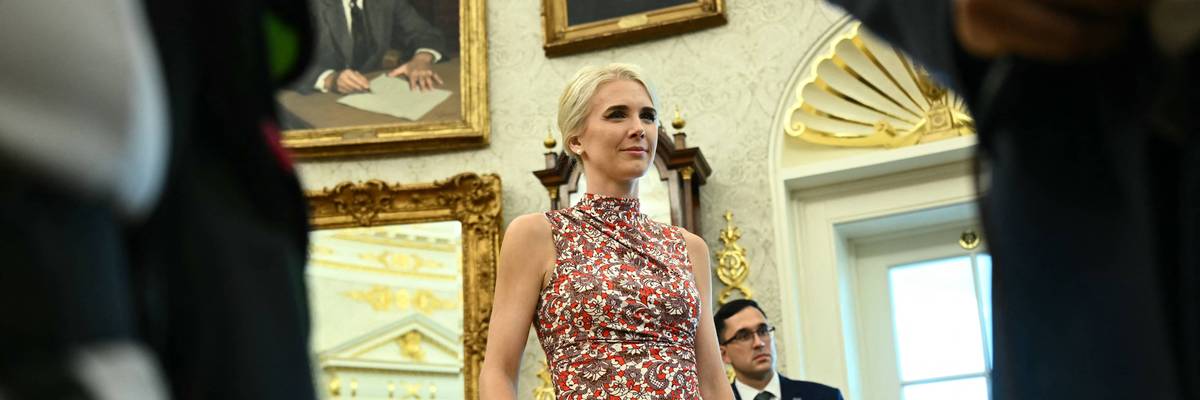
White House aide Natalie Harp is seen in the Oval Office of the White House on June 26, 2026.
Trump's Big Cash Gifts to Natalie Harp, Other Aides Were Likely Illegal, Complaint Alleges
"An investigation into this matter is clearly warranted, and, if a violation is indeed found, this matter must be referred to the Department of Justice."
A complaint submitted Thursday by a legal watchdog argues that US President Donald Trump's sizable cash gifts to political aide Natalie Harp and other White House staffers violated federal law because the payments improperly supplemented their government salaries.
"Laws prohibiting government employees from receiving supplemental income are not arbitrary; they exist to ensure that public servants’ priorities remain focused on public service, not a wealthy benefactor who may have other objectives in mind,” said Kedric Payne, vice president, general counsel and senior director for ethics at Campaign Legal Center (CLC), which submitted the new complaint to the US Office of Government Ethics. “An investigation into this matter is clearly warranted, and, if a violation is indeed found, this matter must be referred to the Department of Justice."
The complaint came days after financial disclosures revealed that Trump has doled out gifts totaling $155,000 to several staffers, including Harp, a former far-right news anchor whose role in the White House and relationship with the president have drawn close scrutiny in recent weeks.
Harp, Trump's most loyal aide, received a $45,000 cash gift from the president. Her salary, according to the White House, is $150,000 per year. Trump also gifted White House communications adviser Margo Martin and deputy director of Oval Office operations Chamberlain Harris $45,000 each. The Washington Post reported that the three payments were described as "Cash Gift for Holidays."
Walt Nauta, the director of Oval Office operations, received a $20,000 gift from the president.
CLC's complaint points to 18 US Code § 209, which prohibits executive branch employees from receiving "any salary, or any contribution to or supplementation of salary," from "any source other than the government of the United States, except as may be contributed out of the treasury of any state, county, or municipality."
The watchdog group noted that, when the gifts from the president are included, the four recipients were effectively compensated at the maximum salary for a full-time White House employee—a "rate for which they were ineligible" due to their junior roles.
"In paying White House employees funds beyond their government salaries, President Trump has created the same scenarios Congress specifically contemplated and sought to prevent," the complaint states. "Additionally, it raises the legitimate question as to whether President Trump is paying them for acting on his personal behalf, rather than in the interests of the public. For these reasons, it is important that the OGE investigate whether these payments were impermissibly made."
According to the Post, "there are no other public instances of US presidents giving staff employed by the White House large cash payments. Government ethics experts said they were not aware of any other payments of this scale from a superior to a subordinate government worker."
Richard Briffault, a professor of legislation at Columbia Law School, told NBC News that Trump's cash payments to aides appeared to be "technically illegal."
“Bosses will give gifts to their assistants,” said Briffault. "[But] these are substantial sums—much more than the usual Christmas gifts for most people."
Despite the apparently unprecedented and unlawful nature of the gifts, Briffault said there is "zero chance" that the current Justice Department—headed by Trump's former personal attorney, Todd Blanche—will investigate the payments.
We are at a crossroads
This country and this world are at a monumental crossroads. In a few short weeks, US voters will have an opportunity to beat back the forces of fascism and confront the billionaires who are rigging the economy, our media system, and our democracy, making it increasingly impossible for ordinary people to get by. We’re not just talking about the election. We’re talking about what must be done once these fascist elements are vanquished from power. We need a bolder set of solutions than what either major party has so far been willing to offer and a working-class movement ready to fight like hell for it. Trump didn't emerge from nowhere. The conditions that fueled MAGA authoritarianism were created by decades of radical neoliberal economic policies and a corrupt political system dominated by corporate interests. They slashed taxes on the super-rich, promising that the benefits would trickle down. They said giveaways to the corporate titans would make life more affordable for the rest of us. It was all bullshit. And when a bitter, betrayed populace searches for someone to blame, right-wing demagogues have little trouble finding scapegoats. People know when they're being lied to, but you won't hear any of this from the corporate media. Only independent journalism—powered and funded by people who believe in building a better world—can deliver truly trustworthy daily news. Our Fall Campaign is underway, and we need your help. To power our newsroom through the rest of the year, we need to raise $125,000 by midnight on October 31. So if you share our vision, please contribute whatever you can to sustain our work. |
A complaint submitted Thursday by a legal watchdog argues that US President Donald Trump's sizable cash gifts to political aide Natalie Harp and other White House staffers violated federal law because the payments improperly supplemented their government salaries.
"Laws prohibiting government employees from receiving supplemental income are not arbitrary; they exist to ensure that public servants’ priorities remain focused on public service, not a wealthy benefactor who may have other objectives in mind,” said Kedric Payne, vice president, general counsel and senior director for ethics at Campaign Legal Center (CLC), which submitted the new complaint to the US Office of Government Ethics. “An investigation into this matter is clearly warranted, and, if a violation is indeed found, this matter must be referred to the Department of Justice."
The complaint came days after financial disclosures revealed that Trump has doled out gifts totaling $155,000 to several staffers, including Harp, a former far-right news anchor whose role in the White House and relationship with the president have drawn close scrutiny in recent weeks.
Harp, Trump's most loyal aide, received a $45,000 cash gift from the president. Her salary, according to the White House, is $150,000 per year. Trump also gifted White House communications adviser Margo Martin and deputy director of Oval Office operations Chamberlain Harris $45,000 each. The Washington Post reported that the three payments were described as "Cash Gift for Holidays."
Walt Nauta, the director of Oval Office operations, received a $20,000 gift from the president.
CLC's complaint points to 18 US Code § 209, which prohibits executive branch employees from receiving "any salary, or any contribution to or supplementation of salary," from "any source other than the government of the United States, except as may be contributed out of the treasury of any state, county, or municipality."
The watchdog group noted that, when the gifts from the president are included, the four recipients were effectively compensated at the maximum salary for a full-time White House employee—a "rate for which they were ineligible" due to their junior roles.
"In paying White House employees funds beyond their government salaries, President Trump has created the same scenarios Congress specifically contemplated and sought to prevent," the complaint states. "Additionally, it raises the legitimate question as to whether President Trump is paying them for acting on his personal behalf, rather than in the interests of the public. For these reasons, it is important that the OGE investigate whether these payments were impermissibly made."
According to the Post, "there are no other public instances of US presidents giving staff employed by the White House large cash payments. Government ethics experts said they were not aware of any other payments of this scale from a superior to a subordinate government worker."
Richard Briffault, a professor of legislation at Columbia Law School, told NBC News that Trump's cash payments to aides appeared to be "technically illegal."
“Bosses will give gifts to their assistants,” said Briffault. "[But] these are substantial sums—much more than the usual Christmas gifts for most people."
Despite the apparently unprecedented and unlawful nature of the gifts, Briffault said there is "zero chance" that the current Justice Department—headed by Trump's former personal attorney, Todd Blanche—will investigate the payments.
A complaint submitted Thursday by a legal watchdog argues that US President Donald Trump's sizable cash gifts to political aide Natalie Harp and other White House staffers violated federal law because the payments improperly supplemented their government salaries.
"Laws prohibiting government employees from receiving supplemental income are not arbitrary; they exist to ensure that public servants’ priorities remain focused on public service, not a wealthy benefactor who may have other objectives in mind,” said Kedric Payne, vice president, general counsel and senior director for ethics at Campaign Legal Center (CLC), which submitted the new complaint to the US Office of Government Ethics. “An investigation into this matter is clearly warranted, and, if a violation is indeed found, this matter must be referred to the Department of Justice."
The complaint came days after financial disclosures revealed that Trump has doled out gifts totaling $155,000 to several staffers, including Harp, a former far-right news anchor whose role in the White House and relationship with the president have drawn close scrutiny in recent weeks.
Harp, Trump's most loyal aide, received a $45,000 cash gift from the president. Her salary, according to the White House, is $150,000 per year. Trump also gifted White House communications adviser Margo Martin and deputy director of Oval Office operations Chamberlain Harris $45,000 each. The Washington Post reported that the three payments were described as "Cash Gift for Holidays."
Walt Nauta, the director of Oval Office operations, received a $20,000 gift from the president.
CLC's complaint points to 18 US Code § 209, which prohibits executive branch employees from receiving "any salary, or any contribution to or supplementation of salary," from "any source other than the government of the United States, except as may be contributed out of the treasury of any state, county, or municipality."
The watchdog group noted that, when the gifts from the president are included, the four recipients were effectively compensated at the maximum salary for a full-time White House employee—a "rate for which they were ineligible" due to their junior roles.
"In paying White House employees funds beyond their government salaries, President Trump has created the same scenarios Congress specifically contemplated and sought to prevent," the complaint states. "Additionally, it raises the legitimate question as to whether President Trump is paying them for acting on his personal behalf, rather than in the interests of the public. For these reasons, it is important that the OGE investigate whether these payments were impermissibly made."
According to the Post, "there are no other public instances of US presidents giving staff employed by the White House large cash payments. Government ethics experts said they were not aware of any other payments of this scale from a superior to a subordinate government worker."
Richard Briffault, a professor of legislation at Columbia Law School, told NBC News that Trump's cash payments to aides appeared to be "technically illegal."
“Bosses will give gifts to their assistants,” said Briffault. "[But] these are substantial sums—much more than the usual Christmas gifts for most people."
Despite the apparently unprecedented and unlawful nature of the gifts, Briffault said there is "zero chance" that the current Justice Department—headed by Trump's former personal attorney, Todd Blanche—will investigate the payments.