SUBSCRIBE TO OUR FREE NEWSLETTER
Daily news & progressive opinion—funded by the people, not the corporations—delivered straight to your inbox.
5
#000000
#FFFFFF
To donate by check, phone, or other method, see our More Ways to Give page.
Daily news & progressive opinion—funded by the people, not the corporations—delivered straight to your inbox.
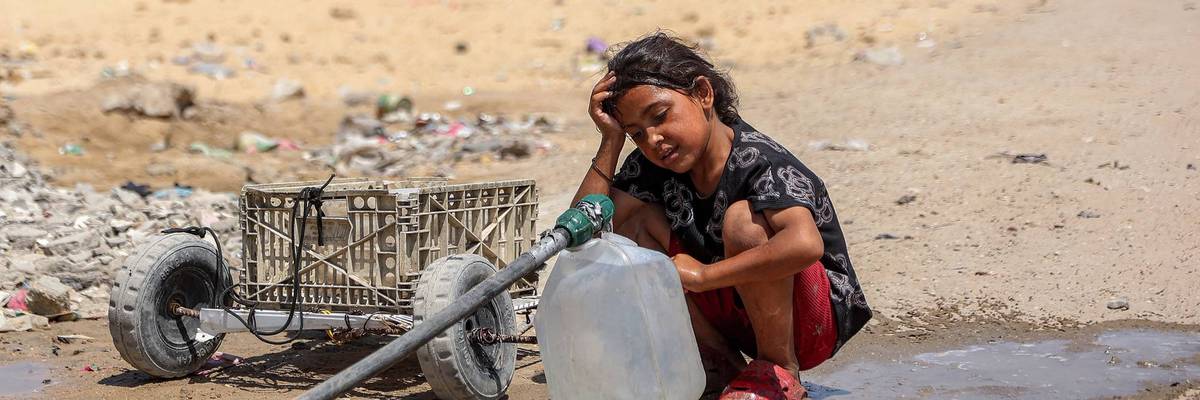
A girl fills containers with water drawn from the leftovers of underground pipes at a camp for people displaced by war in the Sheikh Radwan neighborhood of Gaza City on July 6, 2026.
"This station was one of the most important remaining sources of clean water in Gaza City," said an activist who has used it to supply desperate families.
As Gaza is gripped by a water crisis, Israel has reportedly attacked a facility that provided safe drinking water to thousands of families in Gaza City.
Tamer Nahed, a journalist and activist with the recently created humanitarian group Sake For Gaza, reported via social media on Monday that his group had been forced to suspend its efforts to provide clean water to some of Gaza's most dangerous areas after the facility they partnered with was "directly struck, resulting in the deaths of several people and injuries to others working there."
Middle East Eye reported on Monday that the attack, east of Gaza City, "struck a gathering of displaced people in front of a water refilling station" and killed two people as Israel shelled the city early on Monday.
The Palestinian outlet Al-Quds said the attack "directly targeted civilians as they stood in front of a water filling station" in the Al-Samar area, and was "part of a series of attacks launched by the occupation forces against civilian gatherings and vital facilities in the besieged areas of the Gaza Strip, exacerbating the already deteriorating humanitarian crisis."
Under international law, deliberately attacking civilian facilities or those that are essential for survival, like water facilities, is considered a war crime.
Israel has destroyed or damaged nearly 90% of water and sanitation infrastructure in Gaza, according to Doctors Without Borders (MSF), which says the military has used water as a "weapon" in its genocidal war against Gaza.
The group has documented the military firing upon clearly marked trucks and destroying boreholes and desalination plants relied on by thousands of residents. The group has also documented attacks on civilians accessing clean water.
A late-May report from the UN Children's Fund (UNICEF) found that around 82% of families in Gaza remain water insecure, and up to 70% are unable to collect even six liters of water per person each day. A person needs between 50 and 100 liters of water per day to meet their most basic needs, according to the World Health Organization.
Monday's attack came less than an hour after Nahed announced that the group's 11th truck had "reached one of Gaza’s most dangerous areas, carrying 5,000 liters of fresh drinking water."
The group had been attempting to send one truck per day to families living in tent cities, many of whom have been forced to rely on groundwater and contaminated water in order to survive, leading to serious illness.
Nahed said he and his team "truly risked our lives to reach this place, as it is located very close to military deployment areas, and the road was extremely dangerous at every moment."
He called the attack on the water supply facility "very heartbreaking news" and said as a result, "we have been forced to suspend our water distribution project until further notice."
"This station was one of the most important remaining sources of clean water in Gaza City and served as a lifeline for thousands of families, especially after most other water stations had stopped operating," he said. "We are deeply saddened by the loss of life and by the suspension of a project that was providing clean drinking water to people enduring these extremely difficult conditions."
Monday's attacks were some of the latest of Israel's near-daily strikes despite October's ceasefire agreement. Israel has expanded its control over the Gaza Strip in recent months, with Prime Minister Benjamin Netanyahu saying last week that the military “will not withdraw from the territory" as the agreement requires.
He added on Sunday that unless Hamas fully disarms, there also would be "no reconstruction in Gaza without dismantling and demilitarizing the strip."
Netanyahu described the occupation zone as a "new Gaza envelope inside of Gaza," a term that could refer to permanent occupation or annexation, as the term "Gaza envelope" refers to the communities inside Israeli territory near the Gaza border.
Other ministers in Israel's far-right government, including Finance Minister Bezalel Smotrich, have called for Israel to complete the "conquest" of Gaza and move Israeli settlers to replace the Palestinian population.
A recent proposal by the "Board of Peace," led by US President Donald Trump, conditioned the entry of basic humanitarian supplies, including shelter-building material, reconstruction aid, and other life essentials, on the total disarmament of Palestinian militant groups.
Last week, the United Nations Office for the Coordination of Humanitarian Affairs (OCHA) warned that “the continued expansion of areas under Israeli control in Gaza since the ceasefire agreement in October 2025 is intensifying risks to civilians and further constraining humanitarian efforts."
“Humanitarian access remains severely constrained due to restrictions on movement, which results in delays or pauses in lifesaving activities,” the statement said. “Some partners have had to scale down or temporarily suspend lifesaving activities, particularly following the killing of service providers in those areas. This has affected up to thousands of families in the vicinity.”
Dear Common Dreams reader, It’s been nearly 30 years since I co-founded Common Dreams with my late wife, Lina Newhouser. We had the radical notion that journalism should serve the public good, not corporate profits. It was clear to us from the outset what it would take to build such a project. No paid advertisements. No corporate sponsors. No millionaire publisher telling us what to think or do. Many people said we wouldn't last a year, but we proved those doubters wrong. Together with a tremendous team of journalists and dedicated staff, we built an independent media outlet free from the constraints of profits and corporate control. Our mission has always been simple: To inform. To inspire. To ignite change for the common good. Building Common Dreams was not easy. Our survival was never guaranteed. When you take on the most powerful forces—Wall Street greed, fossil fuel industry destruction, Big Tech lobbyists, and uber-rich oligarchs who have spent billions upon billions rigging the economy and democracy in their favor—the only bulwark you have is supporters who believe in your work. But here’s the urgent message from me today. It's never been this bad out there. And it's never been this hard to keep us going. At the very moment Common Dreams is most needed, the threats we face are intensifying. We need your support now more than ever. We don't accept corporate advertising and never will. We don't have a paywall because we don't think people should be blocked from critical news based on their ability to pay. Everything we do is funded by the donations of readers like you. When everyone does the little they can afford, we are strong. But if that support retreats or dries up, so do we. Will you donate now to make sure Common Dreams not only survives but thrives? —Craig Brown, Co-founder |
As Gaza is gripped by a water crisis, Israel has reportedly attacked a facility that provided safe drinking water to thousands of families in Gaza City.
Tamer Nahed, a journalist and activist with the recently created humanitarian group Sake For Gaza, reported via social media on Monday that his group had been forced to suspend its efforts to provide clean water to some of Gaza's most dangerous areas after the facility they partnered with was "directly struck, resulting in the deaths of several people and injuries to others working there."
Middle East Eye reported on Monday that the attack, east of Gaza City, "struck a gathering of displaced people in front of a water refilling station" and killed two people as Israel shelled the city early on Monday.
The Palestinian outlet Al-Quds said the attack "directly targeted civilians as they stood in front of a water filling station" in the Al-Samar area, and was "part of a series of attacks launched by the occupation forces against civilian gatherings and vital facilities in the besieged areas of the Gaza Strip, exacerbating the already deteriorating humanitarian crisis."
Under international law, deliberately attacking civilian facilities or those that are essential for survival, like water facilities, is considered a war crime.
Israel has destroyed or damaged nearly 90% of water and sanitation infrastructure in Gaza, according to Doctors Without Borders (MSF), which says the military has used water as a "weapon" in its genocidal war against Gaza.
The group has documented the military firing upon clearly marked trucks and destroying boreholes and desalination plants relied on by thousands of residents. The group has also documented attacks on civilians accessing clean water.
A late-May report from the UN Children's Fund (UNICEF) found that around 82% of families in Gaza remain water insecure, and up to 70% are unable to collect even six liters of water per person each day. A person needs between 50 and 100 liters of water per day to meet their most basic needs, according to the World Health Organization.
Monday's attack came less than an hour after Nahed announced that the group's 11th truck had "reached one of Gaza’s most dangerous areas, carrying 5,000 liters of fresh drinking water."
The group had been attempting to send one truck per day to families living in tent cities, many of whom have been forced to rely on groundwater and contaminated water in order to survive, leading to serious illness.
Nahed said he and his team "truly risked our lives to reach this place, as it is located very close to military deployment areas, and the road was extremely dangerous at every moment."
He called the attack on the water supply facility "very heartbreaking news" and said as a result, "we have been forced to suspend our water distribution project until further notice."
"This station was one of the most important remaining sources of clean water in Gaza City and served as a lifeline for thousands of families, especially after most other water stations had stopped operating," he said. "We are deeply saddened by the loss of life and by the suspension of a project that was providing clean drinking water to people enduring these extremely difficult conditions."
Monday's attacks were some of the latest of Israel's near-daily strikes despite October's ceasefire agreement. Israel has expanded its control over the Gaza Strip in recent months, with Prime Minister Benjamin Netanyahu saying last week that the military “will not withdraw from the territory" as the agreement requires.
He added on Sunday that unless Hamas fully disarms, there also would be "no reconstruction in Gaza without dismantling and demilitarizing the strip."
Netanyahu described the occupation zone as a "new Gaza envelope inside of Gaza," a term that could refer to permanent occupation or annexation, as the term "Gaza envelope" refers to the communities inside Israeli territory near the Gaza border.
Other ministers in Israel's far-right government, including Finance Minister Bezalel Smotrich, have called for Israel to complete the "conquest" of Gaza and move Israeli settlers to replace the Palestinian population.
A recent proposal by the "Board of Peace," led by US President Donald Trump, conditioned the entry of basic humanitarian supplies, including shelter-building material, reconstruction aid, and other life essentials, on the total disarmament of Palestinian militant groups.
Last week, the United Nations Office for the Coordination of Humanitarian Affairs (OCHA) warned that “the continued expansion of areas under Israeli control in Gaza since the ceasefire agreement in October 2025 is intensifying risks to civilians and further constraining humanitarian efforts."
“Humanitarian access remains severely constrained due to restrictions on movement, which results in delays or pauses in lifesaving activities,” the statement said. “Some partners have had to scale down or temporarily suspend lifesaving activities, particularly following the killing of service providers in those areas. This has affected up to thousands of families in the vicinity.”
As Gaza is gripped by a water crisis, Israel has reportedly attacked a facility that provided safe drinking water to thousands of families in Gaza City.
Tamer Nahed, a journalist and activist with the recently created humanitarian group Sake For Gaza, reported via social media on Monday that his group had been forced to suspend its efforts to provide clean water to some of Gaza's most dangerous areas after the facility they partnered with was "directly struck, resulting in the deaths of several people and injuries to others working there."
Middle East Eye reported on Monday that the attack, east of Gaza City, "struck a gathering of displaced people in front of a water refilling station" and killed two people as Israel shelled the city early on Monday.
The Palestinian outlet Al-Quds said the attack "directly targeted civilians as they stood in front of a water filling station" in the Al-Samar area, and was "part of a series of attacks launched by the occupation forces against civilian gatherings and vital facilities in the besieged areas of the Gaza Strip, exacerbating the already deteriorating humanitarian crisis."
Under international law, deliberately attacking civilian facilities or those that are essential for survival, like water facilities, is considered a war crime.
Israel has destroyed or damaged nearly 90% of water and sanitation infrastructure in Gaza, according to Doctors Without Borders (MSF), which says the military has used water as a "weapon" in its genocidal war against Gaza.
The group has documented the military firing upon clearly marked trucks and destroying boreholes and desalination plants relied on by thousands of residents. The group has also documented attacks on civilians accessing clean water.
A late-May report from the UN Children's Fund (UNICEF) found that around 82% of families in Gaza remain water insecure, and up to 70% are unable to collect even six liters of water per person each day. A person needs between 50 and 100 liters of water per day to meet their most basic needs, according to the World Health Organization.
Monday's attack came less than an hour after Nahed announced that the group's 11th truck had "reached one of Gaza’s most dangerous areas, carrying 5,000 liters of fresh drinking water."
The group had been attempting to send one truck per day to families living in tent cities, many of whom have been forced to rely on groundwater and contaminated water in order to survive, leading to serious illness.
Nahed said he and his team "truly risked our lives to reach this place, as it is located very close to military deployment areas, and the road was extremely dangerous at every moment."
He called the attack on the water supply facility "very heartbreaking news" and said as a result, "we have been forced to suspend our water distribution project until further notice."
"This station was one of the most important remaining sources of clean water in Gaza City and served as a lifeline for thousands of families, especially after most other water stations had stopped operating," he said. "We are deeply saddened by the loss of life and by the suspension of a project that was providing clean drinking water to people enduring these extremely difficult conditions."
Monday's attacks were some of the latest of Israel's near-daily strikes despite October's ceasefire agreement. Israel has expanded its control over the Gaza Strip in recent months, with Prime Minister Benjamin Netanyahu saying last week that the military “will not withdraw from the territory" as the agreement requires.
He added on Sunday that unless Hamas fully disarms, there also would be "no reconstruction in Gaza without dismantling and demilitarizing the strip."
Netanyahu described the occupation zone as a "new Gaza envelope inside of Gaza," a term that could refer to permanent occupation or annexation, as the term "Gaza envelope" refers to the communities inside Israeli territory near the Gaza border.
Other ministers in Israel's far-right government, including Finance Minister Bezalel Smotrich, have called for Israel to complete the "conquest" of Gaza and move Israeli settlers to replace the Palestinian population.
A recent proposal by the "Board of Peace," led by US President Donald Trump, conditioned the entry of basic humanitarian supplies, including shelter-building material, reconstruction aid, and other life essentials, on the total disarmament of Palestinian militant groups.
Last week, the United Nations Office for the Coordination of Humanitarian Affairs (OCHA) warned that “the continued expansion of areas under Israeli control in Gaza since the ceasefire agreement in October 2025 is intensifying risks to civilians and further constraining humanitarian efforts."
“Humanitarian access remains severely constrained due to restrictions on movement, which results in delays or pauses in lifesaving activities,” the statement said. “Some partners have had to scale down or temporarily suspend lifesaving activities, particularly following the killing of service providers in those areas. This has affected up to thousands of families in the vicinity.”