

Residents gather food and supplies from a volunteer food pantry in the San Bernardino Mountain community on March 7, 2023 in Valley of Enchantment, California.
As Hunger Surges and Medicaid Cliff Looms, Biden Readies Record Pentagon Budget
"We can absolutely afford to alleviate child hunger," said the Working Families Party. "Priorities are just apparently elsewhere."
As tens of millions of people across the United States face food benefit cuts and the potential loss of health insurance in the coming weeks, President Joe Biden is reportedly finalizing a fiscal year 2024 budget that would hand the Pentagon more than $835 billion—including $170 billion for weapons procurement.
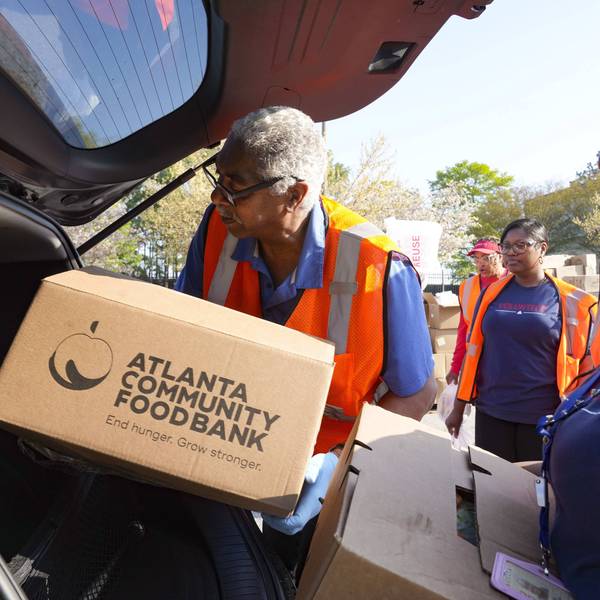
Set for official release on Thursday, the president's historic Pentagon budget request will stand in stark contrast to the painful austerity recently inflicted on vulnerable Americans, many of whom have been forced to wait in increasingly long food bank lines after their Supplemental Nutrition Assistance Program (SNAP) benefits were slashed earlier this month—the consequence of a trade-off that Congress negotiated and Biden approved late last year.
Bloomberg reported Tuesday that "the spending plan President Joe Biden will propose Thursday includes what officials say is one of the nation's largest peacetime defense budgets, with $170 billion for weapons procurement and $145 billion for research and development, both recent records."
"Among the major systems that would benefit from the proposed new budget is Lockheed Martin Corp.'s F-35, the costliest U.S. weapons system. The budget will request $13.5 billion for the fighter jets in procurement, continued development, and upgrades," the outlet noted. "The Pentagon will request 83 F-35s for the Air Force, Navy, and Marine Corps, meeting the services' objectives. That includes a planned 48 planes for the Air Force and 35 for the Navy and Marines."
Progressive lawmakers and peace advocates have long argued that excessive military spending—much of which inevitably winds up in the coffers of private contractors—comes at the expense of critical social investments and outcomes, from ending child poverty to guaranteeing healthcare and affordable housing for all.
"The choice to spend so much on the military is equally a choice not to provide healthcare, invest in early education, address climate chaos, and more," Public Citizen president Robert Weissman said in a recent statement.
Last month, Reps. Barbara Lee (D-Calif.) and Mark Pocan (D-Wis.) reintroduced their bill calling for a $100 billion cut to topline U.S. military spending, money they argued would be far better spent elsewhere.
"Our national priorities are reflected in our spending," Lee said. "Cutting just $100 billion could do so much good: It could power every household in the U.S. with solar energy; hire 1 million elementary school teachers amid a worsening teacher shortage; provide free tuition for two out of three public college students; or cover medical care for 7 million veterans."
But instead of proposing a cut to fraud-ridden Pentagon spending, Biden is reportedly aiming for an increase of around $20 billion—and, if recent history is any indication, Congress will likely add tens of billions more to the president's request, pushing the overall 2024 military budget close to $900 billion.
With the Pentagon set to watch its budget grow yet again with bipartisan support, millions of people in the U.S. are staring down the possibility of losing Medicaid coverage starting next month thanks to the return of eligibility reviews that have largely been paused throughout the coronavirus pandemic.
Estimates suggest that nearly 18 million low-income people could be removed from the healthcare program as right-wing governors—including Sarah Huckabee Sanders of Arkansas—race to gut state rolls, with a green light from Congress and the Biden administration.
The combination of SNAP benefit cuts and the looming loss of insurance coverage could be disastrous for many, and aid organizations are preparing for the worst.
"We are bracing, and our agencies, member food banks, food pantries, and soup kitchens are not prepared for what is about to hit them," Lisa Hamler-Fugitt, executive director of the Ohio Association of Foodbanks, told The Washington Post over the weekend. "This reduction, and end of the public health emergency, could not be coming at a worse time."
Slate's Alexander Sammon argued Tuesday that "for President Biden, the quiet expiration of enhanced SNAP marks yet another disappearing act in his once vaunted welfare state."
"The Child Tax Credit, a signature Biden policy in the American Rescue Plan Act, halved child poverty," Sammon wrote. "But it expired with relatively little pushback at the end of 2021. Enhanced unemployment benefits expired three months before that. Now, Medicaid is next."
"As it stands, enhanced SNAP looks like yet another program that works well and is well-liked—but that Democrats can't make last," Sammon added. "Some Democrats have indeed talked about expanding SNAP permanently in the new Farm Bill, much in the same way they've talked about expanding Social Security and Medicare. But the lack of willingness to fight for SNAP when it was already expanded is not a heartening sign."
We are at a crossroads
This country and this world are at a monumental crossroads. In a few short weeks, US voters will have an opportunity to beat back the forces of fascism and confront the billionaires who are rigging the economy, our media system, and our democracy, making it increasingly impossible for ordinary people to get by. We’re not just talking about the election. We’re talking about what must be done once these fascist elements are vanquished from power. We need a bolder set of solutions than what either major party has so far been willing to offer and a working-class movement ready to fight like hell for it. Trump didn't emerge from nowhere. The conditions that fueled MAGA authoritarianism were created by decades of radical neoliberal economic policies and a corrupt political system dominated by corporate interests. They slashed taxes on the super-rich, promising that the benefits would trickle down. They said giveaways to the corporate titans would make life more affordable for the rest of us. It was all bullshit. And when a bitter, betrayed populace searches for someone to blame, right-wing demagogues have little trouble finding scapegoats. People know when they're being lied to, but you won't hear any of this from the corporate media. Only independent journalism—powered and funded by people who believe in building a better world—can deliver truly trustworthy daily news. Our Fall Campaign is underway, and we need your help. To power our newsroom through the rest of the year, we need to raise $125,000 by midnight on October 31. So if you share our vision, please contribute whatever you can to sustain our work. |
As tens of millions of people across the United States face food benefit cuts and the potential loss of health insurance in the coming weeks, President Joe Biden is reportedly finalizing a fiscal year 2024 budget that would hand the Pentagon more than $835 billion—including $170 billion for weapons procurement.
Set for official release on Thursday, the president's historic Pentagon budget request will stand in stark contrast to the painful austerity recently inflicted on vulnerable Americans, many of whom have been forced to wait in increasingly long food bank lines after their Supplemental Nutrition Assistance Program (SNAP) benefits were slashed earlier this month—the consequence of a trade-off that Congress negotiated and Biden approved late last year.
Bloomberg reported Tuesday that "the spending plan President Joe Biden will propose Thursday includes what officials say is one of the nation's largest peacetime defense budgets, with $170 billion for weapons procurement and $145 billion for research and development, both recent records."
"Among the major systems that would benefit from the proposed new budget is Lockheed Martin Corp.'s F-35, the costliest U.S. weapons system. The budget will request $13.5 billion for the fighter jets in procurement, continued development, and upgrades," the outlet noted. "The Pentagon will request 83 F-35s for the Air Force, Navy, and Marine Corps, meeting the services' objectives. That includes a planned 48 planes for the Air Force and 35 for the Navy and Marines."
Progressive lawmakers and peace advocates have long argued that excessive military spending—much of which inevitably winds up in the coffers of private contractors—comes at the expense of critical social investments and outcomes, from ending child poverty to guaranteeing healthcare and affordable housing for all.
"The choice to spend so much on the military is equally a choice not to provide healthcare, invest in early education, address climate chaos, and more," Public Citizen president Robert Weissman said in a recent statement.
Last month, Reps. Barbara Lee (D-Calif.) and Mark Pocan (D-Wis.) reintroduced their bill calling for a $100 billion cut to topline U.S. military spending, money they argued would be far better spent elsewhere.
"Our national priorities are reflected in our spending," Lee said. "Cutting just $100 billion could do so much good: It could power every household in the U.S. with solar energy; hire 1 million elementary school teachers amid a worsening teacher shortage; provide free tuition for two out of three public college students; or cover medical care for 7 million veterans."
But instead of proposing a cut to fraud-ridden Pentagon spending, Biden is reportedly aiming for an increase of around $20 billion—and, if recent history is any indication, Congress will likely add tens of billions more to the president's request, pushing the overall 2024 military budget close to $900 billion.
With the Pentagon set to watch its budget grow yet again with bipartisan support, millions of people in the U.S. are staring down the possibility of losing Medicaid coverage starting next month thanks to the return of eligibility reviews that have largely been paused throughout the coronavirus pandemic.
Estimates suggest that nearly 18 million low-income people could be removed from the healthcare program as right-wing governors—including Sarah Huckabee Sanders of Arkansas—race to gut state rolls, with a green light from Congress and the Biden administration.
The combination of SNAP benefit cuts and the looming loss of insurance coverage could be disastrous for many, and aid organizations are preparing for the worst.
"We are bracing, and our agencies, member food banks, food pantries, and soup kitchens are not prepared for what is about to hit them," Lisa Hamler-Fugitt, executive director of the Ohio Association of Foodbanks, told The Washington Post over the weekend. "This reduction, and end of the public health emergency, could not be coming at a worse time."
Slate's Alexander Sammon argued Tuesday that "for President Biden, the quiet expiration of enhanced SNAP marks yet another disappearing act in his once vaunted welfare state."
"The Child Tax Credit, a signature Biden policy in the American Rescue Plan Act, halved child poverty," Sammon wrote. "But it expired with relatively little pushback at the end of 2021. Enhanced unemployment benefits expired three months before that. Now, Medicaid is next."
"As it stands, enhanced SNAP looks like yet another program that works well and is well-liked—but that Democrats can't make last," Sammon added. "Some Democrats have indeed talked about expanding SNAP permanently in the new Farm Bill, much in the same way they've talked about expanding Social Security and Medicare. But the lack of willingness to fight for SNAP when it was already expanded is not a heartening sign."
- Progressives Praise Biden Budget for Investments in 'Widespread Prosperity and Economic Growth' ›
- Opinion | Aside From the Military Bloat, Biden Budget Is Worth Celebrating | Common Dreams ›
As tens of millions of people across the United States face food benefit cuts and the potential loss of health insurance in the coming weeks, President Joe Biden is reportedly finalizing a fiscal year 2024 budget that would hand the Pentagon more than $835 billion—including $170 billion for weapons procurement.
Set for official release on Thursday, the president's historic Pentagon budget request will stand in stark contrast to the painful austerity recently inflicted on vulnerable Americans, many of whom have been forced to wait in increasingly long food bank lines after their Supplemental Nutrition Assistance Program (SNAP) benefits were slashed earlier this month—the consequence of a trade-off that Congress negotiated and Biden approved late last year.
Bloomberg reported Tuesday that "the spending plan President Joe Biden will propose Thursday includes what officials say is one of the nation's largest peacetime defense budgets, with $170 billion for weapons procurement and $145 billion for research and development, both recent records."
"Among the major systems that would benefit from the proposed new budget is Lockheed Martin Corp.'s F-35, the costliest U.S. weapons system. The budget will request $13.5 billion for the fighter jets in procurement, continued development, and upgrades," the outlet noted. "The Pentagon will request 83 F-35s for the Air Force, Navy, and Marine Corps, meeting the services' objectives. That includes a planned 48 planes for the Air Force and 35 for the Navy and Marines."
Progressive lawmakers and peace advocates have long argued that excessive military spending—much of which inevitably winds up in the coffers of private contractors—comes at the expense of critical social investments and outcomes, from ending child poverty to guaranteeing healthcare and affordable housing for all.
"The choice to spend so much on the military is equally a choice not to provide healthcare, invest in early education, address climate chaos, and more," Public Citizen president Robert Weissman said in a recent statement.
Last month, Reps. Barbara Lee (D-Calif.) and Mark Pocan (D-Wis.) reintroduced their bill calling for a $100 billion cut to topline U.S. military spending, money they argued would be far better spent elsewhere.
"Our national priorities are reflected in our spending," Lee said. "Cutting just $100 billion could do so much good: It could power every household in the U.S. with solar energy; hire 1 million elementary school teachers amid a worsening teacher shortage; provide free tuition for two out of three public college students; or cover medical care for 7 million veterans."
But instead of proposing a cut to fraud-ridden Pentagon spending, Biden is reportedly aiming for an increase of around $20 billion—and, if recent history is any indication, Congress will likely add tens of billions more to the president's request, pushing the overall 2024 military budget close to $900 billion.
With the Pentagon set to watch its budget grow yet again with bipartisan support, millions of people in the U.S. are staring down the possibility of losing Medicaid coverage starting next month thanks to the return of eligibility reviews that have largely been paused throughout the coronavirus pandemic.
Estimates suggest that nearly 18 million low-income people could be removed from the healthcare program as right-wing governors—including Sarah Huckabee Sanders of Arkansas—race to gut state rolls, with a green light from Congress and the Biden administration.
The combination of SNAP benefit cuts and the looming loss of insurance coverage could be disastrous for many, and aid organizations are preparing for the worst.
"We are bracing, and our agencies, member food banks, food pantries, and soup kitchens are not prepared for what is about to hit them," Lisa Hamler-Fugitt, executive director of the Ohio Association of Foodbanks, told The Washington Post over the weekend. "This reduction, and end of the public health emergency, could not be coming at a worse time."
Slate's Alexander Sammon argued Tuesday that "for President Biden, the quiet expiration of enhanced SNAP marks yet another disappearing act in his once vaunted welfare state."
"The Child Tax Credit, a signature Biden policy in the American Rescue Plan Act, halved child poverty," Sammon wrote. "But it expired with relatively little pushback at the end of 2021. Enhanced unemployment benefits expired three months before that. Now, Medicaid is next."
"As it stands, enhanced SNAP looks like yet another program that works well and is well-liked—but that Democrats can't make last," Sammon added. "Some Democrats have indeed talked about expanding SNAP permanently in the new Farm Bill, much in the same way they've talked about expanding Social Security and Medicare. But the lack of willingness to fight for SNAP when it was already expanded is not a heartening sign."
- Progressives Praise Biden Budget for Investments in 'Widespread Prosperity and Economic Growth' ›
- Opinion | Aside From the Military Bloat, Biden Budget Is Worth Celebrating | Common Dreams ›