

SUBSCRIBE TO OUR FREE NEWSLETTER
Daily news & progressive opinion—funded by the people, not the corporations—delivered straight to your inbox.
5
#000000
#FFFFFF
To donate by check, phone, or other method, see our More Ways to Give page.
Daily news & progressive opinion—funded by the people, not the corporations—delivered straight to your inbox.
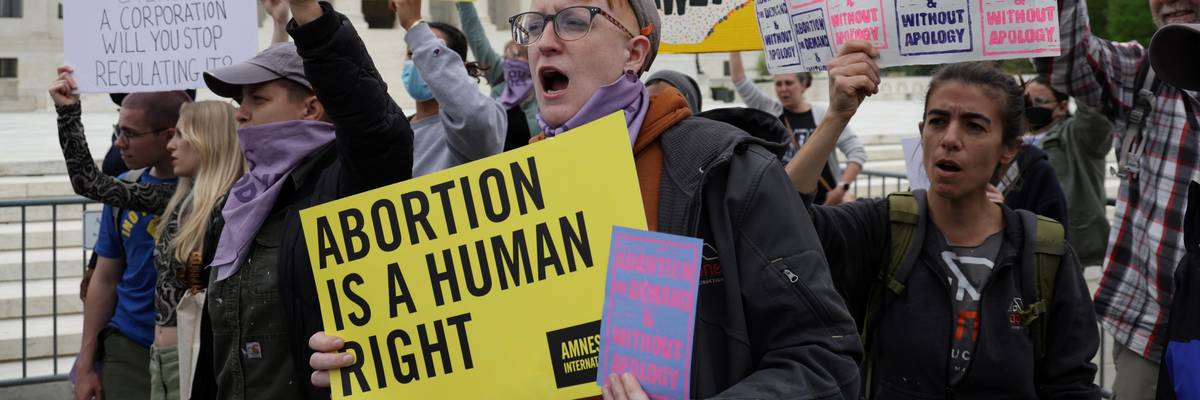
Reproductive rights advocates protest in response to the leaked Supreme Court draft decision to overturn Roe v. Wade on May 3, 2022 in Washington, D.C.
"The United States touts itself as a beacon of democracy and human rights, yet the committee's findings prove that this could not be further from the truth," said one ACLU campaigner.
The United Nations Human Rights Committee on Friday published what the ACLU called a "scathing" report admonishing the United States' record on a broad range of domestic and international issues, most of them adversely affecting the rights of minorities, women, poor people, and migrants.
The committee assessed U.S. compliance with the International Covenant on Civil and Political Rights (ICCPR), a major human rights treaty ratified by the United States in 1992.
"The United States touts itself as a beacon of democracy and human rights, yet the committee's findings prove that this could not be further from the truth," Jamil Dakwar, director of the ACLU's Human Rights Program, said in a statement.
The report praised the Biden administration for taking significant steps to protect LGBTQ+ people, racial minorities, and others. However, the committee said it "remains concerned at the lack of measures to effectively incorporate the covenant in the domestic legal order."
Among the areas of concern are the persistence of hate crimes including mass shootings, discrimination and abuse against Indigenous peoples and migrants including people legally seeking asylum, slow progress on climate justice, and failure to adequately combat human trafficking and forced labor.
The report also decried violence against women, the epidemic of missing and murdered Indigenous women and girls, the high maternal mortality rate—especially among people of color—and the erosion of reproductive rights following the U.S. Supreme Court's 2022 Dobbs v. Jackson Women's Health Organization ruling.
The committee further said it was "gravely concerned at the continuing use of the death penalty," while expressing alarm over police brutality, racial disparities in the criminal justice system, solitary confinement in prisons, life sentences without parole, and the criminalization of unhoused people.
Violations of privacy and voting rights and attacks on freedom of expression, assembly, and the press are also highlighted in the report.
Abroad, the committee expressed concern over the continued operation of the U.S. military prison at Guantánamo Bay, the killing of civilians in Middle Eastern and African nations in drone strikes, and enduring impunity for the perpetrators of war crimes, including torture.
Dakwar said the report underscores "the critical need to prioritize and strengthen human rights at home and establish a national human rights institution to ensure that our most basic rights are protected."
“It is critical that the U.S. government take this opportunity to heed the United Nations' recommendations."
According to the U.N. Office of the High Commissioner for Human Rights, 84 nations had accredited NHRIs as of 2021.
“It is critical that the U.S. government take this opportunity to heed the United Nations' recommendations and deliver on behalf of the American people—including immigrants, racial and ethnic minorities, women and girls, LGBTQ+ people, incarcerated people, Indigenous people, and other marginalized communities that are disproportionately impacted by the government's continued violations," Dakwar stressed.
U.S. officials, he added, "must adopt a plan of action and concrete measures to address the large-scale rights violations identified by the committee, which cause harm to millions of people in the U.S. and those under its jurisdiction or those impacted globally by its actions and policies."
Dear Common Dreams reader, It’s been nearly 30 years since I co-founded Common Dreams with my late wife, Lina Newhouser. We had the radical notion that journalism should serve the public good, not corporate profits. It was clear to us from the outset what it would take to build such a project. No paid advertisements. No corporate sponsors. No millionaire publisher telling us what to think or do. Many people said we wouldn't last a year, but we proved those doubters wrong. Together with a tremendous team of journalists and dedicated staff, we built an independent media outlet free from the constraints of profits and corporate control. Our mission has always been simple: To inform. To inspire. To ignite change for the common good. Building Common Dreams was not easy. Our survival was never guaranteed. When you take on the most powerful forces—Wall Street greed, fossil fuel industry destruction, Big Tech lobbyists, and uber-rich oligarchs who have spent billions upon billions rigging the economy and democracy in their favor—the only bulwark you have is supporters who believe in your work. But here’s the urgent message from me today. It's never been this bad out there. And it's never been this hard to keep us going. At the very moment Common Dreams is most needed, the threats we face are intensifying. We need your support now more than ever. We don't accept corporate advertising and never will. We don't have a paywall because we don't think people should be blocked from critical news based on their ability to pay. Everything we do is funded by the donations of readers like you. When everyone does the little they can afford, we are strong. But if that support retreats or dries up, so do we. Will you donate now to make sure Common Dreams not only survives but thrives? —Craig Brown, Co-founder |
The United Nations Human Rights Committee on Friday published what the ACLU called a "scathing" report admonishing the United States' record on a broad range of domestic and international issues, most of them adversely affecting the rights of minorities, women, poor people, and migrants.
The committee assessed U.S. compliance with the International Covenant on Civil and Political Rights (ICCPR), a major human rights treaty ratified by the United States in 1992.
"The United States touts itself as a beacon of democracy and human rights, yet the committee's findings prove that this could not be further from the truth," Jamil Dakwar, director of the ACLU's Human Rights Program, said in a statement.
The report praised the Biden administration for taking significant steps to protect LGBTQ+ people, racial minorities, and others. However, the committee said it "remains concerned at the lack of measures to effectively incorporate the covenant in the domestic legal order."
Among the areas of concern are the persistence of hate crimes including mass shootings, discrimination and abuse against Indigenous peoples and migrants including people legally seeking asylum, slow progress on climate justice, and failure to adequately combat human trafficking and forced labor.
The report also decried violence against women, the epidemic of missing and murdered Indigenous women and girls, the high maternal mortality rate—especially among people of color—and the erosion of reproductive rights following the U.S. Supreme Court's 2022 Dobbs v. Jackson Women's Health Organization ruling.
The committee further said it was "gravely concerned at the continuing use of the death penalty," while expressing alarm over police brutality, racial disparities in the criminal justice system, solitary confinement in prisons, life sentences without parole, and the criminalization of unhoused people.
Violations of privacy and voting rights and attacks on freedom of expression, assembly, and the press are also highlighted in the report.
Abroad, the committee expressed concern over the continued operation of the U.S. military prison at Guantánamo Bay, the killing of civilians in Middle Eastern and African nations in drone strikes, and enduring impunity for the perpetrators of war crimes, including torture.
Dakwar said the report underscores "the critical need to prioritize and strengthen human rights at home and establish a national human rights institution to ensure that our most basic rights are protected."
“It is critical that the U.S. government take this opportunity to heed the United Nations' recommendations."
According to the U.N. Office of the High Commissioner for Human Rights, 84 nations had accredited NHRIs as of 2021.
“It is critical that the U.S. government take this opportunity to heed the United Nations' recommendations and deliver on behalf of the American people—including immigrants, racial and ethnic minorities, women and girls, LGBTQ+ people, incarcerated people, Indigenous people, and other marginalized communities that are disproportionately impacted by the government's continued violations," Dakwar stressed.
U.S. officials, he added, "must adopt a plan of action and concrete measures to address the large-scale rights violations identified by the committee, which cause harm to millions of people in the U.S. and those under its jurisdiction or those impacted globally by its actions and policies."
The United Nations Human Rights Committee on Friday published what the ACLU called a "scathing" report admonishing the United States' record on a broad range of domestic and international issues, most of them adversely affecting the rights of minorities, women, poor people, and migrants.
The committee assessed U.S. compliance with the International Covenant on Civil and Political Rights (ICCPR), a major human rights treaty ratified by the United States in 1992.
"The United States touts itself as a beacon of democracy and human rights, yet the committee's findings prove that this could not be further from the truth," Jamil Dakwar, director of the ACLU's Human Rights Program, said in a statement.
The report praised the Biden administration for taking significant steps to protect LGBTQ+ people, racial minorities, and others. However, the committee said it "remains concerned at the lack of measures to effectively incorporate the covenant in the domestic legal order."
Among the areas of concern are the persistence of hate crimes including mass shootings, discrimination and abuse against Indigenous peoples and migrants including people legally seeking asylum, slow progress on climate justice, and failure to adequately combat human trafficking and forced labor.
The report also decried violence against women, the epidemic of missing and murdered Indigenous women and girls, the high maternal mortality rate—especially among people of color—and the erosion of reproductive rights following the U.S. Supreme Court's 2022 Dobbs v. Jackson Women's Health Organization ruling.
The committee further said it was "gravely concerned at the continuing use of the death penalty," while expressing alarm over police brutality, racial disparities in the criminal justice system, solitary confinement in prisons, life sentences without parole, and the criminalization of unhoused people.
Violations of privacy and voting rights and attacks on freedom of expression, assembly, and the press are also highlighted in the report.
Abroad, the committee expressed concern over the continued operation of the U.S. military prison at Guantánamo Bay, the killing of civilians in Middle Eastern and African nations in drone strikes, and enduring impunity for the perpetrators of war crimes, including torture.
Dakwar said the report underscores "the critical need to prioritize and strengthen human rights at home and establish a national human rights institution to ensure that our most basic rights are protected."
“It is critical that the U.S. government take this opportunity to heed the United Nations' recommendations."
According to the U.N. Office of the High Commissioner for Human Rights, 84 nations had accredited NHRIs as of 2021.
“It is critical that the U.S. government take this opportunity to heed the United Nations' recommendations and deliver on behalf of the American people—including immigrants, racial and ethnic minorities, women and girls, LGBTQ+ people, incarcerated people, Indigenous people, and other marginalized communities that are disproportionately impacted by the government's continued violations," Dakwar stressed.
U.S. officials, he added, "must adopt a plan of action and concrete measures to address the large-scale rights violations identified by the committee, which cause harm to millions of people in the U.S. and those under its jurisdiction or those impacted globally by its actions and policies."

