SUBSCRIBE TO OUR FREE NEWSLETTER
Daily news & progressive opinion—funded by the people, not the corporations—delivered straight to your inbox.
5
#000000
#FFFFFF
To donate by check, phone, or other method, see our More Ways to Give page.
A United Nations committee of independent monitors this week released a damning assessment of human rights in the United States, showing an overall dismal performance on issues from Guantanamo Bay detentions to mass surveillance to accountability for past atrocities--earning what the U.S. Human Rights Network called a "failing grade."
The United Nations Human Rights Committee's investigation was one of a handful of periodic reviews aimed at evaluating countries that have ratified the International Covenant on Civil and Political Rights established in 1976. In particular, the assessment measured U.S. implementation of the committee's recommendations for improving the country's human rights record.
The experts determined that the U.S. performance in 2014 was "relatively poor," Vincent Ploton, head of external relations for the Geneva-based Centre for Civil and Political Rights (CCPR), told Common Dreams.
The agency delivers grades that range from "A" the "E." The U.S. score for 2014 was summarized in the following graphic, compiled by CCPR. Ploton explained: "There is only one B1 grade, which means substantial action was taken. C1 means that there was no implementation, and C2 is worse, as it means the information provided by the U.S. was not relevant to the recommendations. D1 means there was no response."
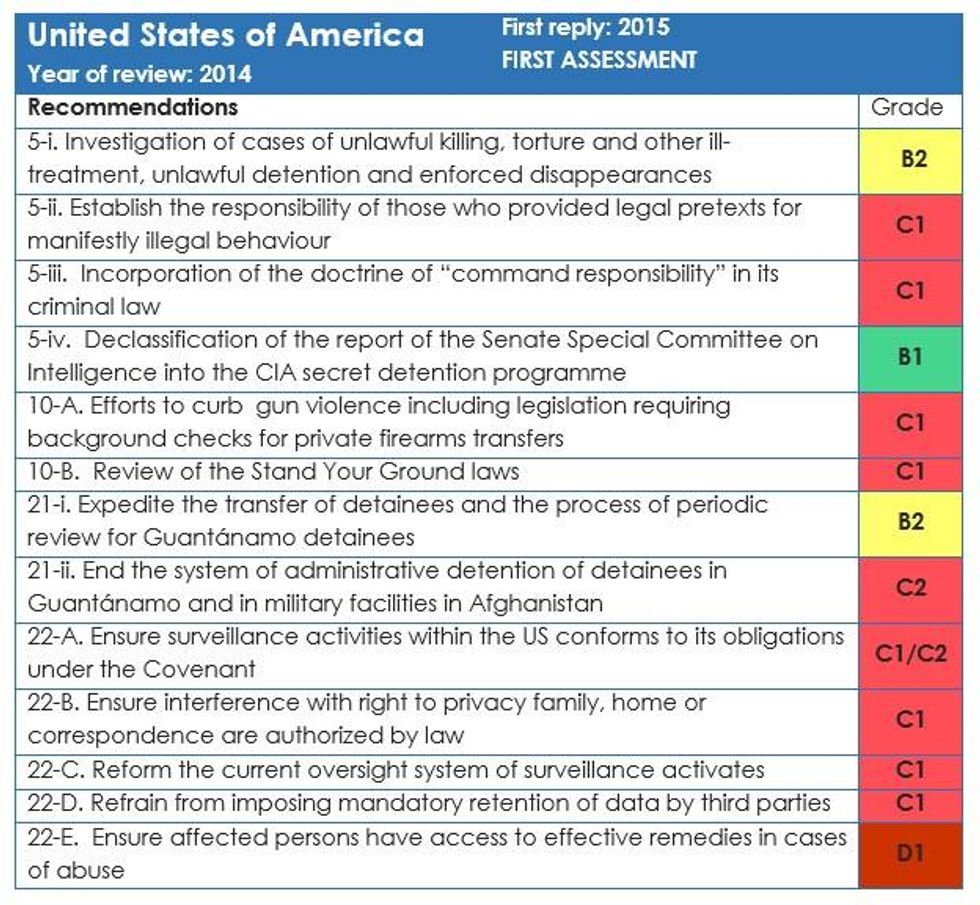
The U.S. had no A grades, and "the fact that the CIA report was only partially published was likely the reason for the B1 grade," noted Ploton, referring to the U.S. Senate Intelligence Committee's investigation of post-9/11 CIA torture.
"These low grades suggest the U.S. has a long way to go before it is in compliance with international law," said Faiza Patel, co-director of the Liberty and National Security Program at the Brennan Center for Justice, in a statement. The Brennan Center and Amnesty International previously raised concerns to the Committee about mass surveillance in the United States. "The Administration and Congress must take immediate steps to address the lack of intelligence oversight and restore the right to privacy in the digital age."
The findings prompted immediate condemnation from human rights and social justice organizations based in the U.S., including the Dream Defenders, who joined a civil society delegation to Geneva last year to urge the repeal of "Stand Your Ground" laws.
"It is shocking that after being given an entire year to address Stand Your Ground's 'incompatibility with the right to life,' the United States has failed to act with a sense of urgency," said Ciara Taylor, director of political consciousness for the Dream Defenders. "We see utter disregard for the lives of people of color in policies like Stand Your Ground, and in the daily actions of local law enforcement officials, who are positioned within the system to uphold these policies and the State's many systems of oppression."
"The Committee is right: the US is pressing forward with military commissions which violate international human rights standards," declared James G. Connell III, an attorney for Guantanamo detainee Ammar al Baluchi. "Torture corrupts everything it touches, and these military commissions are no exception."
And as journalist Kevin Gosztola wrote in his assessment of the UN report on Wednesday, "Detainees in Afghanistan and Guantanamo Bay remain in prison cells without charge or trial. There is no plan to abandon the dysfunctional and second-class legal system known as military commissions. Not only do those detainees lack rights to a fair trial, but they continue to endure torture and abuse as the political class in America ignores the fact that most never committed any crimes against the United States."
A United Nations committee of independent monitors this week released a damning assessment of human rights in the United States, showing an overall dismal performance on issues from Guantanamo Bay detentions to mass surveillance to accountability for past atrocities--earning what the U.S. Human Rights Network called a "failing grade."
The United Nations Human Rights Committee's investigation was one of a handful of periodic reviews aimed at evaluating countries that have ratified the International Covenant on Civil and Political Rights established in 1976. In particular, the assessment measured U.S. implementation of the committee's recommendations for improving the country's human rights record.
The experts determined that the U.S. performance in 2014 was "relatively poor," Vincent Ploton, head of external relations for the Geneva-based Centre for Civil and Political Rights (CCPR), told Common Dreams.
The agency delivers grades that range from "A" the "E." The U.S. score for 2014 was summarized in the following graphic, compiled by CCPR. Ploton explained: "There is only one B1 grade, which means substantial action was taken. C1 means that there was no implementation, and C2 is worse, as it means the information provided by the U.S. was not relevant to the recommendations. D1 means there was no response."
The U.S. had no A grades, and "the fact that the CIA report was only partially published was likely the reason for the B1 grade," noted Ploton, referring to the U.S. Senate Intelligence Committee's investigation of post-9/11 CIA torture.
"These low grades suggest the U.S. has a long way to go before it is in compliance with international law," said Faiza Patel, co-director of the Liberty and National Security Program at the Brennan Center for Justice, in a statement. The Brennan Center and Amnesty International previously raised concerns to the Committee about mass surveillance in the United States. "The Administration and Congress must take immediate steps to address the lack of intelligence oversight and restore the right to privacy in the digital age."
The findings prompted immediate condemnation from human rights and social justice organizations based in the U.S., including the Dream Defenders, who joined a civil society delegation to Geneva last year to urge the repeal of "Stand Your Ground" laws.
"It is shocking that after being given an entire year to address Stand Your Ground's 'incompatibility with the right to life,' the United States has failed to act with a sense of urgency," said Ciara Taylor, director of political consciousness for the Dream Defenders. "We see utter disregard for the lives of people of color in policies like Stand Your Ground, and in the daily actions of local law enforcement officials, who are positioned within the system to uphold these policies and the State's many systems of oppression."
"The Committee is right: the US is pressing forward with military commissions which violate international human rights standards," declared James G. Connell III, an attorney for Guantanamo detainee Ammar al Baluchi. "Torture corrupts everything it touches, and these military commissions are no exception."
And as journalist Kevin Gosztola wrote in his assessment of the UN report on Wednesday, "Detainees in Afghanistan and Guantanamo Bay remain in prison cells without charge or trial. There is no plan to abandon the dysfunctional and second-class legal system known as military commissions. Not only do those detainees lack rights to a fair trial, but they continue to endure torture and abuse as the political class in America ignores the fact that most never committed any crimes against the United States."
A United Nations committee of independent monitors this week released a damning assessment of human rights in the United States, showing an overall dismal performance on issues from Guantanamo Bay detentions to mass surveillance to accountability for past atrocities--earning what the U.S. Human Rights Network called a "failing grade."
The United Nations Human Rights Committee's investigation was one of a handful of periodic reviews aimed at evaluating countries that have ratified the International Covenant on Civil and Political Rights established in 1976. In particular, the assessment measured U.S. implementation of the committee's recommendations for improving the country's human rights record.
The experts determined that the U.S. performance in 2014 was "relatively poor," Vincent Ploton, head of external relations for the Geneva-based Centre for Civil and Political Rights (CCPR), told Common Dreams.
The agency delivers grades that range from "A" the "E." The U.S. score for 2014 was summarized in the following graphic, compiled by CCPR. Ploton explained: "There is only one B1 grade, which means substantial action was taken. C1 means that there was no implementation, and C2 is worse, as it means the information provided by the U.S. was not relevant to the recommendations. D1 means there was no response."
The U.S. had no A grades, and "the fact that the CIA report was only partially published was likely the reason for the B1 grade," noted Ploton, referring to the U.S. Senate Intelligence Committee's investigation of post-9/11 CIA torture.
"These low grades suggest the U.S. has a long way to go before it is in compliance with international law," said Faiza Patel, co-director of the Liberty and National Security Program at the Brennan Center for Justice, in a statement. The Brennan Center and Amnesty International previously raised concerns to the Committee about mass surveillance in the United States. "The Administration and Congress must take immediate steps to address the lack of intelligence oversight and restore the right to privacy in the digital age."
The findings prompted immediate condemnation from human rights and social justice organizations based in the U.S., including the Dream Defenders, who joined a civil society delegation to Geneva last year to urge the repeal of "Stand Your Ground" laws.
"It is shocking that after being given an entire year to address Stand Your Ground's 'incompatibility with the right to life,' the United States has failed to act with a sense of urgency," said Ciara Taylor, director of political consciousness for the Dream Defenders. "We see utter disregard for the lives of people of color in policies like Stand Your Ground, and in the daily actions of local law enforcement officials, who are positioned within the system to uphold these policies and the State's many systems of oppression."
"The Committee is right: the US is pressing forward with military commissions which violate international human rights standards," declared James G. Connell III, an attorney for Guantanamo detainee Ammar al Baluchi. "Torture corrupts everything it touches, and these military commissions are no exception."
And as journalist Kevin Gosztola wrote in his assessment of the UN report on Wednesday, "Detainees in Afghanistan and Guantanamo Bay remain in prison cells without charge or trial. There is no plan to abandon the dysfunctional and second-class legal system known as military commissions. Not only do those detainees lack rights to a fair trial, but they continue to endure torture and abuse as the political class in America ignores the fact that most never committed any crimes against the United States."