

SUBSCRIBE TO OUR FREE NEWSLETTER
Daily news & progressive opinion—funded by the people, not the corporations—delivered straight to your inbox.
5
#000000
#FFFFFF
To donate by check, phone, or other method, see our More Ways to Give page.
Daily news & progressive opinion—funded by the people, not the corporations—delivered straight to your inbox.
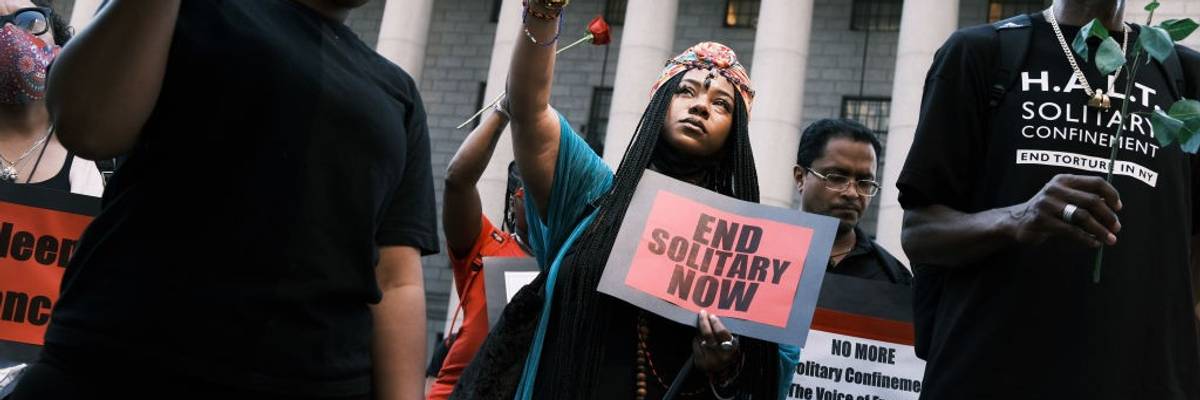
Demonstrators protest solitary confinement in New York City on June 7, 2021.
Rep. Cori Bush, who is leading the End Solitary Confinement Act, argues that "we are using taxpayer money to torture people."
The U.S. Supreme Court's three liberal justices issued a scathing dissent this week as the tribunal's right-wing supermajority rejected the appeal of an Illinois inmate with mental illness imprisoned in solitary confinement without access to fresh air for three straight years.
The nation's high court declined to hear the appeal of Michael Johnson, an inmate at Pontiac Correctional Center northeast of Peoria, whose attorneys argued he was being subjected to unconstitutional "cruel and unusual punishment" as he was deprived of fresh air and outdoor exercise while enduring horrific conditions in a tiny, filthy cell.
Justice Ketanji Brown Jackson wrote in a dissent joined by Justices Sonia Sotomayor and Elena Kagan that during three continuous years in solitary, "Johnson spent nearly every hour of his existence in a windowless, perpetually lit cell about the size of a parking space."
"His cell was poorly ventilated, resulting in unbearable heat and noxious odors. The space was also unsanitary, often caked with human waste," the dissent continued. "And because Pontiac officials would not provide cleaning supplies to Johnson unless he purchased them from the commissary, he was frequently forced to clean that filth with his bare hands. Johnson was allowed out of his cell to shower only once per week, for 10 brief minutes."
According to The New York Times:
Mr. Johnson suffered from what the corrections system acknowledged was profound mental illness. He violated countless prison rules, disobeying guards' orders, spitting at them, and damaging property.
As a punishment for those violations, prison authorities took away the hour of exercise that prisoners in solitary were generally afforded five days a week, typically in a small, secured cage outdoors.
"Each yard restriction was imposed for a period of between 30 and 90 days, but the restrictions were stacked such that, in total, Johnson received over three years' worth of yard restrictions," Jackson's dissent noted. "The cramped confines of Johnson's cell prevented him from exercising there. Thus, for three years, Johnson had no opportunity at all to stretch his limbs or breathe fresh air."
"The consequences of such a prolonged period of exercise deprivation were predictably severe," Jackson added. "Most notably, Johnson's mental state deteriorated rapidly. He suffered from hallucinations, excoriated his own flesh, urinated and defecated on himself, and smeared feces all over his body and cell. Johnson became suicidal and sometimes engaged in misconduct with the hope that prison guards would beat him to death."
Responding to the ruling, U.S. Sen. Peter Welch (D-Vt.)
wrote on social media Tuesday that "excessive use of solitary confinement is cruel, violates the Constitution, and doesn't rehabilitate individuals. Disappointing that SCOTUS ducked this case."
While praising the three liberal justices' dissent, Daniel Greenfield, an attorney at the Roderick & Solange MacArthur Justice Center said in a
statement that "three years of 24/7 solitary confinement unrelieved by any opportunity for exercise would have appalled the Founders. It should be no less shocking to us today."
On Tuesday, just a day after the ruling, the Federal Anti-Solitary Task Force—a coalition of the Center for Constitutional Rights, ACLU, #HALTSolitary, National Religious Campaign Against Torture, Unlock the Box Campaign, and Zealous—held a National Day of Action Against Solitary Confinement.
The day's main event was an afternoon virtual rally during which U.S. Rep. Cori Bush (D-Mo.) asserted that "we are using taxpayer money to torture people."
"As we convene today, there are still over 122,000 people being held in solitary confinement across our country," said Bush, who in July led the introduction of the End Solitary Confinement Act, which according to the congresswoman now has 20 co-sponsors.
"And the problem, we know, is getting worse," she added. "As of last year, solitary confinement has increased nearly 12% in the Federal Bureau of Prisons, despite President [Joe] Biden's campaign pledge to end this horrific practice once and for all."
"Let's be clear," she stressed. "This is shameful, and another example of how our government talks a big game about human rights, but does little to affirm and protect them in actual practice."
"The catastrophic harms of solitary confinement are indisputable," Bush continued, listing suicide and other forms of self-harm, heart disease, depression, and other serious physical and mental ailments. "Placement in solitary for any length of time... can cause severe long-term harm."
"This punitive and violent tactic does not improve safety. It is long past time to prohibit its use," the congresswoman added. "The people of this country agree; that's why recent polling shows that a majority of voters across the political spectrum support federal legislation ending solitary confinement entirely, beyond a limit of four hours."
In addition to ending solitary confinement in federal facilities for over four hours, Bush's bill would protect vulnerable prisoners from being placed in solitary confinement, establish alternatives for longer-term inmate separation from the general prison population, impose strict due process protections, create oversight and enforcement mechanisms, and incentivize states and municipalities to enact similar legislation.
Solitary confinement has long been recognized as torture. Research including a 1990s study of dozens of former Yugoslavian prisoners of war held for an average of six months in isolation found that people locked up in solitary confinement registered brain abnormalities comparable to those who suffered physical head trauma.
"In moments like these, we are called upon to recognize the common humanity in one another," Bush said during Tuesday's online rally. "Ending solitary confinement is one of these ways."
Dear Common Dreams reader, It’s been nearly 30 years since I co-founded Common Dreams with my late wife, Lina Newhouser. We had the radical notion that journalism should serve the public good, not corporate profits. It was clear to us from the outset what it would take to build such a project. No paid advertisements. No corporate sponsors. No millionaire publisher telling us what to think or do. Many people said we wouldn't last a year, but we proved those doubters wrong. Together with a tremendous team of journalists and dedicated staff, we built an independent media outlet free from the constraints of profits and corporate control. Our mission has always been simple: To inform. To inspire. To ignite change for the common good. Building Common Dreams was not easy. Our survival was never guaranteed. When you take on the most powerful forces—Wall Street greed, fossil fuel industry destruction, Big Tech lobbyists, and uber-rich oligarchs who have spent billions upon billions rigging the economy and democracy in their favor—the only bulwark you have is supporters who believe in your work. But here’s the urgent message from me today. It's never been this bad out there. And it's never been this hard to keep us going. At the very moment Common Dreams is most needed, the threats we face are intensifying. We need your support now more than ever. We don't accept corporate advertising and never will. We don't have a paywall because we don't think people should be blocked from critical news based on their ability to pay. Everything we do is funded by the donations of readers like you. When everyone does the little they can afford, we are strong. But if that support retreats or dries up, so do we. Will you donate now to make sure Common Dreams not only survives but thrives? —Craig Brown, Co-founder |
The U.S. Supreme Court's three liberal justices issued a scathing dissent this week as the tribunal's right-wing supermajority rejected the appeal of an Illinois inmate with mental illness imprisoned in solitary confinement without access to fresh air for three straight years.
The nation's high court declined to hear the appeal of Michael Johnson, an inmate at Pontiac Correctional Center northeast of Peoria, whose attorneys argued he was being subjected to unconstitutional "cruel and unusual punishment" as he was deprived of fresh air and outdoor exercise while enduring horrific conditions in a tiny, filthy cell.
Justice Ketanji Brown Jackson wrote in a dissent joined by Justices Sonia Sotomayor and Elena Kagan that during three continuous years in solitary, "Johnson spent nearly every hour of his existence in a windowless, perpetually lit cell about the size of a parking space."
"His cell was poorly ventilated, resulting in unbearable heat and noxious odors. The space was also unsanitary, often caked with human waste," the dissent continued. "And because Pontiac officials would not provide cleaning supplies to Johnson unless he purchased them from the commissary, he was frequently forced to clean that filth with his bare hands. Johnson was allowed out of his cell to shower only once per week, for 10 brief minutes."
According to The New York Times:
Mr. Johnson suffered from what the corrections system acknowledged was profound mental illness. He violated countless prison rules, disobeying guards' orders, spitting at them, and damaging property.
As a punishment for those violations, prison authorities took away the hour of exercise that prisoners in solitary were generally afforded five days a week, typically in a small, secured cage outdoors.
"Each yard restriction was imposed for a period of between 30 and 90 days, but the restrictions were stacked such that, in total, Johnson received over three years' worth of yard restrictions," Jackson's dissent noted. "The cramped confines of Johnson's cell prevented him from exercising there. Thus, for three years, Johnson had no opportunity at all to stretch his limbs or breathe fresh air."
"The consequences of such a prolonged period of exercise deprivation were predictably severe," Jackson added. "Most notably, Johnson's mental state deteriorated rapidly. He suffered from hallucinations, excoriated his own flesh, urinated and defecated on himself, and smeared feces all over his body and cell. Johnson became suicidal and sometimes engaged in misconduct with the hope that prison guards would beat him to death."
Responding to the ruling, U.S. Sen. Peter Welch (D-Vt.)
wrote on social media Tuesday that "excessive use of solitary confinement is cruel, violates the Constitution, and doesn't rehabilitate individuals. Disappointing that SCOTUS ducked this case."
While praising the three liberal justices' dissent, Daniel Greenfield, an attorney at the Roderick & Solange MacArthur Justice Center said in a
statement that "three years of 24/7 solitary confinement unrelieved by any opportunity for exercise would have appalled the Founders. It should be no less shocking to us today."
On Tuesday, just a day after the ruling, the Federal Anti-Solitary Task Force—a coalition of the Center for Constitutional Rights, ACLU, #HALTSolitary, National Religious Campaign Against Torture, Unlock the Box Campaign, and Zealous—held a National Day of Action Against Solitary Confinement.
The day's main event was an afternoon virtual rally during which U.S. Rep. Cori Bush (D-Mo.) asserted that "we are using taxpayer money to torture people."
"As we convene today, there are still over 122,000 people being held in solitary confinement across our country," said Bush, who in July led the introduction of the End Solitary Confinement Act, which according to the congresswoman now has 20 co-sponsors.
"And the problem, we know, is getting worse," she added. "As of last year, solitary confinement has increased nearly 12% in the Federal Bureau of Prisons, despite President [Joe] Biden's campaign pledge to end this horrific practice once and for all."
"Let's be clear," she stressed. "This is shameful, and another example of how our government talks a big game about human rights, but does little to affirm and protect them in actual practice."
"The catastrophic harms of solitary confinement are indisputable," Bush continued, listing suicide and other forms of self-harm, heart disease, depression, and other serious physical and mental ailments. "Placement in solitary for any length of time... can cause severe long-term harm."
"This punitive and violent tactic does not improve safety. It is long past time to prohibit its use," the congresswoman added. "The people of this country agree; that's why recent polling shows that a majority of voters across the political spectrum support federal legislation ending solitary confinement entirely, beyond a limit of four hours."
In addition to ending solitary confinement in federal facilities for over four hours, Bush's bill would protect vulnerable prisoners from being placed in solitary confinement, establish alternatives for longer-term inmate separation from the general prison population, impose strict due process protections, create oversight and enforcement mechanisms, and incentivize states and municipalities to enact similar legislation.
Solitary confinement has long been recognized as torture. Research including a 1990s study of dozens of former Yugoslavian prisoners of war held for an average of six months in isolation found that people locked up in solitary confinement registered brain abnormalities comparable to those who suffered physical head trauma.
"In moments like these, we are called upon to recognize the common humanity in one another," Bush said during Tuesday's online rally. "Ending solitary confinement is one of these ways."
The U.S. Supreme Court's three liberal justices issued a scathing dissent this week as the tribunal's right-wing supermajority rejected the appeal of an Illinois inmate with mental illness imprisoned in solitary confinement without access to fresh air for three straight years.
The nation's high court declined to hear the appeal of Michael Johnson, an inmate at Pontiac Correctional Center northeast of Peoria, whose attorneys argued he was being subjected to unconstitutional "cruel and unusual punishment" as he was deprived of fresh air and outdoor exercise while enduring horrific conditions in a tiny, filthy cell.
Justice Ketanji Brown Jackson wrote in a dissent joined by Justices Sonia Sotomayor and Elena Kagan that during three continuous years in solitary, "Johnson spent nearly every hour of his existence in a windowless, perpetually lit cell about the size of a parking space."
"His cell was poorly ventilated, resulting in unbearable heat and noxious odors. The space was also unsanitary, often caked with human waste," the dissent continued. "And because Pontiac officials would not provide cleaning supplies to Johnson unless he purchased them from the commissary, he was frequently forced to clean that filth with his bare hands. Johnson was allowed out of his cell to shower only once per week, for 10 brief minutes."
According to The New York Times:
Mr. Johnson suffered from what the corrections system acknowledged was profound mental illness. He violated countless prison rules, disobeying guards' orders, spitting at them, and damaging property.
As a punishment for those violations, prison authorities took away the hour of exercise that prisoners in solitary were generally afforded five days a week, typically in a small, secured cage outdoors.
"Each yard restriction was imposed for a period of between 30 and 90 days, but the restrictions were stacked such that, in total, Johnson received over three years' worth of yard restrictions," Jackson's dissent noted. "The cramped confines of Johnson's cell prevented him from exercising there. Thus, for three years, Johnson had no opportunity at all to stretch his limbs or breathe fresh air."
"The consequences of such a prolonged period of exercise deprivation were predictably severe," Jackson added. "Most notably, Johnson's mental state deteriorated rapidly. He suffered from hallucinations, excoriated his own flesh, urinated and defecated on himself, and smeared feces all over his body and cell. Johnson became suicidal and sometimes engaged in misconduct with the hope that prison guards would beat him to death."
Responding to the ruling, U.S. Sen. Peter Welch (D-Vt.)
wrote on social media Tuesday that "excessive use of solitary confinement is cruel, violates the Constitution, and doesn't rehabilitate individuals. Disappointing that SCOTUS ducked this case."
While praising the three liberal justices' dissent, Daniel Greenfield, an attorney at the Roderick & Solange MacArthur Justice Center said in a
statement that "three years of 24/7 solitary confinement unrelieved by any opportunity for exercise would have appalled the Founders. It should be no less shocking to us today."
On Tuesday, just a day after the ruling, the Federal Anti-Solitary Task Force—a coalition of the Center for Constitutional Rights, ACLU, #HALTSolitary, National Religious Campaign Against Torture, Unlock the Box Campaign, and Zealous—held a National Day of Action Against Solitary Confinement.
The day's main event was an afternoon virtual rally during which U.S. Rep. Cori Bush (D-Mo.) asserted that "we are using taxpayer money to torture people."
"As we convene today, there are still over 122,000 people being held in solitary confinement across our country," said Bush, who in July led the introduction of the End Solitary Confinement Act, which according to the congresswoman now has 20 co-sponsors.
"And the problem, we know, is getting worse," she added. "As of last year, solitary confinement has increased nearly 12% in the Federal Bureau of Prisons, despite President [Joe] Biden's campaign pledge to end this horrific practice once and for all."
"Let's be clear," she stressed. "This is shameful, and another example of how our government talks a big game about human rights, but does little to affirm and protect them in actual practice."
"The catastrophic harms of solitary confinement are indisputable," Bush continued, listing suicide and other forms of self-harm, heart disease, depression, and other serious physical and mental ailments. "Placement in solitary for any length of time... can cause severe long-term harm."
"This punitive and violent tactic does not improve safety. It is long past time to prohibit its use," the congresswoman added. "The people of this country agree; that's why recent polling shows that a majority of voters across the political spectrum support federal legislation ending solitary confinement entirely, beyond a limit of four hours."
In addition to ending solitary confinement in federal facilities for over four hours, Bush's bill would protect vulnerable prisoners from being placed in solitary confinement, establish alternatives for longer-term inmate separation from the general prison population, impose strict due process protections, create oversight and enforcement mechanisms, and incentivize states and municipalities to enact similar legislation.
Solitary confinement has long been recognized as torture. Research including a 1990s study of dozens of former Yugoslavian prisoners of war held for an average of six months in isolation found that people locked up in solitary confinement registered brain abnormalities comparable to those who suffered physical head trauma.
"In moments like these, we are called upon to recognize the common humanity in one another," Bush said during Tuesday's online rally. "Ending solitary confinement is one of these ways."

