SUBSCRIBE TO OUR FREE NEWSLETTER
Daily news & progressive opinion—funded by the people, not the corporations—delivered straight to your inbox.
5
#000000
#FFFFFF
To donate by check, phone, or other method, see our More Ways to Give page.
Daily news & progressive opinion—funded by the people, not the corporations—delivered straight to your inbox.
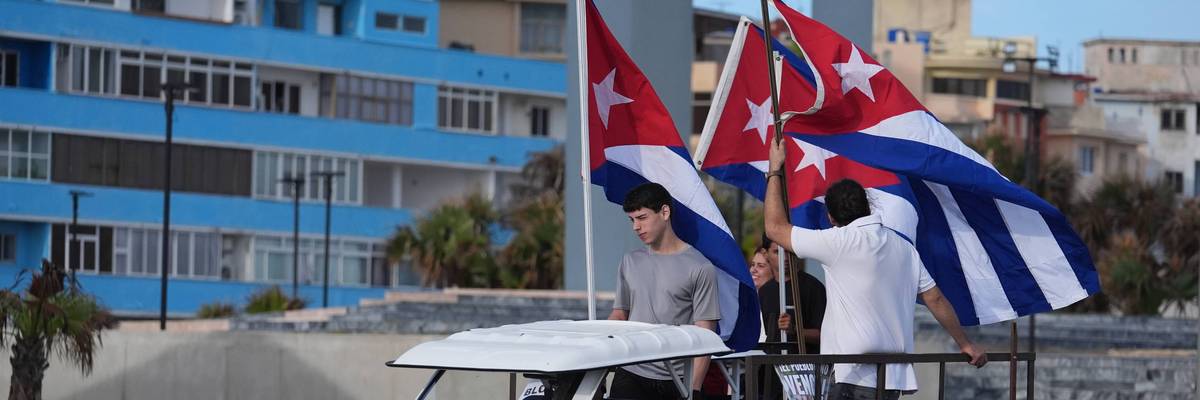
Cubans ride electric tricycles and bicycles during an anti-imperialist march amid ongoing shortages and prolonged power outages, as the island faces deepening economic strain under the decades-long United States embargo in Havana, Cuba on April 2, 2026.
“The continued use of Guantánamo Bay, which has an extensive history of abuse and torture, is horrific and unconscionable."
Dozens of human rights organizations sent a letter to Congress on Friday, decrying threats by US military officials to detain Cubans who flee to the US to escape President Donald Trump's crushing economic blockade at Guantánamo Bay.
The 86 groups, which include the Center for Constitutional Rights, the Center for Victims of Torture, the International Refugee Assistance Project, and Refugees International, zeroed in on remarks made by US Marine Corps Gen. Francis Donovan, the commander of the US Southern Command (SOUTHCOM), during a Senate Armed Services Committee hearing last month about how the military would respond to the mass influx of Cuban refugees to the United States.
The risks of a refugee exodus from Cuba were sparked in January after Trump tightened the already brutal regime of economic sanctions by threatening to slap harsh tariffs on any nation that provided oil to Cuba. The result has been a crippling fuel shortage that has caused routine blackouts and disrupted every facet of daily life, from hospital care to food cultivation.
Trump enacted the fuel blockade in what he has described as an effort to coerce the government to step down from power and make way for one more amenable to the interests of American companies. With Cuba in a weakened state, he has threatened to "take" the island outright using American military force.
The United Nations has warned that if the blockade is prolonged, it could bring about a total "humanitarian collapse.”
Asked by Sen. Tom Cotton (R-Ark.) about what would be done if this caused a mass influx of Cuban refugees to the US, Donovan said they had an executive order that would involve coordinating with the Department of Homeland Security to handle a "mass migration event."
Donovan said it would include using the US military base at Guantánamo Bay, “where we would set up a camp to deal with those migrants or any overflow from any situation in Cuba itself.”
“Given the well-documented history of abusive and unlawful detention at Guantánamo, any proposal to use the base for additional detention is deeply troubling and unacceptable," the organizations wrote on Friday,
They note the prison’s history as a site used for extrajudicial torture during the global War on Terror and as a holding facility for other migrant groups, including Haitian refugees and asylum seekers who fled a military coup in the 1990s, many of whom were subjected to substandard living conditions.
"Time and again, we have seen the US government try to use Guantánamo as a legal black hole to mistreat migrants, subjecting them to inhumane conditions and interfering with both their right to seek protection in the United States and their right to counsel," said Pedro Sepulveda, a litigation fellow for the International Refugee Assistance Project.
Despite pledges from multiple presidents to close the camp for good, it remains open more than two decades after former President George W. Bush began using it to detain hundreds of terrorism suspects without trial.
Trump has expanded its use during his second term, using it to temporarily hold more than 700 migrants since February 2025—including dozens of Cubans rounded up by immigration agents.
Trump’s use of the camp marks the first time it has been used to hold people detained in the continental United States. A Washington Post investigation from February found that those in the facility were subject to weeks-long periods of isolation, invasive strip searches, and denied contact with lawyers.
The human rights groups called on Congress to block any funding that could be used to detain Cubans fleeing Trump's blockade and to shut down Guantánamo Bay for good.
"The president has held Guantánamo detention as a threat over the heads of migrants in the United States and now threatens the same over Cubans who may be forced to flee their homes as a result of his own actions," said Yumna Rizvi, a senior policy analyst for the Center for Victims of Torture.
Michael Galant, the senior research and outreach associate at the Center for Economic and Policy Research, said, “If the Trump administration is worried about Cuban migration, the solution is simple: Stop intentionally impoverishing the Cuban people through an embargo and fuel blockade.”
Dear Common Dreams reader, It’s been nearly 30 years since I co-founded Common Dreams with my late wife, Lina Newhouser. We had the radical notion that journalism should serve the public good, not corporate profits. It was clear to us from the outset what it would take to build such a project. No paid advertisements. No corporate sponsors. No millionaire publisher telling us what to think or do. Many people said we wouldn't last a year, but we proved those doubters wrong. Together with a tremendous team of journalists and dedicated staff, we built an independent media outlet free from the constraints of profits and corporate control. Our mission has always been simple: To inform. To inspire. To ignite change for the common good. Building Common Dreams was not easy. Our survival was never guaranteed. When you take on the most powerful forces—Wall Street greed, fossil fuel industry destruction, Big Tech lobbyists, and uber-rich oligarchs who have spent billions upon billions rigging the economy and democracy in their favor—the only bulwark you have is supporters who believe in your work. But here’s the urgent message from me today. It's never been this bad out there. And it's never been this hard to keep us going. At the very moment Common Dreams is most needed, the threats we face are intensifying. We need your support now more than ever. We don't accept corporate advertising and never will. We don't have a paywall because we don't think people should be blocked from critical news based on their ability to pay. Everything we do is funded by the donations of readers like you. When everyone does the little they can afford, we are strong. But if that support retreats or dries up, so do we. Will you donate now to make sure Common Dreams not only survives but thrives? —Craig Brown, Co-founder |
Dozens of human rights organizations sent a letter to Congress on Friday, decrying threats by US military officials to detain Cubans who flee to the US to escape President Donald Trump's crushing economic blockade at Guantánamo Bay.
The 86 groups, which include the Center for Constitutional Rights, the Center for Victims of Torture, the International Refugee Assistance Project, and Refugees International, zeroed in on remarks made by US Marine Corps Gen. Francis Donovan, the commander of the US Southern Command (SOUTHCOM), during a Senate Armed Services Committee hearing last month about how the military would respond to the mass influx of Cuban refugees to the United States.
The risks of a refugee exodus from Cuba were sparked in January after Trump tightened the already brutal regime of economic sanctions by threatening to slap harsh tariffs on any nation that provided oil to Cuba. The result has been a crippling fuel shortage that has caused routine blackouts and disrupted every facet of daily life, from hospital care to food cultivation.
Trump enacted the fuel blockade in what he has described as an effort to coerce the government to step down from power and make way for one more amenable to the interests of American companies. With Cuba in a weakened state, he has threatened to "take" the island outright using American military force.
The United Nations has warned that if the blockade is prolonged, it could bring about a total "humanitarian collapse.”
Asked by Sen. Tom Cotton (R-Ark.) about what would be done if this caused a mass influx of Cuban refugees to the US, Donovan said they had an executive order that would involve coordinating with the Department of Homeland Security to handle a "mass migration event."
Donovan said it would include using the US military base at Guantánamo Bay, “where we would set up a camp to deal with those migrants or any overflow from any situation in Cuba itself.”
“Given the well-documented history of abusive and unlawful detention at Guantánamo, any proposal to use the base for additional detention is deeply troubling and unacceptable," the organizations wrote on Friday,
They note the prison’s history as a site used for extrajudicial torture during the global War on Terror and as a holding facility for other migrant groups, including Haitian refugees and asylum seekers who fled a military coup in the 1990s, many of whom were subjected to substandard living conditions.
"Time and again, we have seen the US government try to use Guantánamo as a legal black hole to mistreat migrants, subjecting them to inhumane conditions and interfering with both their right to seek protection in the United States and their right to counsel," said Pedro Sepulveda, a litigation fellow for the International Refugee Assistance Project.
Despite pledges from multiple presidents to close the camp for good, it remains open more than two decades after former President George W. Bush began using it to detain hundreds of terrorism suspects without trial.
Trump has expanded its use during his second term, using it to temporarily hold more than 700 migrants since February 2025—including dozens of Cubans rounded up by immigration agents.
Trump’s use of the camp marks the first time it has been used to hold people detained in the continental United States. A Washington Post investigation from February found that those in the facility were subject to weeks-long periods of isolation, invasive strip searches, and denied contact with lawyers.
The human rights groups called on Congress to block any funding that could be used to detain Cubans fleeing Trump's blockade and to shut down Guantánamo Bay for good.
"The president has held Guantánamo detention as a threat over the heads of migrants in the United States and now threatens the same over Cubans who may be forced to flee their homes as a result of his own actions," said Yumna Rizvi, a senior policy analyst for the Center for Victims of Torture.
Michael Galant, the senior research and outreach associate at the Center for Economic and Policy Research, said, “If the Trump administration is worried about Cuban migration, the solution is simple: Stop intentionally impoverishing the Cuban people through an embargo and fuel blockade.”
Dozens of human rights organizations sent a letter to Congress on Friday, decrying threats by US military officials to detain Cubans who flee to the US to escape President Donald Trump's crushing economic blockade at Guantánamo Bay.
The 86 groups, which include the Center for Constitutional Rights, the Center for Victims of Torture, the International Refugee Assistance Project, and Refugees International, zeroed in on remarks made by US Marine Corps Gen. Francis Donovan, the commander of the US Southern Command (SOUTHCOM), during a Senate Armed Services Committee hearing last month about how the military would respond to the mass influx of Cuban refugees to the United States.
The risks of a refugee exodus from Cuba were sparked in January after Trump tightened the already brutal regime of economic sanctions by threatening to slap harsh tariffs on any nation that provided oil to Cuba. The result has been a crippling fuel shortage that has caused routine blackouts and disrupted every facet of daily life, from hospital care to food cultivation.
Trump enacted the fuel blockade in what he has described as an effort to coerce the government to step down from power and make way for one more amenable to the interests of American companies. With Cuba in a weakened state, he has threatened to "take" the island outright using American military force.
The United Nations has warned that if the blockade is prolonged, it could bring about a total "humanitarian collapse.”
Asked by Sen. Tom Cotton (R-Ark.) about what would be done if this caused a mass influx of Cuban refugees to the US, Donovan said they had an executive order that would involve coordinating with the Department of Homeland Security to handle a "mass migration event."
Donovan said it would include using the US military base at Guantánamo Bay, “where we would set up a camp to deal with those migrants or any overflow from any situation in Cuba itself.”
“Given the well-documented history of abusive and unlawful detention at Guantánamo, any proposal to use the base for additional detention is deeply troubling and unacceptable," the organizations wrote on Friday,
They note the prison’s history as a site used for extrajudicial torture during the global War on Terror and as a holding facility for other migrant groups, including Haitian refugees and asylum seekers who fled a military coup in the 1990s, many of whom were subjected to substandard living conditions.
"Time and again, we have seen the US government try to use Guantánamo as a legal black hole to mistreat migrants, subjecting them to inhumane conditions and interfering with both their right to seek protection in the United States and their right to counsel," said Pedro Sepulveda, a litigation fellow for the International Refugee Assistance Project.
Despite pledges from multiple presidents to close the camp for good, it remains open more than two decades after former President George W. Bush began using it to detain hundreds of terrorism suspects without trial.
Trump has expanded its use during his second term, using it to temporarily hold more than 700 migrants since February 2025—including dozens of Cubans rounded up by immigration agents.
Trump’s use of the camp marks the first time it has been used to hold people detained in the continental United States. A Washington Post investigation from February found that those in the facility were subject to weeks-long periods of isolation, invasive strip searches, and denied contact with lawyers.
The human rights groups called on Congress to block any funding that could be used to detain Cubans fleeing Trump's blockade and to shut down Guantánamo Bay for good.
"The president has held Guantánamo detention as a threat over the heads of migrants in the United States and now threatens the same over Cubans who may be forced to flee their homes as a result of his own actions," said Yumna Rizvi, a senior policy analyst for the Center for Victims of Torture.
Michael Galant, the senior research and outreach associate at the Center for Economic and Policy Research, said, “If the Trump administration is worried about Cuban migration, the solution is simple: Stop intentionally impoverishing the Cuban people through an embargo and fuel blockade.”