SUBSCRIBE TO OUR FREE NEWSLETTER
Daily news & progressive opinion—funded by the people, not the corporations—delivered straight to your inbox.
5
#000000
#FFFFFF
To donate by check, phone, or other method, see our More Ways to Give page.
Daily news & progressive opinion—funded by the people, not the corporations—delivered straight to your inbox.
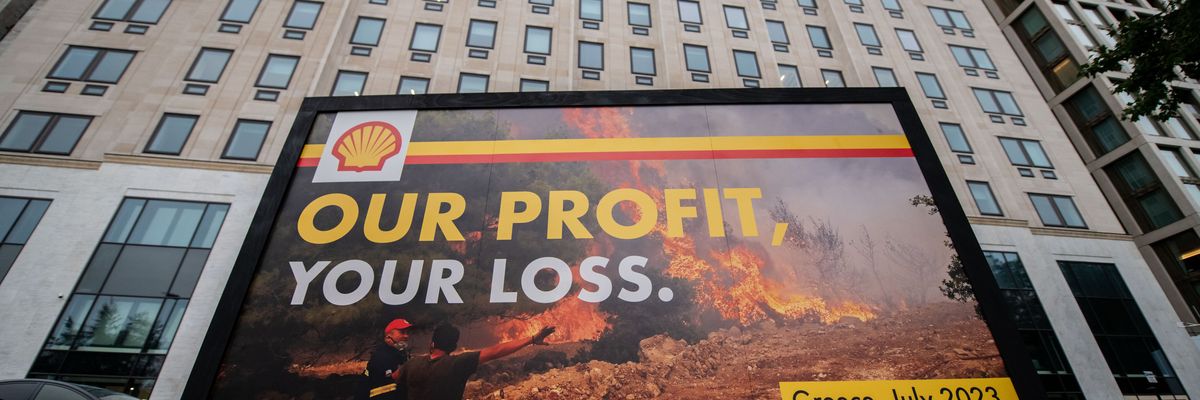
Greenpeace activists display a billboard during a protest outside Shell headquarters on July 27, 2023 in London.
"The global energy crisis has been a giant cash grab for fossil fuel firms," said one campaigner. "And instead of investing their record profits in clean energy, these companies are doubling down on oil, gas, and shareholder payouts."
The year 2023 was marked by weather events that made it increasingly clear that the Earth has entered what United Nations Secretary General António Guterres called the "era of global boiling," with wildfires and prolonged heatwaves impacting millions of people and scientists confirming their suffering was the direct result of fossil fuel extraction and planetary heating.
But for the world's five largest oil giants, the year marked record profits and the approval of several major new fossil fuel projects, allowing the companies to lavish their shareholders with payouts that are expected to exceed $100 billion—signaling that executives have little anxiety that demand for their products will fall, said one economist.
The companies—BP, Shell, Chevron, ExxonMobil, and TotalEnergies—spent $104 billion on shareholder payouts in 2022, and are expected to reward investors with even more in buybacks and dividends for 2023, The Guardian reported.
Shell announced plans in November to pay investors at least $23 billion—more than six times the amount it planned to spend on renewable energy projects—while BP promised shareholders a 10% raise in dividends and Chevron could exceed the $75 billion stock buyback it announced early last year.
Alice Harrison, a campaigner for Global Witness, noted that fossil fuel shareholders will be enjoying their paydays as households across Europe struggle with fuel poverty and the world faces the rising threat of climate disasters brought on by the industry.
"The global energy crisis has been a giant cash grab for fossil fuel firms," Harrison told The Guardian. "And instead of investing their record profits in clean energy, these companies are doubling down on oil, gas, and shareholder payouts. Yet again millions of families won't be able to afford to heat their homes this winter, and countries around the world will continue to suffer the extreme weather events of climate collapse. This is the fossil fuel economy, and it's rigged in favor of the rich."
In 2023 campaigners intensified their demands for accountability from the oil, gas, and coal industries, and as of last month had successfully pressured more than 1,600 universities, pension funds, and other institutions to divest from fossil fuels. In the U.S., provisions in the Inflation Reduction Act, which has been touted as the "largest investment in climate and energy in American history," went into effect.
But Dieter Helm, a professor of economic policy at the University of Oxford, The Guardian that if the industry were truly fearful of policymakers phasing out fossil fuel extraction and expediting a transition to renewable sources, they would be spending far less on new projects and shareholder payouts.
"For this to be the case you would have to believe that the energy transition is happening, and that demand for fossil fuels is going to fall," Helm told The Guardian.
In 2023, U.S. President Joe Biden infuriated climate campaigners by approving the Willow oil drilling project in Alaska, which could lead to roughly 280 million metric tons of heat-trapping carbon dioxide emissions. His administration also included in a debt limit deal language that would expedite the approval of the Mountain Valley Pipeline, which could emit the equivalent of more than 89 million metric tons of carbon dioxide, while the U.K. government greenlit a massive oil drilling field in the North Sea and French company TotalEnergies continued to construct the 900-mile-long East African Crude Oil Pipeline, which would transport up to 230,000 barrels of crude oil per day.
"These companies are investing a huge amount in new projects, and they're handing out bigger dividends because they are confident that they're going to make big returns," Helm said. "And when we look at the state of our current climate progress, who's to say they're wrong?"
Climate campaigner Vanessa Nakate pointed out that the shareholder paydays are expected following a deal on a loss and damage fund at the 28th annual United Nations Climate Change Conference, aimed at helping developing countries to fight the climate emergency. That fund was hailed as "historic" and included a commitment of $700 million from wealthy countries—a sum that is expected to be dwarfed by fossil fuel investors' profits.
"They have picked people's pockets, fueled inflation and pollution, and deepened poverty," U.K. House of Lords member and Tax Justice Network co-founder Prem Sikka said of the oil giants. "Governments do nothing to end their monopolistic control. Need to break-up this cartel."
Dear Common Dreams reader, It’s been nearly 30 years since I co-founded Common Dreams with my late wife, Lina Newhouser. We had the radical notion that journalism should serve the public good, not corporate profits. It was clear to us from the outset what it would take to build such a project. No paid advertisements. No corporate sponsors. No millionaire publisher telling us what to think or do. Many people said we wouldn't last a year, but we proved those doubters wrong. Together with a tremendous team of journalists and dedicated staff, we built an independent media outlet free from the constraints of profits and corporate control. Our mission has always been simple: To inform. To inspire. To ignite change for the common good. Building Common Dreams was not easy. Our survival was never guaranteed. When you take on the most powerful forces—Wall Street greed, fossil fuel industry destruction, Big Tech lobbyists, and uber-rich oligarchs who have spent billions upon billions rigging the economy and democracy in their favor—the only bulwark you have is supporters who believe in your work. But here’s the urgent message from me today. It's never been this bad out there. And it's never been this hard to keep us going. At the very moment Common Dreams is most needed, the threats we face are intensifying. We need your support now more than ever. We don't accept corporate advertising and never will. We don't have a paywall because we don't think people should be blocked from critical news based on their ability to pay. Everything we do is funded by the donations of readers like you. When everyone does the little they can afford, we are strong. But if that support retreats or dries up, so do we. Will you donate now to make sure Common Dreams not only survives but thrives? —Craig Brown, Co-founder |
The year 2023 was marked by weather events that made it increasingly clear that the Earth has entered what United Nations Secretary General António Guterres called the "era of global boiling," with wildfires and prolonged heatwaves impacting millions of people and scientists confirming their suffering was the direct result of fossil fuel extraction and planetary heating.
But for the world's five largest oil giants, the year marked record profits and the approval of several major new fossil fuel projects, allowing the companies to lavish their shareholders with payouts that are expected to exceed $100 billion—signaling that executives have little anxiety that demand for their products will fall, said one economist.
The companies—BP, Shell, Chevron, ExxonMobil, and TotalEnergies—spent $104 billion on shareholder payouts in 2022, and are expected to reward investors with even more in buybacks and dividends for 2023, The Guardian reported.
Shell announced plans in November to pay investors at least $23 billion—more than six times the amount it planned to spend on renewable energy projects—while BP promised shareholders a 10% raise in dividends and Chevron could exceed the $75 billion stock buyback it announced early last year.
Alice Harrison, a campaigner for Global Witness, noted that fossil fuel shareholders will be enjoying their paydays as households across Europe struggle with fuel poverty and the world faces the rising threat of climate disasters brought on by the industry.
"The global energy crisis has been a giant cash grab for fossil fuel firms," Harrison told The Guardian. "And instead of investing their record profits in clean energy, these companies are doubling down on oil, gas, and shareholder payouts. Yet again millions of families won't be able to afford to heat their homes this winter, and countries around the world will continue to suffer the extreme weather events of climate collapse. This is the fossil fuel economy, and it's rigged in favor of the rich."
In 2023 campaigners intensified their demands for accountability from the oil, gas, and coal industries, and as of last month had successfully pressured more than 1,600 universities, pension funds, and other institutions to divest from fossil fuels. In the U.S., provisions in the Inflation Reduction Act, which has been touted as the "largest investment in climate and energy in American history," went into effect.
But Dieter Helm, a professor of economic policy at the University of Oxford, The Guardian that if the industry were truly fearful of policymakers phasing out fossil fuel extraction and expediting a transition to renewable sources, they would be spending far less on new projects and shareholder payouts.
"For this to be the case you would have to believe that the energy transition is happening, and that demand for fossil fuels is going to fall," Helm told The Guardian.
In 2023, U.S. President Joe Biden infuriated climate campaigners by approving the Willow oil drilling project in Alaska, which could lead to roughly 280 million metric tons of heat-trapping carbon dioxide emissions. His administration also included in a debt limit deal language that would expedite the approval of the Mountain Valley Pipeline, which could emit the equivalent of more than 89 million metric tons of carbon dioxide, while the U.K. government greenlit a massive oil drilling field in the North Sea and French company TotalEnergies continued to construct the 900-mile-long East African Crude Oil Pipeline, which would transport up to 230,000 barrels of crude oil per day.
"These companies are investing a huge amount in new projects, and they're handing out bigger dividends because they are confident that they're going to make big returns," Helm said. "And when we look at the state of our current climate progress, who's to say they're wrong?"
Climate campaigner Vanessa Nakate pointed out that the shareholder paydays are expected following a deal on a loss and damage fund at the 28th annual United Nations Climate Change Conference, aimed at helping developing countries to fight the climate emergency. That fund was hailed as "historic" and included a commitment of $700 million from wealthy countries—a sum that is expected to be dwarfed by fossil fuel investors' profits.
"They have picked people's pockets, fueled inflation and pollution, and deepened poverty," U.K. House of Lords member and Tax Justice Network co-founder Prem Sikka said of the oil giants. "Governments do nothing to end their monopolistic control. Need to break-up this cartel."
The year 2023 was marked by weather events that made it increasingly clear that the Earth has entered what United Nations Secretary General António Guterres called the "era of global boiling," with wildfires and prolonged heatwaves impacting millions of people and scientists confirming their suffering was the direct result of fossil fuel extraction and planetary heating.
But for the world's five largest oil giants, the year marked record profits and the approval of several major new fossil fuel projects, allowing the companies to lavish their shareholders with payouts that are expected to exceed $100 billion—signaling that executives have little anxiety that demand for their products will fall, said one economist.
The companies—BP, Shell, Chevron, ExxonMobil, and TotalEnergies—spent $104 billion on shareholder payouts in 2022, and are expected to reward investors with even more in buybacks and dividends for 2023, The Guardian reported.
Shell announced plans in November to pay investors at least $23 billion—more than six times the amount it planned to spend on renewable energy projects—while BP promised shareholders a 10% raise in dividends and Chevron could exceed the $75 billion stock buyback it announced early last year.
Alice Harrison, a campaigner for Global Witness, noted that fossil fuel shareholders will be enjoying their paydays as households across Europe struggle with fuel poverty and the world faces the rising threat of climate disasters brought on by the industry.
"The global energy crisis has been a giant cash grab for fossil fuel firms," Harrison told The Guardian. "And instead of investing their record profits in clean energy, these companies are doubling down on oil, gas, and shareholder payouts. Yet again millions of families won't be able to afford to heat their homes this winter, and countries around the world will continue to suffer the extreme weather events of climate collapse. This is the fossil fuel economy, and it's rigged in favor of the rich."
In 2023 campaigners intensified their demands for accountability from the oil, gas, and coal industries, and as of last month had successfully pressured more than 1,600 universities, pension funds, and other institutions to divest from fossil fuels. In the U.S., provisions in the Inflation Reduction Act, which has been touted as the "largest investment in climate and energy in American history," went into effect.
But Dieter Helm, a professor of economic policy at the University of Oxford, The Guardian that if the industry were truly fearful of policymakers phasing out fossil fuel extraction and expediting a transition to renewable sources, they would be spending far less on new projects and shareholder payouts.
"For this to be the case you would have to believe that the energy transition is happening, and that demand for fossil fuels is going to fall," Helm told The Guardian.
In 2023, U.S. President Joe Biden infuriated climate campaigners by approving the Willow oil drilling project in Alaska, which could lead to roughly 280 million metric tons of heat-trapping carbon dioxide emissions. His administration also included in a debt limit deal language that would expedite the approval of the Mountain Valley Pipeline, which could emit the equivalent of more than 89 million metric tons of carbon dioxide, while the U.K. government greenlit a massive oil drilling field in the North Sea and French company TotalEnergies continued to construct the 900-mile-long East African Crude Oil Pipeline, which would transport up to 230,000 barrels of crude oil per day.
"These companies are investing a huge amount in new projects, and they're handing out bigger dividends because they are confident that they're going to make big returns," Helm said. "And when we look at the state of our current climate progress, who's to say they're wrong?"
Climate campaigner Vanessa Nakate pointed out that the shareholder paydays are expected following a deal on a loss and damage fund at the 28th annual United Nations Climate Change Conference, aimed at helping developing countries to fight the climate emergency. That fund was hailed as "historic" and included a commitment of $700 million from wealthy countries—a sum that is expected to be dwarfed by fossil fuel investors' profits.
"They have picked people's pockets, fueled inflation and pollution, and deepened poverty," U.K. House of Lords member and Tax Justice Network co-founder Prem Sikka said of the oil giants. "Governments do nothing to end their monopolistic control. Need to break-up this cartel."