SUBSCRIBE TO OUR FREE NEWSLETTER
Daily news & progressive opinion—funded by the people, not the corporations—delivered straight to your inbox.
5
#000000
#FFFFFF
To donate by check, phone, or other method, see our More Ways to Give page.
Daily news & progressive opinion—funded by the people, not the corporations—delivered straight to your inbox.
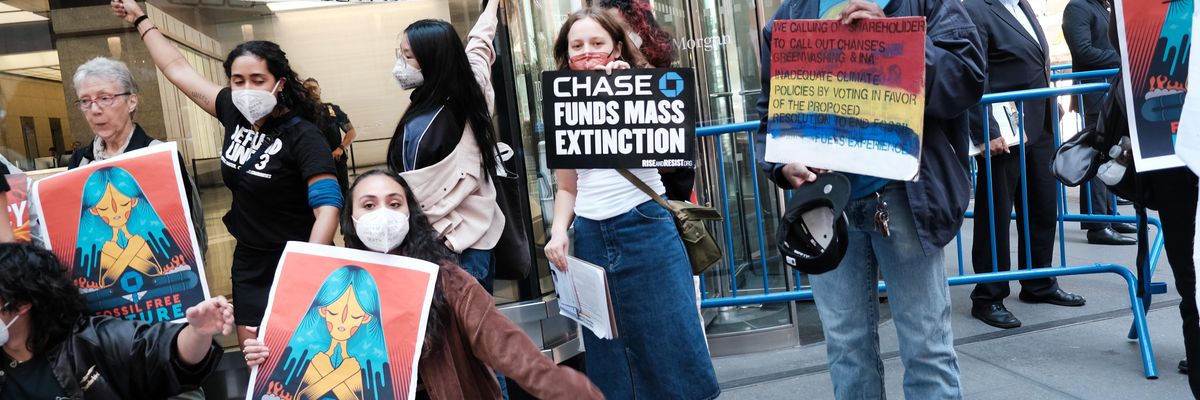
Climate activists demonstrate outside the headquarters of JPMorgan Chase during the bank's annual shareholder meeting on May 17, 2022 in New York City.
"Any climate commitment from a bank that is still financing fossil fuel expansion is greenwashing, pure and simple," said a Stop the Money Pipeline campaigner.
Taking aim at Wall Street banks financing the oil, gas, and coal extraction fueling the climate crisis, a coalition of institutional investors on Tuesday announced the filing of climate-related shareholder resolutions in an effort to force "more climate-friendly policies that better align with" the firms' public commitments to combating the planetary emergency.
In the resolutions, members of the Interfaith Center on Corporate Responsibility (ICCR) and Harrington Investments asked six banks—Bank of America, Goldman Sachs, JPMorgan Chase, Morgan Stanley, Citigroup, and Wells Fargo—to enact policies phasing out fossil fuel finance, disclose plans for aligning their financing with their stated near-term emissions reduction goals, and to set absolute end-of-decade emissions reduction targets for their energy sector financing.
Shareholders also filed climate resolutions at four companies—Chubb, Travelers, The Hartford, and Berkshire Hathaway—that insure fossil fuel projects.
"Each of the major banks has publicly committed to aligning its financing with the goals of the Paris agreement to achieve net-zero emissions by 2050, a target widely considered imperative to avoid catastrophic climate impacts and financial losses," ICCR said in a statement. "Scientific consensus shows that new fossil fuel expansion is incompatible with achieving net-zero by 2050, yet these banks continue to invest billions of dollars each year in new fossil fuel development—a fact corroborated by a new Reclaim Finance report released last week."
As Stop the Money Pipeline—a coalition of over 200 groups seeking to hold "financial backers of climate chaos accountable"—noted:
A slate of resolutions calling for policies to phase out financing for fossil fuel expansion was filed by the same investors at U.S. banks in 2022. They received between 9% and 13% support, which was a significant milestone for these first-of-their-kind proposals. This year's fossil fuel financing proposals have been updated to encourage banks to finance clients' low-carbon transition so long as those plans are credible and verified. The previous resolutions were supported by many major institutional investors, including the New York State and New York City Common Retirement Funds.
New in 2023 are the resolutions on absolute emissions reduction targets for energy sector financing filed by the New York City and New York State comptrollers, and the resolutions calling for disclosure of climate transition plans filed by As You Sow. The day before the resolutions were filed, Denmark's largest bank, Danske, announced a phaseout of corporate financing for companies engaged in new coal, oil and, gas development.
"Any climate commitment from a bank that is still financing fossil fuel expansion is greenwashing, pure and simple," Arielle Swernoff, U.S. banks campaign manager at Stop the Money Pipeline, said in a statement. "By supporting these resolutions, shareholders can hold banks accountable to their own climate commitments, effectively manage risk, and protect people and the planet."
Dan Chu, executive director of the Sierra Club Foundation—which led the filing at JPMorgan Chase—lamented that "all major U.S. banks continue to finance billions of dollars for new coal, oil, and gas projects every year. Such financing undermines the banks' net-zero commitments and exposes investors to material risks."
"These shareholder resolutions simply ask banks to align their promises with their actions and to adopt policies to phase out the financing of new fossil fuel development," Chu added.
Referring to a warning from the International Energy Agency, Kate Monahan of Trillium Asset Management—which spearheaded the Bank of America filing—said that "we will not be able to achieve the Paris agreement's goal of limiting warming to 1.5°C if banks continue to finance new fossil fuel exploration and development."
"Bank of America has publicly committed to the Paris agreement but continues to finance fossil fuel expansion with no phaseout plan, exposing itself to accusations of greenwashing and reputational damage," Monahan contended. " By continuing to fund new fossil fuels, Bank of America and others are taking actions with potentially catastrophic consequences."
Dear Common Dreams reader, It’s been nearly 30 years since I co-founded Common Dreams with my late wife, Lina Newhouser. We had the radical notion that journalism should serve the public good, not corporate profits. It was clear to us from the outset what it would take to build such a project. No paid advertisements. No corporate sponsors. No millionaire publisher telling us what to think or do. Many people said we wouldn't last a year, but we proved those doubters wrong. Together with a tremendous team of journalists and dedicated staff, we built an independent media outlet free from the constraints of profits and corporate control. Our mission has always been simple: To inform. To inspire. To ignite change for the common good. Building Common Dreams was not easy. Our survival was never guaranteed. When you take on the most powerful forces—Wall Street greed, fossil fuel industry destruction, Big Tech lobbyists, and uber-rich oligarchs who have spent billions upon billions rigging the economy and democracy in their favor—the only bulwark you have is supporters who believe in your work. But here’s the urgent message from me today. It's never been this bad out there. And it's never been this hard to keep us going. At the very moment Common Dreams is most needed, the threats we face are intensifying. We need your support now more than ever. We don't accept corporate advertising and never will. We don't have a paywall because we don't think people should be blocked from critical news based on their ability to pay. Everything we do is funded by the donations of readers like you. When everyone does the little they can afford, we are strong. But if that support retreats or dries up, so do we. Will you donate now to make sure Common Dreams not only survives but thrives? —Craig Brown, Co-founder |
Taking aim at Wall Street banks financing the oil, gas, and coal extraction fueling the climate crisis, a coalition of institutional investors on Tuesday announced the filing of climate-related shareholder resolutions in an effort to force "more climate-friendly policies that better align with" the firms' public commitments to combating the planetary emergency.
In the resolutions, members of the Interfaith Center on Corporate Responsibility (ICCR) and Harrington Investments asked six banks—Bank of America, Goldman Sachs, JPMorgan Chase, Morgan Stanley, Citigroup, and Wells Fargo—to enact policies phasing out fossil fuel finance, disclose plans for aligning their financing with their stated near-term emissions reduction goals, and to set absolute end-of-decade emissions reduction targets for their energy sector financing.
Shareholders also filed climate resolutions at four companies—Chubb, Travelers, The Hartford, and Berkshire Hathaway—that insure fossil fuel projects.
"Each of the major banks has publicly committed to aligning its financing with the goals of the Paris agreement to achieve net-zero emissions by 2050, a target widely considered imperative to avoid catastrophic climate impacts and financial losses," ICCR said in a statement. "Scientific consensus shows that new fossil fuel expansion is incompatible with achieving net-zero by 2050, yet these banks continue to invest billions of dollars each year in new fossil fuel development—a fact corroborated by a new Reclaim Finance report released last week."
As Stop the Money Pipeline—a coalition of over 200 groups seeking to hold "financial backers of climate chaos accountable"—noted:
A slate of resolutions calling for policies to phase out financing for fossil fuel expansion was filed by the same investors at U.S. banks in 2022. They received between 9% and 13% support, which was a significant milestone for these first-of-their-kind proposals. This year's fossil fuel financing proposals have been updated to encourage banks to finance clients' low-carbon transition so long as those plans are credible and verified. The previous resolutions were supported by many major institutional investors, including the New York State and New York City Common Retirement Funds.
New in 2023 are the resolutions on absolute emissions reduction targets for energy sector financing filed by the New York City and New York State comptrollers, and the resolutions calling for disclosure of climate transition plans filed by As You Sow. The day before the resolutions were filed, Denmark's largest bank, Danske, announced a phaseout of corporate financing for companies engaged in new coal, oil and, gas development.
"Any climate commitment from a bank that is still financing fossil fuel expansion is greenwashing, pure and simple," Arielle Swernoff, U.S. banks campaign manager at Stop the Money Pipeline, said in a statement. "By supporting these resolutions, shareholders can hold banks accountable to their own climate commitments, effectively manage risk, and protect people and the planet."
Dan Chu, executive director of the Sierra Club Foundation—which led the filing at JPMorgan Chase—lamented that "all major U.S. banks continue to finance billions of dollars for new coal, oil, and gas projects every year. Such financing undermines the banks' net-zero commitments and exposes investors to material risks."
"These shareholder resolutions simply ask banks to align their promises with their actions and to adopt policies to phase out the financing of new fossil fuel development," Chu added.
Referring to a warning from the International Energy Agency, Kate Monahan of Trillium Asset Management—which spearheaded the Bank of America filing—said that "we will not be able to achieve the Paris agreement's goal of limiting warming to 1.5°C if banks continue to finance new fossil fuel exploration and development."
"Bank of America has publicly committed to the Paris agreement but continues to finance fossil fuel expansion with no phaseout plan, exposing itself to accusations of greenwashing and reputational damage," Monahan contended. " By continuing to fund new fossil fuels, Bank of America and others are taking actions with potentially catastrophic consequences."
Taking aim at Wall Street banks financing the oil, gas, and coal extraction fueling the climate crisis, a coalition of institutional investors on Tuesday announced the filing of climate-related shareholder resolutions in an effort to force "more climate-friendly policies that better align with" the firms' public commitments to combating the planetary emergency.
In the resolutions, members of the Interfaith Center on Corporate Responsibility (ICCR) and Harrington Investments asked six banks—Bank of America, Goldman Sachs, JPMorgan Chase, Morgan Stanley, Citigroup, and Wells Fargo—to enact policies phasing out fossil fuel finance, disclose plans for aligning their financing with their stated near-term emissions reduction goals, and to set absolute end-of-decade emissions reduction targets for their energy sector financing.
Shareholders also filed climate resolutions at four companies—Chubb, Travelers, The Hartford, and Berkshire Hathaway—that insure fossil fuel projects.
"Each of the major banks has publicly committed to aligning its financing with the goals of the Paris agreement to achieve net-zero emissions by 2050, a target widely considered imperative to avoid catastrophic climate impacts and financial losses," ICCR said in a statement. "Scientific consensus shows that new fossil fuel expansion is incompatible with achieving net-zero by 2050, yet these banks continue to invest billions of dollars each year in new fossil fuel development—a fact corroborated by a new Reclaim Finance report released last week."
As Stop the Money Pipeline—a coalition of over 200 groups seeking to hold "financial backers of climate chaos accountable"—noted:
A slate of resolutions calling for policies to phase out financing for fossil fuel expansion was filed by the same investors at U.S. banks in 2022. They received between 9% and 13% support, which was a significant milestone for these first-of-their-kind proposals. This year's fossil fuel financing proposals have been updated to encourage banks to finance clients' low-carbon transition so long as those plans are credible and verified. The previous resolutions were supported by many major institutional investors, including the New York State and New York City Common Retirement Funds.
New in 2023 are the resolutions on absolute emissions reduction targets for energy sector financing filed by the New York City and New York State comptrollers, and the resolutions calling for disclosure of climate transition plans filed by As You Sow. The day before the resolutions were filed, Denmark's largest bank, Danske, announced a phaseout of corporate financing for companies engaged in new coal, oil and, gas development.
"Any climate commitment from a bank that is still financing fossil fuel expansion is greenwashing, pure and simple," Arielle Swernoff, U.S. banks campaign manager at Stop the Money Pipeline, said in a statement. "By supporting these resolutions, shareholders can hold banks accountable to their own climate commitments, effectively manage risk, and protect people and the planet."
Dan Chu, executive director of the Sierra Club Foundation—which led the filing at JPMorgan Chase—lamented that "all major U.S. banks continue to finance billions of dollars for new coal, oil, and gas projects every year. Such financing undermines the banks' net-zero commitments and exposes investors to material risks."
"These shareholder resolutions simply ask banks to align their promises with their actions and to adopt policies to phase out the financing of new fossil fuel development," Chu added.
Referring to a warning from the International Energy Agency, Kate Monahan of Trillium Asset Management—which spearheaded the Bank of America filing—said that "we will not be able to achieve the Paris agreement's goal of limiting warming to 1.5°C if banks continue to finance new fossil fuel exploration and development."
"Bank of America has publicly committed to the Paris agreement but continues to finance fossil fuel expansion with no phaseout plan, exposing itself to accusations of greenwashing and reputational damage," Monahan contended. " By continuing to fund new fossil fuels, Bank of America and others are taking actions with potentially catastrophic consequences."